
News


Imagination Announces New P6600, M6200, M6250 Warrior CPUs

Imagination Announces New P6600, M6200, M6250 Warrior CPUs

Today Imagination launches three new MIPS processor IPs: One in the performance category of Warrior CPUs, the P6600 and two embedded M-class core, the M6200 and M6250.

Warrior P6600

Starting off with the P6600, this is Imagination’s new MIPS flagship core succeeding the P5600. The P5600 was a 3-wide out-of-order design with a pipeline depth of up to 16 stages. The P6600 keeps most of the predecessor’s characteristics such as the main architectural features or full hardware virtualization and security through OmniShield, but adds compatibility for MIPS64 64-bit processing on top. Imagination first introduced a mobile oritented 64-bit MIPS CPU back with the I6400 a little more than a year ago but we’ve yet to see vendors announce products with it. 
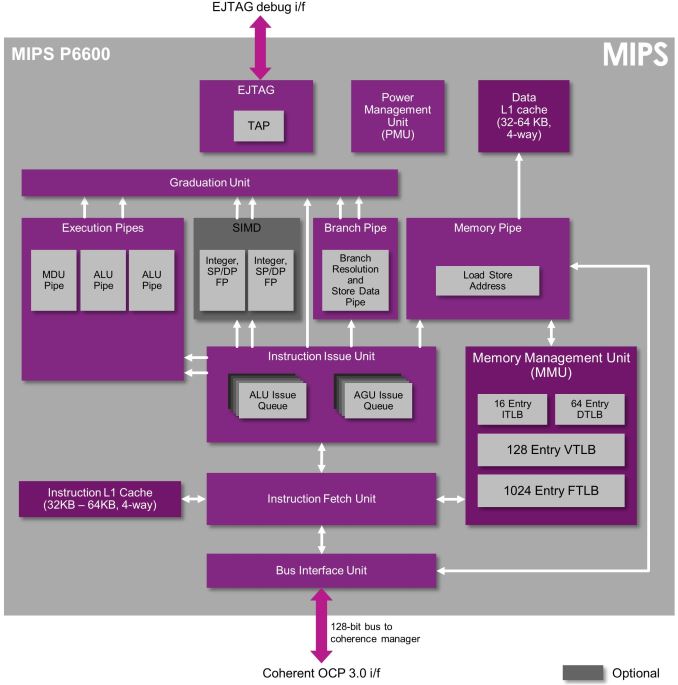
We’re still lacking any details on the architectural improvements of the P6600 over the P5600 so it seems that for now we’re left with guessing what kind of performance the new core will bring. The P5600 was directly competing with ARM’s Cortex A15 in terms of IPC, but ARM has since then not only announced but also seen silicon with two successor IPs to the A15 (A57 and A72), so the P6600 will have some tough competition ahead of itself once it arrives in products.
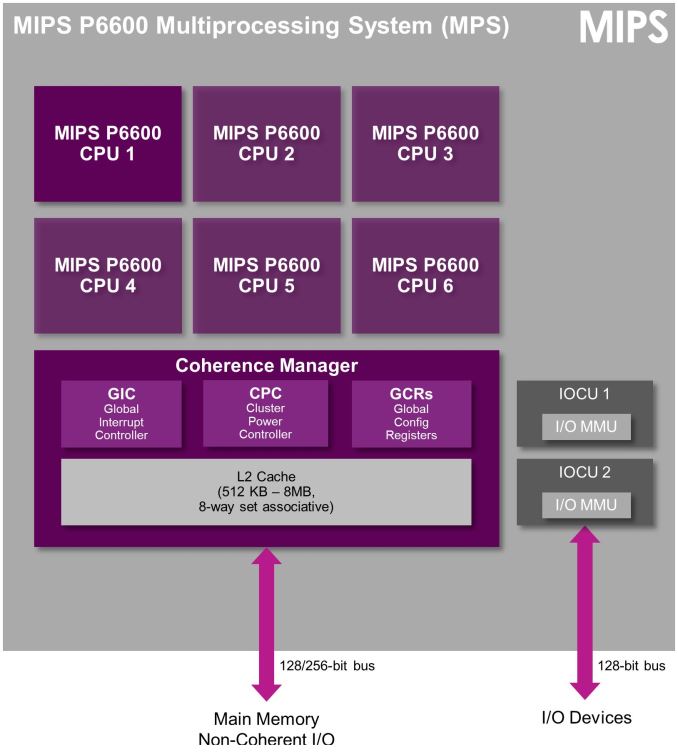
The P6600, much like the P5600 can be implemented from single-core to six-core cluster configurations. What is interesting that as opposed to ARM CPU IP, the MIPS cores allow for asynchronous clock planes between the individual cores if the vendors wishes to implement the SoC’s power management in this way (It can also be set up to work in a synchronous way).

“MIPS P6600 is the next evolution of the high-end MIPS P-class family and builds on the 32-bit P5600 CPU. P6600 is a balanced CPU for mainstream/high-performance computing, enabling powerful multicore 64-bit SoCs with optimal area efficiency for applications in segments including mobile, home entertainment, networking, automotive, HPC or servers, and more. Customers have already licensed the P6600 for applications including high-performance computing and advanced image and vision systems.”

Warrior M6200 & M6250

Also as part of today’s announcement we see two new embedded CPU cores, the M6200 and M6250. Both cores are successors to the microAptiv-UP and UC but able to run at up to 30% higher frequency. The new processors also see an ISA upgrade to MIPS32 Release 6 instead of Release 5.
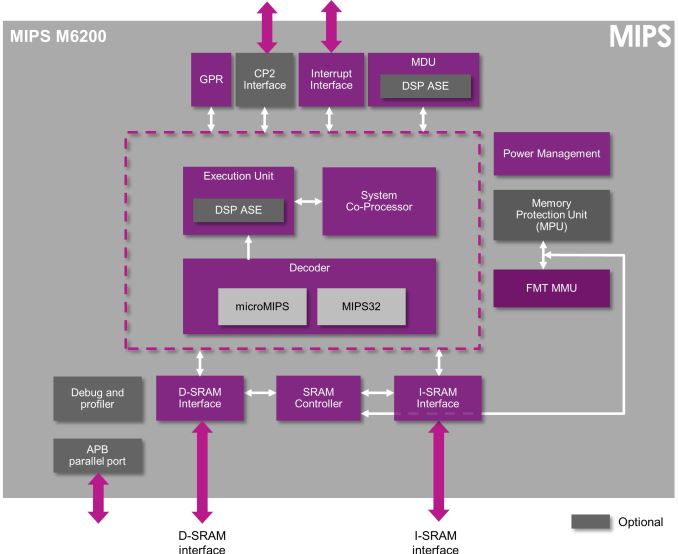
The M6200 is targeted at real-time embedded operating systems with minimal funtionality for cost- and power-savings. It has no MMU and as such can only be described as a microcontroller part.
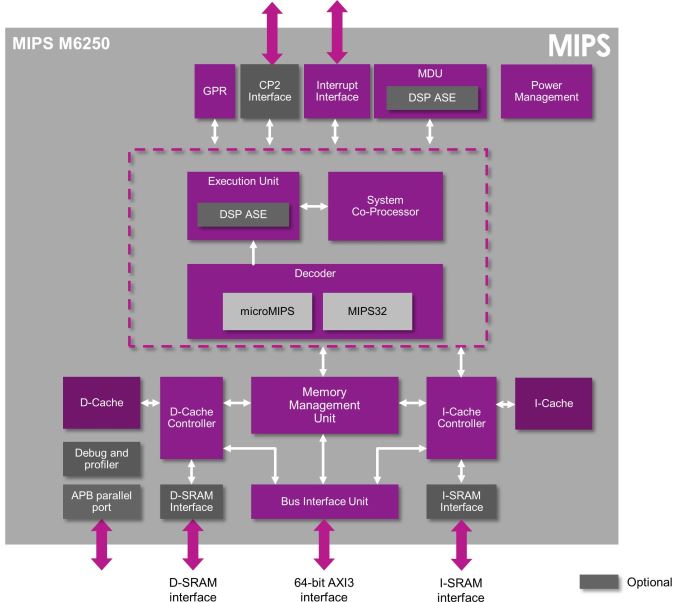
The M6250 is the bigger brother of the M6200 and the biggest difference is the inclusion of a memory management unit (MMU) that makes this a full fledged processor core that can run operating systems like Linux.

“M6200 and M6250 are configurable and fully synthesizable solutions for devices requiring a high level of performance efficiency and small silicon area including wireless or wired modems, GPU supervisors, flash and SSD controllers, industrial and motor control, advanced audio and more.”
Intel's Xeon D Product Family Updated with Storage and Networking-Specific SKUs

Intel’s Xeon D Product Family Updated with Storage and Networking-Specific SKUs

Intel’s Xeon D has been one of the most exciting platforms to come out of Intel this year. Xeon D has created more excitement in the micro-server / edge server market compared to the introduction of Avoton and Rangeley (based on Silvermont x86 Atom cores) a few years back. In introducing the 22nm Atom-based server SoCs, Intel clearly delineated different SKUs for different market segments. While Avoton (C2xx0) concentrated on the storage server market, Rangeley (C2xx8) added some communication accelerators that made it a good fit for networking and communication applications.

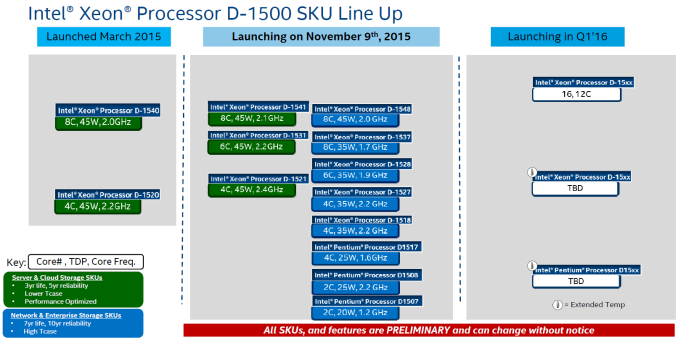
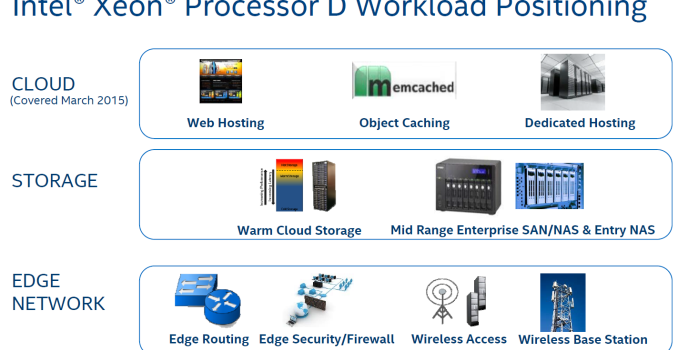
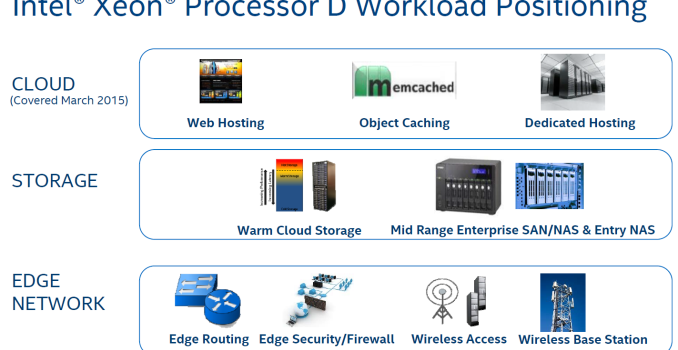
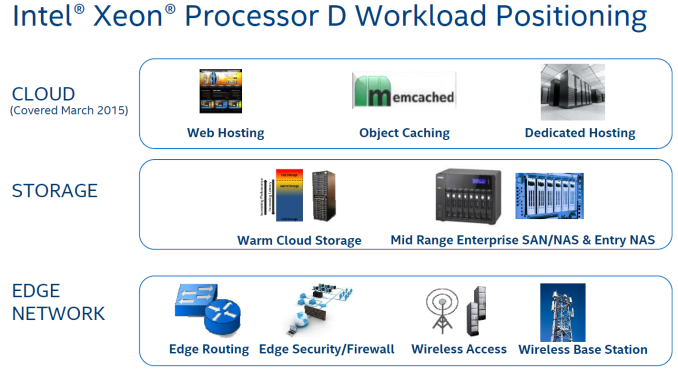
Xeon D was launched with two SKUs (D1520, a 4C/8T SiP, and the D1540, a 8C/16T SiP) earlier this year. While those two SKUs covered the web hosting applications, today’s launches cover the storage and edge network applications. Intel’s slide from a presentation made earlier today sums up the various products in the lineup. Eight new Xeons and three new Pentium processors are being launched in the D-1500 lineup and they come in both 45W and 35W TDP versions. Interestingly, Intel indicated that 12-core and 16-core Xeon D SiPs can be expected early next year.

Note: The Pentium D Processors indicated in the above slide were not launched despite being part of the slide set. Currently, there are a total of 10 Xeon-D SKUs (as of Q4 2015).

Patrick at ServeTheHome has a nice graphic summarizing the clock speeds and pricing of these products. The D15x1 SKUs target the storage market, while the D15x7 and D15x8 target the networking / communication segments.

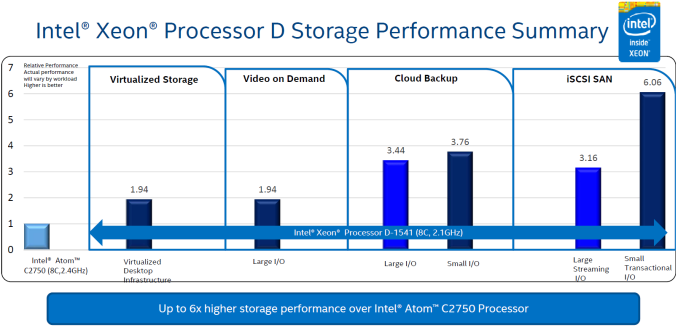
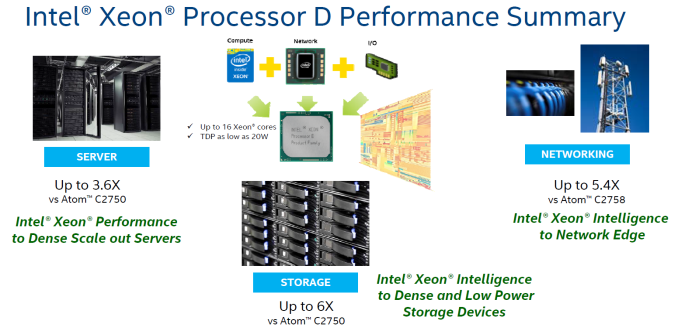
Intel claims that the new storage SKUs provide as much as 6x the performance of the high-end Avoton-based platforms.

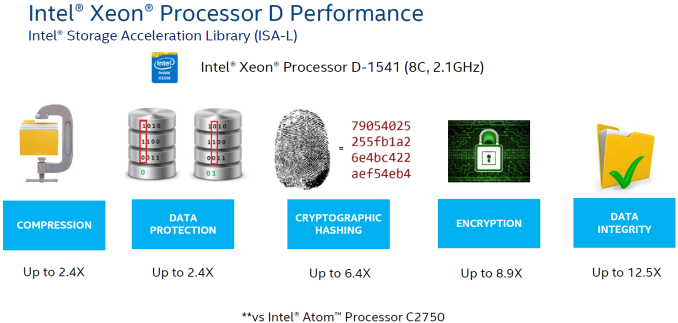
Intel’s Storage Acceleration Library (ISA-L) provides accelerators for compression, checksumming, parity calculation and cryptograhic functions (encryption as well as hashing).

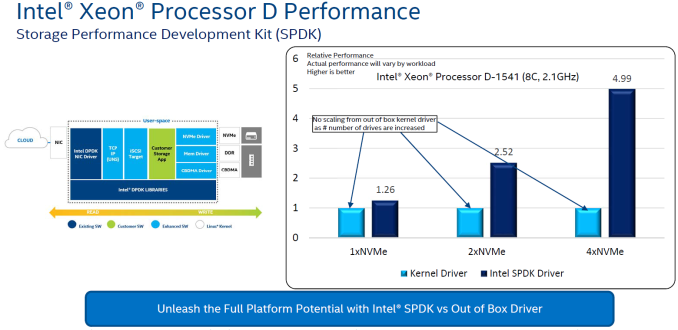
The Storage Performance Development Kit (SPDK) provides better optimization compared to the native Linux drivers – particularly as the number of storage devices in the system ramps up.

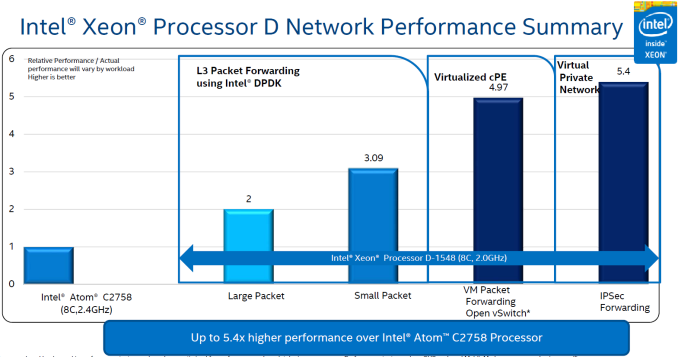
On the networking front, Intel claims up to 5.4x higher performance compared to the Rangeley-based platforms. Intel is promoting their  Data Plane Development Kit (DPDK) to achieve better performance for L3 packet forwarding, VM packet forwarding with Open vSwitch, and IPSec forwarding (VPN applications).

ServeTheHome talks about how the communication accelerators have gained extensive software support since they were launched with the Rangeley SoCs in 2013.

One of the disappointing aspects with respect to the D1520 and D1540 (at least for those intending to use them as virtualization hosts) was the pulling back of the advertised SR-IOV feature. It remains to be seen if the new SKUs have the feature enabled.

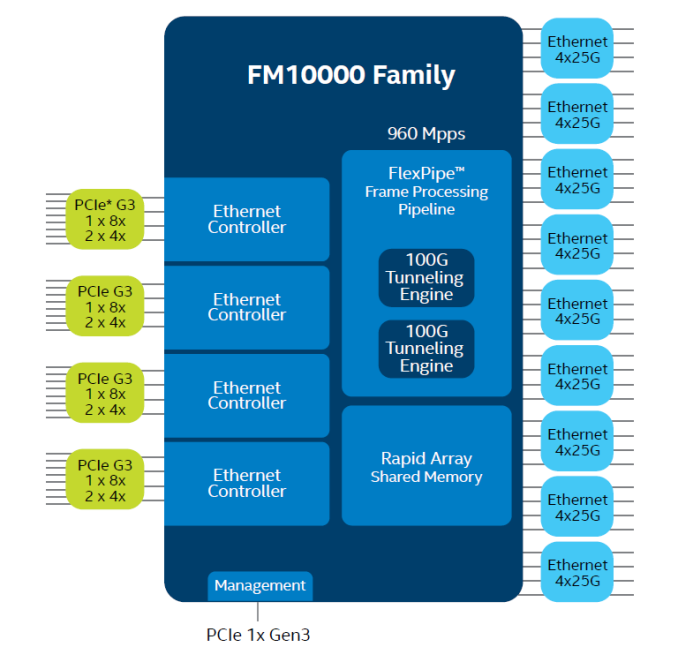
In addition to the new Xeon D SKUs, Intel also announced the FM10000 Ethernet multi-host controller family that can provide up to 36 Ethernet lanes. The FM10000 family supports 1Gbps, 2.5Gbps, 10Gbps, and 25Gbps Ethernet ports and the ability to group four lanes as 40Gbps or 100Gbps ports. The integrated Ethernet controllers can be configured as four 50Gbps or eight 25Gbps host interfaces,.

The new X550 single-chip, low-cost 10GbE platform was also launched. It supports NBASE-T technology (for 2.5Gbps as well as 5 Gbps operation, in addition to 10Gbps).

Operating via a PCIe 3.0 x1 / x4 / x8 link, the new 10GBASE-T controller integrates both MAC and PHY in a single package, and comes in both single and dual-port varieties. Power consumption is just 11 W with both 10GbE ports active, making it amenable to passive heatsink thermal solutions.

Intel's Xeon D Product Family Updated with Storage and Networking-Specific SKUs

Intel’s Xeon D Product Family Updated with Storage and Networking-Specific SKUs

Intel’s Xeon D has been one of the most exciting platforms to come out of Intel this year. Xeon D has created more excitement in the micro-server / edge server market compared to the introduction of Avoton and Rangeley (based on Silvermont x86 Atom cores) a few years back. In introducing the 22nm Atom-based server SoCs, Intel clearly delineated different SKUs for different market segments. While Avoton (C2xx0) concentrated on the storage server market, Rangeley (C2xx8) added some communication accelerators that made it a good fit for networking and communication applications.

Xeon D was launched with two SKUs (D1520, a 4C/8T SiP, and the D1540, a 8C/16T SiP) earlier this year. While those two SKUs covered the web hosting applications, today’s launches cover the storage and edge network applications. Intel’s slide from a presentation made earlier today sums up the various products in the lineup. Eight new Xeons and three new Pentium processors are being launched in the D-1500 lineup and they come in both 45W and 35W TDP versions. Interestingly, Intel indicated that 12-core and 16-core Xeon D SiPs can be expected early next year.

Note: The Pentium D Processors indicated in the above slide were not launched despite being part of the slide set. Currently, there are a total of 10 Xeon-D SKUs (as of Q4 2015).

Patrick at ServeTheHome has a nice graphic summarizing the clock speeds and pricing of these products. The D15x1 SKUs target the storage market, while the D15x7 and D15x8 target the networking / communication segments.

Intel claims that the new storage SKUs provide as much as 6x the performance of the high-end Avoton-based platforms.

Intel’s Storage Acceleration Library (ISA-L) provides accelerators for compression, checksumming, parity calculation and cryptograhic functions (encryption as well as hashing).

The Storage Performance Development Kit (SPDK) provides better optimization compared to the native Linux drivers – particularly as the number of storage devices in the system ramps up.

On the networking front, Intel claims up to 5.4x higher performance compared to the Rangeley-based platforms. Intel is promoting their  Data Plane Development Kit (DPDK) to achieve better performance for L3 packet forwarding, VM packet forwarding with Open vSwitch, and IPSec forwarding (VPN applications).

ServeTheHome talks about how the communication accelerators have gained extensive software support since they were launched with the Rangeley SoCs in 2013.

One of the disappointing aspects with respect to the D1520 and D1540 (at least for those intending to use them as virtualization hosts) was the pulling back of the advertised SR-IOV feature. It remains to be seen if the new SKUs have the feature enabled.

In addition to the new Xeon D SKUs, Intel also announced the FM10000 Ethernet multi-host controller family that can provide up to 36 Ethernet lanes. The FM10000 family supports 1Gbps, 2.5Gbps, 10Gbps, and 25Gbps Ethernet ports and the ability to group four lanes as 40Gbps or 100Gbps ports. The integrated Ethernet controllers can be configured as four 50Gbps or eight 25Gbps host interfaces,.

The new X550 single-chip, low-cost 10GbE platform was also launched. It supports NBASE-T technology (for 2.5Gbps as well as 5 Gbps operation, in addition to 10Gbps).

Operating via a PCIe 3.0 x1 / x4 / x8 link, the new 10GBASE-T controller integrates both MAC and PHY in a single package, and comes in both single and dual-port varieties. Power consumption is just 11 W with both 10GbE ports active, making it amenable to passive heatsink thermal solutions.

TAG Heuer Unveils The Intel-Powered Connected Smartwatch

TAG Heuer Unveils The Intel-Powered Connected Smartwatch

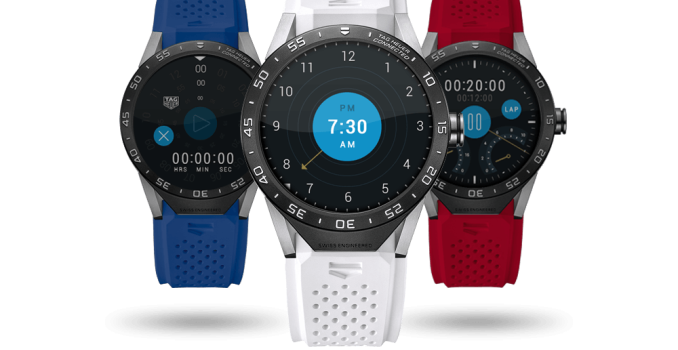
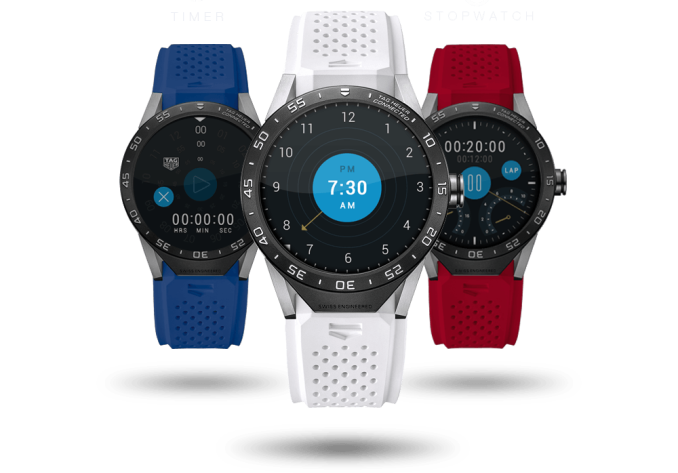
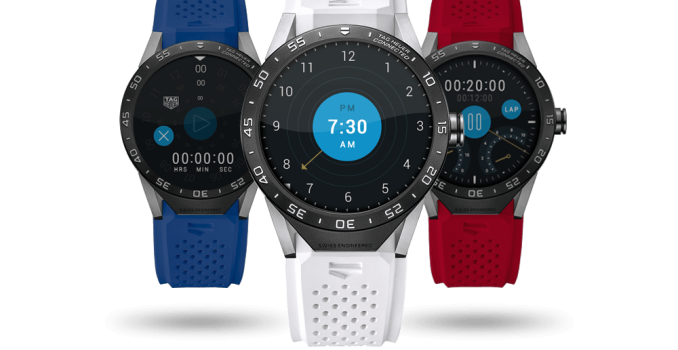
Today TAG Heuer, a traditional Swiss watchmaker, announced their entry into the world of smartwatches with the TAG Heuer Connected. This is really the first example of a luxury Android wear watch, and also the first example of a traditional mechanical watch manufacturer moving into the smartwatch space.

The TAG Heuer Connected has a diameter of 46mm, a thickness of 12.8mm, and a mass of 52 grams. The chassis of the watch is made of titanium, and the LCD display is covered by a sheet of sapphire glass. The display itself is a 1.5″ 360×360 fully circular transflective LTPS LCD, which means it can use the reflection of light to improve visibility and drive down power consumption. The last time I remember hearing about these sorts of displays was Pixel Qi’s transflective LCDs, but the tech hasn’t really gone anywhere since that time. It’ll be interesting to see who is making the panel for the TAG Heuer Connected and how it fares in bright light compared to other smartwatches, as well as compared to a traditional mechanical watch which doesn’t use an LCD at all.

  TAG Heuer Connected
SoC Intel Atom Z34xx
RAM 1GB
NAND 4GB
Display 1.5″ 360×360 LCD, 240ppi
Diameter / Mass 46mm / 52g
Battery 410mAh
OS Android Wear
Other Connectivity 802.11b/g/n + BT 4.1
Price $1499

Interestingly, the TAG Heuer connect is powered by an Intel SoC rather than the Snapdragon 400 chip that has shown up in most Android Wear devices. More specifically, it’s an Intel Z34xx series SoC, which has a peak frequency of 1.6GHz but TAG Heuer notes that the nominal frequency will be more like 500MHz. The SoC is paired with 1GB of RAM and 4GB of NAND, which puts it ahead of the 512MB of RAM found in most Android Wear watches. The sensors include an accelerometer and a gyroscope, but no heart rate monitor which is definitely a letdown for fitness-oriented buyers. The watch is also advertised as having IP67 water resistance.

Because 30% of the Connected’s parts are made outside of Switzerland the watch isn’t officially “Swiss made”, and I don’t expect that’s going to be an easy problem to overcome when there are now many electrical parts inside the watch being made overseas. Something interesting is that the Connected is modeled off of TAG Heuer’s Carrera mechanical watch, and after two years the company will allow you to trade in your Connected along with $1500 to receive an actual Carrera. To me that move seems a bit pessimistic about the company’s own future in the smartwatch space, as it seems like there’s an assumption that users will give up a smartwatch and go back to owning a mechanical watch. It would make more sense to me if you could trade up to newer versions of the Connected.

The last, and possibly most important detail about the TAG Heuer Connected is the price. TAG Heuer’s mechanical watches can cost several hundred dollars, and so it’s no surprise that the TAG Heuer Connected will have a retail price of $1500

TAG Heuer Unveils The Intel-Powered Connected Smartwatch

TAG Heuer Unveils The Intel-Powered Connected Smartwatch

Today TAG Heuer, a traditional Swiss watchmaker, announced their entry into the world of smartwatches with the TAG Heuer Connected. This is really the first example of a luxury Android wear watch, and also the first example of a traditional mechanical watch manufacturer moving into the smartwatch space.

The TAG Heuer Connected has a diameter of 46mm, a thickness of 12.8mm, and a mass of 52 grams. The chassis of the watch is made of titanium, and the LCD display is covered by a sheet of sapphire glass. The display itself is a 1.5″ 360×360 fully circular transflective LTPS LCD, which means it can use the reflection of light to improve visibility and drive down power consumption. The last time I remember hearing about these sorts of displays was Pixel Qi’s transflective LCDs, but the tech hasn’t really gone anywhere since that time. It’ll be interesting to see who is making the panel for the TAG Heuer Connected and how it fares in bright light compared to other smartwatches, as well as compared to a traditional mechanical watch which doesn’t use an LCD at all.

  TAG Heuer Connected
SoC Intel Atom Z34xx
RAM 1GB
NAND 4GB
Display 1.5″ 360×360 LCD, 240ppi
Diameter / Mass 46mm / 52g
Battery 410mAh
OS Android Wear
Other Connectivity 802.11b/g/n + BT 4.1
Price $1499

Interestingly, the TAG Heuer connect is powered by an Intel SoC rather than the Snapdragon 400 chip that has shown up in most Android Wear devices. More specifically, it’s an Intel Z34xx series SoC, which has a peak frequency of 1.6GHz but TAG Heuer notes that the nominal frequency will be more like 500MHz. The SoC is paired with 1GB of RAM and 4GB of NAND, which puts it ahead of the 512MB of RAM found in most Android Wear watches. The sensors include an accelerometer and a gyroscope, but no heart rate monitor which is definitely a letdown for fitness-oriented buyers. The watch is also advertised as having IP67 water resistance.

Because 30% of the Connected’s parts are made outside of Switzerland the watch isn’t officially “Swiss made”, and I don’t expect that’s going to be an easy problem to overcome when there are now many electrical parts inside the watch being made overseas. Something interesting is that the Connected is modeled off of TAG Heuer’s Carrera mechanical watch, and after two years the company will allow you to trade in your Connected along with $1500 to receive an actual Carrera. To me that move seems a bit pessimistic about the company’s own future in the smartwatch space, as it seems like there’s an assumption that users will give up a smartwatch and go back to owning a mechanical watch. It would make more sense to me if you could trade up to newer versions of the Connected.

The last, and possibly most important detail about the TAG Heuer Connected is the price. TAG Heuer’s mechanical watches can cost several hundred dollars, and so it’s no surprise that the TAG Heuer Connected will have a retail price of $1500