News


OnePlus Launches the OnePlus X
OnePlus Launches the OnePlus X

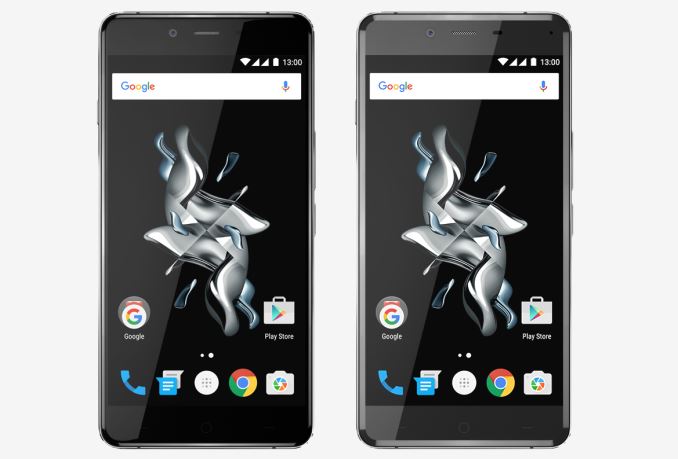
When OnePlus launched the OnePlus Two earlier this year the company also mentioned that they would be launching a second smartphone in 2015, and that the new phone would be announced closer toward the end of the year. With November and the holiday season approaching the phone needed to launch fairly soon to meet that deadline, and today OnePlus has made the new device official. It’s the OnePlus X, and it’s a smaller addition to the OnePlus family, with a 5.0″ display and a completely revamped physical design. You can get all the relevant specifications for the OnePlus X from the chart below.


OnePlus X
SoC 2.3GHz Qualcomm Snapdragon 801 (MSM8974AB)
GPU Adreno 330
RAM 3GB LPDDR3
NAND 16GB + MicroSDXC (No MicroSD on dual-SIM)
Display 5″ 1920×1080 AMOLED
Dimensions 140 x 69 x 6.9 mm, 138/160g
Camera 13MP Rear-Facing, f/2.2
8MP Front-Facing OV8858, f/2.4
Battery 2520 mAh (9.58Wh)
OS OxygenOS/Android 5.1.1 Lollipop
Cellular Connectivity 2G / 3G / 4G LTE (MDM9x25 Category 4)
Other Connectivity 2.4GHz 802.11b/g/n + BT 4.0, microUSB 2.0, GNSS
SIM Nano-SIM (Dual SIM SKU available)
Price Onyx: 249 USD / 269 EUR
Ceramic: 369 EUR

On paper, the OnePlus X does look very similar to the original OnePlus One, but in a smaller form factor. What is probably the most intriguing aspect is the SoC, which is Qualcomm’s MSM8974AB. This appears to be a confirmation that Snapdragon 801 can still be sourced, and it’s interesting that only OnePlus has decided to utilize it despite the issues with Qualcomm’s Snapdragon 808 and 810 SoCs. The OnePlus X uses the 2.3GHz version of Snapdragon 801 rather than the 2.45GHz MSM8974AC used in the OnePlus one, which likely won’t have any significant impact in most cases but it’s worth pointing out as one of the tiny differences between the two phones
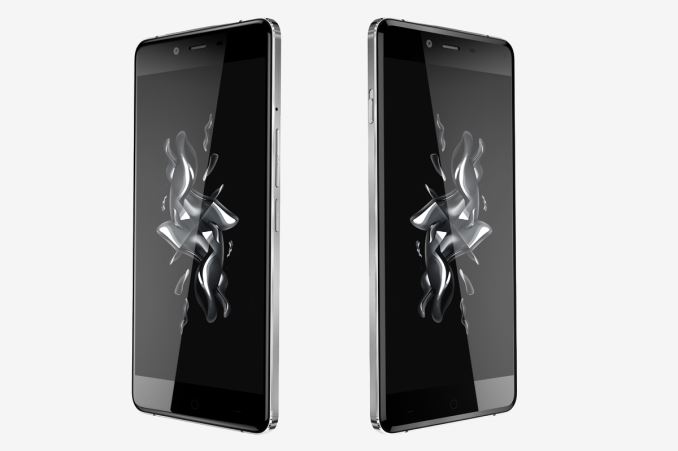
The display is the same resolution as the OnePlus One and OnePlus Two, but with the OnePlus X it has gone down to a 5.0″ size. With that also comes a switch from IPS LCD panels to a 1080p AMOLED panel, and it’ll be interesting to see if the display has the same level of calibration as the OnePlus One did. The WiFi is strange in that it’s advertised as WCN3680, which should be a single spatial stream 802.11ac implementation, but OnePlus only advertises support for 2.4GHz 802.11b/g/n.

While the rear-facing camera is the same resolution as the OnePlus One, it’s explicitly stated to be an ISOCELL sensor which confirms that OnePlus has sourced their camera module from Samsung this time around rather than using Sony’s IMX214 which was used in the OnePlus One. The front-facing camera gets a bump in resolution from 5MP to 8MP, and uses an Omnivision OV8858 sensor. The lens apertures aren’t as wide as the f/2 apertures on the OnePlus One, which will have an impact on low-light shooting performance.

Beyond those changes the OnePlus X looks pretty much like a small OnePlus One as far as the specifications go. Obviously the chassis and display needed to scale down, as did the battery, but these are obvious changes going from a big phone to a smaller one.
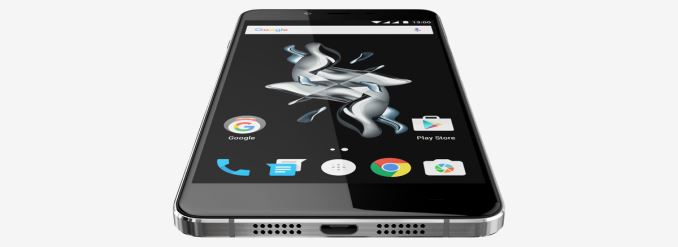
The actual design and construction of the phone is a departure from OnePlus’s existing industrial design. The OnePlus X drops the exposed plastic and textured back of the OnePlus One and Two, and instead aims for a design made of aluminum and glass. The standard version of the phone has flat metal edges that meet slightly curved glass on both sides, and to me the design looks much more impressive than OnePlus’s previous offerings. The phone will also come in two versions, Onyx and Ceramic. The former simply means the black version, while the latter is actually made of ceramic, and also ends up being 22g heavier because of that. The ceramic model will only be sold in limited quantities, with 10,000 being made and sold in Europe and India.

The OnePlus X starts at 249 USD, which is significantly less than the 16GB model of the OnePlus 2 which costs 329 USD. While you definitely do lose a bit as far as specs goes, I actually find the smaller size and new design of the OnePlus X to be much more appealing than the OnePlus Two, and the lower price just makes that look like an even better deal. For anyone interested in buying the OnePlus X you’ll still need to get an invite, and it’ll be launching in Europe on November 5th for 269 EUR, or 369 EUR if you want the ceramic chassis. In the US the phone will be available on November 11th for 249 USD.
Samsung Announces The 18.4" Galaxy View

Samsung Announces The 18.4″ Galaxy View

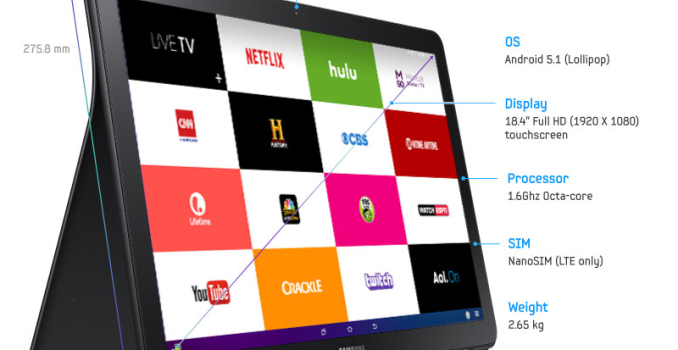
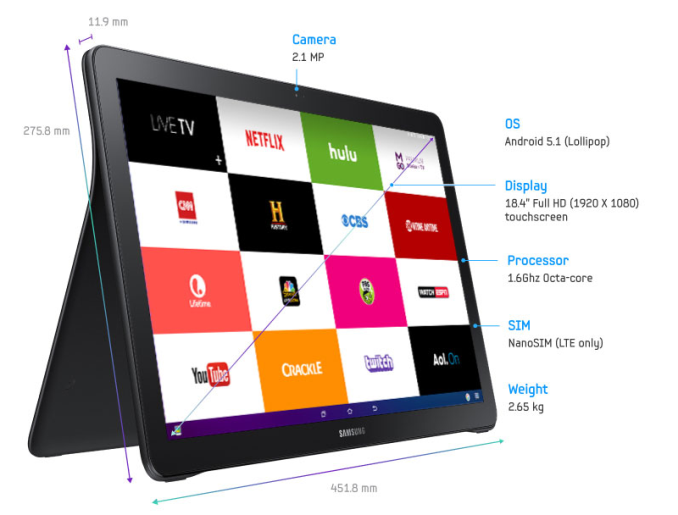
For a while now there have been small pieces of information about an 18.4″ Samsung Android tablet that was due to release in the near future. The tablet was also hinted at earlier this year at IFA. Today that tablet has gone official as the Samsung Galaxy View, and it’s unlike any other Android tablet that I’ve seen before. Some information is still scarce, but I’ve put together the known specifications in the chart below.

  Samsung Galaxy View
SoC 1.6GHz Octa-core
GPU ?
RAM 2GB
NAND 32/64GB + MicroSDXC
Display 18.4″ 1920×1080 LCD
Dimensions 451.8 x 275.8 x 11.9mm, 2650g
Camera 2.1MP Front-Facing
Battery 5700mAh
OS Android 5.1.1 Lollipop
Cellular Connectivity LTE with NanoSIM Slot
Other Connectivity 802.11a/b/g/n/ac + BT 4.1, microUSB 2.0

It’s pretty obvious just by looking at the specs that the Galaxy View is a unique device. It sports an enormous 18.4″ LCD display, with a 1080p resolution. This certainly isn’t near as sharp as the screens you’ll get on recent smartphones and tablets, but you’re also more likely to use the Galaxy View at a farther distance. However, you are ultimately limited by the length of your arms because you need to touch the display, and so a higher resolution probably would have been beneficial, and I would imagine if the Galaxy View ends up being successful to any degree that we’ll see an improved display on the next generation.

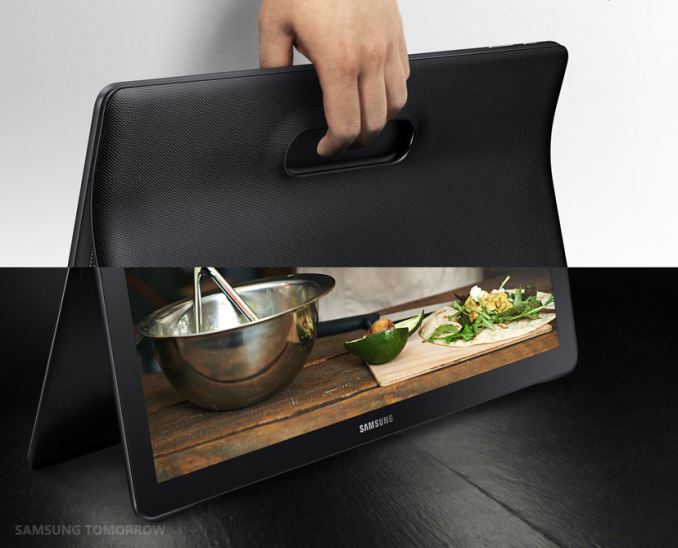
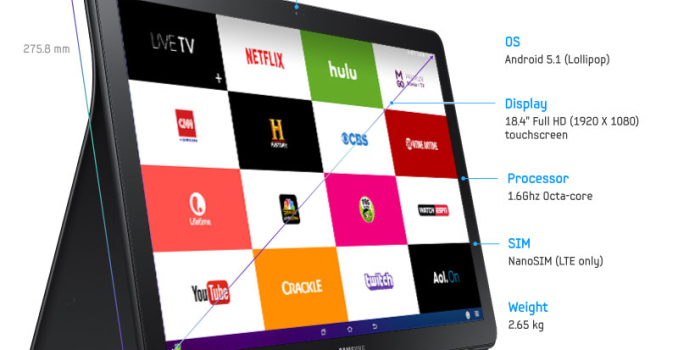
With that large display comes a very big and heavy chassis. At 2.65kg it is by far the heaviest Android device I have ever seen, apart from perhaps some AIO desktops that include an Android partition for whatever reason. In order to make the Galaxy View easier to handle Samsung has actually build in a kickstand of sorts, and a handle which can be used to carry it around. It honestly seems a bit comical, but then again so have other past devices like the original Galaxy Note, and perhaps it will eventually be normal to see people walking down the street carrying a giant tablet at their side.

As for the rest of the internals, Samsung has only provided some high level info. The 1.6GHz Octa-core SoC has been reported as the Exynos 7580 by some other sources, but given that it’s an unknown part and the available information seems less than reputable I wouldn’t want to make any definitive claims at this point about exactly what SoC is in use. It is paired with 2GB of RAM, but it’s not clear whether it’s of the LPDDR3 or LPDDR4 variety, and that will come along with the SoC verification once we get more concrete specs. There’s no rear-facing camera, because when you get to 18.4″ there is really no way to take photos. I do wonder if it might have been a useful inclusion for showing a different point of view when video chatting, but ultimately Samsung has decided not to include one.

The battery also looks very small if you assume a 3.85V chemistry, and in fact it would actually be smaller than the battery in the iPad Air 2 if that’s the case. If that is true I could only assume that Samsung had to reduce the tablet’s mass, and assumed that in most circumstances the user would be close to a power outlet anyway. It’s very possible that Samsung is actually using a battery chemistry with a higher voltage and so the capacity will be much larger than the specification given in mAh would imply. This is again something that will hopefully be clarified in the future.

Samsung hasn’t announced pricing or availability for the Galaxy View yet, but with it now being official those details shouldn’t be far off.

Samsung Announces The 18.4" Galaxy View

Samsung Announces The 18.4″ Galaxy View

For a while now there have been small pieces of information about an 18.4″ Samsung Android tablet that was due to release in the near future. The tablet was also hinted at earlier this year at IFA. Today that tablet has gone official as the Samsung Galaxy View, and it’s unlike any other Android tablet that I’ve seen before. Some information is still scarce, but I’ve put together the known specifications in the chart below.

  Samsung Galaxy View
SoC 1.6GHz Octa-core
GPU ?
RAM 2GB
NAND 32/64GB + MicroSDXC
Display 18.4″ 1920×1080 LCD
Dimensions 451.8 x 275.8 x 11.9mm, 2650g
Camera 2.1MP Front-Facing
Battery 5700mAh
OS Android 5.1.1 Lollipop
Cellular Connectivity LTE with NanoSIM Slot
Other Connectivity 802.11a/b/g/n/ac + BT 4.1, microUSB 2.0

It’s pretty obvious just by looking at the specs that the Galaxy View is a unique device. It sports an enormous 18.4″ LCD display, with a 1080p resolution. This certainly isn’t near as sharp as the screens you’ll get on recent smartphones and tablets, but you’re also more likely to use the Galaxy View at a farther distance. However, you are ultimately limited by the length of your arms because you need to touch the display, and so a higher resolution probably would have been beneficial, and I would imagine if the Galaxy View ends up being successful to any degree that we’ll see an improved display on the next generation.

With that large display comes a very big and heavy chassis. At 2.65kg it is by far the heaviest Android device I have ever seen, apart from perhaps some AIO desktops that include an Android partition for whatever reason. In order to make the Galaxy View easier to handle Samsung has actually build in a kickstand of sorts, and a handle which can be used to carry it around. It honestly seems a bit comical, but then again so have other past devices like the original Galaxy Note, and perhaps it will eventually be normal to see people walking down the street carrying a giant tablet at their side.

As for the rest of the internals, Samsung has only provided some high level info. The 1.6GHz Octa-core SoC has been reported as the Exynos 7580 by some other sources, but given that it’s an unknown part and the available information seems less than reputable I wouldn’t want to make any definitive claims at this point about exactly what SoC is in use. It is paired with 2GB of RAM, but it’s not clear whether it’s of the LPDDR3 or LPDDR4 variety, and that will come along with the SoC verification once we get more concrete specs. There’s no rear-facing camera, because when you get to 18.4″ there is really no way to take photos. I do wonder if it might have been a useful inclusion for showing a different point of view when video chatting, but ultimately Samsung has decided not to include one.

The battery also looks very small if you assume a 3.85V chemistry, and in fact it would actually be smaller than the battery in the iPad Air 2 if that’s the case. If that is true I could only assume that Samsung had to reduce the tablet’s mass, and assumed that in most circumstances the user would be close to a power outlet anyway. It’s very possible that Samsung is actually using a battery chemistry with a higher voltage and so the capacity will be much larger than the specification given in mAh would imply. This is again something that will hopefully be clarified in the future.

Samsung hasn’t announced pricing or availability for the Galaxy View yet, but with it now being official those details shouldn’t be far off.

The Apple iPad Mini 4 Review

For a while now Apple has been holding two launch events toward the end of each year. The first event in September is used to launch new iPhones, and new products and services like the Apple Watch and Apple Pay. In October Apple then has an event where the main focus is on new iPads, along with some other announcements such as new Macs or accessories. This year Apple appears to have switched up the formula, as they rolled both the iPhone and iPad announcements into a single September event. With October essentially over it looks like we won’t be seeing any more Apple launch events this year, and new products like the iMac with 4K Retina display have had quieter soft launches.

Since Apple combined their iPhone and iPad events into one, we actually have a new iPad shipping earlier than they’re usually even announced. The iPad Pro won’t go on sale until November, and the iPad Air 2 didn’t see an update, but the iPad Mini line got a significant overhaul in the form of the iPad Mini 4, and it has been available for well over a month at this point. Read on for the AnandTech review of Apple’s iPad Mini 4.

The Apple iPad Mini 4 Review

For a while now Apple has been holding two launch events toward the end of each year. The first event in September is used to launch new iPhones, and new products and services like the Apple Watch and Apple Pay. In October Apple then has an event where the main focus is on new iPads, along with some other announcements such as new Macs or accessories. This year Apple appears to have switched up the formula, as they rolled both the iPhone and iPad announcements into a single September event. With October essentially over it looks like we won’t be seeing any more Apple launch events this year, and new products like the iMac with 4K Retina display have had quieter soft launches.

Since Apple combined their iPhone and iPad events into one, we actually have a new iPad shipping earlier than they’re usually even announced. The iPad Pro won’t go on sale until November, and the iPad Air 2 didn’t see an update, but the iPad Mini line got a significant overhaul in the form of the iPad Mini 4, and it has been available for well over a month at this point. Read on for the AnandTech review of Apple’s iPad Mini 4.