News


Apple FY 2015 Q4 Results: Record Fourth Quarter With 48 Million iPhones Sold
Apple FY 2015 Q4 Results: Record Fourth Quarter With 48 Million iPhones Sold

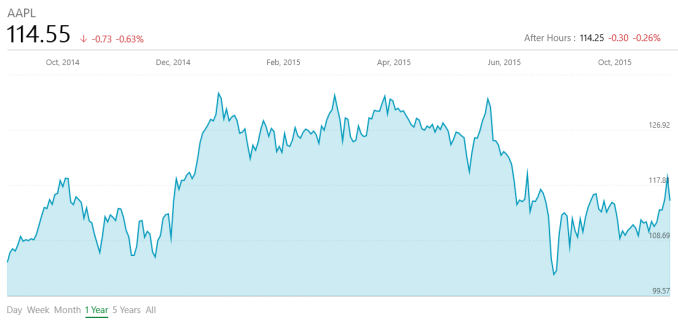
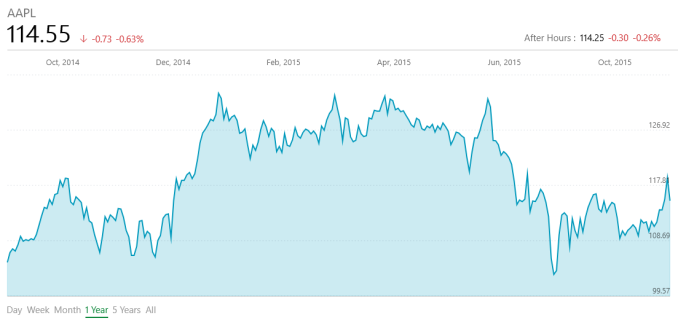
Today Apple released their Q4 results from fiscal year 2015, and in what seems like an almost unending cycle, the company has once again set a new record for the quarter with $51.5 billion in revenue. That is a 22% increase over the same period last year, where the company only had $42 billion in revenue. Apple’s strong margins continue, with 39.9% margin for the quarter. Operating income came in at $14.6 billion, up from $11.2 billion last year, and net income rose $2.6 billion year-over-year, coming in at $11.1 billion for the quarter. Earnings per share was $1.96, up from $1.42 last year.

Apple Q4 2015 Financial Results (GAAP)
  Q4’2015 Q3’2015 Q4’2014
Revenue (in Billions USD) $51.501 $49.605 $42.123
Gross Margin (in Billions USD) $20.548 $19.681 $16.009
Operating Income (in Billions USD) $14.623 $14.083 $11.165
Net Income (in Billions USD) $11.124 $10.677 $8.467
Margins 39.9% 39.7% 38.0%
Earnings per Share (in USD) $1.96 $1.85 $1.42

The large gains can be mostly attributed to the iPhone 6 and 6 Plus, released last year to record sales. The recently launched models were only available for a short time this quarter, but of course contributed their initial sales to Q4. The full impact of the latest models should be even more felt in Q1 FY 2016. Despite the iPhone being far and away the largest product for Apple, Mac sales have also contributed, along with services and Apple Watch.

The iPhone is king at Apple. It contributes the largest portion to their overall revenues, and with the excellent margins Apple enjoys, it is very profitable. Apple sold just over 48 million iPhones last quarter – a quarter where the new model was known to be incoming. Yes, the 6s and 6s Plus were released in Q4, but only at the tail end of the quarter. This is a 22% increase in phones sold year-over-year. Revenue for the iPhone alone was $32.2 billion for Q4, which is up 36% year-over-year and up 3% from last quarter. Q1 2016 (Oct-Dec 2015) will be the holiday quarter, and this is traditionally the strongest quarter for iPhone sales.

Mac sales increased 3% year-over-year, which means that the Mac is still showing slow growth at a time when the rest of the PC market is in decline. Apple sold 5.7 million Macs last quarter, which resulted in $6.9 billion in revenue.

The iPad continues to decline, with sales falling 20% year-over-year. For the quarter, Apple sold 9.9 million iPads, for revenues of $4.3 billion. This one segment is really the only chink in Apple’s armor, and iPhone sales are likely part of the problem, with people turning to larger phones rather than tablets.

Apple Q4 2015 Device Sales (thousands)
  Q4’2015 Q3’2015 Q4’2014 Seq Change Year/Year Change
iPhone 48,046 47,534 39,272 +1% +22%
iPad 9,883 10,931 12,316 -10% -20%
Mac 5,709 4,796 5,520 +19% +3%

Apple has also steadily increased its services, with the segment achieving 10% growth to $5.086 billion. This includes iTunes, AppleCare, Apple Pay, licensing, and other services.

Finally, we have Other Products, which is Apple TV, Apple Watch, Beats, iPod, and accessories. This segment outperformed all other Apple segments in terms of growth, with a 67% increase in revenue year-over-year. With the acquisition of Beats, as well as the launch of the Apple Watch earlier this year, revenue grew from $2.641 billion in Q4 2014 to $3.048 billion this quarter. Unfortunately, Apple does not break out unit numbers for anything in “Other Products” but you can bet this gain was not due to iPod sales.

Apple Q4 2015 Revenue by Product (billions)
  Q4’2015 Q3’2015 Q4’2014 Revenue for current quarter
iPhone $32.209 $31.368 $23.678 62.5%
iPad $4.726 $4.538 $5.316 8.3%
Mac $6.882 $6.030 $6.625 13.4%
iTunes/Software/Services $5.086 $5.028 $4.608 9.9%
Other Products $3.048 $2.641 $1.896 5.9%

I tend to think of Apple as iPhone and other stuff, because the iPhone sales are such a huge part of their revenue stream. iPhone sales now account for 62.5% of revenue, up from 56.2% a year ago. It’s hard to fault them on this though, because clearly the larger displays on the latest iPhones have done very well for the company. But they did show good growth in Macs at a time when other PC vendors have seen a reduction in overall sales. Apple Watch is also off to a good start, but without unit sales its difficult to see any sort of pattern there yet, since it was just launched this year.

Looking ahead for Q1 2016, Apple is expecting revenues of $75.5 billion to $77.5 billion, and gross margins staying between 39% and 40%.

Source: Apple
Apple FY 2015 Q4 Results: Record Fourth Quarter With 48 Million iPhones Sold

Apple FY 2015 Q4 Results: Record Fourth Quarter With 48 Million iPhones Sold

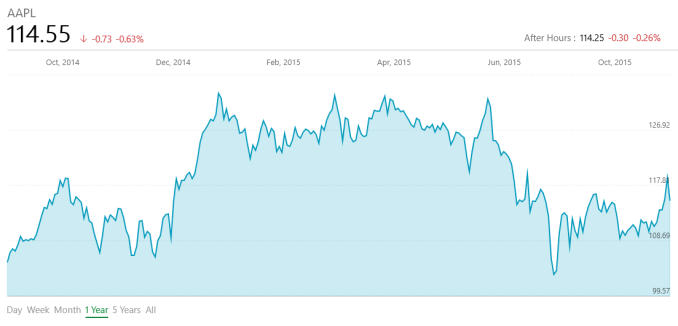
Today Apple released their Q4 results from fiscal year 2015, and in what seems like an almost unending cycle, the company has once again set a new record for the quarter with $51.5 billion in revenue. That is a 22% increase over the same period last year, where the company only had $42 billion in revenue. Apple’s strong margins continue, with 39.9% margin for the quarter. Operating income came in at $14.6 billion, up from $11.2 billion last year, and net income rose $2.6 billion year-over-year, coming in at $11.1 billion for the quarter. Earnings per share was $1.96, up from $1.42 last year.

Apple Q4 2015 Financial Results (GAAP)
  Q4’2015 Q3’2015 Q4’2014
Revenue (in Billions USD) $51.501 $49.605 $42.123
Gross Margin (in Billions USD) $20.548 $19.681 $16.009
Operating Income (in Billions USD) $14.623 $14.083 $11.165
Net Income (in Billions USD) $11.124 $10.677 $8.467
Margins 39.9% 39.7% 38.0%
Earnings per Share (in USD) $1.96 $1.85 $1.42

The large gains can be mostly attributed to the iPhone 6 and 6 Plus, released last year to record sales. The recently launched models were only available for a short time this quarter, but of course contributed their initial sales to Q4. The full impact of the latest models should be even more felt in Q1 FY 2016. Despite the iPhone being far and away the largest product for Apple, Mac sales have also contributed, along with services and Apple Watch.

The iPhone is king at Apple. It contributes the largest portion to their overall revenues, and with the excellent margins Apple enjoys, it is very profitable. Apple sold just over 48 million iPhones last quarter – a quarter where the new model was known to be incoming. Yes, the 6s and 6s Plus were released in Q4, but only at the tail end of the quarter. This is a 22% increase in phones sold year-over-year. Revenue for the iPhone alone was $32.2 billion for Q4, which is up 36% year-over-year and up 3% from last quarter. Q1 2016 (Oct-Dec 2015) will be the holiday quarter, and this is traditionally the strongest quarter for iPhone sales.

Mac sales increased 3% year-over-year, which means that the Mac is still showing slow growth at a time when the rest of the PC market is in decline. Apple sold 5.7 million Macs last quarter, which resulted in $6.9 billion in revenue.

The iPad continues to decline, with sales falling 20% year-over-year. For the quarter, Apple sold 9.9 million iPads, for revenues of $4.3 billion. This one segment is really the only chink in Apple’s armor, and iPhone sales are likely part of the problem, with people turning to larger phones rather than tablets.

Apple Q4 2015 Device Sales (thousands)
  Q4’2015 Q3’2015 Q4’2014 Seq Change Year/Year Change
iPhone 48,046 47,534 39,272 +1% +22%
iPad 9,883 10,931 12,316 -10% -20%
Mac 5,709 4,796 5,520 +19% +3%

Apple has also steadily increased its services, with the segment achieving 10% growth to $5.086 billion. This includes iTunes, AppleCare, Apple Pay, licensing, and other services.

Finally, we have Other Products, which is Apple TV, Apple Watch, Beats, iPod, and accessories. This segment outperformed all other Apple segments in terms of growth, with a 67% increase in revenue year-over-year. With the acquisition of Beats, as well as the launch of the Apple Watch earlier this year, revenue grew from $2.641 billion in Q4 2014 to $3.048 billion this quarter. Unfortunately, Apple does not break out unit numbers for anything in “Other Products” but you can bet this gain was not due to iPod sales.

Apple Q4 2015 Revenue by Product (billions)
  Q4’2015 Q3’2015 Q4’2014 Revenue for current quarter
iPhone $32.209 $31.368 $23.678 62.5%
iPad $4.726 $4.538 $5.316 8.3%
Mac $6.882 $6.030 $6.625 13.4%
iTunes/Software/Services $5.086 $5.028 $4.608 9.9%
Other Products $3.048 $2.641 $1.896 5.9%

I tend to think of Apple as iPhone and other stuff, because the iPhone sales are such a huge part of their revenue stream. iPhone sales now account for 62.5% of revenue, up from 56.2% a year ago. It’s hard to fault them on this though, because clearly the larger displays on the latest iPhones have done very well for the company. But they did show good growth in Macs at a time when other PC vendors have seen a reduction in overall sales. Apple Watch is also off to a good start, but without unit sales its difficult to see any sort of pattern there yet, since it was just launched this year.

Looking ahead for Q1 2016, Apple is expecting revenues of $75.5 billion to $77.5 billion, and gross margins staying between 39% and 40%.

Source: Apple
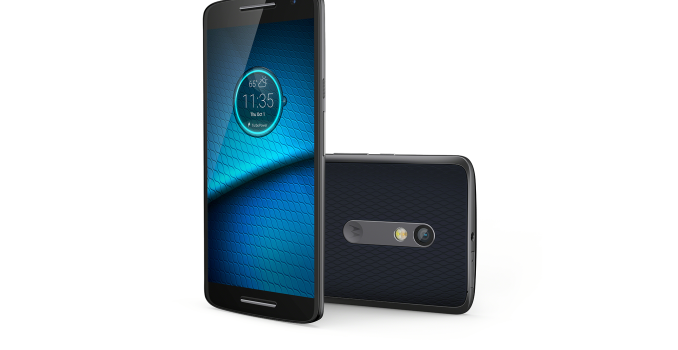
Motorola Announces the DROID Turbo 2 and DROID Maxx 2 For Verizon

Motorola Announces the DROID Turbo 2 and DROID Maxx 2 For Verizon

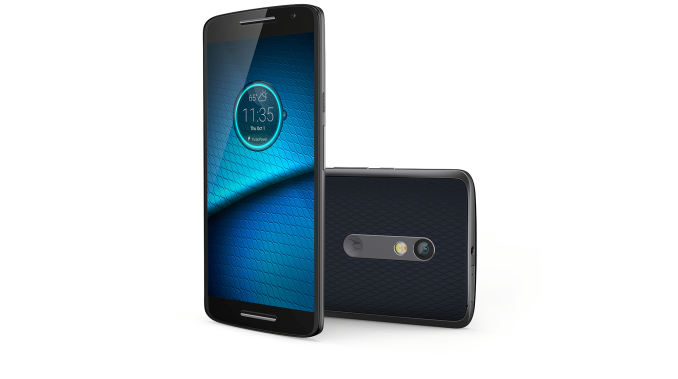
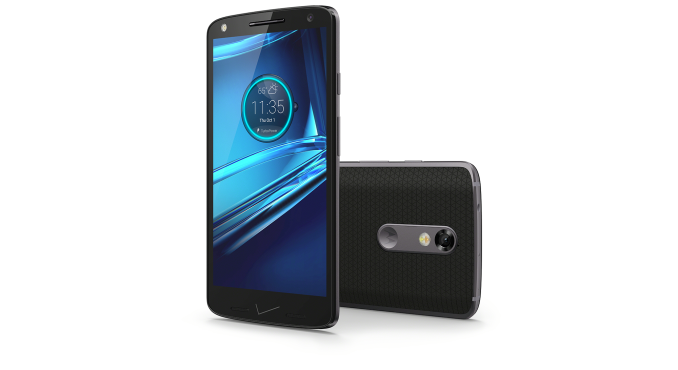
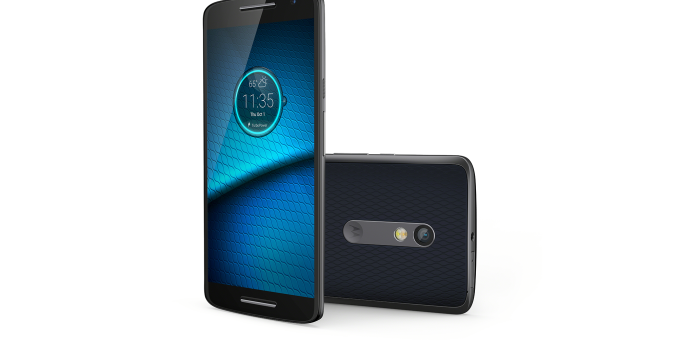
Motorola has been one of Verizon’s Android device partners for many years now. Before Verizon had the iPhone, Motorola’s DROID smartphones provided several alternatives for users who didn’t want to leave Verizon, or who wanted the features or differentiation provided by Android smartphones. While the DROID line isn’t what it once was, there are still DROID branded smartphones made by Motorola launched on Verizon every year. Today Verizon and Motorola announced two devices that follow up on the original DROID Turbo and DROID Maxx. Appropriately, the new phones are called the DROID Turbo 2 and the DROID Maxx 2, and you can view their specs in the chart below.

  DROID Turbo 2 DROID Maxx 2
SoC Qualcomm Snapdragon 810 Qualcomm Snapdragon 615
GPU Adreno 430 Adreno 405
RAM 3GB LPDDR4 2GB LPDDR3
NAND 32/64GB + MIcroSDXC 16GB + MicroSDXC
Display 5.4″ 2560×1440 AMOLED 5.5″ 1920×1080 IPS LCD
Dimensions 149.8 x 78 x 7.6-9.2mm, 169g 148 x 75 x 8.9-10.9 mm, 169g
Camera 21MP Rear-Facing, F/2.0
5MP Front-Facing
Battery 3760 mAh 3630 mAh
OS Android 5.1.1 Lollipop
Cellular Connectivity 2G / 3G / 4G LTE (Qualcomm UE Category 7/9) 2G / 3G / 4G LTE (MDM9x25 Category 4)
Other Connectivity 2×2 802.11a/b/g/n/ac + BT 4.0, microUSB 2.0, GNSS 2×2 802.11a/b/g/n + BT 4.0, microUSB 2.0, GNSS
SIM Nano-SIM
Price 32GB: 24 months @ $24 ($576 Total)
64GB: 24 months @ $30 ($720 Total)
16GB: 24 months @ 16 ($384 Total)

It’s clear that the DROID Maxx 2 is positioned as more of a mid-range device, with the DROID Turbo 2 at the high end. Both devices are similar as far as their size, mass, and battery capacity is concerned. While the Turbo 2 is actually slightly thinner and has a smaller display than the Maxx 2, the height and width of the chassis are a bit longer. The display on the Turbo 2 is also a QHD AMOLED panel, while the Maxx 2 is a 1080p IPS LCD.

The display on the DROID Turbo 2 is actually the device’s selling point, although when saying the word display it’s not necessarily referring to the display panel used. Instead, the unique part about this display is the fact that Motorola claims that it’s shatterproof. Unlike a typical smartphone display stack, the Turbo 2’s Moto ShatterShield display consists of several layers which are designed to absorb the shock of an impact. Instead of a single cover glass, the Turbo 2 has an exterior lens that sits overtop of an interior lens, with both being significantly more flexible than traditional cover glass. Motorola also has an additional touch layer to create redundancy if one is damaged during an impact, and the flexible AMOLED display also works to protect from damage.

Motorola DROID Turbo 2

Motorola claims that the exterior and interior lenses are designed to have the highest degree of optical transmissivity, but it’s likely that there will be some degree of reduction in transmissivity when compared to standard smartphone displays. Reflections will also be amplified, and since there are gaps between the layers you’ll be dealing with internal reflection which could make the display more difficult to use in heavy ambient lighting. As of right now it’s really hard to say what impact Motorola’s ShatterShield display has on visual quality, but it seems safe to assume that both Motorola and Verizon are confident about its ability to protect against damage as they are providing a four year warranty specifically for if the display does crack or shatter.

Since the DROID Turbo 2 is a Verizon exclusive smartphone, it’s hard to say if or when we’ll see Motorola bring their ShatterShield displays to products that ship on a wider scale. It’s possible that the launch in the DROID Turbo 2 is a method of testing how consumers respond to the feature and how much demand there will be. I personally have done well by just not dropping my phones, but obviously accidents do happen and it only takes a single drop to ruin a perfect record and leave you with a shattered display. 

Anyone interested in the DROID Turbo 2 or DROID Maxx 2 can get them in two days if they’re on Verizon in the US. On a 24 month installment plan the Turbo 2 is $24 per month for the 32GB model, or $30 per month for the 64GB model, while the DROID Maxx 2 is $16 per month.

Motorola Announces the DROID Turbo 2 and DROID Maxx 2 For Verizon

Motorola Announces the DROID Turbo 2 and DROID Maxx 2 For Verizon

Motorola has been one of Verizon’s Android device partners for many years now. Before Verizon had the iPhone, Motorola’s DROID smartphones provided several alternatives for users who didn’t want to leave Verizon, or who wanted the features or differentiation provided by Android smartphones. While the DROID line isn’t what it once was, there are still DROID branded smartphones made by Motorola launched on Verizon every year. Today Verizon and Motorola announced two devices that follow up on the original DROID Turbo and DROID Maxx. Appropriately, the new phones are called the DROID Turbo 2 and the DROID Maxx 2, and you can view their specs in the chart below.

  DROID Turbo 2 DROID Maxx 2
SoC Qualcomm Snapdragon 810 Qualcomm Snapdragon 615
GPU Adreno 430 Adreno 405
RAM 3GB LPDDR4 2GB LPDDR3
NAND 32/64GB + MIcroSDXC 16GB + MicroSDXC
Display 5.4″ 2560×1440 AMOLED 5.5″ 1920×1080 IPS LCD
Dimensions 149.8 x 78 x 7.6-9.2mm, 169g 148 x 75 x 8.9-10.9 mm, 169g
Camera 21MP Rear-Facing, F/2.0
5MP Front-Facing
Battery 3760 mAh 3630 mAh
OS Android 5.1.1 Lollipop
Cellular Connectivity 2G / 3G / 4G LTE (Qualcomm UE Category 7/9) 2G / 3G / 4G LTE (MDM9x25 Category 4)
Other Connectivity 2×2 802.11a/b/g/n/ac + BT 4.0, microUSB 2.0, GNSS 2×2 802.11a/b/g/n + BT 4.0, microUSB 2.0, GNSS
SIM Nano-SIM
Price 32GB: 24 months @ $24 ($576 Total)
64GB: 24 months @ $30 ($720 Total)
16GB: 24 months @ 16 ($384 Total)

It’s clear that the DROID Maxx 2 is positioned as more of a mid-range device, with the DROID Turbo 2 at the high end. Both devices are similar as far as their size, mass, and battery capacity is concerned. While the Turbo 2 is actually slightly thinner and has a smaller display than the Maxx 2, the height and width of the chassis are a bit longer. The display on the Turbo 2 is also a QHD AMOLED panel, while the Maxx 2 is a 1080p IPS LCD.

The display on the DROID Turbo 2 is actually the device’s selling point, although when saying the word display it’s not necessarily referring to the display panel used. Instead, the unique part about this display is the fact that Motorola claims that it’s shatterproof. Unlike a typical smartphone display stack, the Turbo 2’s Moto ShatterShield display consists of several layers which are designed to absorb the shock of an impact. Instead of a single cover glass, the Turbo 2 has an exterior lens that sits overtop of an interior lens, with both being significantly more flexible than traditional cover glass. Motorola also has an additional touch layer to create redundancy if one is damaged during an impact, and the flexible AMOLED display also works to protect from damage.

Motorola DROID Turbo 2

Motorola claims that the exterior and interior lenses are designed to have the highest degree of optical transmissivity, but it’s likely that there will be some degree of reduction in transmissivity when compared to standard smartphone displays. Reflections will also be amplified, and since there are gaps between the layers you’ll be dealing with internal reflection which could make the display more difficult to use in heavy ambient lighting. As of right now it’s really hard to say what impact Motorola’s ShatterShield display has on visual quality, but it seems safe to assume that both Motorola and Verizon are confident about its ability to protect against damage as they are providing a four year warranty specifically for if the display does crack or shatter.

Since the DROID Turbo 2 is a Verizon exclusive smartphone, it’s hard to say if or when we’ll see Motorola bring their ShatterShield displays to products that ship on a wider scale. It’s possible that the launch in the DROID Turbo 2 is a method of testing how consumers respond to the feature and how much demand there will be. I personally have done well by just not dropping my phones, but obviously accidents do happen and it only takes a single drop to ruin a perfect record and leave you with a shattered display. 

Anyone interested in the DROID Turbo 2 or DROID Maxx 2 can get them in two days if they’re on Verizon in the US. On a 24 month installment plan the Turbo 2 is $24 per month for the 32GB model, or $30 per month for the 64GB model, while the DROID Maxx 2 is $16 per month.

ARM Announces New CCI-550 and DMC-500 System IPs

ARM Announces New CCI-550 and DMC-500 System IPs

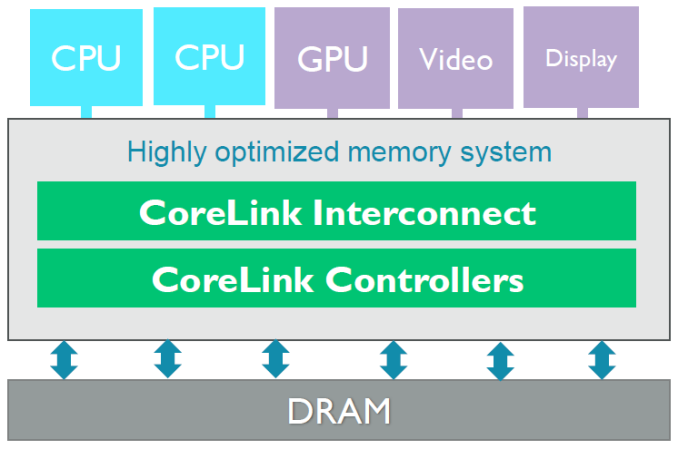
Today ARM announces two new additions to its CoreLink system IP design portfolio, the CCI-550 interconnect and DMC-500 memory controller. Starting off with the CCI announcement, we find the third iteration of the Cache Coherent Interconnect. The CCI is the cornerstone of ARM’s big.LITTLE strategy as it provides the required cache-coherent system interconnect between CPU clusters and other SoC blocks such as the main memory controllers and thus enabling heterogeneous multiprocessing between all the IP blocks.

The CCI-550 is an improvement to the CCI-500 which ARM announced back in February among other IPs such as the new Cortex A72 core design. Both the CCI-500 and the new CCI-550 are generational successors to the CCI-400 that is found in all currently released big.LITTLE SoCs such as Samsung’s Exynos, MediaTek’s Helio or Qualcomm’s Snapdragon designs. Back in February I was pretty excited to see ARM improve this part of their IP portfolio as it seemed that there was a lot of optimization that could be done in terms of performance and power.

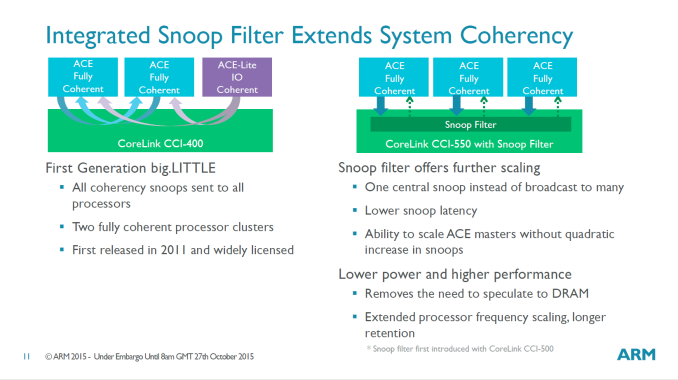
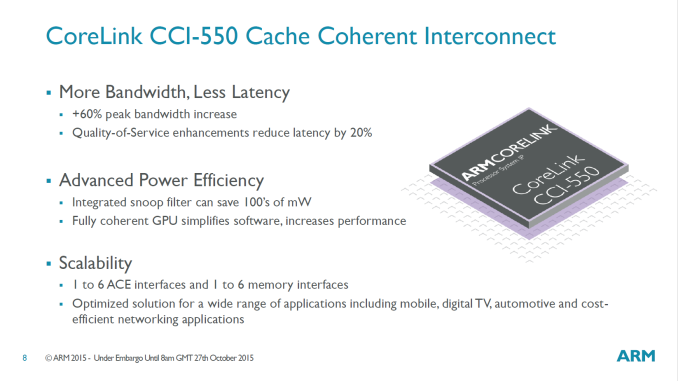
As a reminder, the primary characteristics of the new CCI-5X0 designs is the addition of a snoop filter within the interconnect that is able to maintain a directory of all cache contents among its coherent agents. On previous IP such as the CCI-400, all coherency messages needed to be broadcasted among all agents, causing them to have to wake up and respond. This not only impacted performance due to the increased latency but also had a power impact caused by the processing overhead. For the new CCI family, ARM explains that in heavy use-cases the new snoop filter can save up to “100’s” of milliwatts of power which is a quite significant figure.

Due the broadcast nature of how the CCI-400 was operated, it meant that adding another coherent agent would have incurred a quadratical increase in the amount of messages such as snoop lookups. The CCI-500 on the other hand is able to take advantage of the new filter to increase the number of ACE (AXI Coherency Extension) master ports from 2 to 4 without increased overhead. This for example enabled the implementation of up to 4 CPU clusters if a vendor wished to do so. The new CCI-550 again improves this configuration option by raising the maximum number of ACE master ports to up to 6.

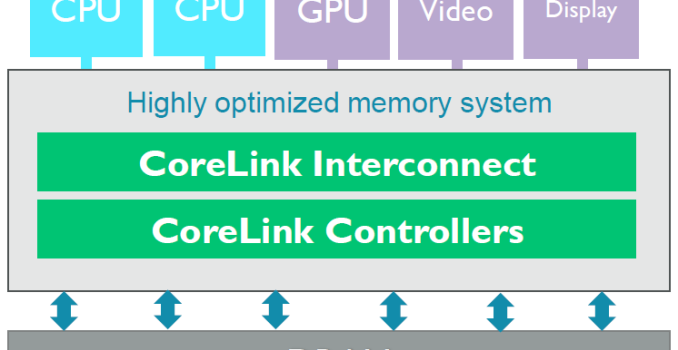
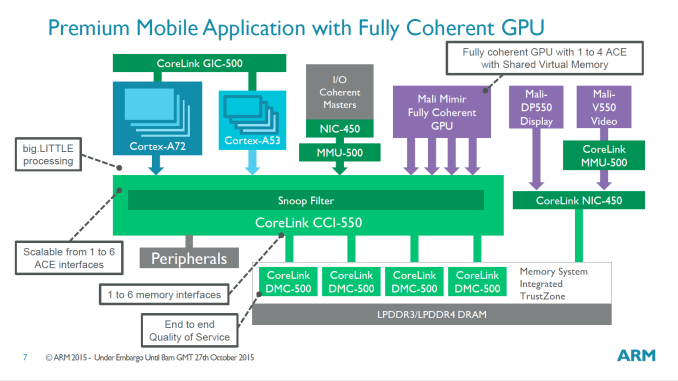
In the example SoC layout diagram that ARM provides, we see the CCI-550 configured with two CPU clusters such as the Cortex A53 and a Cortex A72. The remaining four ACE master ports could be then dedicated to a fully coherent GPU.

ARM explains that its still to-be-announced next-generation Mali IP codenamed “Mimir” will be fully cache-coherent and would be a perfect fit to take advantage of such a configuration (Current generation Midgard-based GPUs such as the T6-/7-/800 series are only I/O coherent). Fully coherent GPUs will be able to take advantage of shared virtual memory and new simplified programmers models provided by APIs such as OpenCL 2.0 and HSA.

While the amount of ACE master ports increases from 4 to 6, the amount of possible memory interfaces has also gone up from a maximum of 4 to up to 6. This allows an increase of up to 60% in the total peak interconnect bandwidth (total aggregate bandwidth). This improvement not only comes from the two additional memory interfaces, but also an additional increase which can be credited to micro-architectural improvements on the interconnect itself. For example, we’re told the CCI-550 is able to reduce CPU-to-memory latency by 20% when compared to the CCI-500.

ARM explains that its CCI IP is highly customizable and thus each vendor can configure it to their needs. The IP will be able to scale in terms of physical implementation based on the number of desired interfaces and ports.

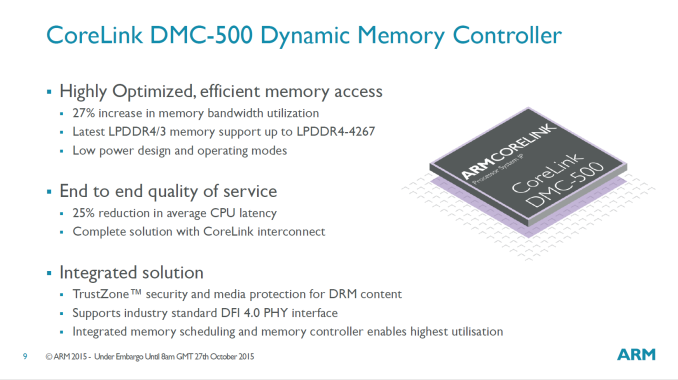
As an IP vendor, ARM is aiming to provide highly optimized integrated solutions, and memory controllers are consequently part of such designs. ARM previously offered the DMC-520 with DDR4 support but this memory controller was aimed at more complex enterprise designs employing AMBA 5 system IP such as ARM’s CCN (Cache Coherent Network). The DMC-500 announced today on the other hand is ARM’s first mobile-targeted memory controller with support for the new LPDDR4 memory standard. Aimed for AMBA 4 system IPs such as the CCI family, this is the memory controller IP we’ll most likely see adopted by vendors in consumer devices such as smartphones.

The DMC-500 promises support for LPDDR4 up to 2133MHz while still maintaining LPDDR3 compatibility. This is an important differentiation factor as in doing so ARM is able to offer maximum flexibility in terms of choice of implementation for vendors. Performance wise, ARM promises up to 27% increase in memory bandwidth utilization in a low power design.

All in all today’s announcements provide some solid improvements in ARM’s IP portfolio. On the memory controller side I’m not certain what the rate of adoption ARM’s DMC’s is; as far as I know the main “heavyweight” SoC vendors currently chose to employ their own memory controller IP. Those who don’t have their own IP and instead use ARM’s designs are often hard to single out as many times the choice of memory controller is completely invisible to the system.

On the interconnect side I predict that we’ll be seeing a lot more discussions and developments from third-party vendors. Even among today’s higher-profile big.LITTLE SoCs I’m only aware of LG’s Odin to use ARM’s CCI as a “center-piece” in their SoC fabric while other vendors such as Samsung chose to implement it alongside their own interconnect fabric. Vendors who have the resources and design talent may also chose to implement cache coherency into their own interconnect IP. They would thus be able deploy big.LITTLE systems or other similar fully coherent SoCs without ARM’s CCI IP. For example, MediaTek is among the first to do exactly this in the Helio X20 with help of the in-house designed MCSI. Next year we should be seeing new big.LITTLE SoCs equipped with both ARM’s IP such as the CCI-500 or 550 alongside third-party IP, creating a new differentiation point for SoC vendors that will undoubtedly make competitive landscape much more interesting.