News


Netgear Nighthawk X8 (R8500) Wave 2 802.11ac Router Set to Ship
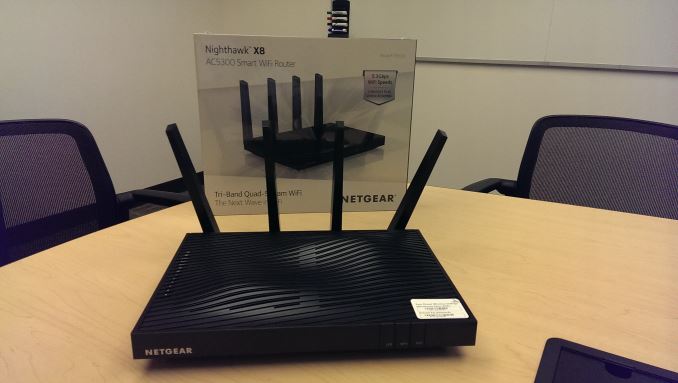
Netgear Nighthawk X8 (R8500) Wave 2 802.11ac Router Set to Ship

Broadcom’s XStream platform has enjoyed quite a bit of success in the Wi-Fi router market despite its high cost. The first generation XStream platform used a 3×3 configuration for each band, and lacked Wave 2 features such as MU-MIMO support or 160 MHz channels. At the 2015 CES, Broadcom updated their XStream product portfolio with the BCM4366, a 4×4 MU-MIMO capable radio that could work along with the BCM47094, a dual-core Cortex-A9-based network processor SoC. At the same time, D-Link also announced the DIR-895L AC5300 router based on that platform. Early last month, we also had Asus announcing the RT-AC5300U with the 4×4 tri-band XStream configuration. Unfortunately, none of these announcements came with a concrete ship date. Netgear was conspicuously silent about their plans with the new platform, even though they were the first vendor to come out with a product based on XStream Gen 1 – the Nighthawk X6 (R8000). Today, Netgear is announcing the Nighthawk X8 (R8500) based on the second generation XStream platform. Unlike the announcements from other vendors, the R8500 is available for purchase today.

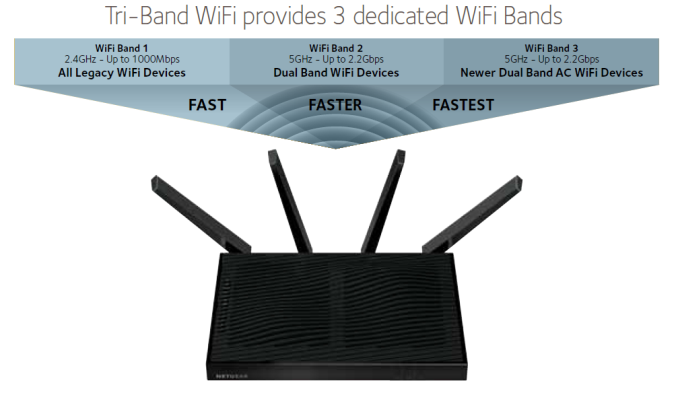
As a recap, the tri-band Wave 2 XStream platform integrates two 4×4 5 GHz radios (at 2.1 Gbps each) and one 4×4 2.4 GHz radio (at 1 Gbps). The setup is capable of using 1024 QAM (Broadcom-proprietary NitroQAM, works only with clients having Broadcom Wi-Fi receiver chipsets) to boost performance. Most of the
Wi-Fi aspects have been covered in our D-Link and Asus router launch articles, and I won’t go into detail here. Instead, the focus of this piece will be on the differentiating aspects in the Nighthawk X8.
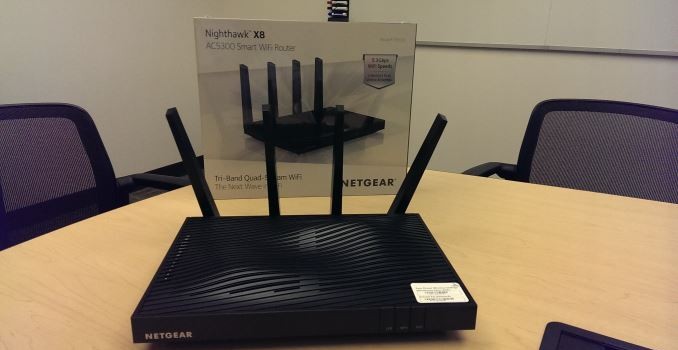
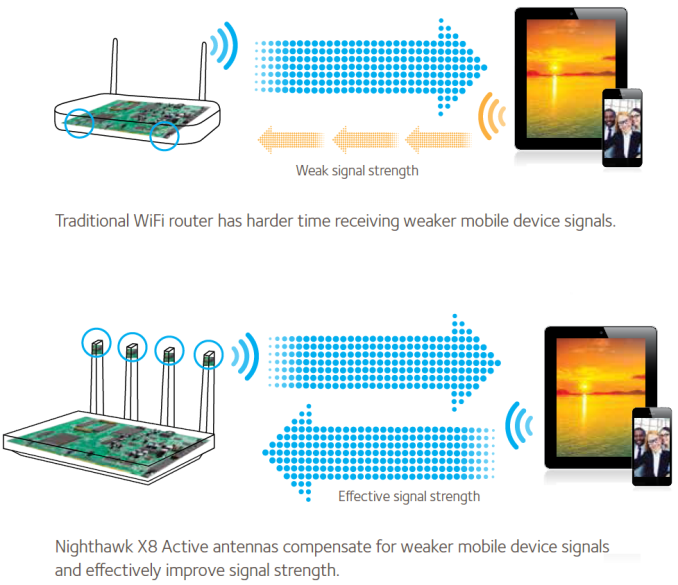
The most striking aspect of the R8500 when compared to the other XStream Gen 2 routers is the presence of only four external antennae instead of eight. Netgear has opted to go for four external and four internal ones. Physical appearances aside, the four external antennae are all active ones. This is the first time that we are actually seeing active antennae being deployed – the Wi-Fi amplifiers are moved from their usual location in the router’s motherboard to the top of the antennae. This reduces cross-talk on the board and also avoids signal loss in the transmission between the antennae and the board.
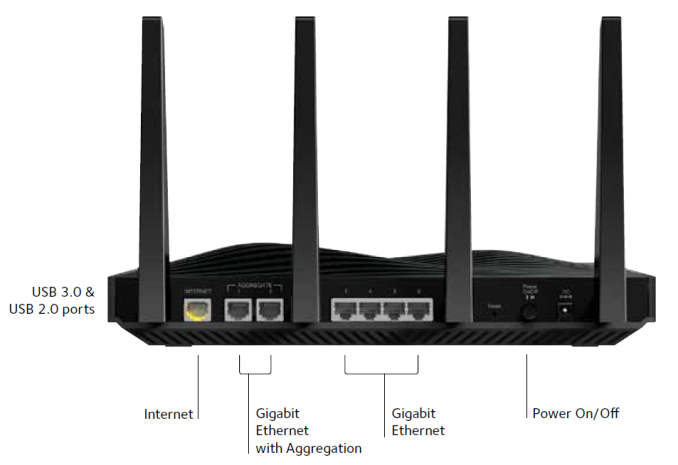
The other interesting feature is the availability of 6 LAN ports in addition to the WAN port (all GbE, obviously). Two of the 6 LAN ports come with 802.3addynamic link aggregation support in-built into the firmware. For select devices (such as certain ReadyNAS models), connecting both wired ports to ports on the device will automatically configure everything to take advantage of the teamed link. For example, it will be possible for two different wired clients or multiple Wi-Fi clients to stream out simultaneously from the NAS and get more than 1 Gbps of effective throughput from the NAS.
Note the industrial design with two waves on the top of the chassis – indicative of a Wave 2 device

Like all other XStream Gen 2 products and Quantenna-based products, the MU-MIMO capability is present in the hardware, but the firmware to enable them will be made available later on. Netgear indicated it would be before the end of the year, but we wouldn’t be surprised if it comes only after the Wi-Fi Alliance starts certifying MU-MIMO interoperability in 2016.

Other than the active antennae and link aggregation features, the R8500 comes with the standard value-adds that have been part of all the Nighthawk routers since the R7000 – beamforming, dynamic QoS (based on Broadcom’s iQoS engine in the Broadcom-based routers and the Qualcomm Atheros StreamBoost engine in the Quantenna-based routers), VPN and DLNA support. All the XStream Gen 1 features in the R8000 (such as ‘Smart Connect’ to steer clients to the appropriate band) are carried over to the R8500. The router also comes with ReadyCLOUD USB Access, which enables secure access to any USB drive connected to the router over the Internet. Netgear also supplies ReadySHARE Vault, a PC program for backing up content to any USB drive attached to the router. Consumers loath to accessing a web UI to monitor / configure / repair their networks can also use the Netgear Genie app for this purpose.

The Nighthawk X8 R8500 AC5300 router is available for purchase today at an MSRP of $400.


Netgear's New ReadyNAS 21x Models Go Quad-Core

Netgear’s New ReadyNAS 21x Models Go Quad-Core

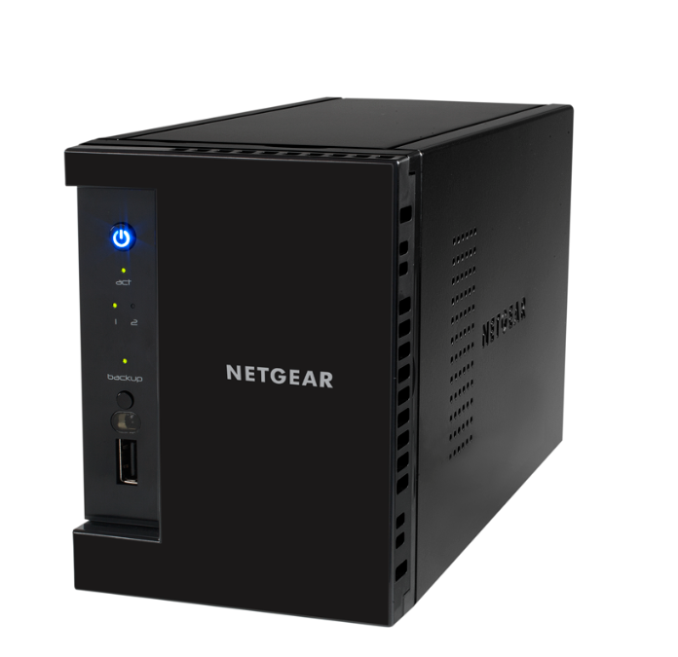
We had covered Netgear’s ReadyNAS 200 series launch at the 2015 CES. Based on a dual-core ARM Cortex-A15 SoC designed by Annapurna Labs, the ReadyNAS RN202 (2-bay) and RN204 (4-bay) brought some advantages of the btrfs file system in a cost-effective manner to the SOHO / consumer market. We recently reviewed the Netgear RN202 and the unit performed reasonably well in our evaluation.

Today, Netgear is introducing two new models in the ReadyNAS 210 series, the 2-bay RN212 and 4-bay RN214. Both of these come with quad-core ARM Cortex-A15 SoCs (again, from Annapurna Labs). Other than the increased processing power with an updated SoC, the units are identical to the ones launched earlier this year. This means that the new units also have 2 GB of RAM, three USB 3.0 ports and one eSATA port. We have dual GbE links capable of link aggregation (802.3ad LACP), and Netgear indicated that the RN21x would have better performance with port trunking compared to the RN20x.

Focus is also on the software transcoding capabilities that come as part of the media server feature. The claim is that the quad-core platform allows real-time transcoding of 1080p content to lower bit-rates and resolutions (particularly for delivery over the Internet). The transcoding is still done in software, though. Netgear also has an anti-virus engine that allows inspection at line rates (resulting in minimal performance loss).

Performance claims for the ReadyNAS RN212 and RN214 point to 200 MBps reads and 160 MBps writes – not the best in the market, but in the top half of the scale when it comes to ARM-based units. As expected from any COTS NAS nowadays, the units come with a mobile app (Netgear ReadyCLOUD). The contents of the NAS can be securely accessed even from an external network using the app, thanks to the VPN tunnel that gets configured with minimal user input.

Netgear is launching the RN21x in tandem with the Nighthawk X8 R8500 router. The link aggregation capabilities of the NAS go well with the newly added capability on the router side. Multiple streams to/from the NAS should easily allow saturation of 1GbE clients as well as the 802.11ac Wi-Fi connections. Tech-savvy consumers can easily relate to the benefits of btrfs (bitrot protection and continuous snapshot protection). For the rest, the projection as a complement to the Nighthawk X8 AC5300 router will tend to boost visibility.

The diskless RN212 and RN214 models are available for purchase today, carrying MSRPs of $329 and $499 respectively.

Netgear's New ReadyNAS 21x Models Go Quad-Core

Netgear’s New ReadyNAS 21x Models Go Quad-Core

We had covered Netgear’s ReadyNAS 200 series launch at the 2015 CES. Based on a dual-core ARM Cortex-A15 SoC designed by Annapurna Labs, the ReadyNAS RN202 (2-bay) and RN204 (4-bay) brought some advantages of the btrfs file system in a cost-effective manner to the SOHO / consumer market. We recently reviewed the Netgear RN202 and the unit performed reasonably well in our evaluation.

Today, Netgear is introducing two new models in the ReadyNAS 210 series, the 2-bay RN212 and 4-bay RN214. Both of these come with quad-core ARM Cortex-A15 SoCs (again, from Annapurna Labs). Other than the increased processing power with an updated SoC, the units are identical to the ones launched earlier this year. This means that the new units also have 2 GB of RAM, three USB 3.0 ports and one eSATA port. We have dual GbE links capable of link aggregation (802.3ad LACP), and Netgear indicated that the RN21x would have better performance with port trunking compared to the RN20x.

Focus is also on the software transcoding capabilities that come as part of the media server feature. The claim is that the quad-core platform allows real-time transcoding of 1080p content to lower bit-rates and resolutions (particularly for delivery over the Internet). The transcoding is still done in software, though. Netgear also has an anti-virus engine that allows inspection at line rates (resulting in minimal performance loss).

Performance claims for the ReadyNAS RN212 and RN214 point to 200 MBps reads and 160 MBps writes – not the best in the market, but in the top half of the scale when it comes to ARM-based units. As expected from any COTS NAS nowadays, the units come with a mobile app (Netgear ReadyCLOUD). The contents of the NAS can be securely accessed even from an external network using the app, thanks to the VPN tunnel that gets configured with minimal user input.

Netgear is launching the RN21x in tandem with the Nighthawk X8 R8500 router. The link aggregation capabilities of the NAS go well with the newly added capability on the router side. Multiple streams to/from the NAS should easily allow saturation of 1GbE clients as well as the 802.11ac Wi-Fi connections. Tech-savvy consumers can easily relate to the benefits of btrfs (bitrot protection and continuous snapshot protection). For the rest, the projection as a complement to the Nighthawk X8 AC5300 router will tend to boost visibility.

The diskless RN212 and RN214 models are available for purchase today, carrying MSRPs of $329 and $499 respectively.

Netgear's New ReadyNAS 21x Models Go Quad-Core

Netgear’s New ReadyNAS 21x Models Go Quad-Core

We had covered Netgear’s ReadyNAS 200 series launch at the 2015 CES. Based on a dual-core ARM Cortex-A15 SoC designed by Annapurna Labs, the ReadyNAS RN202 (2-bay) and RN204 (4-bay) brought some advantages of the btrfs file system in a cost-effective manner to the SOHO / consumer market. We recently reviewed the Netgear RN202 and the unit performed reasonably well in our evaluation.

Today, Netgear is introducing two new models in the ReadyNAS 210 series, the 2-bay RN212 and 4-bay RN214. Both of these come with quad-core ARM Cortex-A15 SoCs (again, from Annapurna Labs). Other than the increased processing power with an updated SoC, the units are identical to the ones launched earlier this year. This means that the new units also have 2 GB of RAM, three USB 3.0 ports and one eSATA port. We have dual GbE links capable of link aggregation (802.3ad LACP), and Netgear indicated that the RN21x would have better performance with port trunking compared to the RN20x.

Focus is also on the software transcoding capabilities that come as part of the media server feature. The claim is that the quad-core platform allows real-time transcoding of 1080p content to lower bit-rates and resolutions (particularly for delivery over the Internet). The transcoding is still done in software, though. Netgear also has an anti-virus engine that allows inspection at line rates (resulting in minimal performance loss).

Performance claims for the ReadyNAS RN212 and RN214 point to 200 MBps reads and 160 MBps writes – not the best in the market, but in the top half of the scale when it comes to ARM-based units. As expected from any COTS NAS nowadays, the units come with a mobile app (Netgear ReadyCLOUD). The contents of the NAS can be securely accessed even from an external network using the app, thanks to the VPN tunnel that gets configured with minimal user input.

Netgear is launching the RN21x in tandem with the Nighthawk X8 R8500 router. The link aggregation capabilities of the NAS go well with the newly added capability on the router side. Multiple streams to/from the NAS should easily allow saturation of 1GbE clients as well as the 802.11ac Wi-Fi connections. Tech-savvy consumers can easily relate to the benefits of btrfs (bitrot protection and continuous snapshot protection). For the rest, the projection as a complement to the Nighthawk X8 AC5300 router will tend to boost visibility.

The diskless RN212 and RN214 models are available for purchase today, carrying MSRPs of $329 and $499 respectively.

NVIDIA Announces Maxwell-Based Quadro M Mobile Series

NVIDIA Announces Maxwell-Based Quadro M Mobile Series

By and large we erroneously tend to think of NVIDIA’s Quadro family of video cards as desktop video cards. While NVIDA has offered mobile Quadro cards for nearly a decade now, it’s largely the desktop versions that get all of the attention in the press, and this outcome is not unexpected. Professional CAD, CAM, and content creation have long been the domain of high-powered workstations, and while notebooks have since taken over the majority of the PC market, the transition in the professional space has been slower. Consequently the mobile Quadro family has not attracted nearly as much attention given the importance of desktop workstations.

As the last quarter of 2015 kicks off though, this is a situation that is changing for NVIDIA and workstations vendors as a whole. Intel announced their first mobile Xeon, the Xeon E3-1500M v5, marking Intel’s formalization of the mobile workstation market. And with Intel now more on-board than ever before, for vendors like NVIDIA this means that mobile workstations – though less powerful than their desktop counterparts – may not be playing second-fiddle to desktops much longer.

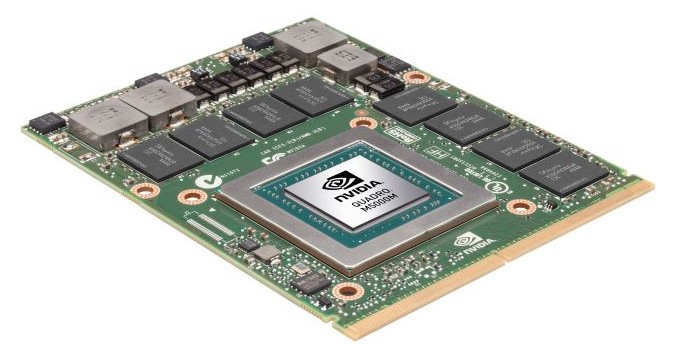
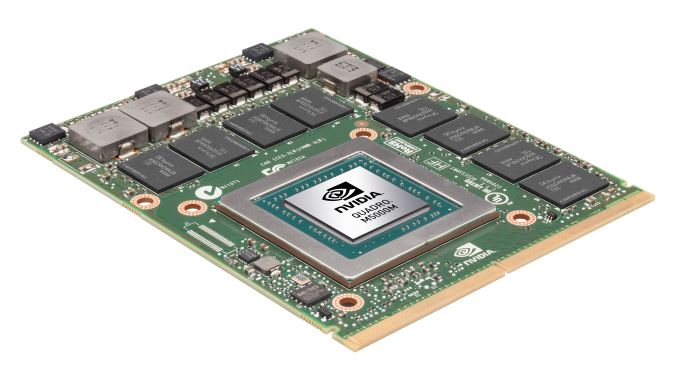
This brings us to today’s announcement from NVIDIA, the Quadro M Mobile series. After having updated the desktop Quadro lineup with new products based on Maxwell GPUs back in August, NVIIDA is starting off October by giving the mobile Quadro lineup the same Maxwell treatment. Altogether NVIDIA is launching six new Quadro M Mobile video cards, refreshing the entire lineup from top-to-bottom in a single go.

Overall this is a low-key launch for NVIDIA – there weren’t any full press briefings – but I suspect that for NVIDIA the launch of the latest generation of Quadro Mobile parts will be a big deal. The Maxwell architecture’s major gains in efficiency have helped all platforms, but no platform has been helped more than the power and heat dissipation limited mobile market, making mobile the form factor where Maxwell truly shines. As we’ve already seen in the consumer space over the past year, NVIDIA has been able to significantly increase their performance over the Kepler generation while staying within their regular TDPs, and this bodes well for NVIDIA’s Quadro Mobile lineup. NVIDIA is touting an up to 2x increase in performance, and as we’ve seen Maxwell should be able to come very close to that in many mobile workloads.

NVIDIA Quadro Mobile Specification Comparison (High-End)
  Quadro M5000M Quadro M4000M Quadro M3000M
CUDA Cores 1536 1280 1024
Memory Clock 5GHz GDDR5 5GHz GDDR5 5GHz GDDR5
Memory Bus Width 256-bit 256-bit 256-bit
VRAM 8GB 4GB 4GB
FP64 1/32 1/32 1/32
TDP 100W 100W 75W
GPU GM204 GM204 GM204
Architecture Maxwell 2 Maxwell 2 Maxwell 2

Taking a look at the individual cards, NVIDIA has opted to retain their traditional family-number-mobile naming scheme. This results in these new parts being the Quadro MxxxxM series, a bit of a mouthful of a product name.

Digging deeper, the new Quadro parts can essentially be divided up into two groups of cards. The Quadro M3000M, M4000M, and M5000 are all based on NVIDIA’s GM204 GPU. The most powerful of these is roughly comparable to the GeForce GTX 980M, with 1536 CUDA cores enabled. It’s also the only SKU to get 8GB of VRAM, made possible through the use of the recent introduction of 8Gb GDDR5 memory chips. Meanwhile the 1280 and 1024 CUDA cores respectively is the M4000M and M3000M, which use further cut down GPUs and pair it up with 4GB of VRAM. Both the M5000M and M4000M are top-wattage 100W parts, while the M3000M brings that down to 75W.

NVIDIA Quadro Mobile Specification Comparison (Low-End)
  Quadro M2000M Quadro M1000M Quadro M600M
CUDA Cores 640 512 384
Memory Clock 5GHz GDDR5 5GHz GDDR5 5GHz GDDR5
Memory Bus Width 128-bit 128-bit 128-bit
VRAM 4GB 2GB 2GB
FP64 1/32 1/32 1/32
TDP 55W 45W 30W
GPU GM107 GM107 GM107
Architecture Maxwell 1 Maxwell 1 Maxwell 1

At the other end of the spectrum we have the M600M, M1000M, and M2000M. Post press time we received confirmation from NVIDIA that these parts are based on the company’s GM107 GPU, so the Quadro M Mobile family is going to be split between the Maxwell 2 and Maxwell 1 architectures.

In any case, these parts are the lower power, lower performance, and lower price members of the Quadro M Mobile family. The M2000M features 640 CUDA cores and 4GB of VRAM, while the M1000M drops to 512 CUDA cores and 2GB of VRAM, with the M600M bringing up the rear with just 384 CUDA cores and 2GB of VRAM. TDPs for these parts are 55W, 40W, and 30W respectively, which means these parts are going to be more practical for thin and light mobile workstations than the 100W heavy-hitters at the high-end of the family.

In regards of features, these parts will inherit the standard Maxwell family features, including Maxwell’s energy efficiency improvements and greater media encode/decode support. For the Maxwell 2 based parts (M3000M and up), this includes full hardware support for HEVC encoding and limited “hybrid” HEVC decode support. As for the Maxwell 1 based parts (M2000M and below) this includes a faster-than-Kepler H.264 video encoder and “hybrid” HEVC decode support, but no HEVC encode support. NVIDIA has also confirmed that Optimus will be supported on all of these parts; otherwise in a direct-wired situation, each part can drive up to 4 displays, as opposed to 2 for the previous Kepler generation parts.

Finally, as the launch of the Quadro M Mobile series is timed to roughly coincide with the release of Intel’s Skylake processors, NVIDIA tells us that OEM availability will be similar. The parts will be rolling out over the rest of the quarter, with NVIDIA already securing design wins in Dell’s Precision 15 5000 series, Precision 15 and 17 7000 series, HP’s ZBook series, and the previously announced Lenovo ThinkPad P50 and P70.