News


Toshiba Refreshes The Chromebook 2 With Broadwell

Toshiba Refreshes The Chromebook 2 With Broadwell

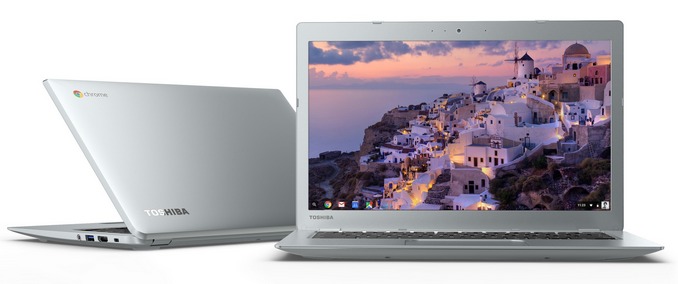
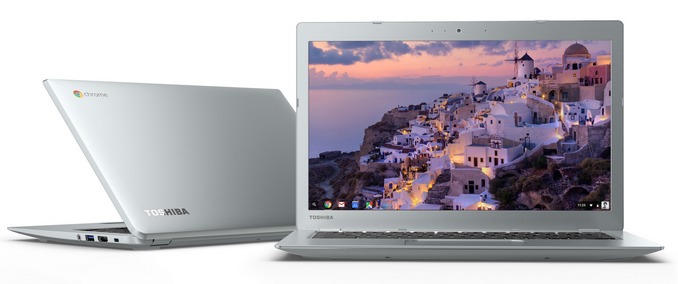
Toshiba announced today that it has refreshed their Chromebook 2 model. The new version will be available with 5th generation Core i3 or Celeron processors. Thanks to the the poor branding by Intel and vague release notes by Toshiba, the Celeron model may be the same N2840 as before or it may also be Core based. This is a pretty mild refresh, but the optional Core should mean a pretty significant increase in performance compared to the outgoing Silvermont based N2840.

The Chromebook 2 keeps its 13.3-inch IPS display, as well as the ability to configure it with up to 4 GB of memory which should be plenty for most tasks in Chrome OS. The notebook is just 2.9 lbs and offers up to nine hours of battery life according to Toshiba. The company is trying to leverage some other branding as well, saying that the front facing stereo speakers are tuned by Skullcandy.

Toshiba Chromebook 2 Specifications
Processor 5th Generation Core i3 or Celeron
Connectivity 2×2 dual-band 802.11ac (Intel 7260NGW)
Bluetooth 4.0 (Intel 7260NGW)
Memory up to 4GB DDR3L
Storage 16GB eMMC
Battery 3-cell ~10.8V, 3860mAh, 44Wh
I/O 1 x USB 3.0
1 x USB 2.0
HD webcam
Dual array microphone
HDMI
Headphone/mic jack
SD Card reader
Dimensions 12.6″ x 8.4″ x 0.76″ / 320 x 213 x 19.3 mm
Display 13.3-inch IPS 1920×1080
Weight 2.95 lbs. / 1340g
Price $330 (Celeron) $430 (i3)


Overall, the device does not change much, but it was already one of the nicer looking Chromebooks around. We were able to do a full review on this based on the N2840 Celeron, and the one complaint was that it needed a bit more processing power. The i3 model should help out a lot in that respect. The new model also gains a backlit keyboard which is kind of surprising in this price range.

The new models will be shipping on October.

Source: Toshiba

ASUS Transformer Book Lineup Bolstered With T100HA and TP200SA Models

ASUS Transformer Book Lineup Bolstered With T100HA and TP200SA Models

ASUS has been quite successful at trying to carve out a place in the tech sector by packing more into their lineup than the competitors. We saw that clearly with the ASUS Zenbook UX305 Notebook, which offers much more storage and RAM than pretty much any other notebook in its price range, and doesn’t skimp on the form factor either. In the smartphone space, they also offer an impressive 4 GB of memory and 64 GB of storage in the ASUS ZenFone 2, and at a price that is pretty impressive. Back in 2013, Anand took a look at the ASUS Transformer Book lineup with the original T100. It was not perfect, but it certainly set a new bar for what to expect for what used to be netbook level pricing.

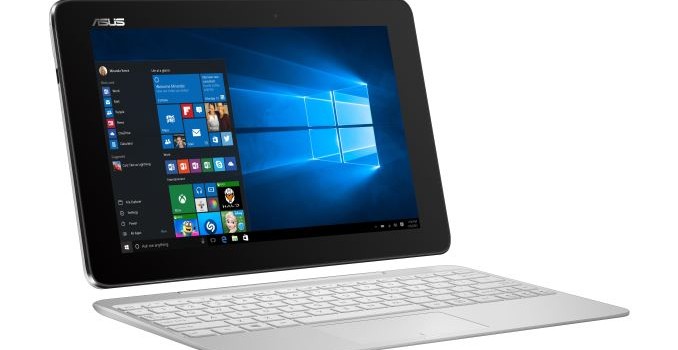
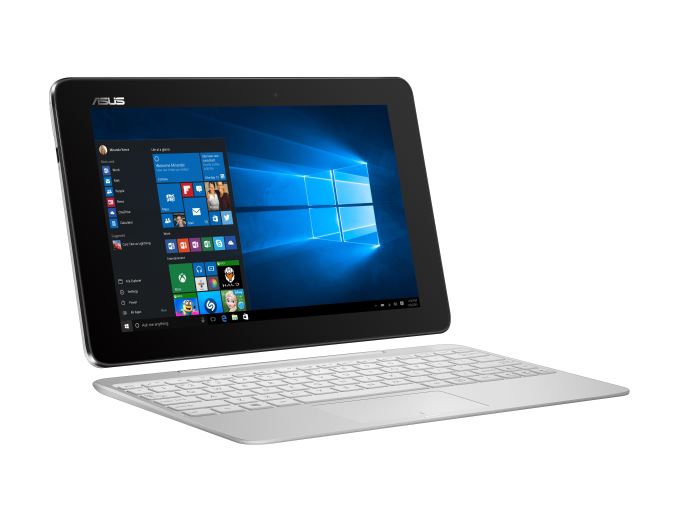
Today ASUS is at it again. The T100HA is the next generation of the original Transformer Book, and this time comes with Intel’s Atom x5, with the detachable keyboard that defines the T100 series. The TP200SA is a convertible notebook with a 360° hinge allowing it to be used as a tablet as well.

ASUS Transformer Book
  T100HA TP200SA
Processor Intel Atom x5-Z8500
1.44-2.24 GHz quad-core 14nm
2W SDP
Intel Celeron N3050
1.6-2.16 GHz dual-core 14nm
4W SDP 6W TDP
Memory 4GB
GPU Intel HD Graphics Gen 8
Display 10.1″ 1280×800 IPS with touch 11.6″ 1366×768 IPS with touch
Storage 64 GB eMMC
I/O 1 x micro USB
1 x micro HDMI
1 x micro SD
1 x Type-C USB 3.0
Keyboard Dock 1 x USB 2.0
1 x micro HDMI
1 x micro SD
1 x Type-C USB 3.0
1 x USB 2.0
1 x USB 3.0
Dimensions (mm) : 265 x 175 x 8.38 plus 7.11-9.91 for dock
(inches) : 10.43″ x 6.89″ x 0.33″ plus 0.28-0.39 for dock
(mm) : 297 x 201 x 18.54
(inches) : 11.68″ x 7.93″ x 0.73″
Weight Tablet: 580 g / 1.28 lbs
Dock: 471 g / 1.04 lbs
1.20 kg / 2.65 lbs
Battery Up to 12 hours Up to 8 hours
Price $299 $349

The T100HA moves to Intel’s Cherry Trail Atom lineup which is the new 14 nm version of Atom. We first saw the x7 version of this in the Microsoft Surface 3, and ASUS is going with the quad-core x5-Z8500 model. The four cores have a base frequency of 1.44 GHz and a burst frequency of 2.24 GHz. The Scenario Design Power of this SoC is slightly lower than its x7 brother at just two watts. Graphics are Intel’s Gen 8 graphics with 12 execution units, and a frequency range of 200 to 600 MHz. This should be a pretty nice bump in performance over the outgoing Bay Trail model, and the 14 nm Atom should also increase battery life. ASUS claims that T100 can now get up to 12 hours on a single charge.

The tablet features an IPS display, and here it drops a bit of resolution over the old model but it also moves from a 16:9 to 16:10 aspect ratio, with the new model featuring a 1280×800 resolution. ASUS has also redesigned the keyboard dock, and the tablet now locks in with the help of neodymium magnets.

But I think where ASUS shows its strengths is the available storage and RAM, with the new model offering 4 GB of RAM and 64 GB of eMMC storage as the only option. For the price of $299, the 10.1-inch tablet offers quite a bit of versatility and performance, and as is always the case with the Transformer Book lineup, the price also includes the detachable keyboard. Impressive stuff. The 1.28 lb tablet also features micro USB, micro HDMI, micro SD, and a USB Type-C port, albeit with just USB 3.0 speeds available, along with another USB 2.0 port on the keyboard dock.

For those that would prefer a more traditional notebook, ASUS offers the Transformer Book Flip T200SA. At 11.6 inches, it’s certainly a small notebook, but it also packs a lot in for a low cost notebook. The display is an IPS panel as well, which needs to be called out only because notebooks in this price range generally still ship with TN panels. The TP200SA features Intel’s Braswell SoC, with the Celeron N3050. This is also based on the same Airmont cores as Cherry Trail, but in this case it is just two cores, from 1.6 to 2.16 GHz, but with a TDP up to 6 watts which should let the two cores stretch their legs. The graphics is also Intel Gen 8 with 12 EUs and 320-600 MHz available. Once again, ASUS is outfitting this model with 4 GB of RAM and 64 GB of storage, which is a nice baseline offering to have. The 2.65 lb notebook also features micro HDMI, Micro SD, USB Type-C 3.0, and two full sized USB ports with one at 2.0 speeds and another at 3.0 speeds. The notebook will come in a dark blue color scheme and will be sold for $349.

We’ve seen some pretty impressive low cost offerings in the last while, but ASUS has stepped up their game and are outfitting these models with enough storage and RAM to not make them feel overly strained. 32 GB on Windows 10 is doable, but space management becomes an issue fairly quickly despite the changes to how the OS uses that space. Even low cost tablets generally come with IPS panels, including the outgoing T100 model, but the TP200SA being outfitted with IPS at this price is very nice to see.

ASUS will begin selling both models later in the month.

Source: ASUS

Desktop NVIDIA GTX 980 Coming To Gaming Notebooks

Desktop NVIDIA GTX 980 Coming To Gaming Notebooks

For as long as NVIDIA has been putting GPUs into notebooks, they would always have a separate lineup of GPUs which were designed for the thermally constrained environment of a notebook computer. But today’s announcement puts NVIDIA’s new strategy front and center, that the full desktop-class GTX 980 (with 2048 cores) will be made available in an MXM format for notebooks as well as integrated designs.

Maxwell was the first GPU from NVIDIA which they designated as being designed for the mobile and consumer markets first. Despite this focus on mobile performance and efficiency, NVIDIA has managed to optimize the 28nm process to focus on efficiency first and foremost but still with powerful designs, including the GTX 980 and GM204 and of course now featuring the GTX 980 Ti and Titan X models as well.

There has certainly been a paradigm shift in the GPU market lately. Yes, desktop class cards certainly have a much bigger power budget than anything in a notebook, but due to the 28nm process being the sole contender for four generations, GPU architectures have focused on silicon efficiency rather than relying on node shrinks to rein in the power budget. As a result, the maximum power requirement for the high end GPUs has come down quite significantly – this helps with thermals and noise levels as well. So let’s get to today’s news from NVIDIA. No longer are they satisfied with the performance levels available in notebooks, and they have worked with OEMs on a new initiative to shoehorn desktop class parts into the notebook lineup.

And they are not going forward with low end desktop parts either. The GTX 980M is already roughly 75% of the performance of the desktop GTX 980, so there is little point in starting with a lower end part. NVIDIA is going right for the top with the full desktop-class GTX 980 now available in certain notebooks first. The regular TDP numbers for a desktop version of the GTX 980 come in at 165W – the version going into these new notebooks we are told will come in under that, but there won’t be any official number attached to it.

NVIDIA is leaving a lot of the design up to the OEMs so that they can create the experience they want. One of the keys for this launch though is a focus on overclocking which is something that has generally been lacking in the notebook space outside of a couple of niche products. This may be combined with Intel’s latest K series mobile parts too which also offer overclocking, and the enthusiast market just got a major kick in the backside.

NVIDIA did offer guidance and support for the OEMs as they were building their solutions, and we should have a pretty wide range of products offered. We will have to wait for OEMs to officially launch products to get a full list of what they have added, but NVIDIA is requiring four to eight phase power on the GTX 980 compared to just two to three phase on GTX 980M. The desktop-class part will have up to 50% higher peak current available under load.

When discussing the new initiative, NVIDIA was very quick to point that they are not binning chips to put in the notebook either, although the GPUs are put through extra verification to ensure that they meet higher requirements for performance and efficiency to ensure there will be enough headroom for use in a notebook, as well as some extra for overclocking. They assured us that they have had no issues with yields with the extra scrutiny, so volume should not be an issue. So the chips are pre-selected for the OEMs to use.

While this is in fact a full desktop GM204 GTX 980 with 2048 cores, being that it is in a notebook the voltages and frequencies will be reduced a bit, but final clock speeds will depend on the final designs from the notebook manufacturers. What will not be lacking though is the full memory speed, with up to 7 Gbps of bandwidth available from the GDDR5 memory, and 4 and 8 GB versions will be available.

It’s not just enough to fit a desktop part into a notebook though, especially if you are going after the overclocking enthusiast market. NVIDIA has also worked to include fan control into their tool set which should also let owners tweak the fan profile for various scenarios. This will all be accessible in notebook overclocking tools provided by the OEMs.

Virtual Reality is likely one of the most demanding compute tasks to come along in quite some time, and NVIDIA is announcing that the GTX 980 notebooks will be the first notebooks certified for driving VR. Not only is the resolution for VR higher than most gaming notebooks, but the refresh rate is bumped up as well. NVIDIA is showing a difference of 120 Megapixels per second for 1080p gaming versus 450 Megapixels per second for a VR headset.

Since NVIDIA doesn’t directly sell notebooks, we will have to wait for OEMs to announce pricing and shipping dates, but NVIDIA had six notebook designs to go along with the announcement from Aorus, Clevo, ASUS, and MSI. MSI should be first out of the gate with a new model of both the GT72 and the GT80 which will offer GTX 980 in SLI. ASUS is going to be using the GTX 980 in their new liquid cooled GX700VO that was announced at IFA. Aorus will offer the X7 G-SYNC, and Clevo will have both the P870DM and P775DM.

MSI GT72 G-SYNC

MSI GT80

ASUS GX700VO With Liquid Cooling Dock

AORUS X7 G-SYNC

Clevo P775DM

Clevo P870DM

Clearly this play is a niche within a niche, but the gaming notebook segment is still alive and well (and profitable) and there seems to be an audience who is just willing to pay for the best while still keeping it ‘portable’. Packing a desktop GPU into a notebook which isn’t the size of a small car is a feat that would not have been possible just a generation or two ago – the only other alternative is some Thunderbolt implementation which still hasn’t reached maturity. NVIDIA’s push to making Maxwell as efficient as possible has had a nice side effect for them. It is an interesting play and it will be interesting to see if these new designs can run as cool and quiet as the GTX 980M models already do.

Source: NVIDIA

Desktop NVIDIA GTX 980 Coming To Gaming Notebooks

Desktop NVIDIA GTX 980 Coming To Gaming Notebooks

For as long as NVIDIA has been putting GPUs into notebooks, they would always have a separate lineup of GPUs which were designed for the thermally constrained environment of a notebook computer. But today’s announcement puts NVIDIA’s new strategy front and center, that the full desktop-class GTX 980 (with 2048 cores) will be made available in an MXM format for notebooks as well as integrated designs.

Maxwell was the first GPU from NVIDIA which they designated as being designed for the mobile and consumer markets first. Despite this focus on mobile performance and efficiency, NVIDIA has managed to optimize the 28nm process to focus on efficiency first and foremost but still with powerful designs, including the GTX 980 and GM204 and of course now featuring the GTX 980 Ti and Titan X models as well.

There has certainly been a paradigm shift in the GPU market lately. Yes, desktop class cards certainly have a much bigger power budget than anything in a notebook, but due to the 28nm process being the sole contender for four generations, GPU architectures have focused on silicon efficiency rather than relying on node shrinks to rein in the power budget. As a result, the maximum power requirement for the high end GPUs has come down quite significantly – this helps with thermals and noise levels as well. So let’s get to today’s news from NVIDIA. No longer are they satisfied with the performance levels available in notebooks, and they have worked with OEMs on a new initiative to shoehorn desktop class parts into the notebook lineup.

And they are not going forward with low end desktop parts either. The GTX 980M is already roughly 75% of the performance of the desktop GTX 980, so there is little point in starting with a lower end part. NVIDIA is going right for the top with the full desktop-class GTX 980 now available in certain notebooks first. The regular TDP numbers for a desktop version of the GTX 980 come in at 165W – the version going into these new notebooks we are told will come in under that, but there won’t be any official number attached to it.

NVIDIA is leaving a lot of the design up to the OEMs so that they can create the experience they want. One of the keys for this launch though is a focus on overclocking which is something that has generally been lacking in the notebook space outside of a couple of niche products. This may be combined with Intel’s latest K series mobile parts too which also offer overclocking, and the enthusiast market just got a major kick in the backside.

NVIDIA did offer guidance and support for the OEMs as they were building their solutions, and we should have a pretty wide range of products offered. We will have to wait for OEMs to officially launch products to get a full list of what they have added, but NVIDIA is requiring four to eight phase power on the GTX 980 compared to just two to three phase on GTX 980M. The desktop-class part will have up to 50% higher peak current available under load.

When discussing the new initiative, NVIDIA was very quick to point that they are not binning chips to put in the notebook either, although the GPUs are put through extra verification to ensure that they meet higher requirements for performance and efficiency to ensure there will be enough headroom for use in a notebook, as well as some extra for overclocking. They assured us that they have had no issues with yields with the extra scrutiny, so volume should not be an issue. So the chips are pre-selected for the OEMs to use.

While this is in fact a full desktop GM204 GTX 980 with 2048 cores, being that it is in a notebook the voltages and frequencies will be reduced a bit, but final clock speeds will depend on the final designs from the notebook manufacturers. What will not be lacking though is the full memory speed, with up to 7 Gbps of bandwidth available from the GDDR5 memory, and 4 and 8 GB versions will be available.

It’s not just enough to fit a desktop part into a notebook though, especially if you are going after the overclocking enthusiast market. NVIDIA has also worked to include fan control into their tool set which should also let owners tweak the fan profile for various scenarios. This will all be accessible in notebook overclocking tools provided by the OEMs.

Virtual Reality is likely one of the most demanding compute tasks to come along in quite some time, and NVIDIA is announcing that the GTX 980 notebooks will be the first notebooks certified for driving VR. Not only is the resolution for VR higher than most gaming notebooks, but the refresh rate is bumped up as well. NVIDIA is showing a difference of 120 Megapixels per second for 1080p gaming versus 450 Megapixels per second for a VR headset.

Since NVIDIA doesn’t directly sell notebooks, we will have to wait for OEMs to announce pricing and shipping dates, but NVIDIA had six notebook designs to go along with the announcement from Aorus, Clevo, ASUS, and MSI. MSI should be first out of the gate with a new model of both the GT72 and the GT80 which will offer GTX 980 in SLI. ASUS is going to be using the GTX 980 in their new liquid cooled GX700VO that was announced at IFA. Aorus will offer the X7 G-SYNC, and Clevo will have both the P870DM and P775DM.

MSI GT72 G-SYNC

MSI GT80

ASUS GX700VO With Liquid Cooling Dock

AORUS X7 G-SYNC

Clevo P775DM

Clevo P870DM

Clearly this play is a niche within a niche, but the gaming notebook segment is still alive and well (and profitable) and there seems to be an audience who is just willing to pay for the best while still keeping it ‘portable’. Packing a desktop GPU into a notebook which isn’t the size of a small car is a feat that would not have been possible just a generation or two ago – the only other alternative is some Thunderbolt implementation which still hasn’t reached maturity. NVIDIA’s push to making Maxwell as efficient as possible has had a nice side effect for them. It is an interesting play and it will be interesting to see if these new designs can run as cool and quiet as the GTX 980M models already do.

Source: NVIDIA
ASUS Transformer Book Lineup Bolstered With T100HA and TP200SA Models

ASUS Transformer Book Lineup Bolstered With T100HA and TP200SA Models

ASUS has been quite successful at trying to carve out a place in the tech sector by packing more into their lineup than the competitors. We saw that clearly with the ASUS Zenbook UX305 Notebook, which offers much more storage and RAM than pretty much any other notebook in its price range, and doesn’t skimp on the form factor either. In the smartphone space, they also offer an impressive 4 GB of memory and 64 GB of storage in the ASUS ZenFone 2, and at a price that is pretty impressive. Back in 2013, Anand took a look at the ASUS Transformer Book lineup with the original T100. It was not perfect, but it certainly set a new bar for what to expect for what used to be netbook level pricing.

Today ASUS is at it again. The T100HA is the next generation of the original Transformer Book, and this time comes with Intel’s Atom x5, with the detachable keyboard that defines the T100 series. The TP200SA is a convertible notebook with a 360° hinge allowing it to be used as a tablet as well.

ASUS Transformer Book
  T100HA TP200SA
Processor Intel Atom x5-Z8500
1.44-2.24 GHz quad-core 14nm
2W SDP
Intel Celeron N3050
1.6-2.16 GHz dual-core 14nm
4W SDP 6W TDP
Memory 4GB
GPU Intel HD Graphics Gen 8
Display 10.1″ 1280×800 IPS with touch 11.6″ 1366×768 IPS with touch
Storage 64 GB eMMC
I/O 1 x micro USB
1 x micro HDMI
1 x micro SD
1 x Type-C USB 3.0
Keyboard Dock 1 x USB 2.0
1 x micro HDMI
1 x micro SD
1 x Type-C USB 3.0
1 x USB 2.0
1 x USB 3.0
Dimensions (mm) : 265 x 175 x 8.38 plus 7.11-9.91 for dock
(inches) : 10.43″ x 6.89″ x 0.33″ plus 0.28-0.39 for dock
(mm) : 297 x 201 x 18.54
(inches) : 11.68″ x 7.93″ x 0.73″
Weight Tablet: 580 g / 1.28 lbs
Dock: 471 g / 1.04 lbs
1.20 kg / 2.65 lbs
Battery Up to 12 hours Up to 8 hours
Price $299 $349

The T100HA moves to Intel’s Cherry Trail Atom lineup which is the new 14 nm version of Atom. We first saw the x7 version of this in the Microsoft Surface 3, and ASUS is going with the quad-core x5-Z8500 model. The four cores have a base frequency of 1.44 GHz and a burst frequency of 2.24 GHz. The Scenario Design Power of this SoC is slightly lower than its x7 brother at just two watts. Graphics are Intel’s Gen 8 graphics with 12 execution units, and a frequency range of 200 to 600 MHz. This should be a pretty nice bump in performance over the outgoing Bay Trail model, and the 14 nm Atom should also increase battery life. ASUS claims that T100 can now get up to 12 hours on a single charge.

The tablet features an IPS display, and here it drops a bit of resolution over the old model but it also moves from a 16:9 to 16:10 aspect ratio, with the new model featuring a 1280×800 resolution. ASUS has also redesigned the keyboard dock, and the tablet now locks in with the help of neodymium magnets.

But I think where ASUS shows its strengths is the available storage and RAM, with the new model offering 4 GB of RAM and 64 GB of eMMC storage as the only option. For the price of $299, the 10.1-inch tablet offers quite a bit of versatility and performance, and as is always the case with the Transformer Book lineup, the price also includes the detachable keyboard. Impressive stuff. The 1.28 lb tablet also features micro USB, micro HDMI, micro SD, and a USB Type-C port, albeit with just USB 3.0 speeds available, along with another USB 2.0 port on the keyboard dock.

For those that would prefer a more traditional notebook, ASUS offers the Transformer Book Flip T200SA. At 11.6 inches, it’s certainly a small notebook, but it also packs a lot in for a low cost notebook. The display is an IPS panel as well, which needs to be called out only because notebooks in this price range generally still ship with TN panels. The TP200SA features Intel’s Braswell SoC, with the Celeron N3050. This is also based on the same Airmont cores as Cherry Trail, but in this case it is just two cores, from 1.6 to 2.16 GHz, but with a TDP up to 6 watts which should let the two cores stretch their legs. The graphics is also Intel Gen 8 with 12 EUs and 320-600 MHz available. Once again, ASUS is outfitting this model with 4 GB of RAM and 64 GB of storage, which is a nice baseline offering to have. The 2.65 lb notebook also features micro HDMI, Micro SD, USB Type-C 3.0, and two full sized USB ports with one at 2.0 speeds and another at 3.0 speeds. The notebook will come in a dark blue color scheme and will be sold for $349.

We’ve seen some pretty impressive low cost offerings in the last while, but ASUS has stepped up their game and are outfitting these models with enough storage and RAM to not make them feel overly strained. 32 GB on Windows 10 is doable, but space management becomes an issue fairly quickly despite the changes to how the OS uses that space. Even low cost tablets generally come with IPS panels, including the outgoing T100 model, but the TP200SA being outfitted with IPS at this price is very nice to see.

ASUS will begin selling both models later in the month.

Source: ASUS