News


Google Launches Android Pay On Google Play

Google Launches Android Pay On Google Play

Today Google officially began the roll out of Android Pay by releasing the Android Pay application on the Google Play Store. Android Pay was announced earlier this year at Google I/O and is Google’s new NFC based payment service for Android smartphones. It’s effectively a successor to Google Wallet, although Google Wallet still exists as a service for sending P2P payments. The rollout of the new application actually began last week as an update for Google Wallet users, but today the application should be available to all users for direct download.

Android Pay will work on any smartphone running Android 4.4 KitKat or newer so long as the phone has NFC hardware. At launch the service will only be available in the United States, and will support a variety of credit and debit cards from various US banks and credit unions. There will also be support for gift cards and loyalty cards from retailers.

Google’s Android Pay website details a number of stores that support Android Pay, but since the service uses NFC it will work at any store that has tap to pay support. It will also work in Android applications that have partnered with Google to support Android Pay payments, and you can view a list of those applications along with a list of supported banks and credit unions on the Android Pay site.

Source Google Play via Engadget

Jim Keller Leaves AMD

Jim Keller Leaves AMD

AMD’s history has been well documented, especially given several reorganizations in the early part of this decade along with changes in senior staff and how both its market share in CPU and GPU markets is progressing. Today we have learned that one of those senior staff, the head of the CPU group Jim Keller, is to leave AMD effective September 18th (today).  Readers may remember that Jim Keller was a recent re-hire in 2012, tasked with leading AMD’s CPU group and helping the company develop new core processor architectures in order to bring AMD’s architecture in line the competition.

Jim Keller has worked at AMD before, most notably developing the K7 and K8 processors that formed the basis of much of AMD’s success at the turn of the century. This includes assisting in the generation of the x86-64 instruction set that would form the basis of many of the x86 based computers people used today. At other points in time Jim has also spent several years each at Apple helping design their A4 and A5 SoCs as well as at DEC on Alpha processors, giving him a wide degree of experience in CPU development that AMD has been tapping during his latest tenure there.

As a re-hire at the top of the CPU chain, Keller’s latest project at AMD was to develop the next generation of high performance processors for AMD and to build a team around the concept of PC performance. This was announced as a rapid departure from the module design of Bulldozer-based cores sharing parts of a processor and towards a new base architecture called Zen. Other projects in the pipeline at AMD CPU group include ARM-based AMD processors (K12), an ARM counterpart of sorts for Zen that is set to launch later on.

As for the big question, the state of Zen, along with confirming that Keller is leaving the company today, AMD is also officially reiterating that their roadmaps are still on course, with Zen set to come to market in the latter half of 2016 and a first full preiod of revenue to be reported in 2017. Given the long (4+ year) design cycles for a modern high-performance CPU, at this point in time all of the “heavy lifting” on Zen development should be done. With only a year or so to go before launch, the rest of Keller’s team at AMD will be focusing on fixing bugs and bringing products to manufacturing.

As a result while the loss of Keller is certainly a significant one for AMD, Keller’s architecture work on Zen should already be complete, which is likely why we are seeing him leave at this time. And as a quick aside to give you an idea of CPU development timelines, by comparison, Jim’s work on K8 was done over 3 years before K8 shipped in 2003. Consequently the biggest loss for AMD here shouldn’t be Zen-related, but rather that they won’t have Keller’s talents to call upon for further refinements of Zen or for a post-Zen architecture.

Meanwhile leadership of the CPU architecture team in Keller’s absence will be turned over to CTO Mark Papermaster, who will be leading the group as they wrap up work on Zen. AMD is calling Mark the “acting leader” of the group, so this is likely an interim posting while AMD looks to find or promote someone to lead the CPU architecture group on a permanent basis. Otherwise as we’re approaching the end of the fiscal quarter, AMD is in their quiet period, so AMD is limited in what they can say at this time. I suspect we’ll hear a bit more on the plan for the final year of Zen development in the company’s Q3 earnings release, which will be on October 14th.

Finally, it will be interesting to see if and when Keller will pop up next in the industry. Given his history of switching jobs to work on new CPU projects and his high level of skill which has allowed him to so freely move between companies, we may yet see Keller show up on another CPU project in the future. On the other hand after having worked for AMD twice and Apple, Keller has certainly earned an early retirement. In the meantime with the launch of Zen closing in for AMD, all eyes will be on just what Keller and his team have put together for AMD’s next generation CPU.

Source: AMD
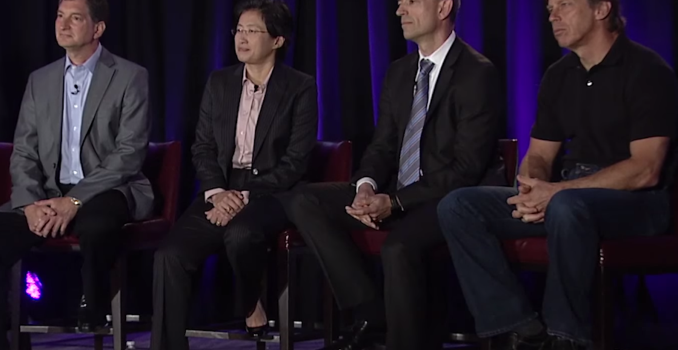
Top image (from left): Mark Papermaster (CTO), Dr. Lisa Su (CEO), Simon Segars (CEO of ARM), Jim Keller


Jim Keller Leaves AMD

Jim Keller Leaves AMD

AMD’s history has been well documented, especially given several reorganizations in the early part of this decade along with changes in senior staff and how both its market share in CPU and GPU markets is progressing. Today we have learned that one of those senior staff, the head of the CPU group Jim Keller, is to leave AMD effective September 18th (today).  Readers may remember that Jim Keller was a recent re-hire in 2012, tasked with leading AMD’s CPU group and helping the company develop new core processor architectures in order to bring AMD’s architecture in line the competition.

Jim Keller has worked at AMD before, most notably developing the K7 and K8 processors that formed the basis of much of AMD’s success at the turn of the century. This includes assisting in the generation of the x86-64 instruction set that would form the basis of many of the x86 based computers people used today. At other points in time Jim has also spent several years each at Apple helping design their A4 and A5 SoCs as well as at DEC on Alpha processors, giving him a wide degree of experience in CPU development that AMD has been tapping during his latest tenure there.

As a re-hire at the top of the CPU chain, Keller’s latest project at AMD was to develop the next generation of high performance processors for AMD and to build a team around the concept of PC performance. This was announced as a rapid departure from the module design of Bulldozer-based cores sharing parts of a processor and towards a new base architecture called Zen. Other projects in the pipeline at AMD CPU group include ARM-based AMD processors (K12), an ARM counterpart of sorts for Zen that is set to launch later on.

As for the big question, the state of Zen, along with confirming that Keller is leaving the company today, AMD is also officially reiterating that their roadmaps are still on course, with Zen set to come to market in the latter half of 2016 and a first full preiod of revenue to be reported in 2017. Given the long (4+ year) design cycles for a modern high-performance CPU, at this point in time all of the “heavy lifting” on Zen development should be done. With only a year or so to go before launch, the rest of Keller’s team at AMD will be focusing on fixing bugs and bringing products to manufacturing.

As a result while the loss of Keller is certainly a significant one for AMD, Keller’s architecture work on Zen should already be complete, which is likely why we are seeing him leave at this time. And as a quick aside to give you an idea of CPU development timelines, by comparison, Jim’s work on K8 was done over 3 years before K8 shipped in 2003. Consequently the biggest loss for AMD here shouldn’t be Zen-related, but rather that they won’t have Keller’s talents to call upon for further refinements of Zen or for a post-Zen architecture.

Meanwhile leadership of the CPU architecture team in Keller’s absence will be turned over to CTO Mark Papermaster, who will be leading the group as they wrap up work on Zen. AMD is calling Mark the “acting leader” of the group, so this is likely an interim posting while AMD looks to find or promote someone to lead the CPU architecture group on a permanent basis. Otherwise as we’re approaching the end of the fiscal quarter, AMD is in their quiet period, so AMD is limited in what they can say at this time. I suspect we’ll hear a bit more on the plan for the final year of Zen development in the company’s Q3 earnings release, which will be on October 14th.

Finally, it will be interesting to see if and when Keller will pop up next in the industry. Given his history of switching jobs to work on new CPU projects and his high level of skill which has allowed him to so freely move between companies, we may yet see Keller show up on another CPU project in the future. On the other hand after having worked for AMD twice and Apple, Keller has certainly earned an early retirement. In the meantime with the launch of Zen closing in for AMD, all eyes will be on just what Keller and his team have put together for AMD’s next generation CPU.

Source: AMD
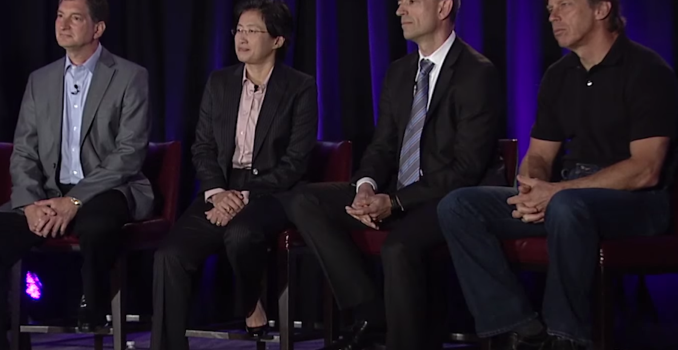
Top image (from left): Mark Papermaster (CTO), Dr. Lisa Su (CEO), Simon Segars (CEO of ARM), Jim Keller

Amazon Releases New Fire TV (2015)

Amazon Releases New Fire TV (2015)

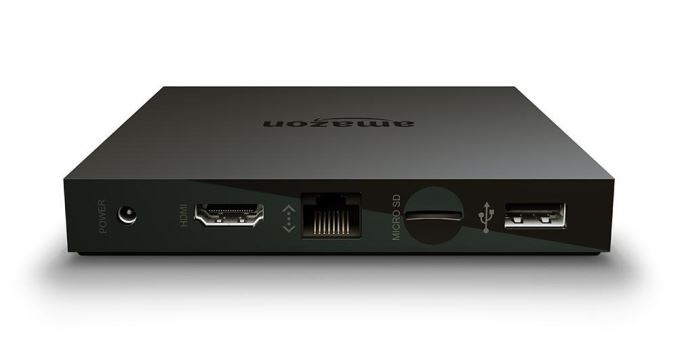
Today Amazon released a refresh of its Fire TV media player and mini-console. The original device was unveiled in April 2014 and the 2015 version sees some upgrades in the internal components and connectivity.
 
The biggest change is the upgrade from the original Snapdragon 600 to MediaTek’s new MT8173 SoC. The MT8173 was originally announced at MWC this year and surprised a lot of people as the Taiwanese semiconductor vendor was the first to show off working prototypes with ARM’s new Cortex A72 CPU core, and it seems the Fire TV is the first device to ship with the new SoC and CPU architecture. 
 
  Fire TV (2014) Fire TV (2015)
SoC Qualcomm APQ8064
Snapdragon 600
4x Krait 300 @ 1.7GHz

Adreno 320 @ 400MHz

MediaTek MT8173C
2x Cortex A72 @ 1989MHz
2x Cortex A53 @ 1573MHz

Power VR GX6250 600MHz

RAM 2GB
Storage 8GB 8GB + microSD
Connectivity 5.5 mm DC Jack
Type A HDMI 1.4b output, w/HDCP
Optical Audio (TOSLINK)
10/100 Ethernet
USB 2.0 Type A

802.11a/b/g/n
2×2 MIMO

5.5 mm DC Jack
Type A HDMI 2.0 output, w/HDCP 2.2
microSD
10/100 Ethernet
USB 2.0 Type A

802.11a/b/g/n/ac
2×2 MIMO

Launch OS Fire OS 3.0 Fire OS 5.0

The new SoC is a 2×2 big.LITTLE configuration with 2 A72 cores clocked in at 1989MHz and 2 A53 cores at 1573MHz. The new CPUs should give a significant performance boost over the Krait 300 found in the 2014 variant.

The new SoC also allows for hardware HEVC decoding and Amazon is touting this as the main feature of the new SKU as it allows for halving of the required bandwidth to stream 1080p content or allows for 4Kp30 content playback. Alas it seems 4Kp60 decoding is not supported and thus makes new Fire TV not quite as future proof as one would have hoped. The new unit comes with a new HDMI 2.0 port sporting HDCP 2.2 compatibility and allows connecting a TV or monitor at up to 2160p at 24/25/30/50/60Hz.

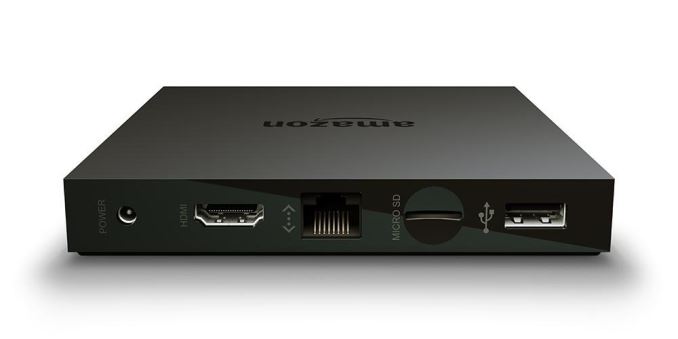
An important change in the connectivity is the dropping of the TOSLINK optical audio out connector in favour of a microSD slot. Also added is 802.11ac Wi-Fi connectivity, still sporting a 2×2 MIMO antenna configuration.

As an accessory to the Fire TV, Amazon also released a new gaming controller, aptly named the Amazon Fire Game Controller. The controller is equipped with the same voice-control functionality that the Fire Voice Remote comes with, thus being able to use replace it as the main controller/remote.

The new Fire TV starts shipping on the 5th of October for $99.99 without the controller or $139.99 for the Gaming Edition which contains both the media play and the controller. Amazon also now releases the original Fire TV Stick with the Voice Remote for $59.99.

Amazon Releases New Fire TV (2015)

Amazon Releases New Fire TV (2015)

Today Amazon released a refresh of its Fire TV media player and mini-console. The original device was unveiled in April 2014 and the 2015 version sees some upgrades in the internal components and connectivity.
 
The biggest change is the upgrade from the original Snapdragon 600 to MediaTek’s new MT8173 SoC. The MT8173 was originally announced at MWC this year and surprised a lot of people as the Taiwanese semiconductor vendor was the first to show off working prototypes with ARM’s new Cortex A72 CPU core, and it seems the Fire TV is the first device to ship with the new SoC and CPU architecture. 
 
  Fire TV (2014) Fire TV (2015)
SoC Qualcomm APQ8064
Snapdragon 600
4x Krait 300 @ 1.7GHz

Adreno 320 @ 400MHz

MediaTek MT8173C
2x Cortex A72 @ 1989MHz
2x Cortex A53 @ 1573MHz

Power VR GX6250 600MHz

RAM 2GB
Storage 8GB 8GB + microSD
Connectivity 5.5 mm DC Jack
Type A HDMI 1.4b output, w/HDCP
Optical Audio (TOSLINK)
10/100 Ethernet
USB 2.0 Type A

802.11a/b/g/n
2×2 MIMO

5.5 mm DC Jack
Type A HDMI 2.0 output, w/HDCP 2.2
microSD
10/100 Ethernet
USB 2.0 Type A

802.11a/b/g/n/ac
2×2 MIMO

Launch OS Fire OS 3.0 Fire OS 5.0

The new SoC is a 2×2 big.LITTLE configuration with 2 A72 cores clocked in at 1989MHz and 2 A53 cores at 1573MHz. The new CPUs should give a significant performance boost over the Krait 300 found in the 2014 variant.

The new SoC also allows for hardware HEVC decoding and Amazon is touting this as the main feature of the new SKU as it allows for halving of the required bandwidth to stream 1080p content or allows for 4Kp30 content playback. Alas it seems 4Kp60 decoding is not supported and thus makes new Fire TV not quite as future proof as one would have hoped. The new unit comes with a new HDMI 2.0 port sporting HDCP 2.2 compatibility and allows connecting a TV or monitor at up to 2160p at 24/25/30/50/60Hz.

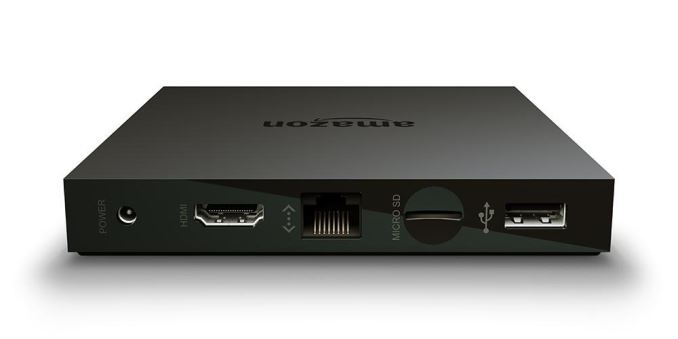
An important change in the connectivity is the dropping of the TOSLINK optical audio out connector in favour of a microSD slot. Also added is 802.11ac Wi-Fi connectivity, still sporting a 2×2 MIMO antenna configuration.

As an accessory to the Fire TV, Amazon also released a new gaming controller, aptly named the Amazon Fire Game Controller. The controller is equipped with the same voice-control functionality that the Fire Voice Remote comes with, thus being able to use replace it as the main controller/remote.

The new Fire TV starts shipping on the 5th of October for $99.99 without the controller or $139.99 for the Gaming Edition which contains both the media play and the controller. Amazon also now releases the original Fire TV Stick with the Voice Remote for $59.99.