
News


Lenovo Announces New PHAB and PHAB PLUS Phablets
Lenovo Announces New PHAB and PHAB PLUS Phablets

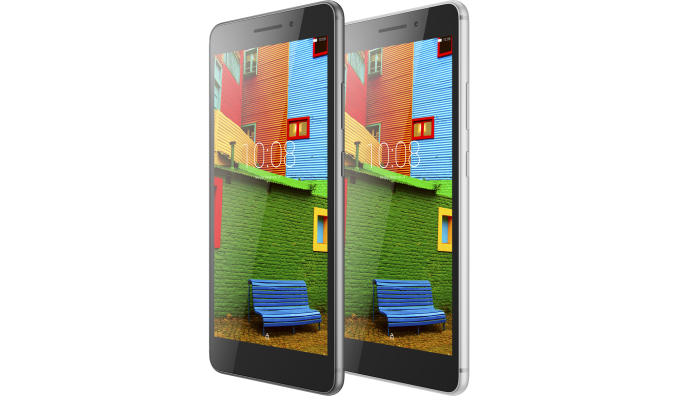
Today Lenovo has made a number of announcements relating to their mobile device business. We’ve seen two new low end tablets, and a very strange but also very interesting high end Android tablet using an Intel Airmont SoC. While their tablets fill in the spaces for very large screens, the new Lenovo PHAB and Lenovo PHAB PLUS are positioned to sell to buyers looking for something larger than 6″ but not quite at the size of the 8, 9, and 10″ tablets on the market. Below you can view all the known specifications for Lenovo’s new PHAB phablets.

  Lenovo PHAB Lenovo PHAB PLUS
SoC Qualcomm Snapdragon 64bit Quad Core Snapdragon 615
1.5GHz 4x Cortex A53
1.1GHz 4x Cortex A53
RAM 1GB 2GB LPDDR3
NAND 16GB NAND + microSD 32GB NAND + microSD
Display 7” 720p IPS 6.8” 1080p IPS
Network 2G / 3G / 4G LTE 2G / 3G / 4G LTE (MDM 9×25 Category 4 LTE)
Dimensions 8.9mm thick, 250g 186.6 x 96.6 x 7.6mm, 229g
Camera 13MP Rear Facing 13MP Rear Facing
5MP Front Facing 5MP Front Facing
Battery 4250 mAh (16.15 Whr) 3500 mAh (13.3 Whr)
OS Android 5.0 Android 5.0
Connectivity 2.4 GHz 802.11b/g/n +
BT 4.0,
USB2.0, GPS/GNSS
2.4 GHz 802.11a/b/g/n/ac +
BT 4.0,
USB2.0, GPS/GNSS
SIM 2x MicroSIM MicroSIM + NanoSIM
Launch Price $179 $299

Both the Lenovo PHAB and the Lenovo PHAB PLUS are quite large devices. I was under the impression that once you got to 7″ you started calling your device a tablet, but with the PHAB including cellular capabilities it looks like Lenovo has decided to brand it as a phablet despite its size. It’s also interesting to note that unlike Apple and Samsung’s naming scheme, the “plus” in PHAB PLUS doesn’t mean that the display is bigger; in fact it is actually slightly smaller.

The Lenovo PHAB is obviously the low end model out of these two devices. Its 7″ display has a resolution of only 1280×720, which is quite low for a 7″ device, although there’s not much more than one can expect at $179. Lenovo doesn’t specify exactly what the SoC is, but from it being a 64bit Snapdragon quad core in a low-end device with 1GB of RAM it’s pretty safe to assume that it’s the 1.2GHz implementation of Snapdragon 410, which has four Cortex A53 cores.

As for the designs of these two phablets, the normal Lenovo PHAB has a polycarbonate shell which comes in black, white, red, and blue. Unfortunately I wasn’t provided with images of it. As for the PHAB Plus, it has a metal unibody and comes in either platinum (silver) or gunmetal (grey) finishes.

Like the tablets that Lenovo has also launched today, there’s no exact date for when the Lenovo PHAB and PHAB PLUS will be made available. Lenovo states that they will be available during this year’s winter holiday season, with the PHAB priced at $179 and the PHAB PLUS priced at $299.
Lenovo Launches Three New VIBE Smartphones

Lenovo Launches Three New VIBE Smartphones

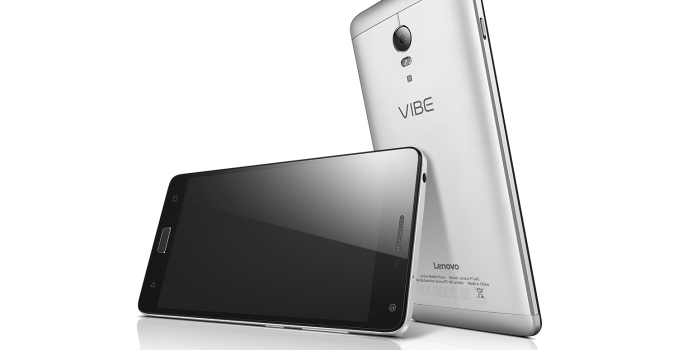
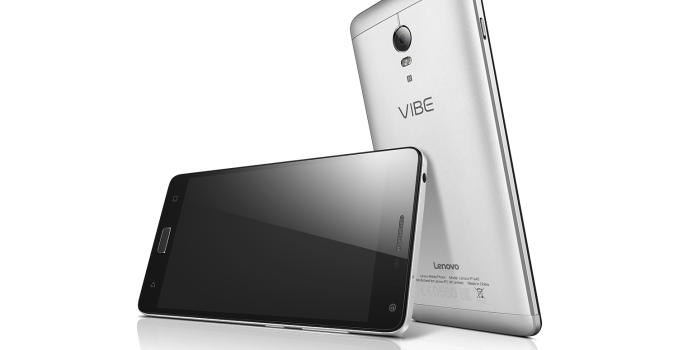
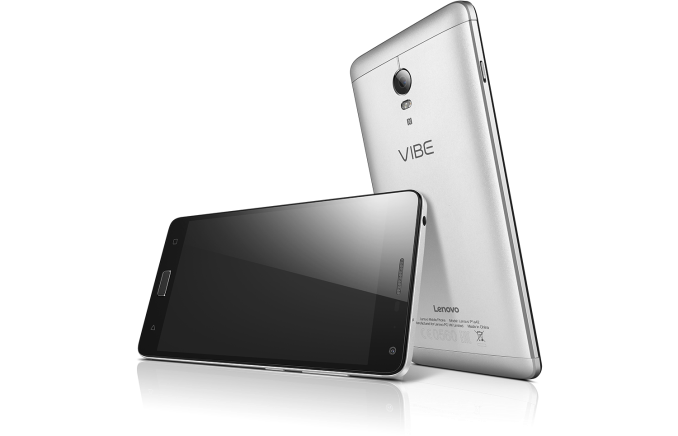
Lenovo has been making quite a number of announcements at IFA this year. We’ve seen a unique high end Android tablet, low end Android tablets, and really big phablets. Their last announcement relating to mobile is the launch of 3 new smartphones under the Lenovo VIBE brand. You can check out the specs for Lenovo’s new smartphones in the chart below.

Lenovo VIBE Smartphones  
Model Lenovo VIBE S1 Lenovo VIBE P1 Lenovo VIBE P1m
SoC MediaTek MT6752 1.7GHz 1.5GHz Snapdragon 615 MediaTek MT6735P 1GHz
RAM/NAND 3GB / 32GB NAND
MicroSD
2GB / 32GB NAND
MicroSD
2GB RAM, 16GB
NAND + MicroSD
Display 5.0″ 1920×1080 IPS LCD 5.5″ 1920×1080 IPS LCD 5.0″ 1280×720 IPS LCD
Dimensions 143.3 x 70.8 x 7.8 mm
132g
152.9 x 75.6 x 4.6-9.9mm
189g
141 x 71.8 x 9.3mm
148g
Camera 13MP Rear Facing 8MP Rear Facing
5MP Front Facing
8MP Front Facing
2MP Front Facing
5MP Front Facing
Battery 2500mAh 5000mAh 4000mAh
OS Android Lollipop
Connectivity 802.11b/g/n + BT 4.0, microUSB 2.0, GNSS 802.11a/b/g/n/ac + BT 4.1, microUSB 2.0, GNSS 802.11a/b/g/n + BT 4.1, microUSB 2.0, GNSS
SIM Dual NanoSIM Dual MicroSIM

It’s difficult to figure out where some of these smartphones fit in the grand scheme of things. The Vibe P1 looks like Lenovo’s phone for those interested in a large but not 6.8″ PHAB large smartphone, while the VIBE S1 is a mid/high device and the P1m is the more low end device of the three. Both the P1 and P1m are characterized by very large batteries, while  the Vibe S1 has a more typical 2500mAh battery.

The internal hardware of the three VIBE smartphones varies greatly. The VIBE S1 and P1m use MediaTek SoCs, while the P1 opts for Qualcomm’s Snapdragon 615. The P1 also sports 802.11ac WiFi, while the other two devices are limited to 802.11n. All of them have support for dual SIMs, which is something of a necessity for phones aimed at markets in Asia.

It’s not likely that these smartphones will make their way to North American markets, but it’s always interesting to see what kind of devices get sold in different markets. Like all of Lenovo’s launches today, the VIBE S1, P1, and P1m will be going on sale this holiday season.

Lenovo Unveils A Trio Of New Android Tablets.

Lenovo Unveils A Trio Of New Android Tablets.

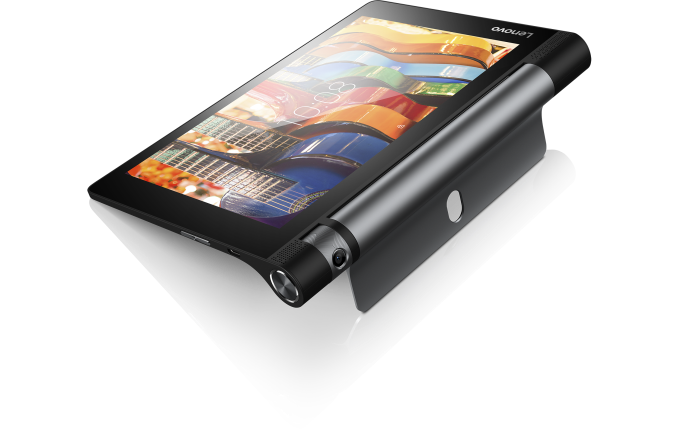
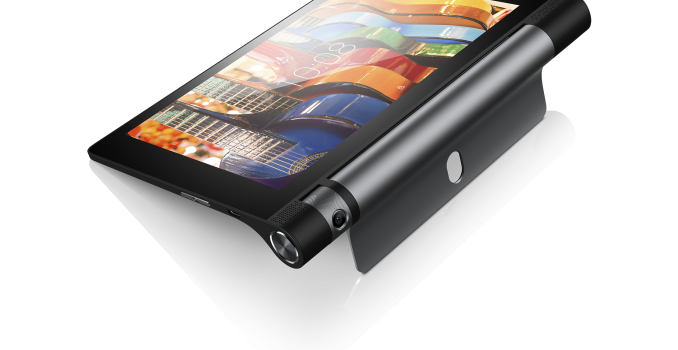
Today Lenovo has launched three new Android tablets in their YOGA Tab series. In order the new devices are the YOGA Tab 3 8″, the YOGA Tab 3 10″, and the YOGA Tab 3 Pro 10″. The first two tablets are fairly low-end devices, while the YOGA Tab 3 Pro is probably the most unique Android tablet that I have ever seen. You can see how these tablets compare to each other by checking out the spec table below.

Lenovo YOGA Tab Series
Model Lenovo YOGA TAB 3 8” Lenovo YOGA TAB 3 10″ Lenovo YOGA TAB 3 Pro 10”
SoC 1.3GHz Snapdragon 212 1.3GHz Snapdragon 212 Intel Atom x5-Z8500
Quad core, 2.24GHz
RAM/NAND 1GB / 16GB NAND
MicroSD
1GB / 16GB NAND
MicroSD
2GB RAM, 16/32GB
NAND + MicroSD
Display 8″ 1280×800 IPS LCD 10.1″ 1280×800 IPS LCD 10.1″ 2560×1600 IPS LCD
Dimensions 210 x 146 x 3 to 7mm 253 x 185 x 3.5 to 9.5mm
655g
179 x 247 x 4.6mm at thinnest point, 665g
Camera 8MP Rotatable Camera 13MP Rear-facing
5MP Front-facing
Battery 6200mAh (23.56Wh) 8700mAh (33.06Wh) 10200mAh (38.76Wh)
OS Android 5.1 Lollipop Android 5.0 Lollipop Android 5.1 Lollipop
Connectivity 802.11b/g/n + BT 4.0, microUSB 2.0, Optional LTE SKU 2×2 802.11a/b/g/n/ac + BT 4.0,
microUSB 2.0, Optional LTE

The YOGA Tab 3 8″ and 10″ use Qualcomm’s Snapdragon 212 SoCs, which are both quad core Cortex A7 parts with Adreno 304 graphics. As for the Yoga Tab 3 Pro 10″, it’s a much more interesting situation. This is one of the first devices shipping with an Intel Airmont SoC, and to my knowledge the first and only Android device to do so. This is Intel’s first Atom SoC built on their 14nm process, and it consists of 4 Atom cores with a peak frequency of 2.24GHz, along with a 12 EU implementation of their Gen8 graphics.

Moving on to the displays, we see that both of the non-pro YOGA Tabs use a 1280×800 IPS LCD. The YOGA Tab Pro steps up significantly with a 10.1″ 2560×1600 IPS LCD. It’s fairly clear that the non-pro YOGA Tabs are intended to be low-end tablets, with the pro model packing the more powerful specifications. One that immediately pops out is the battery capacity. At 38.76Wh, it is the biggest battery I’ve ever seen in an Android tablet, and it rivals the enormous batteries that Apple had to put in the 2012 models of the iPad. Lenovo claims that the YOGA Tab 3 Pro 10″ will last up to 18 hours on its battery.

The YOGA Tab 3 Pro 10″ also has a couple more interesting features. While both of the non-pro models feature two front facing speakers positioned in the tube at the end of the device, the YOGA Tab 3 Pro 10″ has four front-facing speakers, along with Dolby’s Atmos 3D surround sound processing. It also features a pico projector that can project an image up to 70″ in size with a brightness of 50 nits. Lenovo states that the projector can be rotated using gesture controls, although it’s not explained exactly how this works or what it entails.

Lenovo hasn’t set a firm date for the launch of any of these tablets, but their press release states that these are part of their holiday lineup, and so if you’re interested in buying one you should be able to pick one up sometime in December at the latest. Prices for the YOGA Tab 3 8″ and 10″ are unknown, but the YOGA Tab 3 Pro 10″ is priced at $499 for the WiFi model, and $599 for the LTE model.

Lenovo Announces New PHAB and PHAB PLUS Phablets

Lenovo Announces New PHAB and PHAB PLUS Phablets

Today Lenovo has made a number of announcements relating to their mobile device business. We’ve seen two new low end tablets, and a very strange but also very interesting high end Android tablet using an Intel Airmont SoC. While their tablets fill in the spaces for very large screens, the new Lenovo PHAB and Lenovo PHAB PLUS are positioned to sell to buyers looking for something larger than 6″ but not quite at the size of the 8, 9, and 10″ tablets on the market. Below you can view all the known specifications for Lenovo’s new PHAB phablets.

  Lenovo PHAB Lenovo PHAB PLUS
SoC Qualcomm Snapdragon 64bit Quad Core Snapdragon 615
1.5GHz 4x Cortex A53
1.1GHz 4x Cortex A53
RAM 1GB 2GB LPDDR3
NAND 16GB NAND + microSD 32GB NAND + microSD
Display 7” 720p IPS 6.8” 1080p IPS
Network 2G / 3G / 4G LTE 2G / 3G / 4G LTE (MDM 9×25 Category 4 LTE)
Dimensions 8.9mm thick, 250g 186.6 x 96.6 x 7.6mm, 229g
Camera 13MP Rear Facing 13MP Rear Facing
5MP Front Facing 5MP Front Facing
Battery 4250 mAh (16.15 Whr) 3500 mAh (13.3 Whr)
OS Android 5.0 Android 5.0
Connectivity 2.4 GHz 802.11b/g/n +
BT 4.0,
USB2.0, GPS/GNSS
2.4 GHz 802.11a/b/g/n/ac +
BT 4.0,
USB2.0, GPS/GNSS
SIM 2x MicroSIM MicroSIM + NanoSIM
Launch Price $179 $299

Both the Lenovo PHAB and the Lenovo PHAB PLUS are quite large devices. I was under the impression that once you got to 7″ you started calling your device a tablet, but with the PHAB including cellular capabilities it looks like Lenovo has decided to brand it as a phablet despite its size. It’s also interesting to note that unlike Apple and Samsung’s naming scheme, the “plus” in PHAB PLUS doesn’t mean that the display is bigger; in fact it is actually slightly smaller.

The Lenovo PHAB is obviously the low end model out of these two devices. Its 7″ display has a resolution of only 1280×720, which is quite low for a 7″ device, although there’s not much more than one can expect at $179. Lenovo doesn’t specify exactly what the SoC is, but from it being a 64bit Snapdragon quad core in a low-end device with 1GB of RAM it’s pretty safe to assume that it’s the 1.2GHz implementation of Snapdragon 410, which has four Cortex A53 cores.

As for the designs of these two phablets, the normal Lenovo PHAB has a polycarbonate shell which comes in black, white, red, and blue. Unfortunately I wasn’t provided with images of it. As for the PHAB Plus, it has a metal unibody and comes in either platinum (silver) or gunmetal (grey) finishes.

Like the tablets that Lenovo has also launched today, there’s no exact date for when the Lenovo PHAB and PHAB PLUS will be made available. Lenovo states that they will be available during this year’s winter holiday season, with the PHAB priced at $179 and the PHAB PLUS priced at $299.
Lenovo Launches Three New VIBE Smartphones

Lenovo Launches Three New VIBE Smartphones

Lenovo has been making quite a number of announcements at IFA this year. We’ve seen a unique high end Android tablet, low end Android tablets, and really big phablets. Their last announcement relating to mobile is the launch of 3 new smartphones under the Lenovo VIBE brand. You can check out the specs for Lenovo’s new smartphones in the chart below.

Lenovo VIBE Smartphones  
Model Lenovo VIBE S1 Lenovo VIBE P1 Lenovo VIBE P1m
SoC MediaTek MT6752 1.7GHz 1.5GHz Snapdragon 615 MediaTek MT6735P 1GHz
RAM/NAND 3GB / 32GB NAND
MicroSD
2GB / 32GB NAND
MicroSD
2GB RAM, 16GB
NAND + MicroSD
Display 5.0″ 1920×1080 IPS LCD 5.5″ 1920×1080 IPS LCD 5.0″ 1280×720 IPS LCD
Dimensions 143.3 x 70.8 x 7.8 mm
132g
152.9 x 75.6 x 4.6-9.9mm
189g
141 x 71.8 x 9.3mm
148g
Camera 13MP Rear Facing 8MP Rear Facing
5MP Front Facing
8MP Front Facing
2MP Front Facing
5MP Front Facing
Battery 2500mAh 5000mAh 4000mAh
OS Android Lollipop
Connectivity 802.11b/g/n + BT 4.0, microUSB 2.0, GNSS 802.11a/b/g/n/ac + BT 4.1, microUSB 2.0, GNSS 802.11a/b/g/n + BT 4.1, microUSB 2.0, GNSS
SIM Dual NanoSIM Dual MicroSIM

It’s difficult to figure out where some of these smartphones fit in the grand scheme of things. The Vibe P1 looks like Lenovo’s phone for those interested in a large but not 6.8″ PHAB large smartphone, while the VIBE S1 is a mid/high device and the P1m is the more low end device of the three. Both the P1 and P1m are characterized by very large batteries, while  the Vibe S1 has a more typical 2500mAh battery.

The internal hardware of the three VIBE smartphones varies greatly. The VIBE S1 and P1m use MediaTek SoCs, while the P1 opts for Qualcomm’s Snapdragon 615. The P1 also sports 802.11ac WiFi, while the other two devices are limited to 802.11n. All of them have support for dual SIMs, which is something of a necessity for phones aimed at markets in Asia.

It’s not likely that these smartphones will make their way to North American markets, but it’s always interesting to see what kind of devices get sold in different markets. Like all of Lenovo’s launches today, the VIBE S1, P1, and P1m will be going on sale this holiday season.