News


SanDisk Announces Second Generation CloudSpeed Ultra SATA Enterprise SSD

SanDisk Announces Second Generation CloudSpeed Ultra SATA Enterprise SSD

At Flash Memory Summit today SanDisk announced the second generation of their CloudSpeed Ultra enterprise drive. This is the sibling to the gen. 2 CloudSpeed Eco that was announced in June.

As with the Eco gen. 2, the Ultra gen. 2 transitions from 19nm to 15nm MLC and brings a reduced endurance rating but increased performance. The Ultra model continues to be geared for mixed read/write workloads while the Eco is for more read-intensive uses.

SanDisk Enterprise SATA SSDs
Drive Ultra gen. 2 Eco gen. 2 Ultra gen. 1
Capacities 400GB, 800GB, 1600GB 480GB, 960GB, 1920GB 100GB, 200GB, 400GB, 800GB
NAND SanDisk 15nm MLC SanDisk 15nm MLC SanDisk 19nm MLC
Sequential Read 530 MB/s 530 MB/s 450 MB/s
Sequential Write 460 MB/s 460 MB/s 400 MB/s
4kB Random Read IOPS 76k 76k 75k
4kB Random Write IOPS 32k 14k 30k
Endurance Rating 1.8 DWPD 0.6 DWPD 3 DWPD

SanDisk is already supplying the CloudSpeed Ultra gen. 2 to several major customers for large-scale deployments and it will be more broadly available later in 2015, where it will be competing against drives like Samsung’s SM863 and Intel’s DC S3610. Pricing will be under $1/GB, but we don’t know by how much. It probably won’t be undercut by Intel’s DC S3610, but to be competitive it will need to be down near Samsung’s $0.66/GB for the SM863.

SanDisk Announces Second Generation CloudSpeed Ultra SATA Enterprise SSD

SanDisk Announces Second Generation CloudSpeed Ultra SATA Enterprise SSD

At Flash Memory Summit today SanDisk announced the second generation of their CloudSpeed Ultra enterprise drive. This is the sibling to the gen. 2 CloudSpeed Eco that was announced in June.

As with the Eco gen. 2, the Ultra gen. 2 transitions from 19nm to 15nm MLC and brings a reduced endurance rating but increased performance. The Ultra model continues to be geared for mixed read/write workloads while the Eco is for more read-intensive uses.

SanDisk Enterprise SATA SSDs
Drive Ultra gen. 2 Eco gen. 2 Ultra gen. 1
Capacities 400GB, 800GB, 1600GB 480GB, 960GB, 1920GB 100GB, 200GB, 400GB, 800GB
NAND SanDisk 15nm MLC SanDisk 15nm MLC SanDisk 19nm MLC
Sequential Read 530 MB/s 530 MB/s 450 MB/s
Sequential Write 460 MB/s 460 MB/s 400 MB/s
4kB Random Read IOPS 76k 76k 75k
4kB Random Write IOPS 32k 14k 30k
Endurance Rating 1.8 DWPD 0.6 DWPD 3 DWPD

SanDisk is already supplying the CloudSpeed Ultra gen. 2 to several major customers for large-scale deployments and it will be more broadly available later in 2015, where it will be competing against drives like Samsung’s SM863 and Intel’s DC S3610. Pricing will be under $1/GB, but we don’t know by how much. It probably won’t be undercut by Intel’s DC S3610, but to be competitive it will need to be down near Samsung’s $0.66/GB for the SM863.

Seagate Introduces New Nytro PCIe SSDs: XP6500 & XF/XM1440

Seagate Introduces New Nytro PCIe SSDs: XP6500 & XF/XM1440

After acquiring SSD controller designer SandForce, LSI took the quick route towards creating high-performance PCIe SSDs by putting multiple SandForce controllers and an LSI RAID controller on a single expansion card, branding the resulting product as the Nytro. This Nytro product line was transferred to Seagate along with the SandForce division in May 2014, and it’s now getting both a refresh and a major expansion.

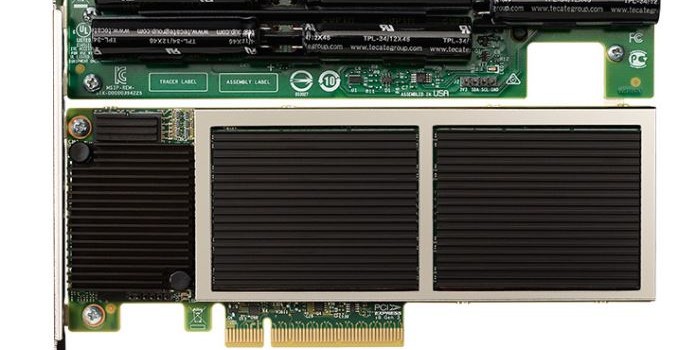
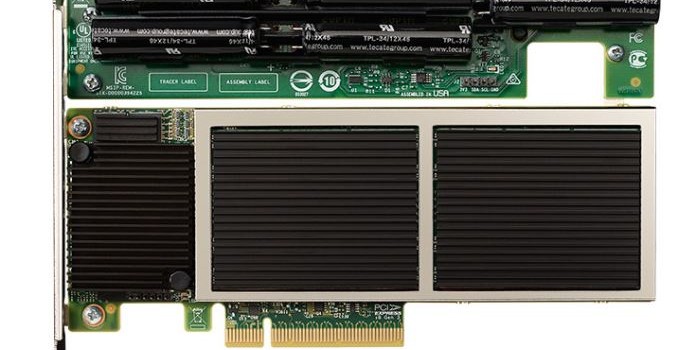
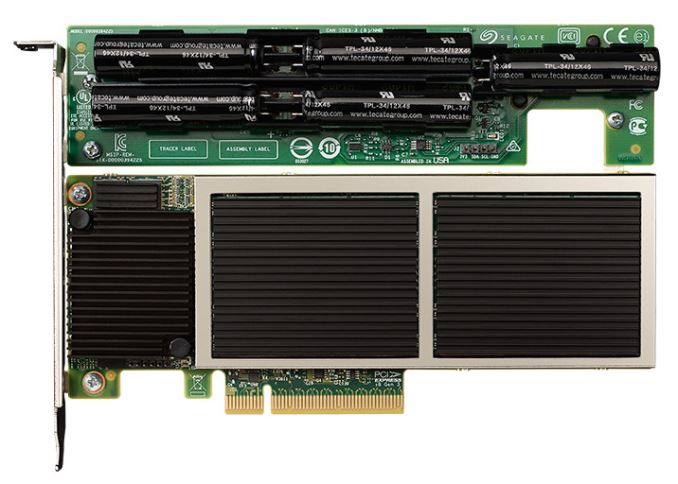
The new Nytro XP6500 succeeds the Nytro XP6302 and offers improved write latency and improved write endurance. Write throughput suffers slightly, but the XP6302’s original performance specifications were inflated by testing at 28% over-provisioning rather than the default of 17% that is implied by the listed capacities. Meanwhile the XP6500 4TB model is listed as optimized for 8kB rather than 4kB random accesses, so its IOPS numbers aren’t directly comparable to the others.

Seagate Nytro XP6000 Series
Drive XP6500 4TB XP6500 1.5TB XP6302
Usable capacity 3.4TB 1.3TB 1.3TB, 1.75TB, 3.5TB
Interface PCIe 3.0 x8
Sequential read 4 GB/s
Sequential write 2.2 GB/s 1.5 GB/s 2.3 GB/s
Random read IOPS 275K (8KB) 300K (4KB) 296K (4KB)
Random write IOPS 85K (8KB) 100K (4KB) 148K (4KB)
Write latency 14µs 33µs
Write endurance 20 PB 8 PB 6.6-11.7 PB
Required airflow 550 LFM 300 LFM

Peak power consumption isn’t listed but is likely significantly increased over the XP6302’s 39W, based on the increase in required airflow from 300LFM to 550LFM for the same operating temperature range. The Nytro XP6500 supports a supercapacitor bank to protect data in its large (2-4GB) DRAM cache. The XP6500 is available either as a full-height expansion card with built-in supercapacitors, or as a half-height card with an optional tethered supercapacitor module. Seagate has announced immediate availability of the Nytro XP6500.

Expanding the Nytro brand into new territory are the XF1440 and XM1440 NVMe drives, in 2.5″ U.2 (SFF-8639) and M.2 22110 form factors respectively. They’re split in to two tiers: “Endurance Optimized” (3 drive writes per day) and “Capacity Optimized” (0.3 DWPD).

Seagate Nytro XF1440
Drive Endurance Optimized Capacity Optimized
Usable capacity 400 GB, 800 GB, 1600 GB 480 GB, 960 GB, 1800 GB
Interface PCIe 3.0 x4 SFF-8639
Sequential read 2700 MB/s
Sequential write 600-1200 MB/s
Random read IOPS 200K
Random write IOPS 34K 3K–7K
Write endurance 3 DWPD 0.3 DWPD
Warranty 5 years
Peak power 12.5 W
Average read/write power 9 W

Performance specifications for the Nytro XM1440 weren’t available, and we aren’t assuming that they will be the same as for the Nytro XF1440. The XF is listed as using eMLC (Enterprise MLC) but the XM is using MLC+, a term often used to refer to higher-binned consumer-grade MLC. Maximum power consumption is significantly lower for the XM, and the XM will be released later (early 2016, when the XF1440 will ship at the end of October), which suggests that there may also be controller differences.

Seagate Nytro XM1440
Drive Endurance Optimized Capacity Optimized
Usable capacity 400 GB, 800 GB 480 GB, 960 GB
Interface M.2 PCIe 3.0 x4
Write endurance 3 DWPD 0.3 DWPD
Warranty 5 years
Peak power 8.25 W
Average read/write power 7 W
Seagate Introduces New Nytro PCIe SSDs: XP6500 & XF/XM1440

Seagate Introduces New Nytro PCIe SSDs: XP6500 & XF/XM1440

After acquiring SSD controller designer SandForce, LSI took the quick route towards creating high-performance PCIe SSDs by putting multiple SandForce controllers and an LSI RAID controller on a single expansion card, branding the resulting product as the Nytro. This Nytro product line was transferred to Seagate along with the SandForce division in May 2014, and it’s now getting both a refresh and a major expansion.

The new Nytro XP6500 succeeds the Nytro XP6302 and offers improved write latency and improved write endurance. Write throughput suffers slightly, but the XP6302’s original performance specifications were inflated by testing at 28% over-provisioning rather than the default of 17% that is implied by the listed capacities. Meanwhile the XP6500 4TB model is listed as optimized for 8kB rather than 4kB random accesses, so its IOPS numbers aren’t directly comparable to the others.

Seagate Nytro XP6000 Series
Drive XP6500 4TB XP6500 1.5TB XP6302
Usable capacity 3.4TB 1.3TB 1.3TB, 1.75TB, 3.5TB
Interface PCIe 3.0 x8
Sequential read 4 GB/s
Sequential write 2.2 GB/s 1.5 GB/s 2.3 GB/s
Random read IOPS 275K (8KB) 300K (4KB) 296K (4KB)
Random write IOPS 85K (8KB) 100K (4KB) 148K (4KB)
Write latency 14µs 33µs
Write endurance 20 PB 8 PB 6.6-11.7 PB
Required airflow 550 LFM 300 LFM

Peak power consumption isn’t listed but is likely significantly increased over the XP6302’s 39W, based on the increase in required airflow from 300LFM to 550LFM for the same operating temperature range. The Nytro XP6500 supports a supercapacitor bank to protect data in its large (2-4GB) DRAM cache. The XP6500 is available either as a full-height expansion card with built-in supercapacitors, or as a half-height card with an optional tethered supercapacitor module. Seagate has announced immediate availability of the Nytro XP6500.

Expanding the Nytro brand into new territory are the XF1440 and XM1440 NVMe drives, in 2.5″ U.2 (SFF-8639) and M.2 22110 form factors respectively. They’re split in to two tiers: “Endurance Optimized” (3 drive writes per day) and “Capacity Optimized” (0.3 DWPD).

Seagate Nytro XF1440
Drive Endurance Optimized Capacity Optimized
Usable capacity 400 GB, 800 GB, 1600 GB 480 GB, 960 GB, 1800 GB
Interface PCIe 3.0 x4 SFF-8639
Sequential read 2700 MB/s
Sequential write 600-1200 MB/s
Random read IOPS 200K
Random write IOPS 34K 3K–7K
Write endurance 3 DWPD 0.3 DWPD
Warranty 5 years
Peak power 12.5 W
Average read/write power 9 W

Performance specifications for the Nytro XM1440 weren’t available, and we aren’t assuming that they will be the same as for the Nytro XF1440. The XF is listed as using eMLC (Enterprise MLC) but the XM is using MLC+, a term often used to refer to higher-binned consumer-grade MLC. Maximum power consumption is significantly lower for the XM, and the XM will be released later (early 2016, when the XF1440 will ship at the end of October), which suggests that there may also be controller differences.

Seagate Nytro XM1440
Drive Endurance Optimized Capacity Optimized
Usable capacity 400 GB, 800 GB 480 GB, 960 GB
Interface M.2 PCIe 3.0 x4
Write endurance 3 DWPD 0.3 DWPD
Warranty 5 years
Peak power 8.25 W
Average read/write power 7 W