News


Seagate Backup Plus Portable 4TB USB 3.0 Drive Review

The rise in popularity of USB 3.0 has enabled a large number of high-speed bus-powered storage devices. While flash drives and external SSDs can take advantage of the high-speed nature of the interface, bus-powered external hard drives (2.5″) still remain the only way for consumers to have an economical high capacity option. Seagate recently launched the Backup Plus Portable 4TB USB 3.0 drive based on one of the first 4TB 2.5″ drives in the market. Read on for our review.

Acer Announces Ultra Low Cost Cloudbooks With Windows 10 Home

Acer Announces Ultra Low Cost Cloudbooks With Windows 10 Home

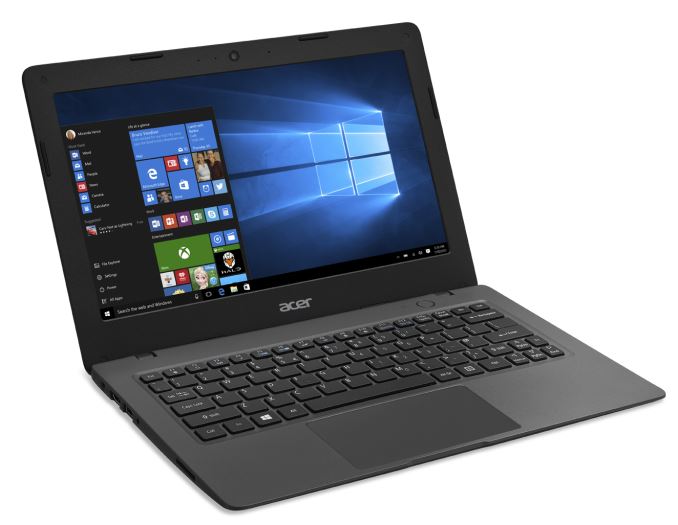
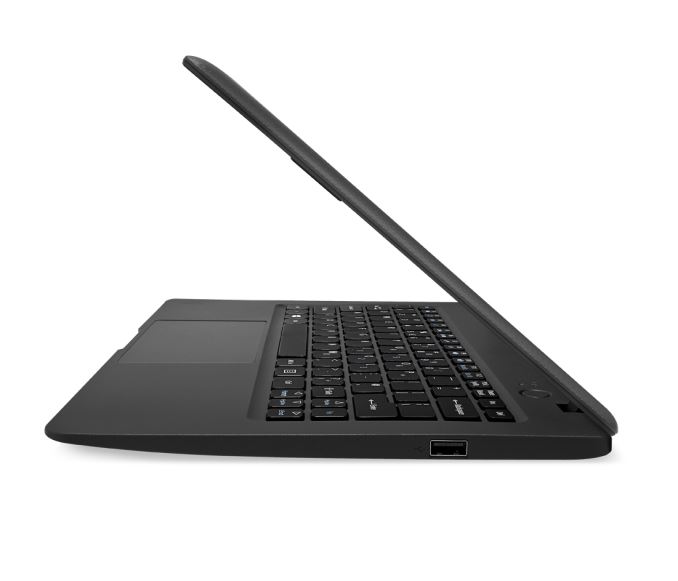
Today Acer is launching a new line of low cost notebooks, which are branded as Acer Aspire One Cloudbooks. There will be an 11.6-inch model, and a 14-inch model, and Acer manages to get both models under $200. We have seen some surprisingly decent notebooks around this price range, such as the HP Stream 11, but Acer has managed to move the barrier to entry even farther down.

The 11.6-inch model starts at only $170, with a bump in storage boosting the price to $190, or for $199.99 you can step up to the 14-inch model. For this price you get a 1366×768 resolution display, which is likely going to be a TN panel. The fanless design is powered by the 14nm Intel Celeron N3050 processor, which is a dual-core model with a base frequency of 1.6 GHz and turbo frequency of 2.16 GHz. This is going to be Airmont cores, similar to the previous N series Celerons with Silvermont. Performance expectations should be in check, but with a 6 watt TDP it should be able to maintain its peak frequency fairly well. As a comparison, the Surface 3 has four Airmont cores at up to 2.4 GHz, but with just a 2 watt scenario design power. Graphics will also get a boost over the older Celerons, with the Airmont cores now paired with Gen 8 graphics and 12 execution units rather than just 4 Gen 7 units available on the older chips.

One of the ways Acer was able to hit these price points was due to the storage available. The 11.6-inch model starts with just 16 GB of storage, and even with the Windows 10 storage features which can save even more space than Windows 8.1’s WIMBoot, 16 GB is not a lot for a Windows install. For those interested in this device, the $20 boost to 32 GB would be a wise investment. The 14-inch model starts with 32 GB and will also offer a 64 GB model later on. There is a SD card slot, but Windows 10 has not yet implemented the same features as Windows Phone has for SD card use, so no Windows Store apps can be installed to it yet, although that is coming later.

Acer Aspire One Cloudbook
  Cloudbook 11 Cloudbook 14
CPU Intel Celeron N3050
Dual-core Airmont 1.6-2.16GHz
Intel HD Graphics 12 EUs 320-600MHz
Memory 2GB DDR3L
Storage 16-32 GB eMMC 32-64 GB eMMC
Display 11.6″ 1366×768 14.0″ 1366×768
Ports USB 3.0 x 1
USB 2.0 x 1
HDMI
SD Card Slot
Headphone
Networking 802.11ac WiFi
Bluetooth 4.0
Dimensions H: 0.70″ (17.8 mm)
W: 11.5″ (292.1 mm)
D: 7.95″ (201.93 mm)
H: 0.70″ (17.8 mm)
W: 13.36″ (339.3 mm)
D: 9.25″ (235.0 mm)
Weight 2.54 lbs (1.15 kg) 3.5 lbs (1.59 kg)
Battery Life Up to 7 hours Up to 6 hours
Price $169.99-$189.99 $199.99+

Both models will feature 802.11ac wireless, which is nice to see since that seems to be one of the first cuts on a budget notebook. Acer is positioning these devices as Cloudbooks, and they include one year of Office 365 Personal and the included 1 TB of OneDrive storage, and Acer is also promoting their cloud based abApps to help in keeping files in sync with smartphones and tablets.

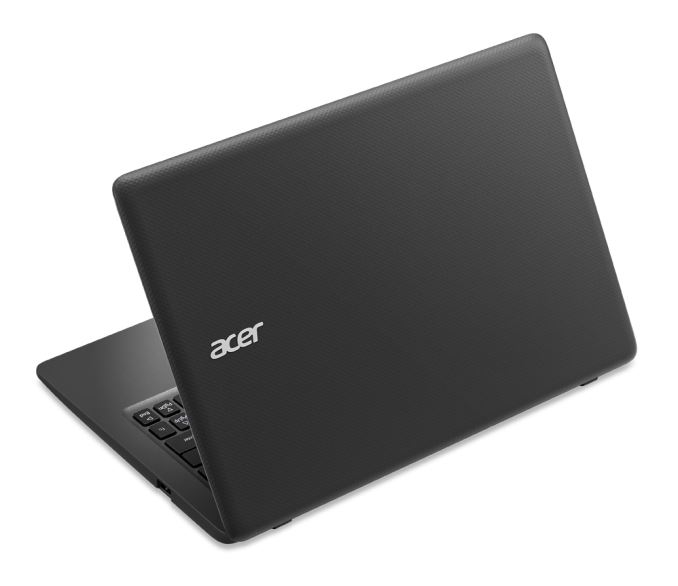
While inexpensive, Acer has done well with the design. Both models are just 0.7-inches thick, and the smaller device comes in at just 2.54 lbs, and the larger 14-inch model tips the scales at 3.5 lbs. The textured pattern is finished in a mineral grey which looks quite sharp.

The Acer Cloudbooks will be available starting this month for the 11.6-inch model, with the 14-inch version coming in September.

Source: Acer


Strontium Nitro Plus Nano USB 3.0 64GB Flash Drive Capsule Review

Strontium Nitro Plus Nano USB 3.0 64GB Flash Drive Capsule Review

Flash drives are a dime a dozen these days, and most of them carry uninteresting specifications. In particular, flash drives advertising smaller physical footprints have tended to carry disappointing performance numbers. We were surprised when Strontium sent us their announcement of the Nitro Plus Nano USB 3.0 flash drive with 100 MBps+ read speeds. We had reviewed the Mushkin Atom 64GB flash drive with a similar form factor, and the numbers claimed by Strontium were quite a bit more than what we managed to get with the Mushkin Atom. Intrigued by Strontium’s performance claims, we got a sample in for further evaluation.

High-performance flash drives have traditionally employed a SATA SSD controller behind a USB 3.0 – SATA bridge. However, this increases the drive cost in what is essentially a price-sensitive market. Vendors have recently begun to introduce native high-performance USB 3.0 flash controllers, and the Strontium Nitro Plus Nano sports one such controller. The list of flash drives used for comparison purposes is provided below:

  • SanDisk Extreme 64GB
  • Mushkin Atom 64GB
  • Strontium Nitro Plus Nano 64GB

Hardware Design and Internals

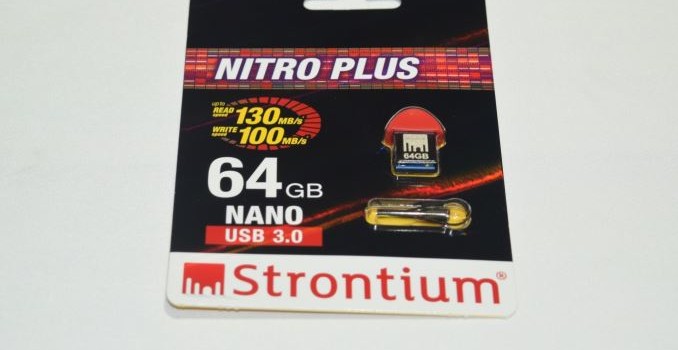
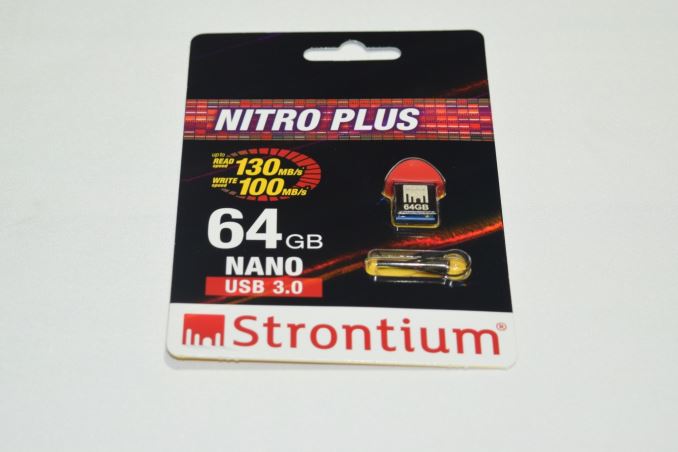
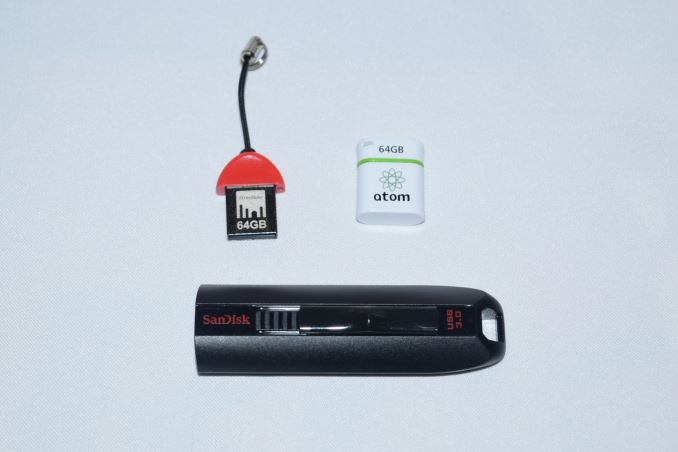
In terms of external design and features, the Strontium Nitro Plus Nano USB 3.0 drive is small and discreet. A red cap that protrudes 8mm from the USB slot and has a total width of only 16mm ensures that the unit can fit in easily even in the ill-placed / oriented USB ports. A small hole at the top accommodates the bundled thread that enables hanging the flash drive off a keychain. As we can see from the photograph below, the Strontium Nitro Plus Nano USB 3.0 is one of the smallest flash drives that we have evaluated in its capacity class.
Without opening up the unit, it is possible to identify the controller and flash inside the unit.
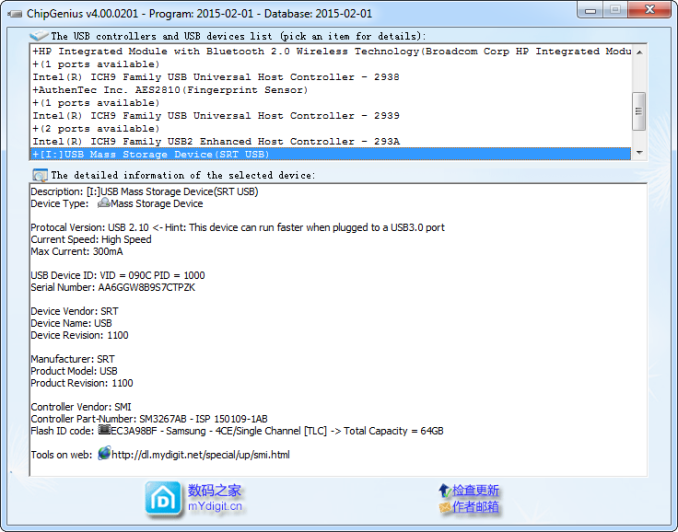
The controller is the Silicon Motion SM3267 single-channel USB 3.0 controller. This appears to be an ideal controller for low-cost flash drives with a small physical footprint because it reduces BOM (bill-of-materials) cost as well as PCB area by integrating the required power IC and crystal oscillator. Depending on the flash memory used, Silicon Motion claims performance of up to 160 MBps reads. Strontium has gone in for Samsung TLC NAND in the flash drive. This must be compared to the Phison PS2251-07 used along with Toshiba TLC NAND in the Mushkin Atom 64GB drive.

Testbed Setup and Testing Methodology

Evaluation of DAS units on Windows is done with the testbed outlined in the table below. For devices with USB 3.0 connections (such as the Strontium Nitro Plus Nano that we are considering today), we utilize the USB 3.0 port directly hanging off the PCH.

AnandTech DAS Testbed Configuration
Motherboard Asus Z97-PRO Wi-Fi ac ATX
CPU Intel Core i7-4790
Memory Corsair Vengeance Pro CMY32GX3M4A2133C11
32 GB (4x 8GB)
DDR3-2133 @ 11-11-11-27
OS Drive Seagate 600 Pro 400 GB
Optical Drive Asus BW-16D1HT 16x Blu-ray Write (w/ M-Disc Support)
Add-on Card Asus Thunderbolt EX II
Chassis Corsair Air 540
PSU Corsair AX760i 760 W
OS Windows 8.1 Pro
Thanks to Asus and Corsair for the build components

The full details of the reasoning behind choosing the above build components can be found here.

Synthetic Benchmarks – ATTO and Crystal DiskMark

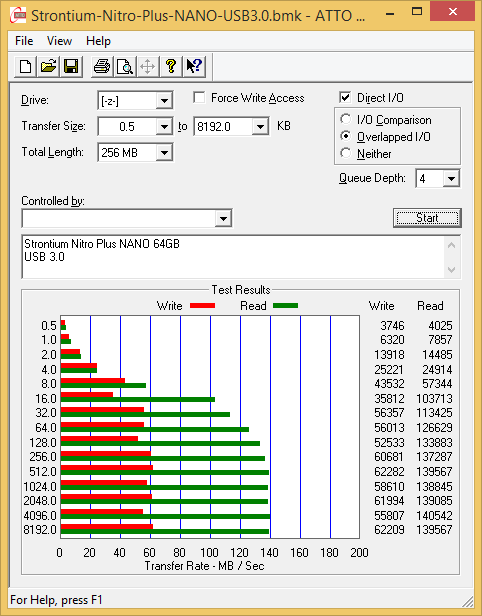
Strontium claims read and write speeds of 130 MBps and 100 MBps respectively, and the read number is backed up by the ATTO benchmarks provided below. Writes only seem to go up to 60 MBps with our standard testing queue depth. Unfortunately, these access traces are not very common in real-life scenarios.

Strontium Nitro Plus Nano 64GBMushkin Atom 64GBSanDisk Extreme 64GB
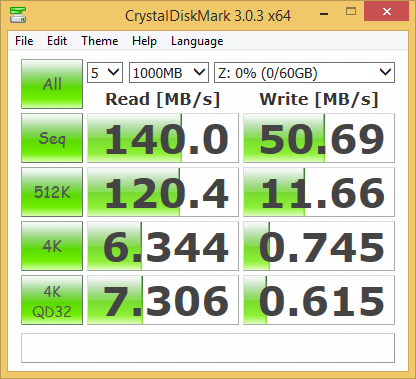
CrystalDiskMark, despite being a canned benchmark, provides a better estimate of the performance range with a selected set of numbers. As evident from the screenshot below, the performance can dip to as low as 0.615 MBps for random 4K writes.

Strontium Nitro Plus Nano 64GBMushkin Atom 64GBSanDisk Extreme 64GB
Benchmarks – robocopy and PCMark 8 Storage Bench

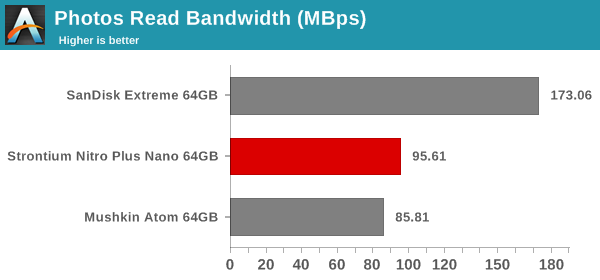
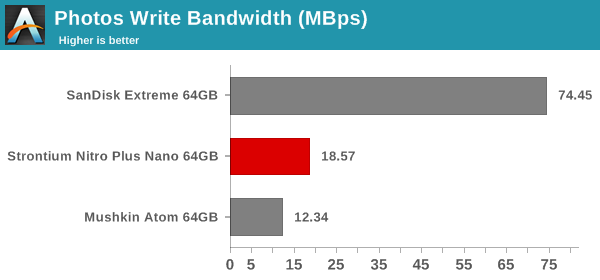
Our testing methodology for DAS units also takes into consideration the usual use-case for such devices. The most common usage scenario is transfer of large amounts of photos and videos to and from the unit. The minor usage scenario is importing files directly off the DAS into a multimedia editing program such as Adobe Photoshop.

In order to tackle the first use-case, we created three test folders with the following characteristics:

  • Photos: 15.6 GB collection of 4320 photos (RAW as well as JPEGs) in 61 sub-folders
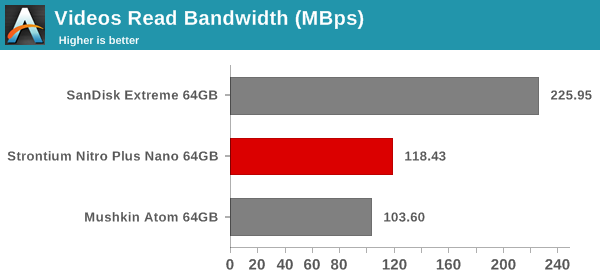
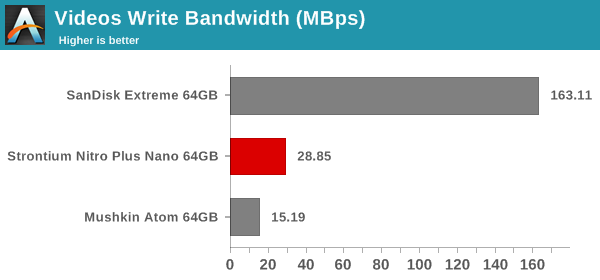
  • Videos: 16.1 GB collection of 244 videos (MP4 as well as MOVs) in 6 sub-folders
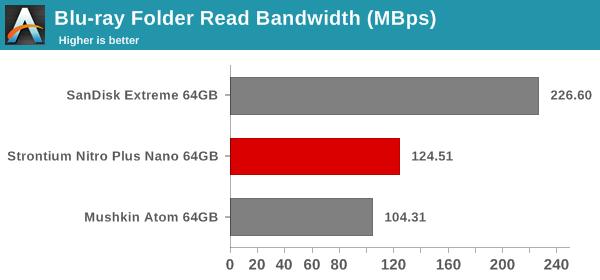
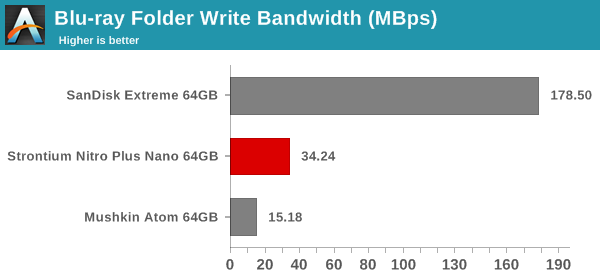
  • BR: 10.7 GB Blu-ray folder structure of the IDT Benchmark Blu-ray (the same that we use in our robocopy tests for NAS systems)
robocopy - Photos Read

robocopy - Photos Write

robocopy - Videos Read

robocopy - Videos Write

robocopy - Blu-ray Folder Read

robocopy - Blu-ray Folder Write

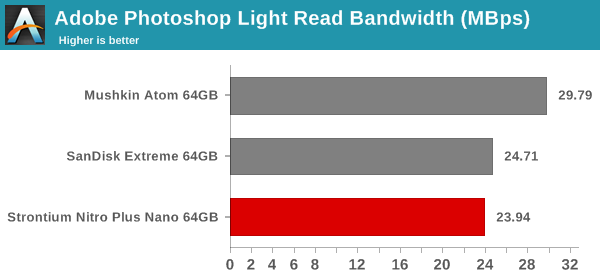
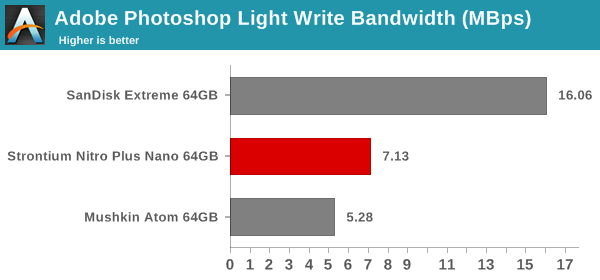
For the second use-case, we take advantage of PC Mark 8’s storage bench. The storage workload involves games as well as multimedia editing applications. The command line version allows us to cherry-pick storage traces to run on a target drive. We chose the following traces.

  • Adobe Photoshop (Light)
  • Adobe Photoshop (Heavy)
  • Adobe After Effects
  • Adobe Illustrator

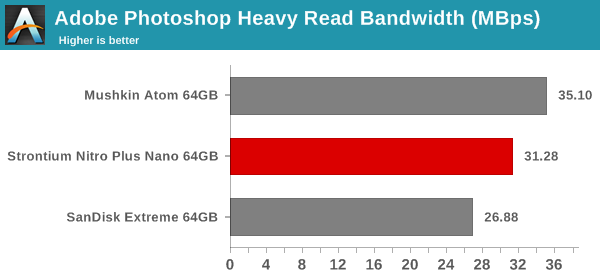
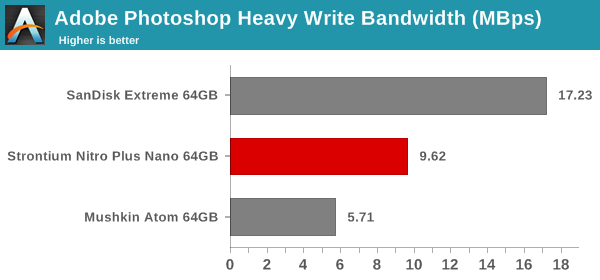
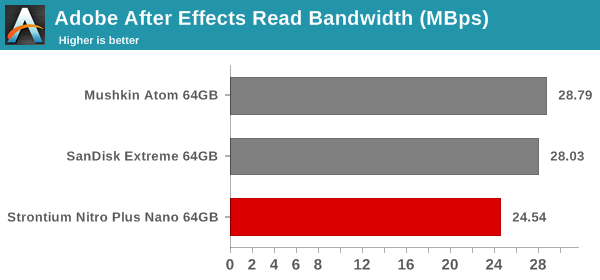
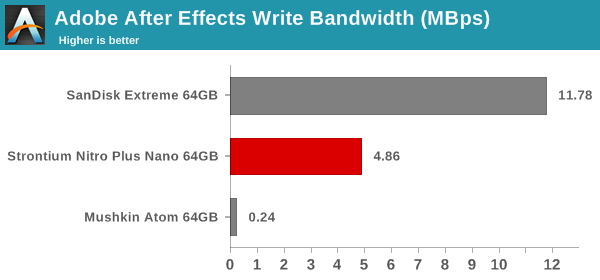
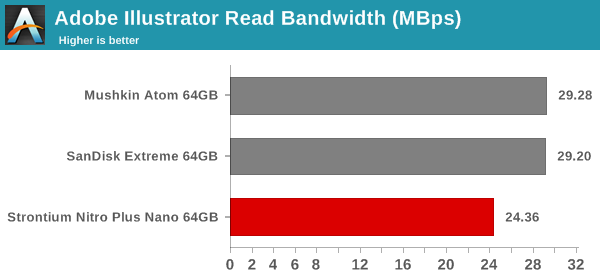
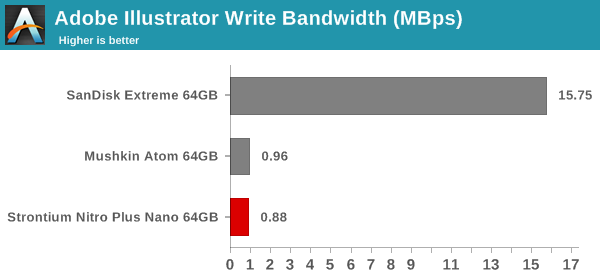
Usually, PC Mark 8 reports time to complete the trace, but the detailed log report has the read and write bandwidth figures which we present in our performance graphs. Note that the bandwidth number reported in the results don’t involve idle time compression. Results might appear low, but that is part of the workload characteristic. Note that the same testbed is being used for all DAS units. Therefore, comparing the numbers for each trace should be possible across different DAS units. In any case, the PCMark 8 storage workloads are hardly the type of traces that would ever run on drives such as the Nitro Plus Nano.

In general, these results show that the Stronitum drive performs better than the Mushkin one in most relevant benchmarks. The Mushkin is the only one that can be used for apples-to-apples comparison, since the SanDisk drive employs a SATA controller behind a USB 3.0 – SATA bridge, and has a much bigger physical footprint.
robocopy - Photoshop Light Read

robocopy - Photoshop Light Write

robocopy - Photoshop Heavy Read

robocopy - Photoshop Heavy Write

robocopy - After Effects Read

robocopy - After Effects Write

robocopy - Illustrator Read

robocopy - Illustrator Write

Performance Consistency

Yet another interesting aspect of these types of units is performance consistency. Aspects that may influence this include thermal throttling and firmware caps on access rates to avoid overheating or other similar scenarios. This aspect is an important one, as the last thing that users want to see when copying over, say, 50 GB of data from the flash drive, is the transfer rate going to USB 2.0 speeds. In order to identify whether the drive under test suffers from this problem, we instrumented our robocopy DAS benchmark suite to record the flash drive’s read and write transfer rates while the robocopy process took place in the background. For supported drives, we also recorded the internal temperature of the drive during the process. The Strontium unit, however, doesn’t expose the temperature over the USB interface. The graphs below show the speeds observed during our real-world DAS suite processing. The first three sets of writes and reads correspond to the photos suite. A small gap (for the transfer of the videos suite from the primary drive to the RAM drive) is followed by three sets for the next data set. Another small RAM-drive transfer gap is followed by three sets for the Blu-ray folder.

An important point to note here is that each of the first three blue and green areas correspond to 15.6 GB of writes and reads respectively. Throttling, if any, is apparent within the processing of the photos suite itself.

Strontium Nitro Plus Nano 64GBMushkin Atom 64GBSanDisk Extreme 64GB
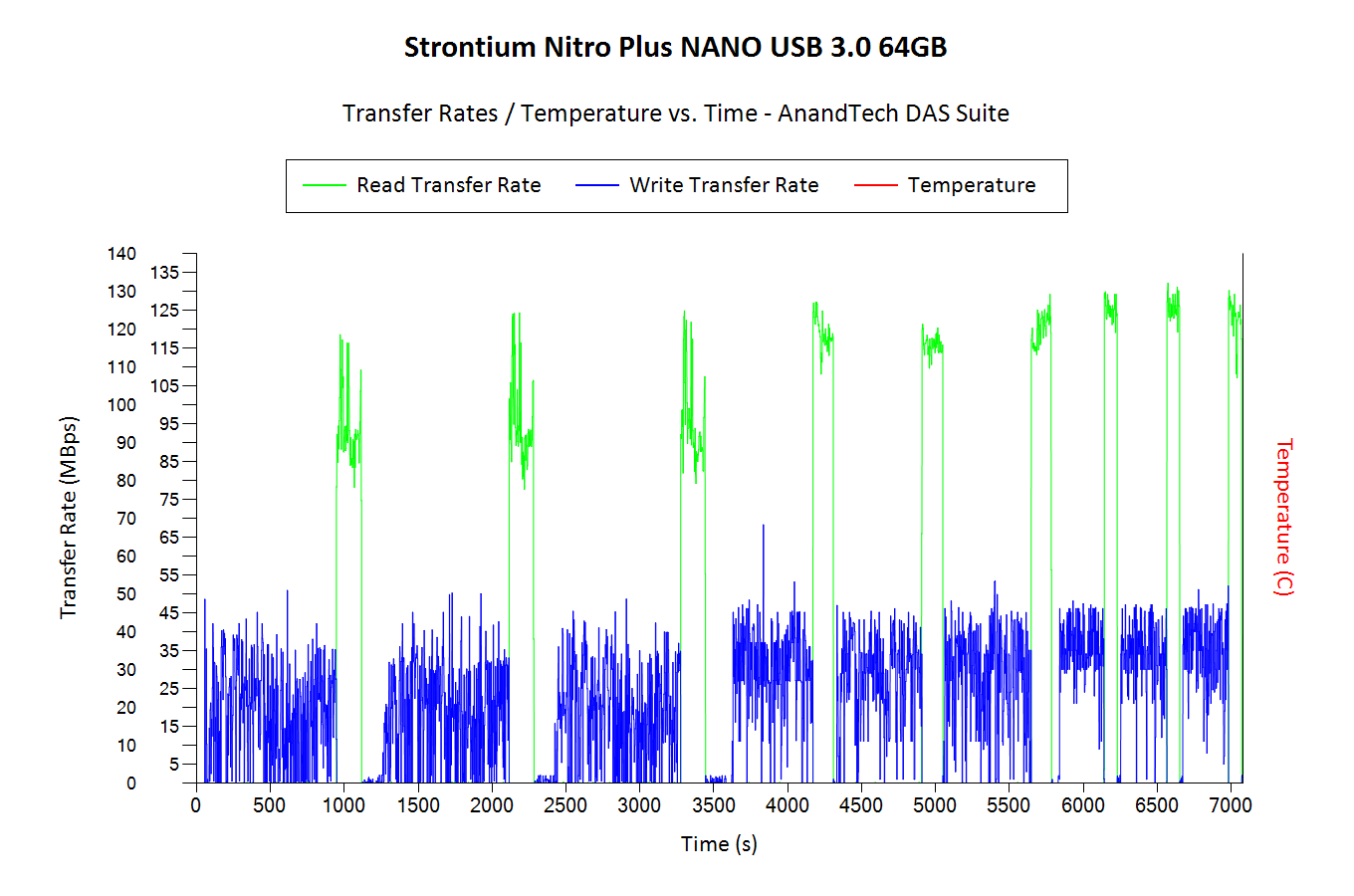
Despite the small size, the Strontium unit has not problems with sustaining the expected transfer rates and there seems to be no thermal throttling at play. The write rates are quite disappointing for small-sized files, but, that is to be expected given the nature of the device.

Concluding Remarks

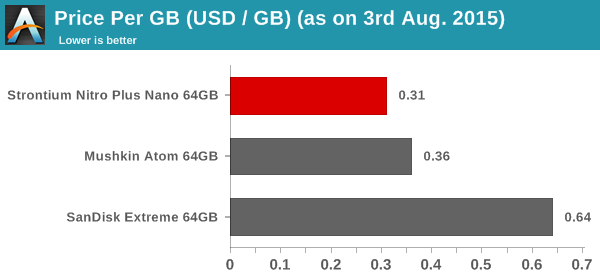
The performance of the drive is impressive when one considers the size of the unit. Obviously, the numbers are not going to be similar to what a real SSD controller with multiple flash chips can give us. This brings us to the most important aspect in this particular market niche – the pricing. As per the press release, the Strontium Nitro Plus Nano USB 3.0 64GB drive is expected to cost $20.
Price per GB

The Strontium unit manages to beat the Mushkin Atom in both pricing and performance numbers for real-life workloads. In addition, Windows reports an usable capacity of 60.44 GB with the Strontium unit, while the Mushkin one comes in at 57.70 GB only. When it comes to packing a punch in the smallest possible form factor for a USB 3.0 flash drive, the Strontium Nitro Plus Nano USB 3.0 is the king of the hill right now. Pretty much the only complaint that could be made against the unit is the absence of a protective covering for the USB connector.

Lattice Announces First superMHL Chips: Sil8630 & Sil9396

Lattice Announces First superMHL Chips: Sil8630 & Sil9396

Earlier this year at CES, the MHL Consortium announced the latest version of the Mobile High-Definition Link (MHL) standard, superMHL. The latest iteration on MHL, superMHL was introduced to further ramp up the amount of bandwidth available to MHL devices along with also integrating some of the latest display technologies. At the time of superMHL’s announcement the focus was on the high-end of the market – driving 8K TVs through the use of the 6 lane superMHL cable – however superMHL was designed to benefit the lower bandwidth segment of the market as well, and this is where Lattice Semiconductor is starting today, with the announcement of the first superMHL chips.

Being announced today by Lattice (née Silicon Image) are the first transmitter and the first receiver to support superMHL, the Sil9396 and Sil8630 respectively. These two chips are small, one-lane chips intended to allow superMHL usage with mobile and PC devices in order to drive displays at up to 4Kp60, and will be the first use for superMHL.


As previously announced alongside superMHL itself earlier this year, superMHL is available as a USB Type-C alt mode, and this is where Lattice is focusing their efforts for today’s mobile-centric products. With Type-C expected to quickly take over the market on both mobile devices and laptop PCs, it’s quickly become the port of choice for virtually every other standard that wants to move high speed data, and superMHL is no exception. What results is an impressive (and dizzying) array of connectivity options, as superMHL can interface with a number of different display types.

That said, the two mobile superMHL combinations that are most likely to actually be seen in the wild are Type-C to HDMI active and Type-C to MHL (i.e. HDMI passive). The difference between the two is that as with previous generations of MHL technology, superMHL can be carried into a TV that supports the protocol over an HDMI port, allowing the use of a straight-through passive cable. Otherwise superMHL can be actively converted via a chip such as the Sil9396 in an HDMI cable, allowing a superMHL device to interface with an HDMI-only display. In both cases superMHL offers the equivalent of HDMI 2.0, including HDCP 2.2 support and the annexes for improved color spaces and HDR.

What Lattice and the MHL Consortium is hoping to do right now in what is a crowded market for display connectivity standards is to have superMHL stand apart from the other standards by the combination of legacy MHL support, USB Type-C support, and the fact that it can work over a single high-speed lane. Legacy MHL support in this context is rather straightforward, as it means superMHL devices can directly transmit to existing MHL receivers by downgrading the protocol, retaining MHL’s power changing abilities in the process. Otherwise HDMI of course can’t be natively passed over Type-C, and DisplayPort requires multiple lanes for 4Kp60 – 4 for DP 1.2, and 2 for DP 1.3 if a display supports the reduced blanking timings. This leaves further lanes open for USB 3.x Superspeed data, meaning that superMHL can drive a 4Kp60 display and carry a full USB Superspeed data connection at the same time. Though as Superspeed requires 2 lanes per connection, we’re not aware of any scenario for USB where a third lane is any better than having just two lanes, though superMHL would still leave the last lane open for something else.

USB Type-C Alt Mode Display Standard Comparison
  superMHL DisplayPort 1.3
Resoluion 4Kp60, 4:4:4 @ 24bit 4Kp60, 4:4:4 @ 24bit
Type-C Lanes Required 1 2
Image Compression “Visually Lossless” (Lossy) No Compression
TV Interface superMHL-over-HDMI (Passive)
HDMI (Active Conversion)
Power Charging USB-PD or MHL (legacy) USB-PD

Meanwhile, along with today’s announcement of the first transmitter/receiver pair, we’ve also learned a few more technical details about the superMHL protocol. superMHL operates at 6Gbps per lane, using what Lattice calls “visually lossless” (i.e. mathematically lossy) compression in order to pack 4Kp60 into that limited amount of bandwidth. So for 4Kp60 we’re looking at around 3:1 compression on the image side. DisplayPort 1.3 by contrast takes up an additional lane to deliver 4k60, but it doesn’t require image compression. Alternatively compression is in the works via Display Stream Compression, but the DisplayPort 1.3 standard has not yet been updated to include it.

Finally, along with announcing their first superMHL transmitters/receivers today, Lattice is also announcing that engineering samples for the Sil8630 and Sil9396 are now available. It will still be some time before these chips will appear in retail products, but it means that OEMs can now being testing them and building designs that ingrate these chips.