News


ECS To Remain in Motherboard Market: Dispels Rumor

ECS To Remain in Motherboard Market: Dispels Rumor

As active members of the PC components industry, we tend to try to keep our ear to the ground relating to how the different companies are approaching their product lines especially in terms of acquisitions, applications, marketing and projections. Most of what we hear is either not news or not entirely relevant for publication but helps us attempt to form a more complete picture when we do publish. One of the reasons we do this is to do with confirming sources, and making sure we publish as accurately as possible. So when a rumor started in the sphere regarding ECS’ motherboard business being moved away from the commercial side of the equation (from Digitimes and others), remaining in only OEM/ODM applications, I naturally went straight to the heart of the matter and contacted ECS for clarification. The following is a letter from Sunny Yang, ECS’ President.

Dear Our Distinguished Customers,

We feel regret to learn the untrue report from DIGITIMES pertaining to “ECS to quit own-brand DIY motherboard business, say Taiwan makers” on Jun. 24, 2015. We like to formally clarify that ECS would never give up any opportunity to work on own-brand DIY motherboard as what we always commit to our valuable customers.

We all learn the knee competition in motherboard industry. To receive the challenge, ECS has made all the efforts to manage our own brand motherboard and create more service and value to our channel customers for years. We would continue to put more resources to provide cutting edge products and marketing events as what we just announced at Taipei Computex in early June and, therefore, enhance our brand value and your confidence level.

ECS has been cooperating with you for many years, we treasure this relationship. We will also do our best to serve your needs through our global structures. We believe, through our close cooperation, a mutually beneficial result can be achieved in a long-term relationship.

Sincerely Yours.
Sunny Yang
President, Elitegroup Computer Systems Co., Ltd.

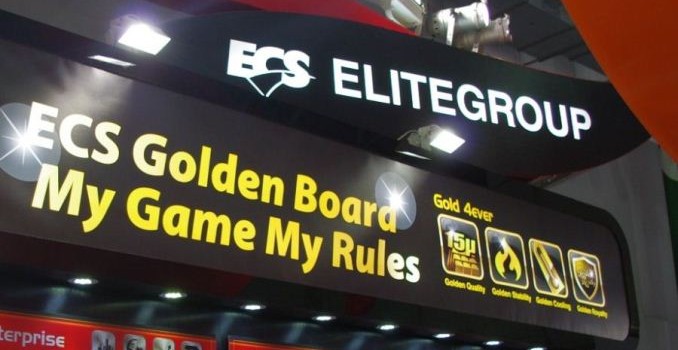
That essentially confirms that ECS will be staying in the consumer motherboard business. Personally I felt the news was a little off to begin with – at Computex ECS were showing their own brand 100-series motherboards, and even developing them with Realtek’s new Dragon network chip which is designed to go in direct competition with Killer. While it’s not unheard of for big companies to pull product lines at the last second, we meet with ECS every year and the ECS Computex booth is naturally very large and they often put on a large show for it. It’s important to consider how much money and marketing has been pumped into ECS’ L33T gaming brand in recent years along with their eSports sponsorship.

ECS as a brand does have a presence in the United States, and we’ve reviewed some interesting samples such as the Lucid Hydra equipped P67H2-A back in 2011 and the only overclockable AMD E350 mini-ITX board on the market, the ECS HDC-I. To this end, the latest figures we have estimated for ECS own-brand motherboard sales are around 3-4 million, which accounts for around 5% of the ~78 million motherboards a year market, but in 2009 reports have suggested they sold 17 million both as a brand and as an OEM/ODM which gives you a sense of scale as to how big ECS actually is. ECS’ main revenue generator is the OEM/ODM side, particularly in manufacturing many mini-PCs for other well-known brands, but their own brand still has value particularly in Asian regions and as the letter above shows, they are still keen on putting it into action.
ECS To Remain in Motherboard Market: Dispels Rumor

ECS To Remain in Motherboard Market: Dispels Rumor

As active members of the PC components industry, we tend to try to keep our ear to the ground relating to how the different companies are approaching their product lines especially in terms of acquisitions, applications, marketing and projections. Most of what we hear is either not news or not entirely relevant for publication but helps us attempt to form a more complete picture when we do publish. One of the reasons we do this is to do with confirming sources, and making sure we publish as accurately as possible. So when a rumor started in the sphere regarding ECS’ motherboard business being moved away from the commercial side of the equation (from Digitimes and others), remaining in only OEM/ODM applications, I naturally went straight to the heart of the matter and contacted ECS for clarification. The following is a letter from Sunny Yang, ECS’ President.

Dear Our Distinguished Customers,

We feel regret to learn the untrue report from DIGITIMES pertaining to “ECS to quit own-brand DIY motherboard business, say Taiwan makers” on Jun. 24, 2015. We like to formally clarify that ECS would never give up any opportunity to work on own-brand DIY motherboard as what we always commit to our valuable customers.

We all learn the knee competition in motherboard industry. To receive the challenge, ECS has made all the efforts to manage our own brand motherboard and create more service and value to our channel customers for years. We would continue to put more resources to provide cutting edge products and marketing events as what we just announced at Taipei Computex in early June and, therefore, enhance our brand value and your confidence level.

ECS has been cooperating with you for many years, we treasure this relationship. We will also do our best to serve your needs through our global structures. We believe, through our close cooperation, a mutually beneficial result can be achieved in a long-term relationship.

Sincerely Yours.
Sunny Yang
President, Elitegroup Computer Systems Co., Ltd.

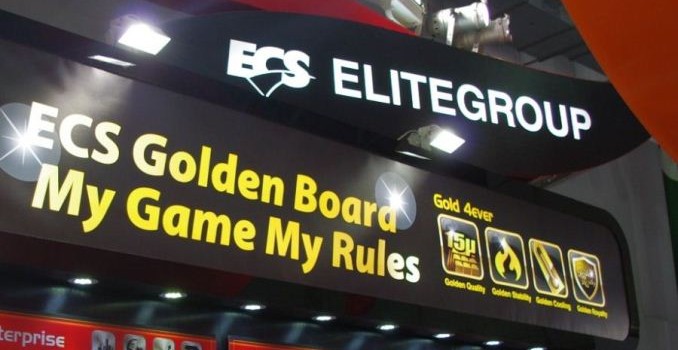
That essentially confirms that ECS will be staying in the consumer motherboard business. Personally I felt the news was a little off to begin with – at Computex ECS were showing their own brand 100-series motherboards, and even developing them with Realtek’s new Dragon network chip which is designed to go in direct competition with Killer. While it’s not unheard of for big companies to pull product lines at the last second, we meet with ECS every year and the ECS Computex booth is naturally very large and they often put on a large show for it. It’s important to consider how much money and marketing has been pumped into ECS’ L33T gaming brand in recent years along with their eSports sponsorship.

ECS as a brand does have a presence in the United States, and we’ve reviewed some interesting samples such as the Lucid Hydra equipped P67H2-A back in 2011 and the only overclockable AMD E350 mini-ITX board on the market, the ECS HDC-I. To this end, the latest figures we have estimated for ECS own-brand motherboard sales are around 3-4 million, which accounts for around 5% of the ~78 million motherboards a year market, but in 2009 reports have suggested they sold 17 million both as a brand and as an OEM/ODM which gives you a sense of scale as to how big ECS actually is. ECS’ main revenue generator is the OEM/ODM side, particularly in manufacturing many mini-PCs for other well-known brands, but their own brand still has value particularly in Asian regions and as the letter above shows, they are still keen on putting it into action.
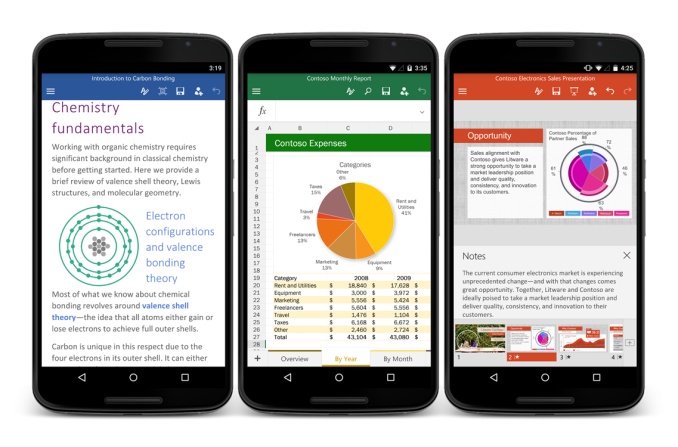
Microsoft Brings Office to Android Smartphones

Microsoft Brings Office to Android Smartphones

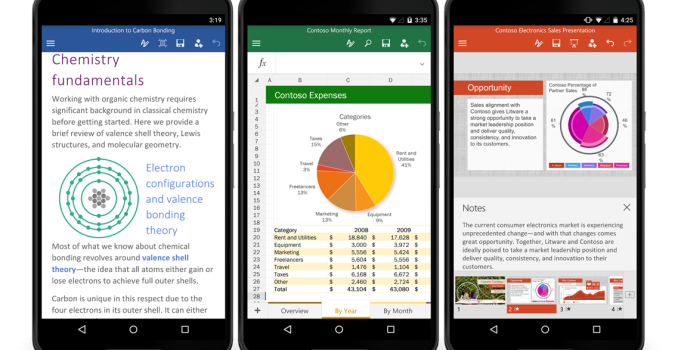
Today Microsoft announced that their line of Office applications has made its way to Android smartphones. After launching the first touch-optimized version of Office on the iPad, Microsoft has gradually been building out support for Android. It began with Office for Android first launching as a preview for ARM based tablets running KitKat, with the final release working on Lollipop. Shortly after, Microsoft began supporting Android tablets that use Intel processors, like the Dell Venue 8. Throughout all this, support for Android phones was still absent. With some Android devices having screens that are 6″ or even larger, creating a version of Office for them actually made a lot of sense.

With today’s release, Microsoft now supports essentially every Android device. Whether your screen is big or small, and your processor ARM or Intel, you’ll be able to use Office on your Android device. Microsoft’s partnerships with phone manufacturers mean that these apps will also come preloaded on many future smartphones and tablets.

Microsoft Brings Office to Android Smartphones

Microsoft Brings Office to Android Smartphones

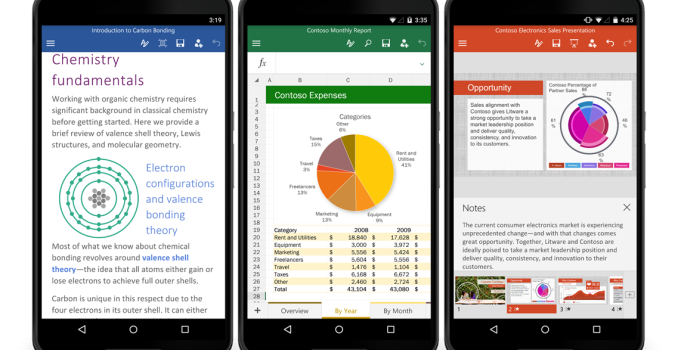
Today Microsoft announced that their line of Office applications has made its way to Android smartphones. After launching the first touch-optimized version of Office on the iPad, Microsoft has gradually been building out support for Android. It began with Office for Android first launching as a preview for ARM based tablets running KitKat, with the final release working on Lollipop. Shortly after, Microsoft began supporting Android tablets that use Intel processors, like the Dell Venue 8. Throughout all this, support for Android phones was still absent. With some Android devices having screens that are 6″ or even larger, creating a version of Office for them actually made a lot of sense.

With today’s release, Microsoft now supports essentially every Android device. Whether your screen is big or small, and your processor ARM or Intel, you’ll be able to use Office on your Android device. Microsoft’s partnerships with phone manufacturers mean that these apps will also come preloaded on many future smartphones and tablets.

Marvell Announces New Kinoma IoT Prototyping Platforms

Marvell Announces New Kinoma IoT Prototyping Platforms

Today Marvell announces two new internet-of-things (IoT) hardware prototyping platforms as part of their Kinoma “JavaScript-powered Internet of Things construction kit” lineup. The Kinoma Element and Kinoma HD provide alternatives to the Kinoma Create that was released last year.

The Element comes in a standalone square form-factor which I estimate should be about 7x7x1 cm. Marvell was unfortunately not able to share the exact dimensions of the piece but it looks compact enough given that it comes in a closed form-factor. The device is powered by microUSB port and has two expansion ports on opposite sides with 8 pins each that can be used for digital GPIO or analog ports and can be re-routed and re-configured by software.

The piece is powered by Marvell’s MW302 WiFi-SoC microcontroller uses an ARM Cortex M4F (A variant of the M4 with an added FPU) at 200MHz and has 512KB of SRAM memory which serves as the platform’s main memory. In terms of connectivity the device is capable of 802.11b/g/n but only in the 2.4GHz band and supports transfer rates of up to 72Mbit/s although those rates will in practice be probably be limited by the CPU’s performance.

The device is able to make due with so little memory by employing execute-in-place (XIP) which is a method of executing code directly on it’s flash storage instead of copying it to separate dedicated memory. The Element is able to run JavaScript byte-code as Marvell has implemented XIP in their new XS6 JavaScript engine.

  
Kinoma Element and Kinoma HD

The Kinoma HD is a beefier platform in the form of a HDMI dongle. The specifications are a tad higher as it is able to take advantage of a more powerful Marvell 88DE 3006 SoC running two ARM Cortex cores at 1.2GHz. We’re still not sure what CPU we’re talking about here but given it’s part of the Armada 1500 family of SoCs we’re likely looking at a Cortex A9 design.

As opposed to the Element which runs FreeRTOS, the HD runs a more conventional OS as it comes with a Linux distribution. It has 256MB of RAM and connectivity is provided by 802.11g/n/ac WiFi. The HDMI output is capable of 1080p and 720p resolutions.

Part of today’s announcement was also the release of Kinoma’s new JavaScript engine, the first independent implementation of JavaScript 6th edition scripting language. In conformance suites the XS6 engine is able to achieve 96% completeness for JavaScript 6th edition far ahead of any other JS engine. On the Kinoma platform JS6 among many language improvements also is able to provide up to 4x speed improvements for application start-up and now offers efficient binding to native C code and connect to OS and hardware features, which is something that is crucial for the KinomaJS development framework.

In the words of Peter Hoddie, VP at Marvell and former CEO of Kinoma before its 2011 acquisition:

“The software tools used to develop embedded hardware products typically lag leading edge software development by many years. IoT developers want the benefits of the latest language improvements, but the memory and CPU performance requirements put it out of the reach of mass-market hardware. With the XS6 engine in KinomaJS, we are bringing the latest advances in JavaScript to embedded developers before they arrive on the web,” 

The Kinoma products thus represent a very low entry-barrier for IoT development and low time and resource investment to get a working prototype application running. Most importantly, it’s the price of the new products that may be most attractive as the Kinoma Element and HD come at an MSRP of respectively US $19.95 and $24.95 and can be pre-ordered now with retail availability in Q4 2015.