News


Phanteks Computex 2015 Booth Tour

Phanteks Computex 2015 Booth Tour

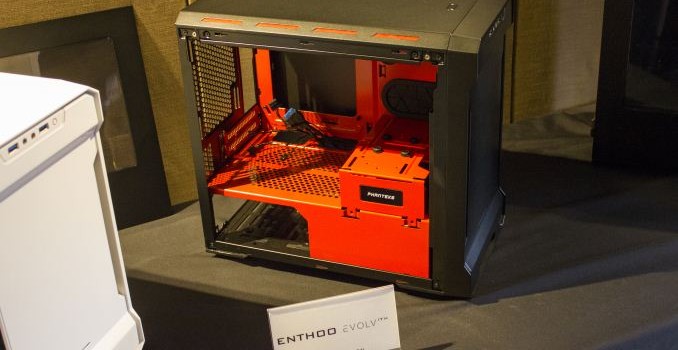
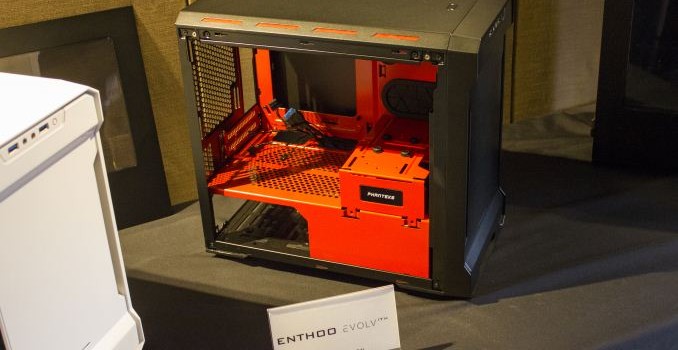
Phanteks had its new Enthoo EVOLV series cases in both mini-ITX and full ATX form factors on display in its suite at Computex. The mini-ITX version is made out of steel and available in two color schemes (white-black & red-black). There’s a single 200mm fan installed in the front with room for two 120/140mm fans at the top and one at the back. It can take a 330mm GPU and a 200mm CPU cooler, so you can build a fairly powerful system. One of the more special aspects of Phanteks’ cases is the PSU cover, which essentially hides the PSU cables to create the clean look that many desire.

The ATX version is fully made out of 3mm thick aluminum (despite the side window). For some reason the design and overall build remind me of the original Mac Pro, which isn’t a bad thing at all. 

One of the unique aspects in the case are fully modular hard drive bays. I have to say I really like the concept because typically many ATX cases easily have +5 irremovable bays, but in reality most users probably won’t use more than one or two. Phanteks includes three with the case, but obviously the user can buy extra ones if needed. 

There are actually two hard drive bays and SSD brackets behind the main chamber, so in most cases the user won’t even need the modular HDD bays and can thus maximize airflow by not having anything between the fans and motherboard. 

Phanteks also had a prototype of a dual-system case that can take a full ATX motherboard and a mini-ITX one. The interesting part is that Phanteks is working on a power splitter, so the two systems could be powered by a single PSU to save on space and cost. As you can see, the concept isn’t really final yet because Phanteks needs to some custom cabling in order to be able to close the case since right now the cables come off too much. It’s a niche product for sure, but the idea of running two full systems inside a decent size case is definitely alluring. See the gallery for more shots of the prototype and other cases Phanteks had to show!

Phanteks Computex 2015 Booth Tour

Phanteks Computex 2015 Booth Tour

Phanteks had its new Enthoo EVOLV series cases in both mini-ITX and full ATX form factors on display in its suite at Computex. The mini-ITX version is made out of steel and available in two color schemes (white-black & red-black). There’s a single 200mm fan installed in the front with room for two 120/140mm fans at the top and one at the back. It can take a 330mm GPU and a 200mm CPU cooler, so you can build a fairly powerful system. One of the more special aspects of Phanteks’ cases is the PSU cover, which essentially hides the PSU cables to create the clean look that many desire.

The ATX version is fully made out of 3mm thick aluminum (despite the side window). For some reason the design and overall build remind me of the original Mac Pro, which isn’t a bad thing at all. 

One of the unique aspects in the case are fully modular hard drive bays. I have to say I really like the concept because typically many ATX cases easily have +5 irremovable bays, but in reality most users probably won’t use more than one or two. Phanteks includes three with the case, but obviously the user can buy extra ones if needed. 

There are actually two hard drive bays and SSD brackets behind the main chamber, so in most cases the user won’t even need the modular HDD bays and can thus maximize airflow by not having anything between the fans and motherboard. 

Phanteks also had a prototype of a dual-system case that can take a full ATX motherboard and a mini-ITX one. The interesting part is that Phanteks is working on a power splitter, so the two systems could be powered by a single PSU to save on space and cost. As you can see, the concept isn’t really final yet because Phanteks needs to some custom cabling in order to be able to close the case since right now the cables come off too much. It’s a niche product for sure, but the idea of running two full systems inside a decent size case is definitely alluring. See the gallery for more shots of the prototype and other cases Phanteks had to show!

Lian Li Computex 2015 Booth Tour

Lian Li Computex 2015 Booth Tour

Lian Li had close to a dozen new or prototype-level cases on display at Computex. I’ve added most in the gallery at the end of this post, but I’ll go through a few of the highlights here as well.

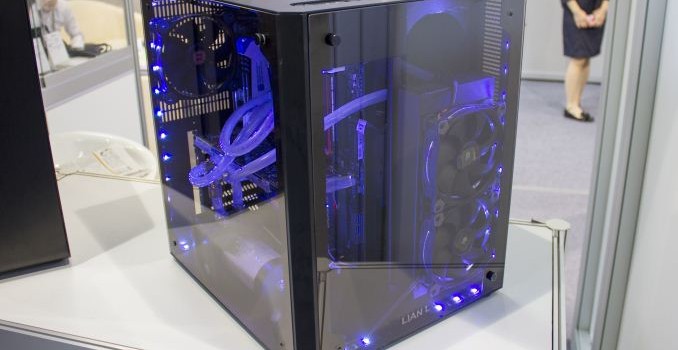
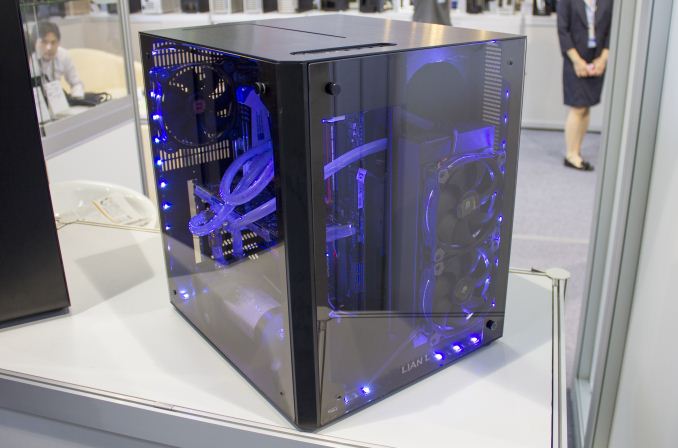
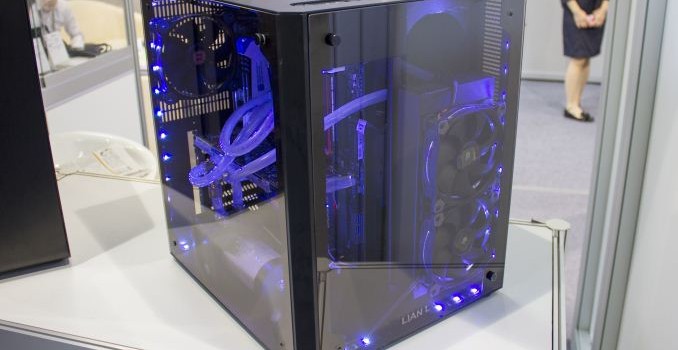
The first one is the PC-V33A, which is a box-like case in which the motherboard is mounted horizontally. The top cover is made out of single piece of aluminum, but it opens up for easy installation. 

The case above is more of a conceptual prototype where Lian Li is playing around with a taller case design. Instead of having hard drive bays next to the motherboard, there’s room for four hard drives in the top chamber, which allows for better airflow in the main chamber. 

One of the more down to earth designs is the PC-K621, which is also Lian Li’s first non-aluminum case. Traditionally Lian Li has kept the Lancool brand for value cases, but it seems that the company is trying to consolidate everything under a single brand now. The PC-K621 is made out of steel and plastic, but it does feel very sturdy and despite the fact that the front panel is made out of plastic, it has a metal-like look in it. Pricing will be about $70, so while it’s not exactly a value case it’s still considerably cheaper than the rest of the Lian Li cases.

One minor change Lian Li has made to its cases is changing the power button material from plastic to aluminum. The company received many complaints of the power button not having the same feel as the rest of the case, so as any respectable company Lian Li listened to its customers and made the change. 

And obviously no Lian Li booth tour is complete without the computer desk case. Lian Li has modified the design a bit so that one can now easily sit with legs under the table, which was one of the issues the earlier cases had (note: that’s Kip Hartwell, Lian Li’s marketing rep, in the photo, not me). The desk is still expensive, though, and Lian Li doesn’t really have any plans of making a value model, but it’s a relatively small niche anyway.

Check out the gallery above if you’re interested in seeing what else Lian Li had to offer!

Lian Li Computex 2015 Booth Tour

Lian Li Computex 2015 Booth Tour

Lian Li had close to a dozen new or prototype-level cases on display at Computex. I’ve added most in the gallery at the end of this post, but I’ll go through a few of the highlights here as well.

The first one is the PC-V33A, which is a box-like case in which the motherboard is mounted horizontally. The top cover is made out of single piece of aluminum, but it opens up for easy installation. 

The case above is more of a conceptual prototype where Lian Li is playing around with a taller case design. Instead of having hard drive bays next to the motherboard, there’s room for four hard drives in the top chamber, which allows for better airflow in the main chamber. 

One of the more down to earth designs is the PC-K621, which is also Lian Li’s first non-aluminum case. Traditionally Lian Li has kept the Lancool brand for value cases, but it seems that the company is trying to consolidate everything under a single brand now. The PC-K621 is made out of steel and plastic, but it does feel very sturdy and despite the fact that the front panel is made out of plastic, it has a metal-like look in it. Pricing will be about $70, so while it’s not exactly a value case it’s still considerably cheaper than the rest of the Lian Li cases.

One minor change Lian Li has made to its cases is changing the power button material from plastic to aluminum. The company received many complaints of the power button not having the same feel as the rest of the case, so as any respectable company Lian Li listened to its customers and made the change. 

And obviously no Lian Li booth tour is complete without the computer desk case. Lian Li has modified the design a bit so that one can now easily sit with legs under the table, which was one of the issues the earlier cases had (note: that’s Kip Hartwell, Lian Li’s marketing rep, in the photo, not me). The desk is still expensive, though, and Lian Li doesn’t really have any plans of making a value model, but it’s a relatively small niche anyway.

Check out the gallery above if you’re interested in seeing what else Lian Li had to offer!

Microsoft Surface Hub Availability And Specifications Announced

Microsoft Surface Hub Availability And Specifications Announced

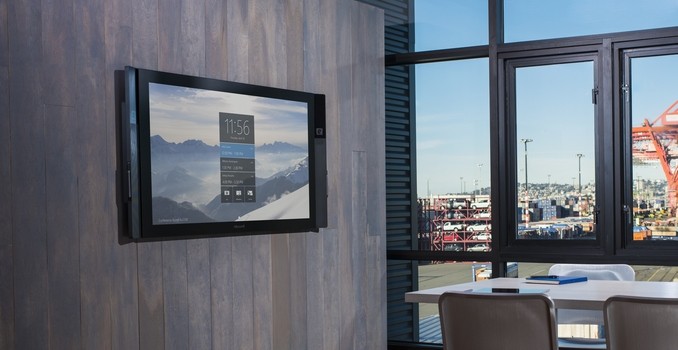
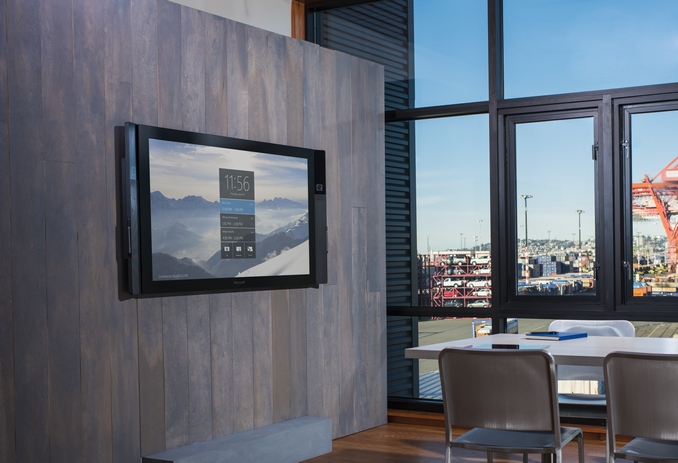
Today Microsoft announced more news regarding the Surface Hub, which is their large-screen collaboration device. Built specifically for the business conference room, the Surface Hub packs some impressive features inside.

The first bit of news though is that the Surface Hub will be available for pre-order starting on July 1st, and shipments will begin in September. It will initially be available in twenty four markets, with the United States, Canada, Australia, Austria, Belgium, Denmark, France, Finland, Germany, Ireland, Italy, Japan, Luxembourg, the Netherlands, New Zealand, Norway, Portugal, Qatar, Singapore, Spain, Sweden, Switzerland, United Arab Emirates and the United Kingdom all getting first dibs on this new device. The prices will seem steep to anyone who does not often furnish a conference room, with the smaller 55-inch model being offered for $6999, and the 84-inch model will sell for $19,999.

That is not inexpensive at all, but it should actually be less expensive that some of the other conference room solutions, and yet pack in technology that they can’t offer. Here is a table of the listed specifications:

Microsoft Surface Hub
  Surface Hub 55″ Surface Hub 84″
Dimensions H: 31.75″ (806.4 mm)
W: 59.62″ (1514.3 mm)
D: 3.38″ (85.8 mm)
H: 46.12″ (1171.5 mm)
W: 86.7″ (2202.9 mm)
D: 4.15″ (105.4 mm)
Weight 105 lbs (48 kg) 280 lbs (127 kg)
CPU Intel Haswell (4th Gen) Core i5 Intel Haswell (4th Gen) Core i7
GPU Intel HD 4600 NVIDIA Quadro K2200 640 CUDA Cores
RAM 8 GB 8 GB
Storage 128 GB SSD 128 GB SSD
Display 55″ 1920×1080 @ 120 Hz
1300:1 Contrast Ratio
100-point Multi-touch
Three Simultaneous Active Pens
Projective Capacitance optically bonded sensor
84″ 3840×2160 @ 120 Hz
1400:1 Contrast Ratio
100-point Multi-touch
Three Simultaneous Active Pens
Projective Capacitance optically bonded sensor
Networking Wired 1 Gbps
Wireless 802.11ac
Bluetooth 4.0 LE
NFC Reader
Miracast Enabled
Ports Internal PC
(1) USB 3.0 (bottom) + (1) USB 3.0 (side access)
(2) USB 2.0
Ethernet 1000 Base-T
DisplayPort Video Output
3.5mm Stereo Out
RS232 Serial Port
RJ11 Connector for system level control

Alternate PC
(2) USB 2.0 type B output, connection for:
Camera
Sensors
Microphone
Speakers
Touchback™
(1) DisplayPort Video Input

Guest PC
DisplayPort Video Input
HDMI Video Input
VGA Video Input
3.5mm Stereo Input
(1) USB 2.0 type B Touchback™ Output

Sensors (2) Passive Infrared Presence Sensors
Ambient Light Sensors
Speakers (2) Front Facing Speakers
Microphone High Performance, 4 Element Array
Cameras (2) 1080p @ 30fps
Price $6,999 $19,999

The first notable aspect is the displays, which both feature optically bonded projective capacitance sensors to minimize reflections. Both models also can support an insane 100 points of concurrent multi-touch, and three simultaneous pen inputs. The 55-inch model is a 1920×1080 panel, and the 84-inch is a 3840×2160 resolution, and both have a refresh rate of 120Hz. The touch digitizer is also 120Hz, and according to Microsoft it makes the experience much more akin to an analog counterpart.

These will not be just displays to project to either. Powering the Surface Hub is a custom version of Windows 10, which is run on a Haswell Core i5 on the smaller model and a Core i7 on the larger one. The 84-inch model also jumps from integrated graphics to the NVIDIA Quadro K2200, which is a Maxwell based GM107 GPU with 640 CUDA Cores. Both Hubs come with 128 GB of SSD storage and 8 GB of RAM, as well as Gigabit Ethernet and 802.11ac, with Bluetooth 4.0 LE, NFC, and Miracast available.

They will also feature two front-facing stereo speakers, a four element microphone, two 1080p cameras each, as well as passive infrared presence sensors and ambient light sensors.

I think the steep price is going to keep these devices closely locked to their target audience of conference and meeting rooms. It would be very cool to have an 84-inch Windows 10 powered Smart TV, but for $20,000 it would be a tough sell.

I’ve asked a couple of questions to Microsoft to get some more details about this device though, including its ability to handle HDMI 2.0 inputs and a few other things, so once I hear back I’ll update the post.

Source: Microsoft