
News


OCZ Announces Trion 100 TLC SSD & Shows Off an Upcoming NVMe Drive with Toshiba Controller
OCZ Announces Trion 100 TLC SSD & Shows Off an Upcoming NVMe Drive with Toshiba Controller

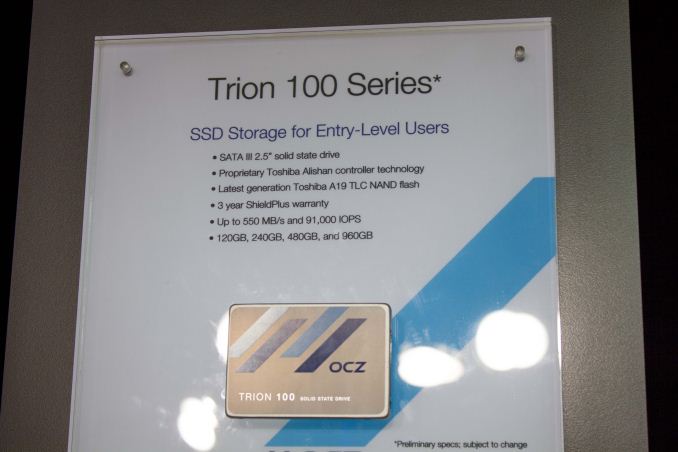
One of the things I’ve been expecting to see at this year’s Computex is more TLC NAND based SSDs. So far only Samsung and SanDisk have been shipping TLC SSDs in high volume, but OCZ will shortly join the club with its Trion 100 SSD series that was showcased on the Computex showfloor. The Trion 100 is based on a totally in-house designed Toshiba “Alishan” controller, whereas some earlier Toshiba controllers have been modified/renamed third party silicons with the company’s firmware. We discussed the cooperation between the two companies in more detail in our interview with OCZ’s CEO, Ralph Schmitt, but to put it shortly the use of Toshiba IP in an OCZ product is part of the companies’ strategy to consolidate product development to maximize resources as it wouldn’t be efficient to have both companies working on platforms that ultimately have the same end goal. 

The NAND in Trion 100 is Toshiba’s A19nm (i.e. second generation 19nm) TLC, although OCZ is planning on switching to the latest 15nm node later this year once the supply is high enough. For error correction the drive uses Toshiba’s own QSBC (Quadruple Swing-By Correction) technology, which from what I was told is basically in between traditional BCH and LDPC correction. I don’t have too many details of the technology at this point, but I will try to gather more information to better know how the technology stacks up against the competition. Typical to TLC drives, the Trion 100 employs an SLC cache to increase peak performance in smaller capacities and also to boost endurance. 

One of the biggest improvements in the Trion 100 is the support for DevSleep and other power saving modes. Because of the silicon design the Barefoot 3 isn’t capable of offering low idle power consumption, which has been one of main criticisms for a while now. With the Trion 100 OCZ is finally looking to provide a solution that’s also suitable for mobile applications where power draw and battery life are major concerns.

The Trion 100 is now in final validation and the official release will take place later in the summer. Hence performance, endurance and pricing are not final yet, but what I was told is that the performance will be read focused (as most light client workloads are read-centric), endurance goal is 20GB/day and price will be slightly below the ARC 100.

Aside from the Trion 100, OCZ also showed off a new unannounced M.2 NVMe drive that will be released later this year (I’m hearing September-October timeframe) as a new RevoDrive. Unlike the previous designs we have seen, this isn’t based on OCZ’s own JetExpress controller, but on Toshiba’s PCIe 3.0 x4 NVMe controller. The reason OCZ is using Toshiba’s controller is cost because the the JetExpress has been designed mainly with enterprise in mind, meaning that it cannot be implemented into a cost effective client drive. 

Obviously OCZ also had it’s new Z-Drive 6000 series on display along with the upcoming JetExpress based XD-JX series.

Antec Reveals the Signature S10 Premium Tower Case

Antec Reveals the Signature S10 Premium Tower Case

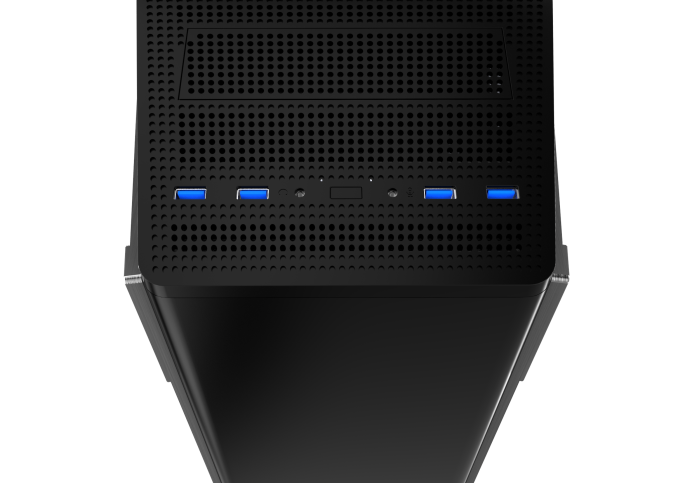
That Antec designed a new case may not really sound like news. After all, cases are the primary focus of the company, which offers dozens of models. However, this particular release is of special interest as the company has overhauled their lineup with a new flagship case, the Signature S10, a unique tower case of massive proportions. Meant to be Antec’s engineering pinnacle, the Signature S10 is an aggressive combination of advanced thermal performance, versatility, and elegant aesthetics.

Measuring 60 cm tall and 59 cm deep (23.7″ × 23.2″), the Signature S10 is one of the largest tower cases in existence. It also weights about 18 kg, making it a very heavy case that is certainly not designed for frequent movement. Still, the proportions of a case alone are not stimulating and not what is unique about this particular release. What is perhaps the most important point of the Signature S10 is that it features Antec’s patented three chamber design internal architecture.

Exactly as the name suggests, the three chamber design architecture splits the interior of the Signature S10 into three compartments. The entire front of the case is reserved for hard disk drives, the bottom compartment is shared between the PSU and five 2.5″ device trays, and the primary compartment is reserved for the main system alone. Note that, despite its size, the Signature S10 does not have any 5.25″ drive bays, so the idea of an optical drive is truly dead for this case. However, there is a slot for a short 5.25″ device (fan controller, card reader, etc.). The chassis is most likely made out of SECC steel and the buyer is given the choice between aluminum and smoked tempered glass doors for the side panels. If Antec’s press release is accurate and we are talking about real glass, not Plexiglass, that would be a sight to behold.

As the Signature S10 is intended to be Antec’s engineering pinnacle, the stock cooling of the case is intense. The very architecture of the case is supposed to aid thermal performance, forcing top-down airflow. There are seven stock fans, five 120 mm and two 140 mm, preinstalled into the Signature S10, the models and specifications of which are unknown at this point of time. To limit the insertion of dust, Antec installed micromesh air filters to each individual chamber.  

Obviously, Antec is trying to combine the very elegant appearance of the Signature series with outstanding thermal performance and expandability options, pitching the case as a good match for advanced gaming systems and workstations. Meanwhile it seems as Antec put every bit of their technology on the Signature S10, and the retail price reflects that, as the MSRP is just shy of $500. Consequently the potential market of the Signature S10 is going to be very small (if not very elite) limited to the most hardcore of enthusiasts who are willing to pay a very hefty price in order to combine elegant aesthetics and quality with thermal performance.

Antec Reveals the Signature S10 Premium Tower Case

Antec Reveals the Signature S10 Premium Tower Case

That Antec designed a new case may not really sound like news. After all, cases are the primary focus of the company, which offers dozens of models. However, this particular release is of special interest as the company has overhauled their lineup with a new flagship case, the Signature S10, a unique tower case of massive proportions. Meant to be Antec’s engineering pinnacle, the Signature S10 is an aggressive combination of advanced thermal performance, versatility, and elegant aesthetics.

Measuring 60 cm tall and 59 cm deep (23.7″ × 23.2″), the Signature S10 is one of the largest tower cases in existence. It also weights about 18 kg, making it a very heavy case that is certainly not designed for frequent movement. Still, the proportions of a case alone are not stimulating and not what is unique about this particular release. What is perhaps the most important point of the Signature S10 is that it features Antec’s patented three chamber design internal architecture.

Exactly as the name suggests, the three chamber design architecture splits the interior of the Signature S10 into three compartments. The entire front of the case is reserved for hard disk drives, the bottom compartment is shared between the PSU and five 2.5″ device trays, and the primary compartment is reserved for the main system alone. Note that, despite its size, the Signature S10 does not have any 5.25″ drive bays, so the idea of an optical drive is truly dead for this case. However, there is a slot for a short 5.25″ device (fan controller, card reader, etc.). The chassis is most likely made out of SECC steel and the buyer is given the choice between aluminum and smoked tempered glass doors for the side panels. If Antec’s press release is accurate and we are talking about real glass, not Plexiglass, that would be a sight to behold.

As the Signature S10 is intended to be Antec’s engineering pinnacle, the stock cooling of the case is intense. The very architecture of the case is supposed to aid thermal performance, forcing top-down airflow. There are seven stock fans, five 120 mm and two 140 mm, preinstalled into the Signature S10, the models and specifications of which are unknown at this point of time. To limit the insertion of dust, Antec installed micromesh air filters to each individual chamber.  

Obviously, Antec is trying to combine the very elegant appearance of the Signature series with outstanding thermal performance and expandability options, pitching the case as a good match for advanced gaming systems and workstations. Meanwhile it seems as Antec put every bit of their technology on the Signature S10, and the retail price reflects that, as the MSRP is just shy of $500. Consequently the potential market of the Signature S10 is going to be very small (if not very elite) limited to the most hardcore of enthusiasts who are willing to pay a very hefty price in order to combine elegant aesthetics and quality with thermal performance.