News


MediaTek announces Helio P10 Mainstream SoC
MediaTek announces Helio P10 Mainstream SoC

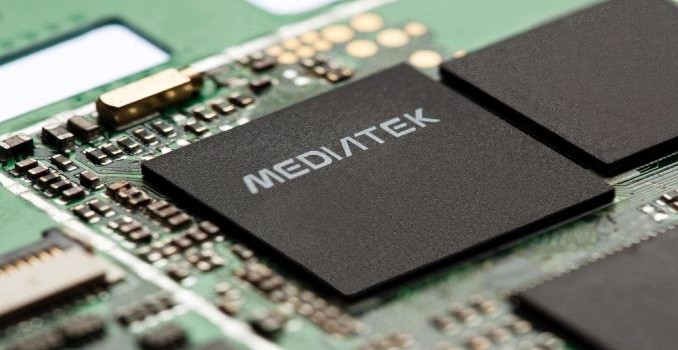
MediaTek started promoting its new Helio branding for SoCs back at MWC this year, and we had the please to cover the the new Helio X20 announcement just a few weeks ago. While the X-series is supposed to target the higher end (dubbed “eXtreme Performance”), the P-line is aimed at the budget mid-range (“Premium Performance” as MediaTek calls it). Today’s announcement of the Helio P10 marks the first SoC in the P-series to adopt the new branding.

The P10 is the direct successor to last year’s MT6752, which saw some quite widespread in adoption by Chinese vendors such as Meizu (M1 note), Gionee (Elife S7) or JiaYu (S3) and others. The P10 improves on its predecessor, the the MT6752, by taking a lot of improvements which were introduced with the X10 and X20.

On the processor side, the CPU configuration remains a dual-cluster with four A53 cores per cluster. The MT6752 clocked both clusters at the same clock, running from 1.7 up to 2.0GHz as its maximum frequency depending on the chip bin. The P10 keeps this 2.0GHz maximum clock for its performance cluster, but has a slower cluster at lower speeds which we weren’t yet able to confirm with MediaTek 1.1GHz.

MediaTek 2015 Main Lineup
SoC MediaTek
Helio X20
(MT6797)
MediaTek
Helio X10
(MT6795)
MediaTek
Helio P10
(
MT6755)
MediaTek
MT6752
CPU 4x Cortex A53 @1.4GHz

4x Cortex A53 @2.0GHz

2x Cortex A72
@2.3-2.5GHz

4x Cortex A53 @2.2GHz

4x Cortex A53 @2.2GHz

4x Cortex A53
@1.1GHz

4x Cortex A53 @2.0GHz

4x Cortex A53
@1.7-2.0GHz

4x Cortex A53
@1.7-2.0GHz

Memory
Controller
2x 32-bit @ 933MHz
LPDDR3

14.9GB/s b/w

2x 32-bit @ 933MHz
LPDDR3

14.9GB/s b/w

2x 32-bit @ 800+MHz
LPDDR3

12.8+GB/s b/w

(To be confirmed)

1x 32-bit @ 800MHz
LPDDR3

6.4GB/s b/w

GPU Mali T8??MP4
@700MHz
PowerVR G6200
@700MHz
Mali T860MP2
@700MHz
Mali T760MP2
@728MHz
Encode/
Decode
2160p30 10-bit
H.264/HEVC/VP9
decode

2160p30
HEVC w/HDR
encode

2160p30 10-bit
H.264/HEVC/VP9
decode

2160p30
HEVC
encode

1080p30
H.264 & HEVC
decode

1080p30
H.264
encode

1080p30
H.264 & HEVC
decode

1080p30
H.264
encode

Camera/ISP Dual ISP
32MP @ 24fps
21MP single or
16MP + 8MP dual
21MP single or
16MP + 8MP dual
16MP
Integrated
Modem
 LTE Cat. 6
300Mbps DL
50Mbps UL

2x20MHz C.A. 
(DL)

LTE Cat. 4 
150Mbps DL 50Mbps UL
 LTE Cat. 6
300Mbps DL
50Mbps UL

2x20MHz C.A. 
(DL)

 LTE Cat. 4 
150Mbps DL
50Mbps UL


Memory bandwidth was supposedly also increased, and I suspect, but again in need of confirmation, that we’re talking about finally switching over to a dual-channel memory controller, as the MT6752 was still sporting a single 32bit controller. The P10 is aimed at 1080p devices so it looks that MediaTek is keeping the graphics performances conservative and power efficient.

MediaTek also upgrades the GPU from a Mali T760 to a T860, but keeps the shader core count steady at 2. We again see some interesting power claims concerning the T8XX series as MediaTek claims the new GPU uses only 70% of the power of the previous T760 iteration while improving performance by 20%, but we might be not talking solely architectural improvements as the P10 comes on a brand-new silicon manufacturing node.

The P10 is the first SoC to be announced on TSMC’s 28HPC+ process. TSMC published the 28HPC process last autumn as a successor to 28HPM – with the advantages of a slight die shrink and improved power characteristics. 28HPC+ is yet another iteration that was publicly talked about last April, and promises a 15% gain in performance or a quite large 30 to 50% reduction in leakage at the same speed when compared to 28HPC.

We’ll continue to see the 28nm process to live on for a long time in the mid-range and cost-sensitive segments as it marks the sweet-spot in the transistors/$ scaling, and 28HPC(+) is one of the first enablers of this life-time extension.

The Helio P10 also takes over the modem sub-system that we’ve seen announced in the X20 – with LTE rel.11 Category 6 capability and 2x20MHz carrier aggregation on the download stream. This also includes crucial CDMA2000 support that MediaTek needs to be able to penetrate the North American and other limited markets.

The mainstream lineup is the Taiwanese company’s bread & butter and is the source of where MediaTek has seen most of its notorious successes. The P10, being part of this segment, will very likely see similar widespread adoption in low-cost devices as the Chinese smartphone boom continues to grow.

The Helio P10 is supposed to be sampling in early Q3 2015 and with phone mass-production happening towards the end of the year in the fourth quarter.
MediaTek announces Helio P10 Mainstream SoC

MediaTek announces Helio P10 Mainstream SoC

MediaTek started promoting its new Helio branding for SoCs back at MWC this year, and we had the please to cover the the new Helio X20 announcement just a few weeks ago. While the X-series is supposed to target the higher end (dubbed “eXtreme Performance”), the P-line is aimed at the budget mid-range (“Premium Performance” as MediaTek calls it). Today’s announcement of the Helio P10 marks the first SoC in the P-series to adopt the new branding.

The P10 is the direct successor to last year’s MT6752, which saw some quite widespread in adoption by Chinese vendors such as Meizu (M1 note), Gionee (Elife S7) or JiaYu (S3) and others. The P10 improves on its predecessor, the the MT6752, by taking a lot of improvements which were introduced with the X10 and X20.

On the processor side, the CPU configuration remains a dual-cluster with four A53 cores per cluster. The MT6752 clocked both clusters at the same clock, running from 1.7 up to 2.0GHz as its maximum frequency depending on the chip bin. The P10 keeps this 2.0GHz maximum clock for its performance cluster, but has a slower cluster at lower speeds which we weren’t yet able to confirm with MediaTek 1.1GHz.

MediaTek 2015 Main Lineup
SoC MediaTek
Helio X20
(MT6797)
MediaTek
Helio X10
(MT6795)
MediaTek
Helio P10
(
MT6755)
MediaTek
MT6752
CPU 4x Cortex A53 @1.4GHz

4x Cortex A53 @2.0GHz

2x Cortex A72
@2.3-2.5GHz

4x Cortex A53 @2.2GHz

4x Cortex A53 @2.2GHz

4x Cortex A53
@1.1GHz

4x Cortex A53 @2.0GHz

4x Cortex A53
@1.7-2.0GHz

4x Cortex A53
@1.7-2.0GHz

Memory
Controller
2x 32-bit @ 933MHz
LPDDR3

14.9GB/s b/w

2x 32-bit @ 933MHz
LPDDR3

14.9GB/s b/w

2x 32-bit @ 800+MHz
LPDDR3

12.8+GB/s b/w

(To be confirmed)

1x 32-bit @ 800MHz
LPDDR3

6.4GB/s b/w

GPU Mali T8??MP4
@700MHz
PowerVR G6200
@700MHz
Mali T860MP2
@700MHz
Mali T760MP2
@728MHz
Encode/
Decode
2160p30 10-bit
H.264/HEVC/VP9
decode

2160p30
HEVC w/HDR
encode

2160p30 10-bit
H.264/HEVC/VP9
decode

2160p30
HEVC
encode

1080p30
H.264 & HEVC
decode

1080p30
H.264
encode

1080p30
H.264 & HEVC
decode

1080p30
H.264
encode

Camera/ISP Dual ISP
32MP @ 24fps
21MP single or
16MP + 8MP dual
21MP single or
16MP + 8MP dual
16MP
Integrated
Modem
 LTE Cat. 6
300Mbps DL
50Mbps UL

2x20MHz C.A. 
(DL)

LTE Cat. 4 
150Mbps DL 50Mbps UL
 LTE Cat. 6
300Mbps DL
50Mbps UL

2x20MHz C.A. 
(DL)

 LTE Cat. 4 
150Mbps DL
50Mbps UL


Memory bandwidth was supposedly also increased, and I suspect, but again in need of confirmation, that we’re talking about finally switching over to a dual-channel memory controller, as the MT6752 was still sporting a single 32bit controller. The P10 is aimed at 1080p devices so it looks that MediaTek is keeping the graphics performances conservative and power efficient.

MediaTek also upgrades the GPU from a Mali T760 to a T860, but keeps the shader core count steady at 2. We again see some interesting power claims concerning the T8XX series as MediaTek claims the new GPU uses only 70% of the power of the previous T760 iteration while improving performance by 20%, but we might be not talking solely architectural improvements as the P10 comes on a brand-new silicon manufacturing node.

The P10 is the first SoC to be announced on TSMC’s 28HPC+ process. TSMC published the 28HPC process last autumn as a successor to 28HPM – with the advantages of a slight die shrink and improved power characteristics. 28HPC+ is yet another iteration that was publicly talked about last April, and promises a 15% gain in performance or a quite large 30 to 50% reduction in leakage at the same speed when compared to 28HPC.

We’ll continue to see the 28nm process to live on for a long time in the mid-range and cost-sensitive segments as it marks the sweet-spot in the transistors/$ scaling, and 28HPC(+) is one of the first enablers of this life-time extension.

The Helio P10 also takes over the modem sub-system that we’ve seen announced in the X20 – with LTE rel.11 Category 6 capability and 2x20MHz carrier aggregation on the download stream. This also includes crucial CDMA2000 support that MediaTek needs to be able to penetrate the North American and other limited markets.

The mainstream lineup is the Taiwanese company’s bread & butter and is the source of where MediaTek has seen most of its notorious successes. The P10, being part of this segment, will very likely see similar widespread adoption in low-cost devices as the Chinese smartphone boom continues to grow.

The Helio P10 is supposed to be sampling in early Q3 2015 and with phone mass-production happening towards the end of the year in the fourth quarter.
ASUS Shows Off The ZenWatch 2 At Computex

ASUS Shows Off The ZenWatch 2 At Computex

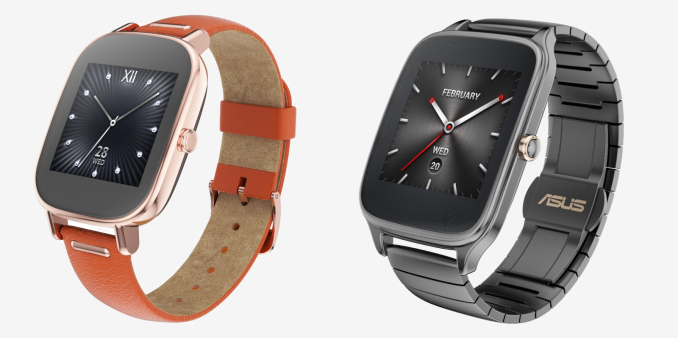
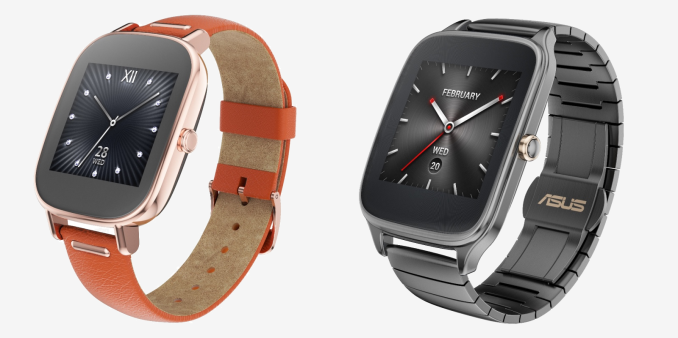
Today ASUS updated their Android Wear smartwatch offering. It wasn’t long ago that we saw the original ASUS ZenWatch at IFA, but it’s now being superseded by the ZenWatch 2. Unfortunately, details are fairly scarce about ASUS’s new watch. It’s powered by an unnamed SoC from Qualcomm, and sports a 2.5D AMOLED display of unknown size. More details about the ZenWatch 2 should come out over the course of Computex.

One area where the ZenWatch 2 is clearly improved over its predecessor is the water and dust resistance. The original ZenWatch had an IP55 rating, and this has been improved to an IP67 rating for greater water submersion protection.

The ZenWatch 2 comes in two sizes, and both models come in silver, gunmetal, and rose-gold finishes. Straps are available in rubber, leather, and metal. One interesting feature on the larger model is that it can be used as a tiny battery power pack to charge your phone, but with the limited battery capacity of smartwatches this seems like something to only be used as a last resort.

ASUS Shows Off The ZenWatch 2 At Computex

ASUS Shows Off The ZenWatch 2 At Computex

Today ASUS updated their Android Wear smartwatch offering. It wasn’t long ago that we saw the original ASUS ZenWatch at IFA, but it’s now being superseded by the ZenWatch 2. Unfortunately, details are fairly scarce about ASUS’s new watch. It’s powered by an unnamed SoC from Qualcomm, and sports a 2.5D AMOLED display of unknown size. More details about the ZenWatch 2 should come out over the course of Computex.

One area where the ZenWatch 2 is clearly improved over its predecessor is the water and dust resistance. The original ZenWatch had an IP55 rating, and this has been improved to an IP67 rating for greater water submersion protection.

The ZenWatch 2 comes in two sizes, and both models come in silver, gunmetal, and rose-gold finishes. Straps are available in rubber, leather, and metal. One interesting feature on the larger model is that it can be used as a tiny battery power pack to charge your phone, but with the limited battery capacity of smartwatches this seems like something to only be used as a last resort.

ASUS Announces Two New 8 Inch ZenPad Tablets

ASUS Announces Two New 8 Inch ZenPad Tablets

ASUS is no stranger to the Android tablet market. They’ve been around since the earliest days of Android tablets with their ASUS Transformer TF101 which launched with Android Honeycomb. Since that time they’ve released a number of iterations of the ASUS Transformer Android tablet, and have also expanded to other parts of the market with tablets like the ASUS MeMO Pad. In addition to their independent endeavors, they worked with Google to design and manufacture both generations of the Nexus 7, which was beloved by Android enthusiasts.

While ASUS has been making Android tablets for a while, it has also been quite some time since we’ve seen a high end tablet come from the company. A focus on expansion into the world of Windows tablets has left the spot for a high end ASUS tablet unfilled. However, with a renewed focus on expanding their role as an Android manufacturer, and global ambitions with devices like the ZenFone 2, it was only a matter of time before ASUS brought new Android tablets to market. It also seemed inevitable that those devices would now fall under ASUS’s Zen branding, and indeed, they do. ASUS’s new Android tablets are the first in a line of tablets under the ZenPad brand.

To put things in perspective and make it easier to compare these two new tablets, I’ve organized their general specifications in the chart below. There are a few things missing at the moment as they haven’t yet been provided by ASUS, but I will update the chart and this article as soon as they are known.

  ASUS ZenPad 8 (Z380) ASUS ZenPad S 8 (Z580CA)
SoC Intel Atom x3-C3230RK
4x Silvermont @ 1.2GHz
Intel Atom Moorefield Z3580
4x Silvermont @ 2.33GHz
GPU ARM Mali 450 MP4 PowerVR G6430 @ 533MHz
RAM 1 or 2GB LPDDR3 4GB LPDDR3
NAND 8/16GB + microSDXC 16/32/64GB + microSDXC
Display 8.0″ 1280×800 IPS LCD 8.0″ 2048×1536 IPS LCD
Dimensions 209 x 123 x 8.5mm 203.2 x 134.5 x 6.68mm
Mass ? 299g
Camera 2MP Front-facing
5MP Rear-facing
5MP Front-facing
8MP Rear-facing
Battery 15.2Wh
OS Android 5.0 Lollipop with ASUS Zen UI
Other Connectivity 802.11b/g/n + BT 4.0, GNSS
Cellular LTE SKU with phone functionality WiFi Only
USB Connector Micro USB USB Type-C

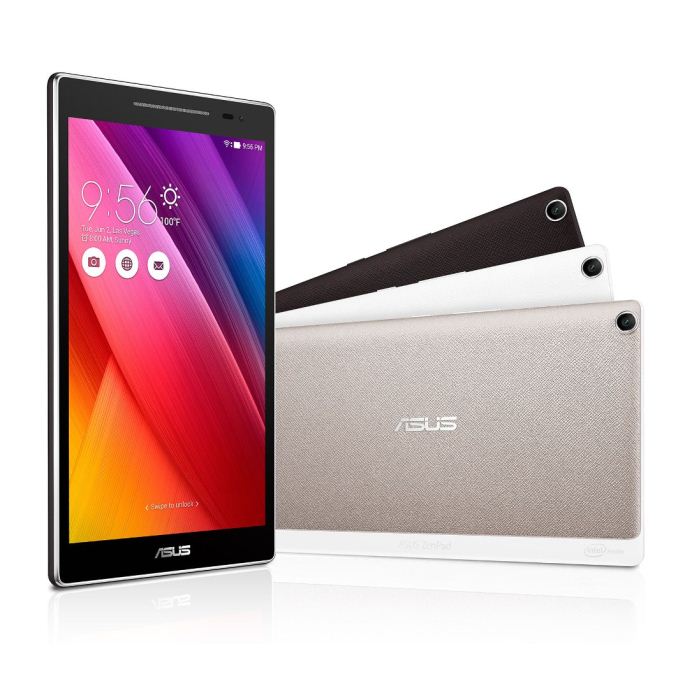
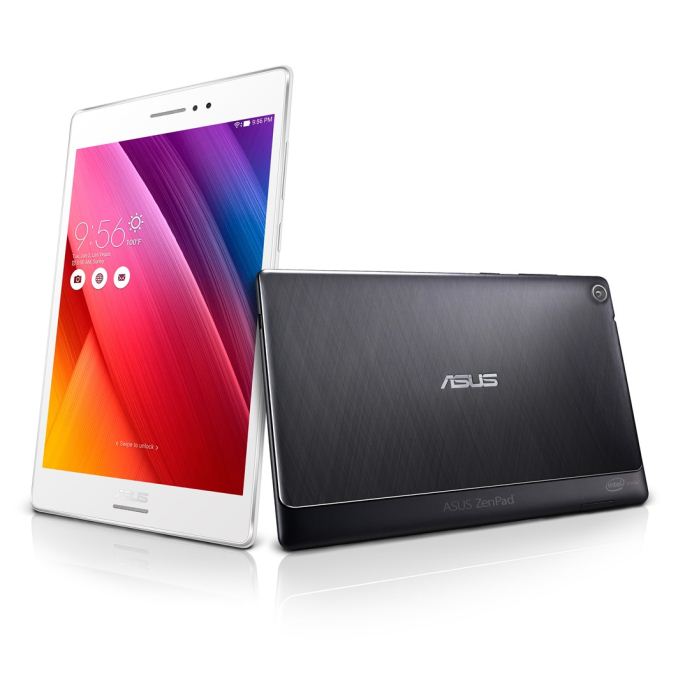
With this launch it appears that ASUS is putting devices into play at both the high end and the low end of the tablet market. The ZenPad Z380 is certainly the thicker of the two devices, and it’s slightly shorter but with a much more narrow profile. You can see the ZenPad Z380 pictured in the cover image above, and the ZenPad S Z580CA is down below. While the Z380 opts for swappable leather textured backs, the Z580CA has a non-removable metallic back, although it’s unknown if it’s actually made of metal. I’ll start by talking about the Z380 before moving onto the Z580CA.

The first thing I noticed about the ZenPad Z380 was that it uses the Intel Atom x3-C3230RK SoC. This is a very interesting chip, because the RK on the end of the name signifies that it’s a chip designed by Rockchip rather than Intel. Through their partnership, Intel licenses their architecture to Rockchip to use in the SoCs they design, and those SoCs are then fabricated on TSMC’s 28nm process. It’s a surprising collaboration of three companies.

Atom x3-C3230RK has four of Intel’s Silvermont cores and they have a peak frequency of 1.2GHz. This puts it pretty far behind Intel’s higher clocked Moorefield parts that are built on their 22nm manufacturing process when it comes to bursty workloads. However, the size of the gap between it and Moorefield will be in a sustained load when both SoCs throttle down remains to be seen. It also sports ARM’s Mali 450 GPU with four cores, although the clock speed on those GPU cores is unknown.

Moving on from the SoC, we see that the ZenPad Z380 comes with either 8GB or 16GB of internal memory, and 1GB or 2GB of RAM. According to ASUS, these specs can vary based on region, so be sure to take a look at the spec sheet if you plan on buying the Z380. It also has an 8″ 1280×800 IPS LCD which is fairly standard for a low end tablet, and a pair of 2MP and 5MP cameras on the front and back respectively.

After the ZenPad Z380 comes the high end ZenPad S Z580CA, which is also a tablet with an 8″ display. However, the fact that both of these tablets have the same display size as measured from corner to corner does not mean they have the same form. This is because the ZenPad S uses an 8″ 2048×1536 IPS panel which has a 4:3 aspect ratio. ASUS is following HTC and Samsung in moving to 4:3 after many years of 16:10 Android tablets. I’m surprised that it took this long for vendors to realize that 16:10 is ill suited to many of the tasks users perform on tablets and makes a device more difficult to manage in varying orientations.

The rest of the internal specifications of the ZenPad S are very similar to those of ASUS’s ZenFone 2. It uses Intel’s Atom Z3580 SoC which is a 22nm part with four Silvermont cores that run at up to 2.33GHz, along with a PowerVR G6430 GPU at 533MHz. Other specs include up to 64GB of NAND, 4GB of LPDDR3 memory, a 5MP front camera, and an 8MP rear camera.

Both of these new ZenPads share the same battery capacity, which is somewhat concerning when one considers that the display on the ZenPad S will most likely consume more power than the ZenPad Z380. They also share the same WiFi, and in both cases it’s a very disappointing 2.4GHz 802.11n part. Although lackluster WiFi is not new to ASUS products on the laptop side with devices like the Zenbook UX305, the ZenFone 2’s 802.11ac support had me hoping that this wouldn’t extend to their mobile devices as well. While pricing for both these new tablets hasn’t been revealed, the Z580CA is clearly aimed at the high end, and when your $199 ZenFone 2 has 802.11ac your high end tablet should too.

There is one final thing that distinguishes the ZenPad S Z580CA from the Z380, as well as from almost any other tablet. It’s the use of the new USB Type-C standard for charging and data connections, with no MicroUSB port available. This is probably going to be painful for some consumers as charging cables get lost or broken and can’t be replaced with easily available MicroUSB cords, but it’s a transition that needs to happen and I applaud ASUS for beginning it sooner rather than later. Using the Type-C port for connecting peripherals or doing display output will definitely be something to investigate if we do a review of the ZenPad Z580CA in the future. When Android M rolls around it will also be interesting to see if you can use the ZenPad Z580CA to charge another device.

ASUS has also announced a range of accessories for these new tablets. The Z380 has protective cases available, and an audio cover that ASUS says enables 5.1 surround sound, powered by the ZenPad’s build in DTS codec. There’s also a power case to extend the tablet’s battery capacity, and a 1024 pressure level stylus which works with both of the new ZenPad tablets.

Overall I think ASUS has two very interesting devices on their hands. For me the ZenPad S is the most interesting of the two because of its hardware and USB Type-C connector, but the ZenPad Z380 could prove to be a formidable competitor to other inexpensive Android tablets depending on its price. Speaking of price, that’s another aspect about these tablets that is currently unknown. Much of the success of these new tablets will be based on whether they provide a good value relative to their price. ASUS has a lot of competition, but if these tablets are priced right they could have a couple of winning tablets on their hands.