News


The ASUS ZenFone 2 Preview

ASUS is not new to the smartphone market. Since the days of Windows Mobile (not the new Windows Mobile) they’ve been selling smartphones. But when it comes to Android devices they’ve been primarily focused on tablets. ASUS worked with Google to design and manufacture both generations of the Nexus 7, which was beloved by Android enthusiasts. Their Padfone devices were an attempt to have a smartphone that attached to a tablet shell to make a sort of 2-in-1 smartphone and tablet. But only recently has the company started making a serious push into the Android smartphone space. Their ZenFone line of phones consists of several devices, with the newest being the ZenFone Zoom and the ZenFone 2, the latter being the device I’m looking at today. While the full review is yet to come, you can continue on to see my initial impressions of the new ASUS ZenFone 2.

Braswell Motherboard Surfaces Online: Quad Core 14nm Airmont in ASUS N3150M-E

Braswell Motherboard Surfaces Online: Quad Core 14nm Airmont in ASUS N3150M-E

When Intel initially released its Airmont platforms, Braswell for mini-PCs and Cherry Trail for tablets, it was unclear whether or not we would see custom desktop build equivalents, rather than just pre-built units. All the SoCs in the Braswell range were officially labelled as mobile parts, falling under the Celeron codename, for this reason. Intel has also recently released Xeon D, tackling the SFF space for enterprise use, but in the back of our minds we were always expecting an upgrade to the low-end Bay Trail motherboards with soldered down processors. Having already heard some news on the grapevine, ASUS is first to publicly display their motherboards online (well, one at first), albeit with no link through the main site and as a result this link was passed on to us by SH SOTN.

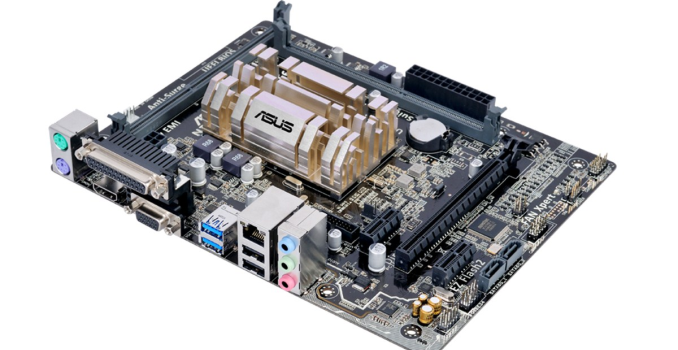
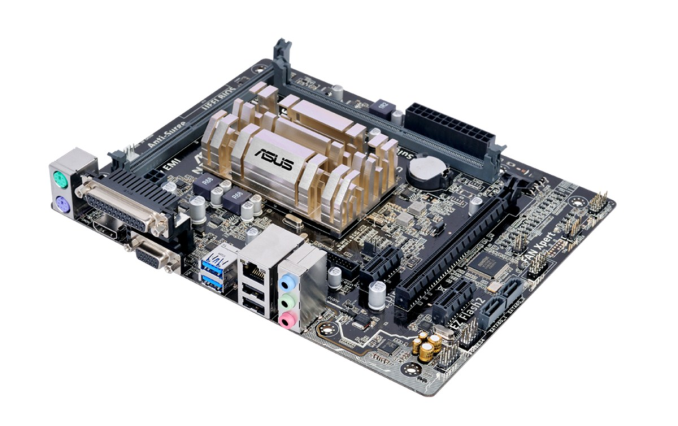
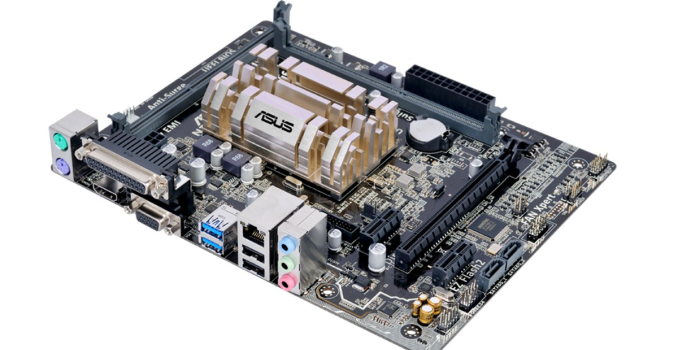
The N3150M-E is a micro-ATX motherboard with the Celeron N3150 processor built-in, and due to the 6W TDP being low enough, we also get a built in fanless heatsink. Braswell supports two DDR3L-1600 memory channels, and perhaps somewhat oddly we have them both here at right angles to each other. Online Intel lists the maximum memory compatibility for the CPU as 8GB, although the Beebox we reported on earlier is rated for 16GB so I would assume that the motherboard side of the equation should be able to do this too.
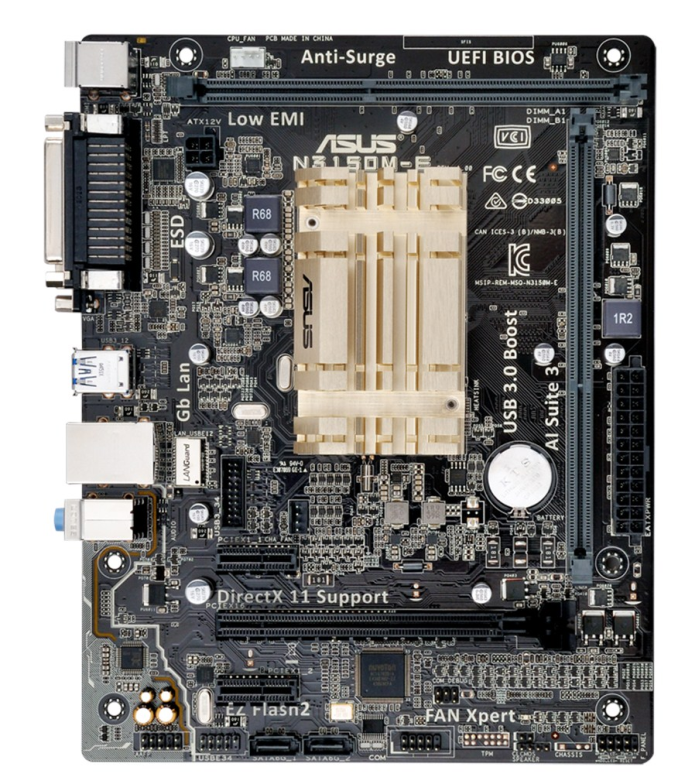
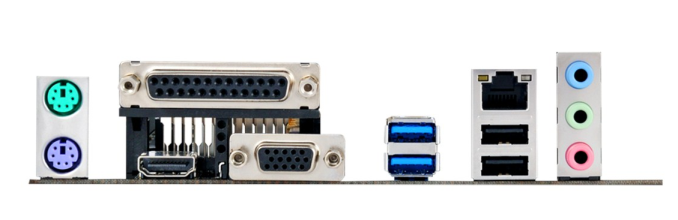
There is a full PCIe 2.0 x16 slot with x8 electrical (but might not offer more than x4 due to SoC limitations, and according to the spec sheet is only x1), allowing for those esoteric arrangements of Atom plus discrete graphics or just for an additional PCIe card, such as a RAID card for a storage platform. By default the N3150M-E gives two SATA 6 Gbps ports, a COM header, a USB 2.0 header and a USB 3.0 header. There are also two USB 3.0 ports on the rear, along with a Realtek network port and Realtek ALC887 audio. The audio solution is an upgraded one, with at least PCB separation between the audio channels and a couple of filter caps. Onboard video outputs are via a VGA and a HDMI connector, and we also get an LPT port for good measure.
The Celeron N3150 is a 14nm Airmont based quad core solution, featuring a 1.6 GHz base clock and a 2.08 GHz turbo. Onboard graphics are via Intel’s Gen8, with 12 EUs having a boost frequency of 600 MHz. Technically Brett has already had a quick review of Airmont cores in the Surface 3‘s Cherry Trail SoC, though it would be interesting to get a desktop variant in to see how the performance compares to previous desktop Atom units.

Source: ASUS, SH SOTN.

Update: It seems within a minute or two, ASUS has also posted the N3050M-E variant online as well. This uses the Celeron N3050, a dual core version with a 1.6 GHz base frequency but a turbo of 2.16 GHz.


Braswell Motherboard Surfaces Online: Quad Core 14nm Airmont in ASUS N3150M-E

Braswell Motherboard Surfaces Online: Quad Core 14nm Airmont in ASUS N3150M-E

When Intel initially released its Airmont platforms, Braswell for mini-PCs and Cherry Trail for tablets, it was unclear whether or not we would see custom desktop build equivalents, rather than just pre-built units. All the SoCs in the Braswell range were officially labelled as mobile parts, falling under the Celeron codename, for this reason. Intel has also recently released Xeon D, tackling the SFF space for enterprise use, but in the back of our minds we were always expecting an upgrade to the low-end Bay Trail motherboards with soldered down processors. Having already heard some news on the grapevine, ASUS is first to publicly display their motherboards online (well, one at first), albeit with no link through the main site and as a result this link was passed on to us by SH SOTN.

The N3150M-E is a micro-ATX motherboard with the Celeron N3150 processor built-in, and due to the 6W TDP being low enough, we also get a built in fanless heatsink. Braswell supports two DDR3L-1600 memory channels, and perhaps somewhat oddly we have them both here at right angles to each other. Online Intel lists the maximum memory compatibility for the CPU as 8GB, although the Beebox we reported on earlier is rated for 16GB so I would assume that the motherboard side of the equation should be able to do this too.

There is a full PCIe 2.0 x16 slot with x8 electrical (but might not offer more than x4 due to SoC limitations, and according to the spec sheet is only x1), allowing for those esoteric arrangements of Atom plus discrete graphics or just for an additional PCIe card, such as a RAID card for a storage platform. By default the N3150M-E gives two SATA 6 Gbps ports, a COM header, a USB 2.0 header and a USB 3.0 header. There are also two USB 3.0 ports on the rear, along with a Realtek network port and Realtek ALC887 audio. The audio solution is an upgraded one, with at least PCB separation between the audio channels and a couple of filter caps. Onboard video outputs are via a VGA and a HDMI connector, and we also get an LPT port for good measure.

The Celeron N3150 is a 14nm Airmont based quad core solution, featuring a 1.6 GHz base clock and a 2.08 GHz turbo. Onboard graphics are via Intel’s Gen8, with 12 EUs having a boost frequency of 600 MHz. Technically Brett has already had a quick review of Airmont cores in the Surface 3‘s Cherry Trail SoC, though it would be interesting to get a desktop variant in to see how the performance compares to previous desktop Atom units.

Source: ASUS, SH SOTN.

Update: It seems within a minute or two, ASUS has also posted the N3050M-E variant online as well. This uses the Celeron N3050, a dual core version with a 1.6 GHz base frequency but a turbo of 2.16 GHz.
NVIDIA Releases 352.86 Game Ready WHQL Drivers For The Witcher 3

NVIDIA Releases 352.86 Game Ready WHQL Drivers For The Witcher 3

With the highly anticipated The Witcher 3 being released today, NVIDIA has pushed out their requisite launch day Game Ready driver for the game with the release of driver version 352.86.

As is typical for a Game Ready driver, the focus on this driver is enabling SLI and GeForce Experience support for The Witcher 3, which along with its high profile nature is also one of the games in NVIDIA’s latest game bundle. Along with The Witcher, this driver also includes profile updates and bug fixes for a handful of other games, including Civilization: Beyond Earth and Magicka 2.

Perhaps more interesting is the fact that this marks the first Windows 7/8 (WDDM 1.x) release of a R352 branch driver. NVIDIA’s previous release for Grand Theft Auto V was from the R349 branch, and in fact this new branch comes barely a month after the introduction of the R349 branch. Unfortunately at this time beyond the handful of bug fixes and new profiles we don’t know whether R352 includes any major updates, as NVIDIA’s release notes don’t mention much else for this release. New branches typically contain more significant feature and performance enhancements, so there may be a surprise or two in here. At any rate what we do know is that NVIDIA has yet to merge their Win7/8 and Win10 drivers at this time, so this release only contains support for Microsoft’s current OSes, while the in-development Windows 10 continues to receive its own driver updates.

As usual, you can grab the drivers for all current desktop and mobile NVIDIA GPUs over at NVIDIA’s driver download page.

NVIDIA Releases 352.86 Game Ready WHQL Drivers For The Witcher 3

NVIDIA Releases 352.86 Game Ready WHQL Drivers For The Witcher 3

With the highly anticipated The Witcher 3 being released today, NVIDIA has pushed out their requisite launch day Game Ready driver for the game with the release of driver version 352.86.

As is typical for a Game Ready driver, the focus on this driver is enabling SLI and GeForce Experience support for The Witcher 3, which along with its high profile nature is also one of the games in NVIDIA’s latest game bundle. Along with The Witcher, this driver also includes profile updates and bug fixes for a handful of other games, including Civilization: Beyond Earth and Magicka 2.

Perhaps more interesting is the fact that this marks the first Windows 7/8 (WDDM 1.x) release of a R352 branch driver. NVIDIA’s previous release for Grand Theft Auto V was from the R349 branch, and in fact this new branch comes barely a month after the introduction of the R349 branch. Unfortunately at this time beyond the handful of bug fixes and new profiles we don’t know whether R352 includes any major updates, as NVIDIA’s release notes don’t mention much else for this release. New branches typically contain more significant feature and performance enhancements, so there may be a surprise or two in here. At any rate what we do know is that NVIDIA has yet to merge their Win7/8 and Win10 drivers at this time, so this release only contains support for Microsoft’s current OSes, while the in-development Windows 10 continues to receive its own driver updates.

As usual, you can grab the drivers for all current desktop and mobile NVIDIA GPUs over at NVIDIA’s driver download page.