News


Linksys EA8500 - First MU-MIMO Enabled 802.11ac Router Set to Ship

Linksys EA8500 – First MU-MIMO Enabled 802.11ac Router Set to Ship

Readers following our wireless networking coverage must be quite familiar with the developments in 802.11ac land. As a recap:

  • The first 3-stream 802.11ac routers (based on the Broadcom BCM4706 chipset) started shipping in May 2012, with Buffalo Technologies and Netgear leading the way. There were marketed as AC1750 units (3×3 5 GHz providing  up to 1300 Mbps and 3×3 2.4 GHz providing up to 450 Mbps). The street pricing of the AC1750 routers started to go down once Qualcomm started shipping their first-generation 802.11ac router platforms in products such as the TP-LINK Archer C7 in April 2013.
  • In Q4 2013, a wave of AC1900 units started to hit the market. Netgear’s Nighthawk R7000, a popular member in this series, still continues to sell well in the market. These units still used a 3×3 5 GHz radio for up to 1300 Mbps, but the 2.4 GHz had some proprietary Broadcom extensions (TurboQAM) to support up to 600 Mbps in an end-to-end Broadcom environment.
  • In 2014, Quantenna began to bring their technology lead in the Wi-Fi space to the market with their Wave 2 4×4 802.11ac chipset. Despite being announced at CES 2014, the Asus RT-AC87U began to ship in July with the QSR1000 radio coupled with a Broadcom SoC. Netgear started to ship the same radio coupled with a Qualcomm IPQ8064 SoC in the Nighthawk X4 in September 2014. The QSR1000’s Wave 2 feature set includes support for MU-MIMO, but neither of these routers shipped with MU-MIMO enabled in the firmware (citing lack of client support at that point of time). Given the 4×4 configuration, these routers were tagged as AC2350 / AC2400 units (600 Mbps in the 2.4 GHz band and 1733 Mbps in the 5 GHz band)
  • In the midst of these Wave 2 product launches, Qualcomm announced plans for their Wave 2 802.11ac platforms (both routers and clients) in April 2014. Broadcom, being late to the Wave 2 party, decided to bring out the XStream platform with dual 5 GHz radios (six-stream configuration) also in April. They were able to get it quickly into the market too, with the Netgear Nighthawk X6 R8000 becoming available in June 2014.
  • At CES 2015, we saw the first set of routers based on Qualcomm’s QCA9880 4×4 Wave 2 802.11ac router platform getting announced. Vendors such as TP-LINK and TRENDnet were expecting their AC2600 class routers to ship towards the middle of the year.

Coming back to today’s announcement regarding the EA8500, Linksys is becoming the first vendor to start shipping a QCA9980-based router. The important aspect here is that the router will ship with MU-MIMO enabled. Client devices with MU-MIMO enabled are also coming into the market just now (more on that in our detailed review). Hopefully, this announcement will spur both Netgear and Asus to enable MU-MIMO in the firmware for their Quantenna-based routers.

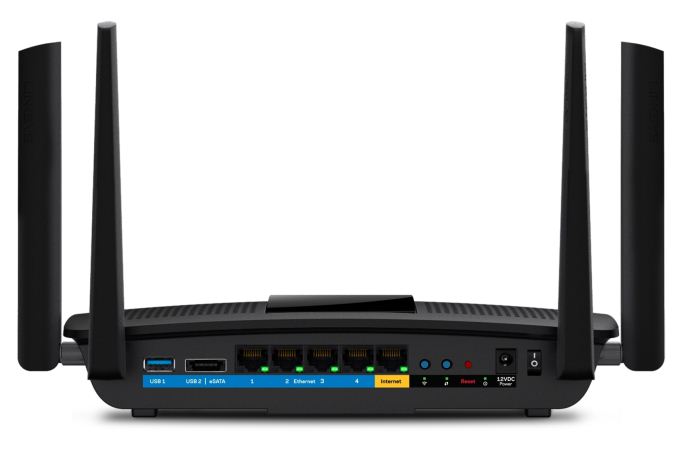
The salient features of the EA8500 router are listed below:

  • 4×4 802.11ac with MU-MIMO and beamforming support
  • QCA9980 radio + 1.4 GHz dual-core IPQ8064 SoC
  • Simultaneous dual-band operation (5 GHz 802.11ac – 1733 Mbps, 5 GHz 802.11n – 600 Mbps, 2.4 GHz 802.11n – 800 Mbps)
  • 1x USB 3.0, 1x USB 2.0 / eSATA
  • 4x 1Gbps LAN, 1x 1Gbps WAN
  • Adjustable antennas for optimal performance
One important point to note is that MU-MIMO capabilities will translate into real benefit only when there are multiple MU-MIMO-capable client devices talking to the router simultaneously. This will probably be a common scenario in enterprise Wi-Fi deployments soon. However, in a typical household, we would imagine that a situation involving multiple MU-MIMO clients is probably at least a good year away. Qualcomm is targeting an end-to-end play here, as the announcement made last year included a number of products in the client space with MU-MIMO capabilities.

Linksys is accepting pre-orders at $280 for the EA8500 today with shipments slated for May 10, 2015. Wide retail and e-tail availability is also expected starting next week. There is no doubt that MU-MIMO will be the most efficient way to boost Wi-Fi performance in the near future, and it is good that Linksys and Qualcomm are teaming together to accelerate its market adoption.

Linksys EA8500 - First MU-MIMO Enabled 802.11ac Router Set to Ship

Linksys EA8500 – First MU-MIMO Enabled 802.11ac Router Set to Ship

Readers following our wireless networking coverage must be quite familiar with the developments in 802.11ac land. As a recap:

  • The first 3-stream 802.11ac routers (based on the Broadcom BCM4706 chipset) started shipping in May 2012, with Buffalo Technologies and Netgear leading the way. There were marketed as AC1750 units (3×3 5 GHz providing  up to 1300 Mbps and 3×3 2.4 GHz providing up to 450 Mbps). The street pricing of the AC1750 routers started to go down once Qualcomm started shipping their first-generation 802.11ac router platforms in products such as the TP-LINK Archer C7 in April 2013.
  • In Q4 2013, a wave of AC1900 units started to hit the market. Netgear’s Nighthawk R7000, a popular member in this series, still continues to sell well in the market. These units still used a 3×3 5 GHz radio for up to 1300 Mbps, but the 2.4 GHz had some proprietary Broadcom extensions (TurboQAM) to support up to 600 Mbps in an end-to-end Broadcom environment.
  • In 2014, Quantenna began to bring their technology lead in the Wi-Fi space to the market with their Wave 2 4×4 802.11ac chipset. Despite being announced at CES 2014, the Asus RT-AC87U began to ship in July with the QSR1000 radio coupled with a Broadcom SoC. Netgear started to ship the same radio coupled with a Qualcomm IPQ8064 SoC in the Nighthawk X4 in September 2014. The QSR1000’s Wave 2 feature set includes support for MU-MIMO, but neither of these routers shipped with MU-MIMO enabled in the firmware (citing lack of client support at that point of time). Given the 4×4 configuration, these routers were tagged as AC2350 / AC2400 units (600 Mbps in the 2.4 GHz band and 1733 Mbps in the 5 GHz band)
  • In the midst of these Wave 2 product launches, Qualcomm announced plans for their Wave 2 802.11ac platforms (both routers and clients) in April 2014. Broadcom, being late to the Wave 2 party, decided to bring out the XStream platform with dual 5 GHz radios (six-stream configuration) also in April. They were able to get it quickly into the market too, with the Netgear Nighthawk X6 R8000 becoming available in June 2014.
  • At CES 2015, we saw the first set of routers based on Qualcomm’s QCA9880 4×4 Wave 2 802.11ac router platform getting announced. Vendors such as TP-LINK and TRENDnet were expecting their AC2600 class routers to ship towards the middle of the year.

Coming back to today’s announcement regarding the EA8500, Linksys is becoming the first vendor to start shipping a QCA9980-based router. The important aspect here is that the router will ship with MU-MIMO enabled. Client devices with MU-MIMO enabled are also coming into the market just now (more on that in our detailed review). Hopefully, this announcement will spur both Netgear and Asus to enable MU-MIMO in the firmware for their Quantenna-based routers.

The salient features of the EA8500 router are listed below:

  • 4×4 802.11ac with MU-MIMO and beamforming support
  • QCA9980 radio + 1.4 GHz dual-core IPQ8064 SoC
  • Simultaneous dual-band operation (5 GHz 802.11ac – 1733 Mbps, 5 GHz 802.11n – 600 Mbps, 2.4 GHz 802.11n – 800 Mbps)
  • 1x USB 3.0, 1x USB 2.0 / eSATA
  • 4x 1Gbps LAN, 1x 1Gbps WAN
  • Adjustable antennas for optimal performance

One important point to note is that MU-MIMO capabilities will translate into real benefit only when there are multiple MU-MIMO-capable client devices talking to the router simultaneously. This will probably be a common scenario in enterprise Wi-Fi deployments soon. However, in a typical household, we would imagine that a situation involving multiple MU-MIMO clients is probably at least a good year away. Qualcomm is targeting an end-to-end play here, as the announcement made last year included a number of products in the client space with MU-MIMO capabilities.

Linksys is accepting pre-orders at $280 for the EA8500 today with shipments slated for May 10, 2015. Wide retail and e-tail availability is also expected starting next week. There is no doubt that MU-MIMO will be the most efficient way to boost Wi-Fi performance in the near future, and it is good that Linksys and Qualcomm are teaming together to accelerate its market adoption.
AMD Announces OEM Desktop Radeon 300 Series

AMD Announces OEM Desktop Radeon 300 Series

Along with today’s announcement of the OEM mobile Radeon M300 series, AMD has also announced the OEM desktop Radeon 300 Series. This was a rather low-key launch with only a very brief press release on the matter along with AMD updating the OEM Radeon website, and as one might expect this is for good reason.

We’ve been through this event once before – most recently with the OEM HD 8000 series – so our regular readers will know the drill. Whether or not GPU manufacturers have new GPUs, OEMs will want new parts to sell, which leads to GPU manufacturers engaging in rebranding and subtle spec changes to create new parts to sell under a new series name. In AMD’s case this is complicated by the fact that they have been updating their GPUs in a piecemeal fashion – Hawaii, Bonaire, and Tonga have all landed at very different times – and AMD is not done yet as they’re going to be launching a new high-end GPU this quarter. So AMD needs a product lineup to include both the new part and their retained parts under a single brand, which leads to another incentive for rebadging.

In any case, as these are OEM parts I advise not reading into the names and specifications too much. AMD’s OEM and Retail parts can be very different at times – and at other times there aren’t any retail parts at all (HD 8000) – so these OEM parts aren’t necessarily indicative of what we’re going to see in retail in the coming months. Though based on AMD’s actions with the Radeon 200 series, we may yet see a similar rebadge happen for the retail 300 series.

AMD OEM Desktop Radeon R9 300 Series
  AMD Radeon HD R9 380 OEM AMD Radeon R9 370 OEM AMD Radeon R9 360 OEM
Was Variant of R9 285 Variant of R7 265 Variant of R9 260 (OEM)
Stream Processors 1792 1024 768
Texture Units 112 64 48
ROPs 32 32 16
Boost Clock <=918MHz <=975MHz <=1050MHz
Memory Clock 5.5GHz GDDR5 5.6GHz GDDR5 6.5GHz GDDR5?
Memory Bus Width 256-bit 256-bit 128-bit
VRAM <=4GB 2GB/4GB 2GB
Transistor Count 5.0B 2.8B 2.08B
GPU Tonga Pitcairn Bonaire
Manufacturing Process TSMC 28nm TSMC 28nm TSMC 28nm
Architecture GCN 1.2 GCN 1.0 GCN 1.1

Starting things off, we have the OEM R9 series. Today’s release tops out at R9 380 OEM (I can only imagine AMD is saving 390 for their new GPU), along with the R9 370 OEM and R9 360 OEM. The R9 380 OEM appears to be a variant of the desktop R9 285, which marks the first time that a Tonga card has been released in an OEM configuration. The quoted clockspeeds are identical to the retail R9 285, which means the “up to” GPU clockspeed should result in the R9 380 OEM being perfectly identical to the R9 285 if given its maximum configuration.

Meanwhile for the R9 370 OEM we have a cut-down Pitcairn card, with only 1024 of its 1280 SPs active. This makes it a variant of the retail R7 265, though with a slightly higher maximum GPU clockspeed. Truth be told I’m a bit worried to see a fresh Pitcairn part in 2015; Pitcairn has been a workhorse for AMD, having now survived into its 4th generation of cards. However at over 3 years old and based on GCN 1.0, it lacks more modern functionality such as the ability to decode 4K H.264 video files, AMD’s improved power management technology, and support for AMD’s Freesync technology.

Finally we have the R9 360 OEM. This appears to be a variant of the R9 260 OEM, featuring an AMD Bonaire GPU with only 768 of its 896 SPs enabled. Oddly, the listed memory bandwidth for the part, 104GB/sec, would require 6.5GHz GDDR5 memory given Bonaire’s 128-bit bus. I suspect that may be an error on AMD’s part, though it’s not outside the realm of possibility. In any case the R9 360 OEM also appears to be a regression from the R9 260 OEM; the latter was a fully enabled Bonaire part, whereas this one is not. At the very least it’s GCN 1.1 based, so it will have the newer features that the Pitcairn based R9 370 OEM lacks.

AMD OEM Desktop Radeon R7 300 Series
  AMD Radeon HD R7 350 OEM AMD Radeon R7 340 OEM
Was R7 250 R7 240
Stream Processors 384 384
Texture Units 24 24
ROPs 8 8
Boost Clock <=1050MHz <=780Hz
Memory Clock <=4.5GHz GDDR5
?GHz DDR3
<=4.5GHz GDDR5
?GHz DDR3
Memory Bus Width 128-bit 128-bit
VRAM 1GB/2GB 1GB/2GB GDDR5
2GB/4GB DDR3
GPU Oland Oland
Manufacturing Process TSMC 28nm TSMC 28nm
Architecture GCN 1.0 GCN 1.0

Up next is the R7 300 OEM series, which is composed of the R7 350 OEM and R7 340 OEM. Both of these cards are straight-up rebadges of AMD’s existing R7 250 OEM and R7 240 OEM parts, and both are based on the same GCN 1.0 Oland GPU. With just 384 SPs these are low cost, low performing parts. The difference between the two is their clockspeeds, with R7 350 being clocked quite a bit higher, whereas R7 340 is clocked lower in exchange for being available as a low-profile card. Unfortunately the memory situation is quite complex here, as these cards can be equipped with either GDDR5 or DDR3; the GDDR5 versions will of course be the much faster versions.

Among its other quirks, Oland lacks a hardware video decoder. So these parts are likely to be paired with low-end AMD Kaveri APUs, possibly for a Dual Graphics configuration.

AMD OEM Desktop Radeon R5 300 Series
  AMD Radeon HD R5 340 OEM AMD Radeon R5 330 OEM
Was Variant of R5 240 Variant of R5 240
Stream Processors 320 320
Texture Units 20 20
ROPs 8 8
Boost Clock <=825MHz <=855Hz
Memory Clock ? GDDR5/DDR3 ? DDR3
Memory Bus Width ? ?
VRAM <=2GB GDDR5/DDR3 <=2GB DDR3
GPU Oland Oland
Manufacturing Process TSMC 28nm TSMC 28nm
Architecture GCN 1.0 GCN 1.0

Finally, for the R5 300 OEM series we have two more Oland parts. These are ultra low end, low-profile single slot parts. AMD does not even publish the GPU bandwidth numbers for these parts, and as a result I suspect these may be 64-bit parts to further cut down on costs. Of particular note, the R5 330 lacks HDMI support, so it’s almost certainly geared towards APAC markets where VGA is still in common use.

Wrapping things up, AMD’s press release mentions that these new OEM parts are shipping now. HP is already confirmed to be shipping PCs with these new cards, and we expect other OEMs to ramp up as well as they launch their back-to-school season computers.

AMD Announces OEM Desktop Radeon 300 Series

AMD Announces OEM Desktop Radeon 300 Series

Along with today’s announcement of the OEM mobile Radeon M300 series, AMD has also announced the OEM desktop Radeon 300 Series. This was a rather low-key launch with only a very brief press release on the matter along with AMD updating the OEM Radeon website, and as one might expect this is for good reason.

We’ve been through this event once before – most recently with the OEM HD 8000 series – so our regular readers will know the drill. Whether or not GPU manufacturers have new GPUs, OEMs will want new parts to sell, which leads to GPU manufacturers engaging in rebranding and subtle spec changes to create new parts to sell under a new series name. In AMD’s case this is complicated by the fact that they have been updating their GPUs in a piecemeal fashion – Hawaii, Bonaire, and Tonga have all landed at very different times – and AMD is not done yet as they’re going to be launching a new high-end GPU this quarter. So AMD needs a product lineup to include both the new part and their retained parts under a single brand, which leads to another incentive for rebadging.

In any case, as these are OEM parts I advise not reading into the names and specifications too much. AMD’s OEM and Retail parts can be very different at times – and at other times there aren’t any retail parts at all (HD 8000) – so these OEM parts aren’t necessarily indicative of what we’re going to see in retail in the coming months. Though based on AMD’s actions with the Radeon 200 series, we may yet see a similar rebadge happen for the retail 300 series.

AMD OEM Desktop Radeon R9 300 Series
  AMD Radeon HD R9 380 OEM AMD Radeon R9 370 OEM AMD Radeon R9 360 OEM
Was Variant of R9 285 Variant of R7 265 Variant of R9 260 (OEM)
Stream Processors 1792 1024 768
Texture Units 112 64 48
ROPs 32 32 16
Boost Clock <=918MHz <=975MHz <=1050MHz
Memory Clock 5.5GHz GDDR5 5.6GHz GDDR5 6.5GHz GDDR5?
Memory Bus Width 256-bit 256-bit 128-bit
VRAM <=4GB 2GB/4GB 2GB
Transistor Count 5.0B 2.8B 2.08B
GPU Tonga Pitcairn Bonaire
Manufacturing Process TSMC 28nm TSMC 28nm TSMC 28nm
Architecture GCN 1.2 GCN 1.0 GCN 1.1

Starting things off, we have the OEM R9 series. Today’s release tops out at R9 380 OEM (I can only imagine AMD is saving 390 for their new GPU), along with the R9 370 OEM and R9 360 OEM. The R9 380 OEM appears to be a variant of the desktop R9 285, which marks the first time that a Tonga card has been released in an OEM configuration. The quoted clockspeeds are identical to the retail R9 285, which means the “up to” GPU clockspeed should result in the R9 380 OEM being perfectly identical to the R9 285 if given its maximum configuration.

Meanwhile for the R9 370 OEM we have a cut-down Pitcairn card, with only 1024 of its 1280 SPs active. This makes it a variant of the retail R7 265, though with a slightly higher maximum GPU clockspeed. Truth be told I’m a bit worried to see a fresh Pitcairn part in 2015; Pitcairn has been a workhorse for AMD, having now survived into its 4th generation of cards. However at over 3 years old and based on GCN 1.0, it lacks more modern functionality such as the ability to decode 4K H.264 video files, AMD’s improved power management technology, and support for AMD’s Freesync technology.

Finally we have the R9 360 OEM. This appears to be a variant of the R9 260 OEM, featuring an AMD Bonaire GPU with only 768 of its 896 SPs enabled. Oddly, the listed memory bandwidth for the part, 104GB/sec, would require 6.5GHz GDDR5 memory given Bonaire’s 128-bit bus. I suspect that may be an error on AMD’s part, though it’s not outside the realm of possibility. In any case the R9 360 OEM also appears to be a regression from the R9 260 OEM; the latter was a fully enabled Bonaire part, whereas this one is not. At the very least it’s GCN 1.1 based, so it will have the newer features that the Pitcairn based R9 370 OEM lacks.

AMD OEM Desktop Radeon R7 300 Series
  AMD Radeon HD R7 350 OEM AMD Radeon R7 340 OEM
Was R7 250 R7 240
Stream Processors 384 384
Texture Units 24 24
ROPs 8 8
Boost Clock <=1050MHz <=780Hz
Memory Clock <=4.5GHz GDDR5
?GHz DDR3
<=4.5GHz GDDR5
?GHz DDR3
Memory Bus Width 128-bit 128-bit
VRAM 1GB/2GB 1GB/2GB GDDR5
2GB/4GB DDR3
GPU Oland Oland
Manufacturing Process TSMC 28nm TSMC 28nm
Architecture GCN 1.0 GCN 1.0

Up next is the R7 300 OEM series, which is composed of the R7 350 OEM and R7 340 OEM. Both of these cards are straight-up rebadges of AMD’s existing R7 250 OEM and R7 240 OEM parts, and both are based on the same GCN 1.0 Oland GPU. With just 384 SPs these are low cost, low performing parts. The difference between the two is their clockspeeds, with R7 350 being clocked quite a bit higher, whereas R7 340 is clocked lower in exchange for being available as a low-profile card. Unfortunately the memory situation is quite complex here, as these cards can be equipped with either GDDR5 or DDR3; the GDDR5 versions will of course be the much faster versions.

Among its other quirks, Oland lacks a hardware video decoder. So these parts are likely to be paired with low-end AMD Kaveri APUs, possibly for a Dual Graphics configuration.

AMD OEM Desktop Radeon R5 300 Series
  AMD Radeon HD R5 340 OEM AMD Radeon R5 330 OEM
Was Variant of R5 240 Variant of R5 240
Stream Processors 320 320
Texture Units 20 20
ROPs 8 8
Boost Clock <=825MHz <=855Hz
Memory Clock ? GDDR5/DDR3 ? DDR3
Memory Bus Width ? ?
VRAM <=2GB GDDR5/DDR3 <=2GB DDR3
GPU Oland Oland
Manufacturing Process TSMC 28nm TSMC 28nm
Architecture GCN 1.0 GCN 1.0

Finally, for the R5 300 OEM series we have two more Oland parts. These are ultra low end, low-profile single slot parts. AMD does not even publish the GPU bandwidth numbers for these parts, and as a result I suspect these may be 64-bit parts to further cut down on costs. Of particular note, the R5 330 lacks HDMI support, so it’s almost certainly geared towards APAC markets where VGA is still in common use.

Wrapping things up, AMD’s press release mentions that these new OEM parts are shipping now. HP is already confirmed to be shipping PCs with these new cards, and we expect other OEMs to ramp up as well as they launch their back-to-school season computers.

Update: AMD Announces Radeon M300 Series Notebook Video Cards

Update: AMD Announces Radeon M300 Series Notebook Video Cards

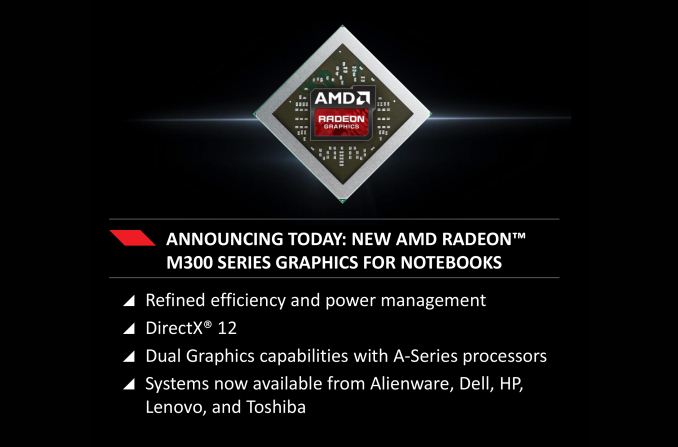
Along with a bevy of roadmap announcements at financial analyst day, AMD has also slipped in a full-on mobile GPU announcement today at the event.

Being announced today is the Radeon M300 series. With so much other news coming out of FAD we’re still tracking down more information on the product line, but of the information released by AMD so far, we do know that these parts are being advertised as refined parts with better efficiency and power management. AMD’s FAD presentation has not made any mention of what specific GPUs are being used here or of specific SKUs (we may yet see a press release), so it’s not clear whether there are new GPUs involved or if these are simply rebadges of existing GPUs and products.

AMD does note that M300 systems should already be available from several of AMD’s usual partners, including Alienware, HP, Dell, Lenovo, and Toshiba. Meanwhile given the timing of the announcement and the fact that AMD is specifically advertising these GPUs as supporting Dual Graphics mode with AMD’s A-series APUs, I suspect some of these GPUs may be intended to work alongside AMD’s Carrizo APU, which is due this year.

Update: AMD has since released the details of the M300 SKUs on their website, and though they’re not incredibly detailed, they give us an idea of just what AMD is up to.

AMD M300 Series GPU Specification Comparison
  R9 M375 R7 M360 R5 M330
Was Variant of R9 M270/M260 Variant of R7 M270/M260 Variant of R5 M255
Stream Processors 640 384 320
Texture Units 40 24 20
ROPs 16 4? 4?
Boost Clock <=1015MHz <=1015MHz <=1030MHz
Memory Clock 2.2GHz DDR3 2GHz DDR3 2GHz DDR3
Memory Bus Width 128-bit 64-bit 64-bit
VRAM <=4GB <=4GB <=4GB
GPU Cape Verde Oland Oland
Manufacturing Process TSMC 28nm TSMC 28nm TSMC 28nm
Architecture GCN 1.0 GCN 1.0 GCN 1.0

Unfortunately it looks like everything is going to be a rebadge/rehash of AMD’s existing GCN 1.0 GPUs. While AMD’s specs do not confirm which GPUs we’re looking at, and hence we’re admittedly taking an educated guess, based on the specs and features we have every reason to believe we’re looking at Cape Verde and Oland, the two GPUs that also backed AMD’s M200 series. I had been hoping for a cut-down Bonaire in here, to bring GCN 1.1 to mobile, but it doesn’t look like that’s in the cards.

What we have then is a 3 product stack with some very unusual configurations. Compared to their M200 counterparts, all 3 M300 parts have much higher GPU clockspeeds. AMD is now allowing clockspeeds over 1GHz, even for the low-end M330. Though as always, we need to remind everyone that these are “up to” speeds, and OEMs get the final choice in what the shipping clockspeed of a M300 part will be in any given laptop.

And although clockspeeds are up, memory bandwidth is way, way down. All of these parts ship with DDR3, and of those only the M375 gets a 128-bit memory bus. The other two parts, based on Oland, are shipping with a 64-bit memory bus. On the M200 series AMD was using GDDR5 with Cape Verde and the full 128-bit memory bus with Oland, so these new parts have half (or less) of the memory bandwidth of their M200 counterparts.  The fact that AMD did this while increasing clockspeeds (which generally has a knock-on impact on power consumption) is very odd, and I would expect that these new parts are going to be bandwidth starved and will not reach the full potential of their respective GPUs. Meanwhile there’s also some uncertainty over the number of ROPs enabled on the M360 and M330; with 64-bit memory buses on a chip that natively has a 128-bit memory bus, AMD may have disabled half of the ROPs in the process.

Looking at these parts overall, in AMD’s FAD event today the company specifically noted the dual graphics capabilities of the M300 series, and I suspect that’s precisely what these parts are meant for. They’re not intended to be stand-alone, but rather they’re designed to be paired with Carrizo/Kaveri APUs to inject more graphics silicon to improve GPU performance. In which case we’re looking at another wrinkle in performance, not only from dual graphics but from the fact that AMD’s APUs tend to be hungry for bandwidth as well, in which case the impact of these slower memory buses may not be as great.

Finally, it’s interesting to note that AMD only went up to M375 here. They did not introduce an M380 or M390 series part, not even rebadging the Pitcairn/Tonga parts that compose the faster members of the M200 series. This may be a sign that AMD intends to introduce faster parts later on, but for the moment that’s merely speculation on my part.