News


Update: AMD Announces Radeon M300 Series Notebook Video Cards
Update: AMD Announces Radeon M300 Series Notebook Video Cards

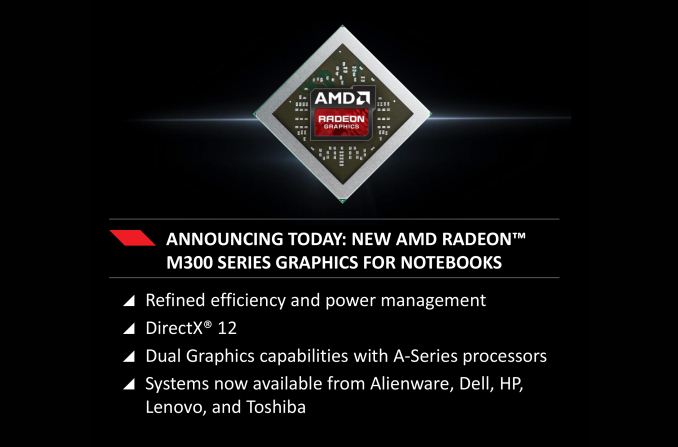
Along with a bevy of roadmap announcements at financial analyst day, AMD has also slipped in a full-on mobile GPU announcement today at the event.

Being announced today is the Radeon M300 series. With so much other news coming out of FAD we’re still tracking down more information on the product line, but of the information released by AMD so far, we do know that these parts are being advertised as refined parts with better efficiency and power management. AMD’s FAD presentation has not made any mention of what specific GPUs are being used here or of specific SKUs (we may yet see a press release), so it’s not clear whether there are new GPUs involved or if these are simply rebadges of existing GPUs and products.

AMD does note that M300 systems should already be available from several of AMD’s usual partners, including Alienware, HP, Dell, Lenovo, and Toshiba. Meanwhile given the timing of the announcement and the fact that AMD is specifically advertising these GPUs as supporting Dual Graphics mode with AMD’s A-series APUs, I suspect some of these GPUs may be intended to work alongside AMD’s Carrizo APU, which is due this year.

Update: AMD has since released the details of the M300 SKUs on their website, and though they’re not incredibly detailed, they give us an idea of just what AMD is up to.

AMD M300 Series GPU Specification Comparison
  R9 M375 R7 M360 R5 M330
Was Variant of R9 M270/M260 Variant of R7 M270/M260 Variant of R5 M255
Stream Processors 640 384 320
Texture Units 40 24 20
ROPs 16 4? 4?
Boost Clock <=1015MHz <=1015MHz <=1030MHz
Memory Clock 2.2GHz DDR3 2GHz DDR3 2GHz DDR3
Memory Bus Width 128-bit 64-bit 64-bit
VRAM <=4GB <=4GB <=4GB
GPU Cape Verde Oland Oland
Manufacturing Process TSMC 28nm TSMC 28nm TSMC 28nm
Architecture GCN 1.0 GCN 1.0 GCN 1.0

Unfortunately it looks like everything is going to be a rebadge/rehash of AMD’s existing GCN 1.0 GPUs. While AMD’s specs do not confirm which GPUs we’re looking at, and hence we’re admittedly taking an educated guess, based on the specs and features we have every reason to believe we’re looking at Cape Verde and Oland, the two GPUs that also backed AMD’s M200 series. I had been hoping for a cut-down Bonaire in here, to bring GCN 1.1 to mobile, but it doesn’t look like that’s in the cards.

What we have then is a 3 product stack with some very unusual configurations. Compared to their M200 counterparts, all 3 M300 parts have much higher GPU clockspeeds. AMD is now allowing clockspeeds over 1GHz, even for the low-end M330. Though as always, we need to remind everyone that these are “up to” speeds, and OEMs get the final choice in what the shipping clockspeed of a M300 part will be in any given laptop.

And although clockspeeds are up, memory bandwidth is way, way down. All of these parts ship with DDR3, and of those only the M375 gets a 128-bit memory bus. The other two parts, based on Oland, are shipping with a 64-bit memory bus. On the M200 series AMD was using GDDR5 with Cape Verde and the full 128-bit memory bus with Oland, so these new parts have half (or less) of the memory bandwidth of their M200 counterparts.  The fact that AMD did this while increasing clockspeeds (which generally has a knock-on impact on power consumption) is very odd, and I would expect that these new parts are going to be bandwidth starved and will not reach the full potential of their respective GPUs. Meanwhile there’s also some uncertainty over the number of ROPs enabled on the M360 and M330; with 64-bit memory buses on a chip that natively has a 128-bit memory bus, AMD may have disabled half of the ROPs in the process.

Looking at these parts overall, in AMD’s FAD event today the company specifically noted the dual graphics capabilities of the M300 series, and I suspect that’s precisely what these parts are meant for. They’re not intended to be stand-alone, but rather they’re designed to be paired with Carrizo/Kaveri APUs to inject more graphics silicon to improve GPU performance. In which case we’re looking at another wrinkle in performance, not only from dual graphics but from the fact that AMD’s APUs tend to be hungry for bandwidth as well, in which case the impact of these slower memory buses may not be as great.

Finally, it’s interesting to note that AMD only went up to M375 here. They did not introduce an M380 or M390 series part, not even rebadging the Pitcairn/Tonga parts that compose the faster members of the M200 series. This may be a sign that AMD intends to introduce faster parts later on, but for the moment that’s merely speculation on my part.
AMD Financial Analyst Day 2015 Round-Up

AMD Financial Analyst Day 2015 Round-Up

Having just wrapped up a bit ago is AMD’s 2015 Financial Analyst Day (FAD). For AMD FADs are a combination of roadmap updates and number breakdowns for financial analysts and investors, showcasing where the company intends to go and why investors should continue to back the company.

We’ve been covering FAD 2015 throughout the afternoon, and we have seen AMD make a number of announcements and roadmap reveals throughout the event. The individual announcements are below, and meanwhile now that the event has wrapped up we want to provide a quick summary of what AMD is going to be up to over the next two years.

AMD Charts Future Growth Opportunities
AMD’s 2016-2017 x86 Roadmap: Zen Is In, Skybridge Is Out
AMD’s K12 ARM CPU Now In 2017
AMD’s 2016 GPU Roadmap: FinFET & High Bandwidth Memory
AMD To Launch New Desktop GPU This Quarter (Q2’15) With HBM
AMD Announces 6th Generation A-Series APU Branding – Carrizo Due This Quarter
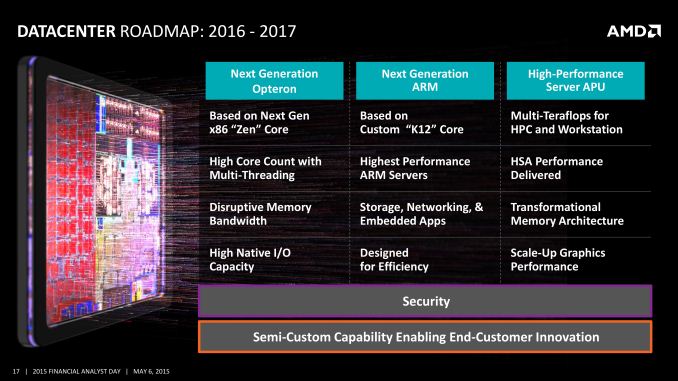
AMD’s 2016-2017 Datacenter Roadmap: x86, ARM, and GPGPU

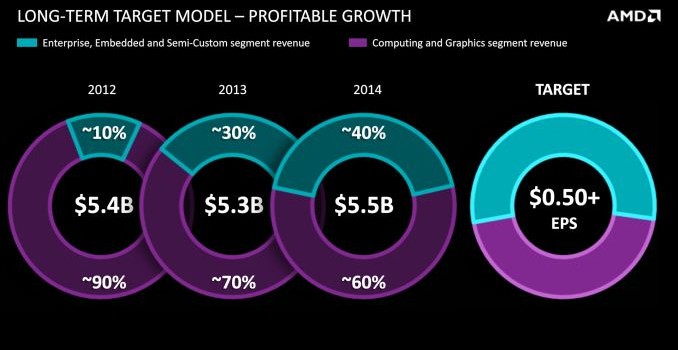
With AMD’s FAD 2012 being a major event for the company – one where then-CEO Rory Reed announced AMD’s intention to move away from being almost solely PC focused to a mix of PC, semi-custom, and ARM products – FAD 2015 by comparison is a far more tame event. Under the direction of Dr. Lisa Su, AMD is largely executing on the plan they set into motion some time ago. And where they have made changes, such as dropping SeaMicro, AMD has announced those changes in advance. So this year’s FAD does not see AMD announcing major changes to the company’s direction.

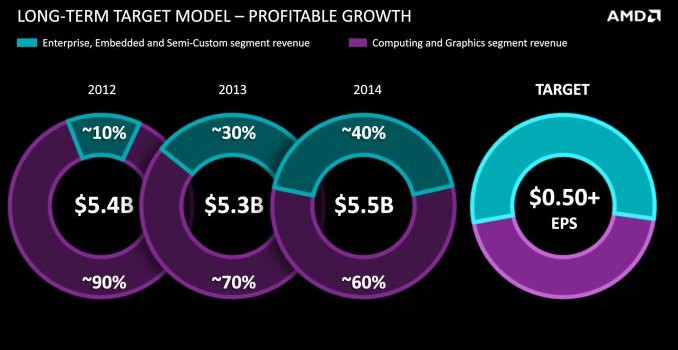
So what is AMD’s direction over the next two years? The short answer to that is that the company is focusing on what they believe to be higher margin, higher growth opportunity markets where they can take a chunk of those markets without necessarily having to wrest revenue and sales from existing competitors. Overall AMD sees their three big growth markets as gaming, immersive platforms, and the datacenter market.

At the same time what AMD is looking to avoid is low-margin markets where they can’t do something to set themselves apart. AMD has made it clear that they’re not going to invest in fields such as mobile (smartphones/tablets) or IoT client devices, as while that’s a high growth field, it’s already overweight with competitors who either have the cost control (MediaTek) or the war chest (Intel) to drive margins down to levels AMD cannot sustain. Similarly, AMD is working to reduce their presence in the low-end PC market, as that too suffers from low margins, and is coupled with a poor outlook that has seen AMD get burnt by a significant drop in demand (and consequently revenue) in that market.

The one exception to this of course is semi-custom silicon, which although is not high-margin, allows AMD to leverage their strengths. Nowhere else can you find a vendor with a top-tier GPU profile, custom x86 CPUs, custom ARM CPUs, and the willingness to help customers build customized chips around those building blocks. Semi-custom silicon also presents AMD with some relatively stable revenue, as contracts for semi-custom designs will typically involve supplying chips for a number of years.

To achieve their goals, AMD has set out a roadmap through 2016 and 2017 to develop the technologies necessary to compete in their respective markets, and to deliver the performance necessary for both semi-custom silicon and finished AMD products.

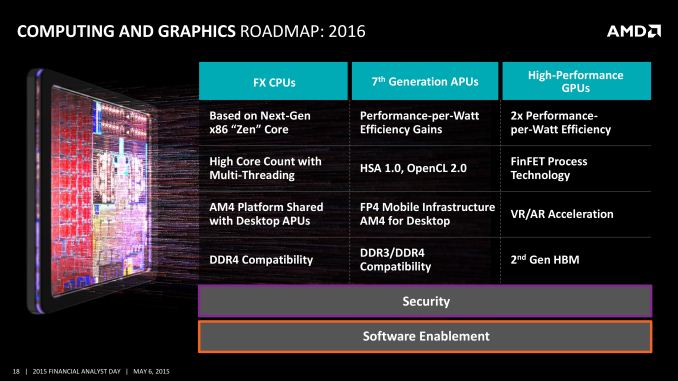
The big item on AMD’s agenda is of course Zen, the company’s forthcoming x86 CPU design. Scheduled to launch in 2016, starting with the high-performance desktop, Zen is a return to fundamentals of sorts for AMD. We do not have performance estimates for Zen, but from an architectural standpoint AMD is making it clear that they are shooting for much higher IPC with Zen than Carrizo/Excavator, touting a 40% increase in IPC.

Zen will ultimately be driving AMD’s entire range of x86 products, top to bottom, datacenter to laptop. AMD’s Dozer and Cat families are at an end, and in the end there will be only Zen. Zen in turn will be part of a long-term process for AMD; the company already has newer iterations of Zen in the works (Zen+) which further improve on the architecture farther out. Coupled with significant gains AMD is expecting to enjoy from FinFET processes, and the company is putting on their optimistic face for their chances in the x86 market.

In fact AMD is backing Zen to the point where other projects have been pushed to the wayside or canceled altogether. AMD’s project Skybridge – a plan for 20nm ambidextrous x86 and ARM CPUs – has essentially been canceled as a result of the combination of lack of customer need for ambidextrous CPUs and the generally poor performance of the 20nm process. Meanwhile Zen’s ARM sibling – K12 – has been pushed back from 2016 to 2017 to allow AMD to complete Zen first, and then roll what they’ve learned from Zen into K12.

For AMD this marks a return to form, and a very aggressive move on the x86 market. After having seen their datacenter market share fall to just 1.5%, for example – with the company admitting they did not invest in high-performance CPUs and it cost them most of their market share – AMD is optimistic that they can recover their datacenter market share through the combination of Zen, K12, and their GPGPU capabilities. This in turn means hitting the datacenter in both the CPU and HPC markets, and even going one step beyond with a forthcoming, very high performance HPC APU that combines all of AMD’s strengths.

Meanwhile on the GPU front, AMD is not providing quite as much visibility on their GPU roadmap, but they are sharing their plans out to 2016. Launching this quarter will be a new AMD desktop product featuring High Bandwidth Memory (HBM), the first such product in the GPU space. HBM promises to significantly increase AMD’s available memory bandwidth and allow their partners to work on more innovative card designs due to the smaller amount of space an HBM solution requires.

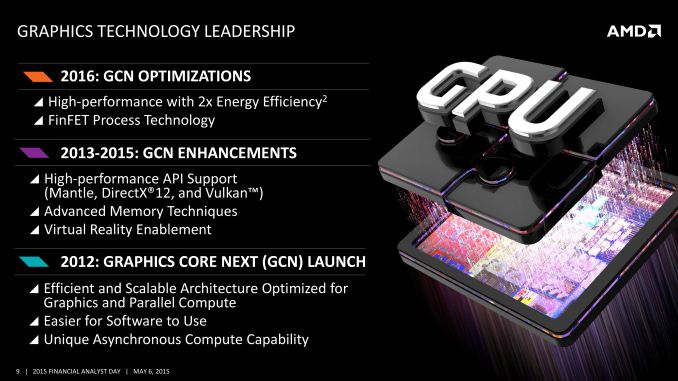
2016 in turn will see AMD continue their focus on HBM with the release of products using HBM Gen2, all the while releasing their first GPUs manufactured on a FinFET process. AMD isn’t naming which process they’re using, though either way it would be a significant step up in manufacturing from the current 28nm process their GPUs use. Overall AMD is touting a 2x increase in perf-per-watt for their 2016 GPUs, with most of that gain coming from the shift to FinFET.

Longer term, while AMD is not committing towards any specific products, AMD is strongly hinting at HBM coming to APUs as well. AMD’s APUs have traditionally struggled under the limited amount of bandwidth 128-bit DDR3 provides, so an HBM-enabled APU would help to further improve AMD’s GPU performance on their APUs.

Wrapping things up, the key to AMD’s plans for the next two years will hinge on both properly anticipating the market and in executing on technology. AMD will need to correctly predict opportunities to grow – particularly rapidly expanding markets as opposed to stealing revenue from existing players – and then execute on that in a timely manner with solid hardware across both the CPU and GPU space. AMD believes they have the pieces they need in development, and with 2015 almost half-over the company is finally reaching the point where their earlier transition is complete, so it will be interesting to see how AMD’s next two years unfold. The company is not yet in dire straits, but after losing market share and seeing gross margins suffer, now is the time where AMD needs to reverse their fortunes and reach profitability if they’re to ensure their own future.

AMD Financial Analyst Day 2015 Round-Up

AMD Financial Analyst Day 2015 Round-Up

Having just wrapped up a bit ago is AMD’s 2015 Financial Analyst Day (FAD). For AMD FADs are a combination of roadmap updates and number breakdowns for financial analysts and investors, showcasing where the company intends to go and why investors should continue to back the company.

We’ve been covering FAD 2015 throughout the afternoon, and we have seen AMD make a number of announcements and roadmap reveals throughout the event. The individual announcements are below, and meanwhile now that the event has wrapped up we want to provide a quick summary of what AMD is going to be up to over the next two years.

AMD Charts Future Growth Opportunities
AMD’s 2016-2017 x86 Roadmap: Zen Is In, Skybridge Is Out
AMD’s K12 ARM CPU Now In 2017
AMD’s 2016 GPU Roadmap: FinFET & High Bandwidth Memory
AMD To Launch New Desktop GPU This Quarter (Q2’15) With HBM
AMD Announces 6th Generation A-Series APU Branding – Carrizo Due This Quarter
AMD’s 2016-2017 Datacenter Roadmap: x86, ARM, and GPGPU

With AMD’s FAD 2012 being a major event for the company – one where then-CEO Rory Reed announced AMD’s intention to move away from being almost solely PC focused to a mix of PC, semi-custom, and ARM products – FAD 2015 by comparison is a far more tame event. Under the direction of Dr. Lisa Su, AMD is largely executing on the plan they set into motion some time ago. And where they have made changes, such as dropping SeaMicro, AMD has announced those changes in advance. So this year’s FAD does not see AMD announcing major changes to the company’s direction.

So what is AMD’s direction over the next two years? The short answer to that is that the company is focusing on what they believe to be higher margin, higher growth opportunity markets where they can take a chunk of those markets without necessarily having to wrest revenue and sales from existing competitors. Overall AMD sees their three big growth markets as gaming, immersive platforms, and the datacenter market.

At the same time what AMD is looking to avoid is low-margin markets where they can’t do something to set themselves apart. AMD has made it clear that they’re not going to invest in fields such as mobile (smartphones/tablets) or IoT client devices, as while that’s a high growth field, it’s already overweight with competitors who either have the cost control (MediaTek) or the war chest (Intel) to drive margins down to levels AMD cannot sustain. Similarly, AMD is working to reduce their presence in the low-end PC market, as that too suffers from low margins, and is coupled with a poor outlook that has seen AMD get burnt by a significant drop in demand (and consequently revenue) in that market.

The one exception to this of course is semi-custom silicon, which although is not high-margin, allows AMD to leverage their strengths. Nowhere else can you find a vendor with a top-tier GPU profile, custom x86 CPUs, custom ARM CPUs, and the willingness to help customers build customized chips around those building blocks. Semi-custom silicon also presents AMD with some relatively stable revenue, as contracts for semi-custom designs will typically involve supplying chips for a number of years.

To achieve their goals, AMD has set out a roadmap through 2016 and 2017 to develop the technologies necessary to compete in their respective markets, and to deliver the performance necessary for both semi-custom silicon and finished AMD products.

The big item on AMD’s agenda is of course Zen, the company’s forthcoming x86 CPU design. Scheduled to launch in 2016, starting with the high-performance desktop, Zen is a return to fundamentals of sorts for AMD. We do not have performance estimates for Zen, but from an architectural standpoint AMD is making it clear that they are shooting for much higher IPC with Zen than Carrizo/Excavator, touting a 40% increase in IPC.

Zen will ultimately be driving AMD’s entire range of x86 products, top to bottom, datacenter to laptop. AMD’s Dozer and Cat families are at an end, and in the end there will be only Zen. Zen in turn will be part of a long-term process for AMD; the company already has newer iterations of Zen in the works (Zen+) which further improve on the architecture farther out. Coupled with significant gains AMD is expecting to enjoy from FinFET processes, and the company is putting on their optimistic face for their chances in the x86 market.

In fact AMD is backing Zen to the point where other projects have been pushed to the wayside or canceled altogether. AMD’s project Skybridge – a plan for 20nm ambidextrous x86 and ARM CPUs – has essentially been canceled as a result of the combination of lack of customer need for ambidextrous CPUs and the generally poor performance of the 20nm process. Meanwhile Zen’s ARM sibling – K12 – has been pushed back from 2016 to 2017 to allow AMD to complete Zen first, and then roll what they’ve learned from Zen into K12.

For AMD this marks a return to form, and a very aggressive move on the x86 market. After having seen their datacenter market share fall to just 1.5%, for example – with the company admitting they did not invest in high-performance CPUs and it cost them most of their market share – AMD is optimistic that they can recover their datacenter market share through the combination of Zen, K12, and their GPGPU capabilities. This in turn means hitting the datacenter in both the CPU and HPC markets, and even going one step beyond with a forthcoming, very high performance HPC APU that combines all of AMD’s strengths.

Meanwhile on the GPU front, AMD is not providing quite as much visibility on their GPU roadmap, but they are sharing their plans out to 2016. Launching this quarter will be a new AMD desktop product featuring High Bandwidth Memory (HBM), the first such product in the GPU space. HBM promises to significantly increase AMD’s available memory bandwidth and allow their partners to work on more innovative card designs due to the smaller amount of space an HBM solution requires.

2016 in turn will see AMD continue their focus on HBM with the release of products using HBM Gen2, all the while releasing their first GPUs manufactured on a FinFET process. AMD isn’t naming which process they’re using, though either way it would be a significant step up in manufacturing from the current 28nm process their GPUs use. Overall AMD is touting a 2x increase in perf-per-watt for their 2016 GPUs, with most of that gain coming from the shift to FinFET.

Longer term, while AMD is not committing towards any specific products, AMD is strongly hinting at HBM coming to APUs as well. AMD’s APUs have traditionally struggled under the limited amount of bandwidth 128-bit DDR3 provides, so an HBM-enabled APU would help to further improve AMD’s GPU performance on their APUs.

Wrapping things up, the key to AMD’s plans for the next two years will hinge on both properly anticipating the market and in executing on technology. AMD will need to correctly predict opportunities to grow – particularly rapidly expanding markets as opposed to stealing revenue from existing players – and then execute on that in a timely manner with solid hardware across both the CPU and GPU space. AMD believes they have the pieces they need in development, and with 2015 almost half-over the company is finally reaching the point where their earlier transition is complete, so it will be interesting to see how AMD’s next two years unfold. The company is not yet in dire straits, but after losing market share and seeing gross margins suffer, now is the time where AMD needs to reverse their fortunes and reach profitability if they’re to ensure their own future.

AMD’s 2016-2017 Datacenter Roadmap: x86, ARM, and GPGPU

AMD’s 2016-2017 Datacenter Roadmap: x86, ARM, and GPGPU

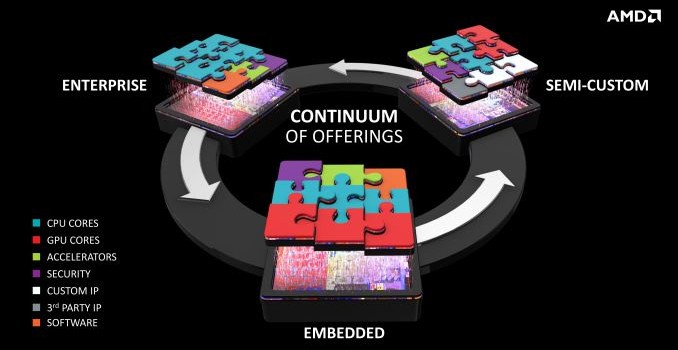
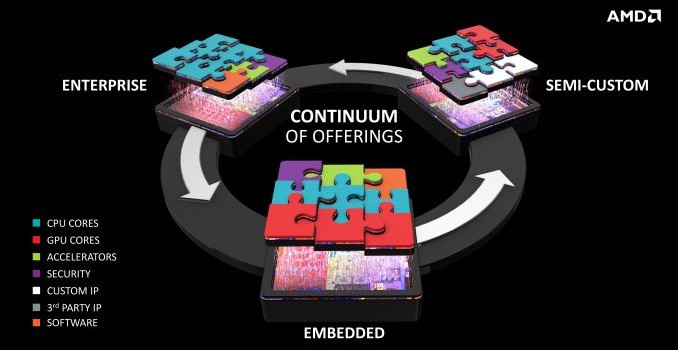
As part of AMD’s business unit reorganization in 2014, many of AMD’s high-growth businesses were organized into a new group at the company, the Enterprise, Embedded, and Semi-Custom Business (EESC). Now through their first few quarters, Fo…

AMD’s 2016-2017 Datacenter Roadmap: x86, ARM, and GPGPU

AMD’s 2016-2017 Datacenter Roadmap: x86, ARM, and GPGPU

As part of AMD’s business unit reorganization in 2014, many of AMD’s high-growth businesses were organized into a new group at the company, the Enterprise, Embedded, and Semi-Custom Business (EESC). Now through their first few quarters, Fo…