News


Synology Launches ARM-based DS1515 and RS815 Value Series NAS Units
Synology Launches ARM-based DS1515 and RS815 Value Series NAS Units

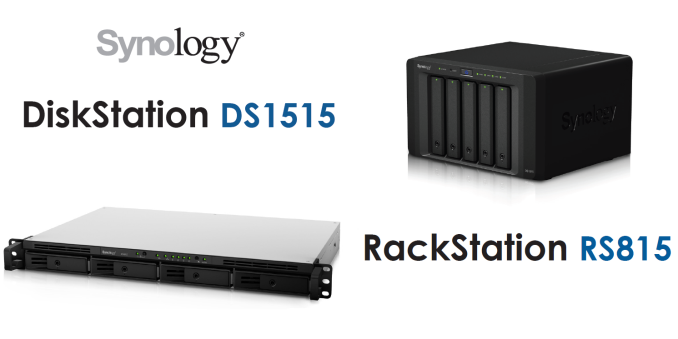
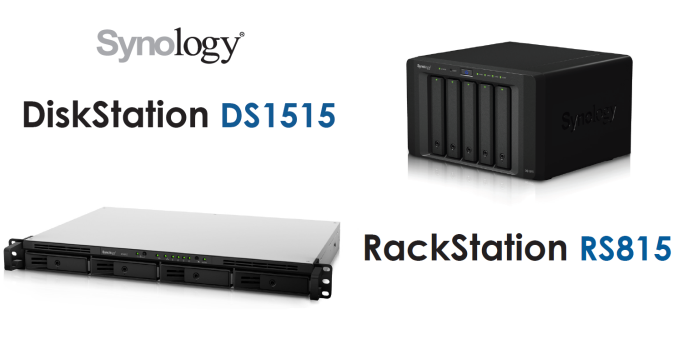
Synology introduced their x15+ series in the second half of 2014. The models were all based on the Intel Rangeley platform (x86). It is now time for a refresh of the Value Series using ARM-based SoCs – the x15 models. There are two units being introduced today, the 5-bay DS1515 in the tower form factor (MSRP: $650) and the 4-bay RS815 in a new short-depth rackmount form factor (MSRP: $600).

DS1515

Based on the Annapurna Labs Alpine AL-314 quad-core Cortex-A15 SoC, the unit has four GbE LAN ports, two USB 3.0 and two eSATA ports. The eSATA ports can be used to connect up to two DX513 / DX213 expansion units. This can provide up to a maximum of 10 bays additional to the five on the main unit. The DS1515 comes with 2GB of RAM.

Gallery: Synology DS1515

The unit comes with Synology’s widely respected DiskStation Manager DSM 5.2 OS supporting a wide variety of networking protocols, applications and add-on packages. The AL-314 SoC comes with hardware encryption engines and a dedicated floating point unit. The presence of four LAN ports help in setting up a high-performance high-availability cluster. Claimed throughput numbers indicate up to 403.7 MBps reads and 421.8 MBps writes.

RS815

The RS815 solution is internally the same as the RS814 introduced last year. Carrying the same Marvell ARMADA XP MV78230 that we reviewed a couple of years back in the LenovoEMC ix4-300d, the performance numbers come in at 216.7 MBps reads and 121.8 MBps writes. The eSATA port allows the connection of a RX415 expansion unit. This can provide up to a maximum of 4 bays additional to the four on the main unit.

Gallery: Synology RS815

The important update is the short-depth chassis design. The RS815 is only 29 cm deep, compared to the RS814’s 46 cm. This allows for denser deployments and compatibility with industrial server environments.

It is refreshing to see Synology continuing to invest in ARM-based models for the Value Series. While these are not true 64-bit solutions yet, they will ensure that Intel x86-based solutions are not the only game in town for high-performance NAS units. The presence of four GbE ports on the DS1515 brings a host of exciting use-cases to the table. The Alpine platform might just about cut the grade for 10G NAS units, but it should be an excellent choice for NAS units with GbE LAN ports. The RS815, on the other hand, takes a tried and tested platform and fits it in a new chassis to expand its application areas.
AMD Releases Catalyst 15.4 Beta Drivers

AMD Releases Catalyst 15.4 Beta Drivers

In a busy day for video card drivers ahead of the Grand Theft Auto V launch, AMD has also released an updated driver set in preparation for release of the game.

Released in beta form, Catalyst 15.4 (display driver ver. 14.502.1014) is AMD’s G…

NVIDIA Releases 350.12 Game Ready WHQL Drivers

NVIDIA Releases 350.12 Game Ready WHQL Drivers

Hot on the heels of their first R349 branch driver release earlier this month with the release of the 350.05 hotfix drivers, NVIDIA is back again with another R349 release. This time NVIDIA is releasing 350.12, which happens to be both a Game Ready release and their first R349 WHQL release.

On the Game Ready front, NVIDIA is releasing these drivers ahead of this evening’s release of the PC version of Grand Theft Auto V, and as is customary for a Game Ready release it contains all of the latest optimizations and profiles necessary for the game. This includes profiles to enable both SLI and 3D Vision support. Meanwhile from a technical standpoint GTA V will be a GameWorks-enabled title, with developer Rockstar using NVIDIA’s Percentage-Closer Soft Shadows (PCSS) and TXAA technologies in the game.

Otherwise as this is also the first R349 WHQL driver we have a bit more detail on what NVIDIA has been working on under the hood for this branch, thanks to a proper set of release notes. Of particular note, NVIDIA has improved the interaction between high resolution (4K+) displays, SLI, and their frame buffer capture technology (used in GameStream/Shadowplay) to reduce the performance hit from using all of these technologies together. Similarly, the NVIDIA control panel is now finally HiDPI aware, capable of supporting 250 DPI.

With this driver release NVIDIA has also posted a bit more information on their OpenCL 1.2 driver. The driver has not yet passed OpenCL conformance testing over at Khronos, but it is expected to do so. OpenCL 1.2 functionality will only be available on Kepler and Maxwell GPUs, with Fermi getting left behind.

Finally, for Windows 10 users, it looks like you’ll want to stick to the Windows Update drivers if you want WDDM 2.0 support. A quick check of the 350.12 INF file shows that it doesn’t have entries for Windows 10, indicating that this driver is not WDDM 2.0 enabled.

As usual, you can grab the drivers for all current desktop and mobile NVIDIA GPUs over at NVIDIA’s driver download page.

Crucial BX100 (120GB, 250GB, 500GB & 1TB) SSD Review

Crucial has been doing very well in the client SSD market during the past year. Crucial’s/Micron’s ability to quickly roll out the 16nm NAND node definitely paid off because the MX100 really nailed it when it came to cost and overall value. The MX100 set a new bar for mainstream SSD prices while still providing solid performance in typical client-level workloads. Back at CES, Crucial introduced some fresh faces to its client SSD lineup by announcing the MX200 and BX100The MX200 is essentially a retail version of Micron’s M600 that was launched last year and which we already reviewed, but the BX100 is a totally new series that utilizes Silicon Motion’s popular SM2246EN controller with custom Crucial firmware. Can the BX100 provide what the MX100 did last year? Read on and find out!