
News


AMD Lays Out Future of Mantle: Changing Direction In Face of DX12 and glNext

AMD Lays Out Future of Mantle: Changing Direction In Face of DX12 and glNext

Much has been made over the advent of low-level graphics APIs over the last year, with APIs based on this concept having sprouted up on a number of platforms in a very short period of time. For game developers this has changed the API landscape dramatically in the last couple of years, and it’s no surprise that as a result API news has been centered on the annual Game Developers Conference. With the 2015 conference taking place this week, we’re going to hear a lot more about it in the run-up to the release of DirectX 12 and other APIs.

Kicking things off this week is AMD, who is going first with an update on Mantle, their in-house low-level API. The first announced of the low-level APIs and so far limited to AMD’s GCN’s architecture, there has been quite a bit of pondering over the future of the API in light of the more recent developments of DirectX 12 and glNext. AMD in turn is seeking to answer these questions first, before Microsoft and Khronos take the stage later this week for their own announcements.

In a news post on AMD’s gaming website, AMD has announced that due to the progress on DX12 and glNext, the company is changing direction on the API. The API will be sticking around, but AMD’s earlier plans have partially changed. As originally planned, AMD is transitioning Mantle application development from a closed beta to a (quasi) released product – via the release of a programming guide and API reference this month – however AMD’s broader plans to also release a Mantle SDK to allow full access, particularly allowing iit to be implemented on other hardware, has been shelved. In place of that AMD is refocusing Mantle on being a “graphics innovation platform” to develop new technologies.

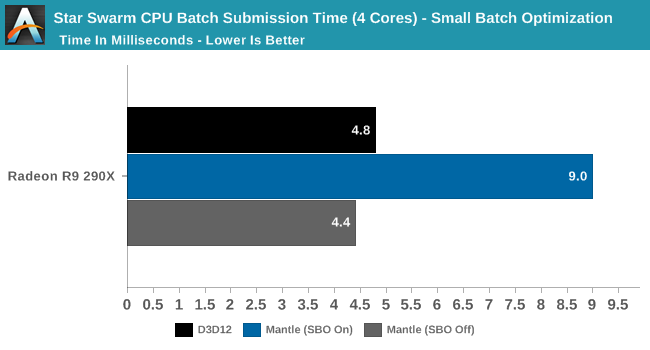
As far as “Mantle 1.0” is concerned, AMD is acknowledging at this point that Mantle’s greatest benefits – reduced CPU usage due to low-level command buffer submission – is something that DX12 and glNext can do just as well, negating the need for Mantle in this context.  For AMD this is still something of a win because it has led to Microsoft and Khronos implementing the core ideas of Mantle in the first place, but it also means that Mantle would be relegated to a third wheel. As a result AMD is shifting focus, and advising developers looking to tap Mantle for its draw call benefits (and other features also found in DX12/glNext) to just use those forthcoming APIs instead.
Mantle’s new focus in turn is going to be a testbed for future graphics API development.  Along with releasing the specifications for “Mantle 1.0”, AMD will essentially keep the closed beta program open for the continued development of Mantle, building it in conjunction with a limited number of partners in a fashion similar to how Mantle has been developed so far.

Thie biggest change here is that any plans to make Mantle open have been put on hold for the moment with the cancelation of the Mantle SDK. With Mantle going back into development and made redundant by DX12/glNext, AMD has canned what was from the start the hardest to develop/least likely to occur API feature, keeping it proprietary (at least for now) for future development. Which is not to say that AMD has given up on their “open” ideals entirely though, as the company is promising to deliver more information on their long-term plans for the API on the 5th, including their future plans for openness.
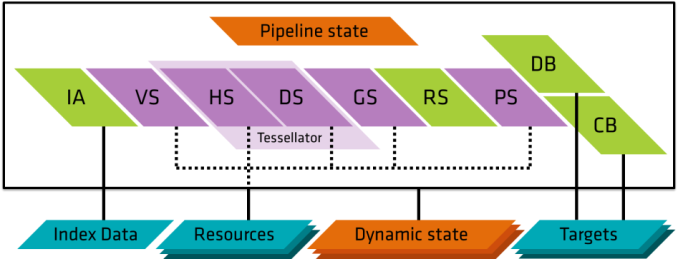

Mantle Pipeline States

As for what happens from here, we will have to see what AMD announces later this week. AMD’s announcement is essentially in two parts: today’s disclosure on the status of Mantle, and a further announcement on the 5th. It’s quite likely that AMD already has their future Mantle features in mind, and will want to discuss those after the DX12 and glNext disclosures.

Finally, from a consumer perspective Mantle won’t be going anywhere. Mantle remains in AMD’s drivers and Mantle applications continue to work, and for that matter there are still more Mantle enabled games to come (pretty much anything Frostbite, for a start). How many more games beyond 2015 though – basically anything post-DX12 – remains to be seen, as developers capable of targeting Mantle will almost certainly want to target DX12 as well as soon as it’s ready.

Update 03/03: To add some further context to AMD’s announcement, we have the announcement of Vulkan (aka glNext). In short Mantle is being used as a building block for Vulkan, making Vulkan a derivative of Mantle. So although Mantle proper goes back under wraps at AMD, “Mantle 1.0” continues on in an evolved form as Vulkan.
Broadcom at MWC 2015: BCM4359 and BCM43455 Wifi Combo Chips Announced

Broadcom at MWC 2015: BCM4359 and BCM43455 Wifi Combo Chips Announced

Today Broadcom took the lead by announcing two new Wifi combo chip solutions meant for the smartphone and tablet market. The BCM4359 is a high-end 2×2 MIMO solution for high-performance smartphones, while the BCM43455 is an updated 1×1 MIMO 802.11ac for mass market phones.

Taking a closer look at the BCM4359, we see several innovative new features, the most characterizing one being the inclusion for the first time of Real Simultaneous Dual Band (RSDB). RSDB enables the chip to connect to both 2.4GHz and 5GHz bands simultaneously. This is achieved by doubling up on the baseband processors on the combo chip. Broadcom uses ARM Cortex R4 as the processing units of the IC, and the 4359 uses two of them. What this enables is a sort of “full duplex” on the two frequency bands instead of having the baseband having to switch between each in an interleaving manner. The PHY bandwidth has been upped to 867 Mbps in the two-stream MIMO mode.

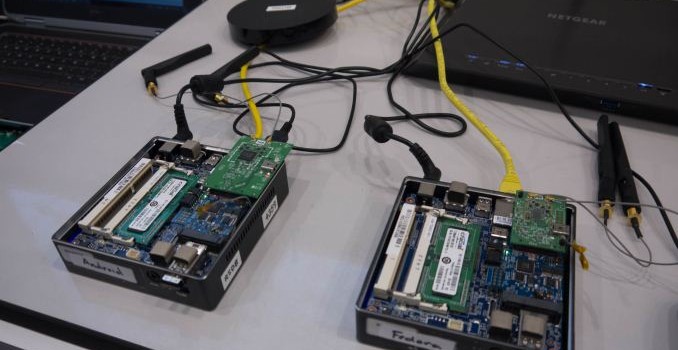
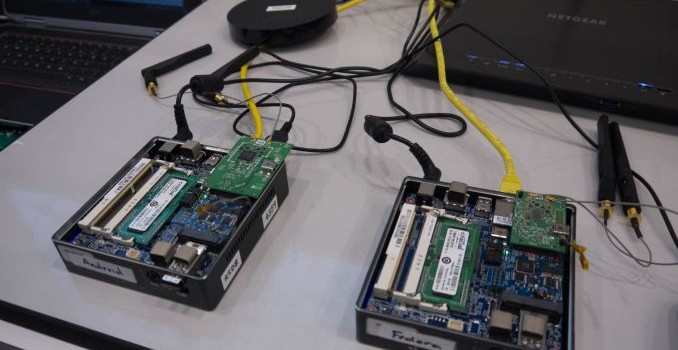
In the demo that Broadcom showed us, we had two test devices and a TV as the showcase setup. One device running the BCM4356 was streaming a video to the secondary device which employed the BCM4359 via the 2.4GHz band, who in turn would then stream via Wifi Display on 5GHz to the TV. As a comparison demo, we had the same setup next to it, but with both streaming devices equiped with only a BCM4356 solution. While the BCM4359 setup managed to achieve enough bandwidth to receive and forward the stream to the TV in full 1080p, the other side with the BCM4356 would only be fluid if the quality was reduced to 480p.

Another advantage of RSDB is that it enables the chip to scan for networks on both bands simultaneously, accelerating the time needed to show available Wifi networks, effectively giving a 2x speed improvement.

The BCM43455 is also a new member of the Broadcom family and serves as a solution for the mass market, meaning a cheaper price-point. It is a 1×1 HT80 802.11ac 2.4 and 5GHz solution, enabling up to a 433Mbps PHY rate at 80MHz channel bandwidth. The chip is able to reduce the BoM by 50%, although Broadcom didn’t specify to what this was compared with.

One key aspect of these new Wifi generation chips is that SDIO has been retired (but still available as a seconary option) as the connection interface to the SoC and instead replaced by PCIe. The BCM4358 was the first such chip to take advantage of this switch, which was employed on for example the Galaxy Note 4. The PCIe interface not only provides higher bandwidths which are beyond what SDIO is capable of, but also enables crucial power advantages such as low power states on the bus and bonuses such as Direct Memory Access (DMA) for the Wifi chipset.

Both the BCM4359 and BCM43455 are sampling now and will be available in devices later in the year.

Broadcom at MWC 2015: BCM4359 and BCM43455 Wifi Combo Chips Announced

Broadcom at MWC 2015: BCM4359 and BCM43455 Wifi Combo Chips Announced

Today Broadcom took the lead by announcing two new Wifi combo chip solutions meant for the smartphone and tablet market. The BCM4359 is a high-end 2×2 MIMO solution for high-performance smartphones, while the BCM43455 is an updated 1×1 MIMO 802.11ac for mass market phones.

Taking a closer look at the BCM4359, we see several innovative new features, the most characterizing one being the inclusion for the first time of Real Simultaneous Dual Band (RSDB). RSDB enables the chip to connect to both 2.4GHz and 5GHz bands simultaneously. This is achieved by doubling up on the baseband processors on the combo chip. Broadcom uses ARM Cortex R4 as the processing units of the IC, and the 4359 uses two of them. What this enables is a sort of “full duplex” on the two frequency bands instead of having the baseband having to switch between each in an interleaving manner. The PHY bandwidth has been upped to 867 Mbps in the two-stream MIMO mode.

In the demo that Broadcom showed us, we had two test devices and a TV as the showcase setup. One device running the BCM4356 was streaming a video to the secondary device which employed the BCM4359 via the 2.4GHz band, who in turn would then stream via Wifi Display on 5GHz to the TV. As a comparison demo, we had the same setup next to it, but with both streaming devices equiped with only a BCM4356 solution. While the BCM4359 setup managed to achieve enough bandwidth to receive and forward the stream to the TV in full 1080p, the other side with the BCM4356 would only be fluid if the quality was reduced to 480p.

Another advantage of RSDB is that it enables the chip to scan for networks on both bands simultaneously, accelerating the time needed to show available Wifi networks, effectively giving a 2x speed improvement.

The BCM43455 is also a new member of the Broadcom family and serves as a solution for the mass market, meaning a cheaper price-point. It is a 1×1 HT80 802.11ac 2.4 and 5GHz solution, enabling up to a 433Mbps PHY rate at 80MHz channel bandwidth. The chip is able to reduce the BoM by 50%, although Broadcom didn’t specify to what this was compared with.

One key aspect of these new Wifi generation chips is that SDIO has been retired (but still available as a seconary option) as the connection interface to the SoC and instead replaced by PCIe. The BCM4358 was the first such chip to take advantage of this switch, which was employed on for example the Galaxy Note 4. The PCIe interface not only provides higher bandwidths which are beyond what SDIO is capable of, but also enables crucial power advantages such as low power states on the bus and bonuses such as Direct Memory Access (DMA) for the Wifi chipset.

Both the BCM4359 and BCM43455 are sampling now and will be available in devices later in the year.

Intel at MWC 2015: SoFIA, Rockchip, Low Cost Integrated LTE, Atom Renaming and 14nm Cherry Trail

Intel at MWC 2015: SoFIA, Rockchip, Low Cost Integrated LTE, Atom Renaming and 14nm Cherry Trail

After day zero at Mobile World Congress already boasting some impressive releases, Intel tackles their platform on day one on several different fronts. As part of a pre-briefing, we were invited into the presentation where Intel discussed the current state of their mobile portfolio along with looking to the future. The pre-briefing was run by Aicha Evans, Corporate Vice President and General Manager of the Wireless Platform Research and Development Group, who you may remember was interviewed by Anand in a series of videos back in 2013. Ms. Evans’ focus stems on the connectivity side of the equation, making sure that Intel’s portfolio develops into a strong base for future platforms.

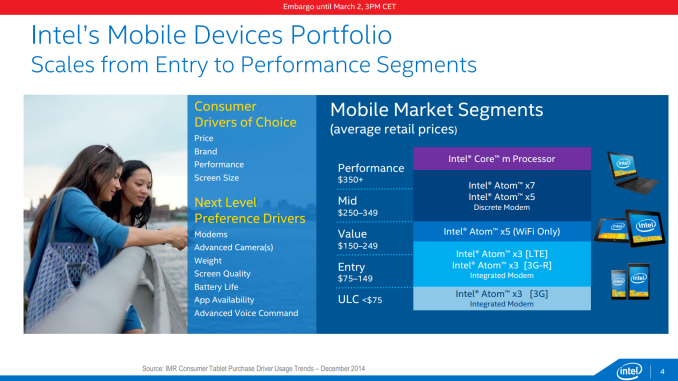
One of the big elements for Intel is the rebranding of their mobile Atom line of SoCs. Up until this point, all the SoCs were difficult to follow and very similar names such as Z3580 or Z3760. This is adjusted into three different segments as follows:

Similar to their personal computing processor line, the Intel Atom structure will take on x3/x5/x7 naming, similar to the i3/i5/i7 of the desktop and notebook space. This is not to be confused with Qualcomm’s modem naming scheme, or anything by BMW.

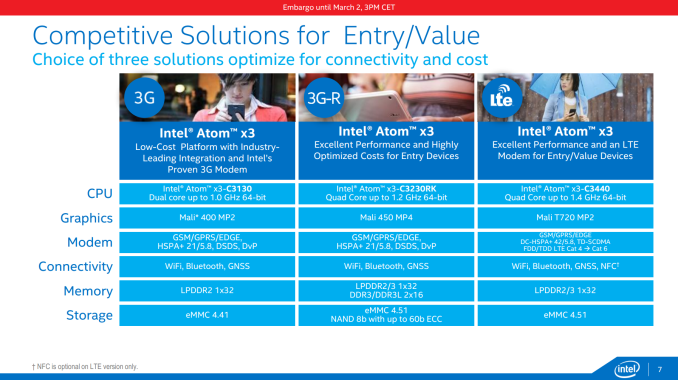
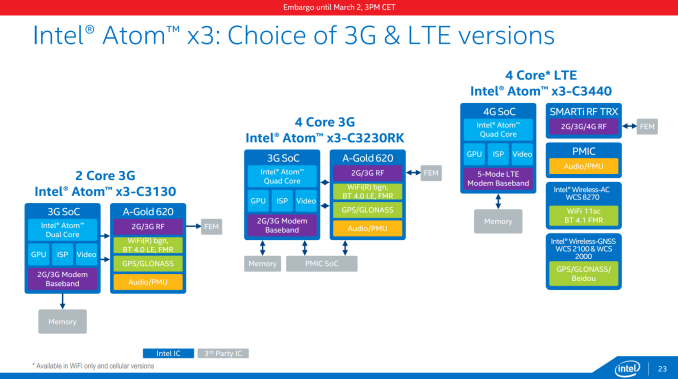
The x3 sits at the bottom, and is comprised of Bay Trail based SoCs at the 28nm node all previously part of the SoFIA program aimed at emerging markets. There will be three x3 parts – a dual core x3, a quad core x3 from the Rockchip agreement, and a final quad core x3 with an integrated LTE modem.

This set raises some interesting points to discuss. Firstly is the use of 28nm is the same node as previous Intel Atoms, and thus should be derived from a TSMC source. It is also poignant to note that for these SoCs Intel is using a Mali GPU rather than the Gen 8 graphics and their own IP. This is due to the SoFIA program being aimed at bringing costs down and functionality into the low price points in a competitive time-to-market.

The Rockchip model, indicated by the ‘RK’ at the end of the name of the SoC, comes from the partnership with Rockchip we reported on back in May 2014. At the time Intel discussed the roadmap for producing a quad core SoC with 3G for the China market in the middle of 2015, which this provides.

The final part of the x3 arrangement revolves combining a 5-mode LTE modem on the same die. Intel is going to support 14 LTE bands on a single SoC with PMIC, WiFi and geolocation technologies (GPS, GLONASS, BeiDou).

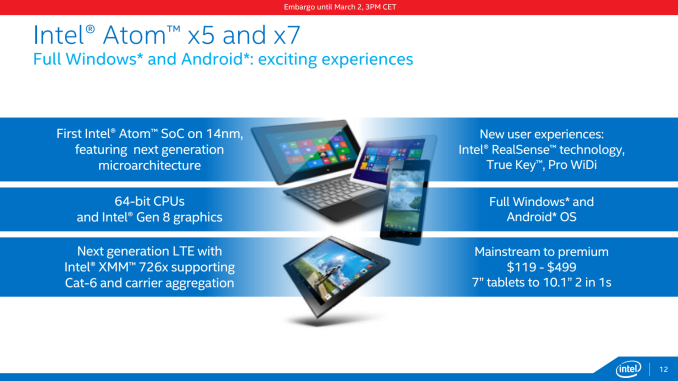
The Atom x5 and x7 SoCs represent the next step up, implementing Intel’s 14nm process and bringing Cherry Trail to market. The x5 and x7 SoCs are aimed primarily at tablets, but can find their way into sub 10.1 inch tablets as well, providing an interesting counterbalance to the high price premium of Intel Core-M 4.5W products based on Broadwell-Y. While the x3 line will focus first on Android moving into Windows, x5 and x7 is designed to be targeting both, particularly with the bundled Gen 8 graphics and LTE with XMM276x supporting Cat-6 and carrier aggregation.

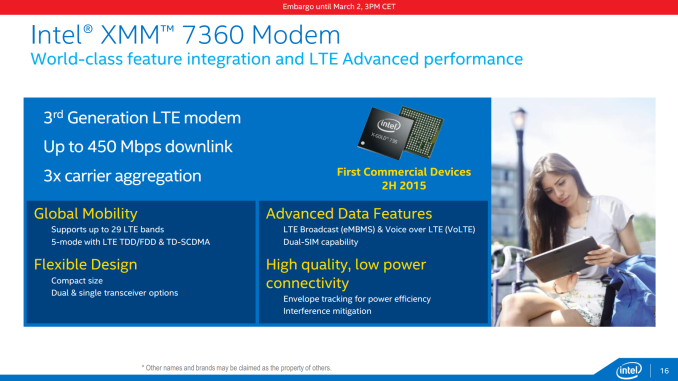
Not a lot of detail was provided about x5 and x7, suggesting that they are aimed more at late 1H/2H 2015 down the line. This coincides with the next generation of Intel’s XMM 7360 modem, featuring up to 450 Mbps downlink and support for up to 29 LTE bands.

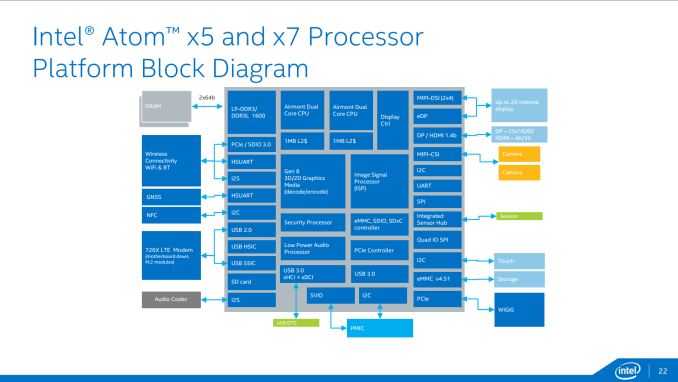
One interesting element in the x5/x7 scenario was the bundled platform block diagram provided by Intel, showing clearly the two dual-core Airmont CPUs each with 1MB of L2 cache, Gen 8 graphics, separate security processors and ISP, as well as USB 3.0 support.

Finally, Intel addressed the obvious lack of a high-end mobile SoC that fits into the performance smartphone category. Intel is still working on development of such a SoC in the form of Braxton and we’ll have more news on this piece in the future.

We are lining up a chance to interview Ms. Evans about Intel’s Atom lineup later this week at MWC, so stay tuned for that.

Intel at MWC 2015: SoFIA, Rockchip, Low Cost Integrated LTE, Atom Renaming and 14nm Cherry Trail

Intel at MWC 2015: SoFIA, Rockchip, Low Cost Integrated LTE, Atom Renaming and 14nm Cherry Trail

After day zero at Mobile World Congress already boasting some impressive releases, Intel tackles their platform on day one on several different fronts. As part of a pre-briefing, we were invited into the presentation where Intel discussed the current state of their mobile portfolio along with looking to the future. The pre-briefing was run by Aicha Evans, Corporate Vice President and General Manager of the Wireless Platform Research and Development Group, who you may remember was interviewed by Anand in a series of videos back in 2013. Ms. Evans’ focus stems on the connectivity side of the equation, making sure that Intel’s portfolio develops into a strong base for future platforms.

One of the big elements for Intel is the rebranding of their mobile Atom line of SoCs. Up until this point, all the SoCs were difficult to follow and very similar names such as Z3580 or Z3760. This is adjusted into three different segments as follows:

Similar to their personal computing processor line, the Intel Atom structure will take on x3/x5/x7 naming, similar to the i3/i5/i7 of the desktop and notebook space. This is not to be confused with Qualcomm’s modem naming scheme, or anything by BMW.

The x3 sits at the bottom, and is comprised of Bay Trail based SoCs at the 28nm node all previously part of the SoFIA program aimed at emerging markets. There will be three x3 parts – a dual core x3, a quad core x3 from the Rockchip agreement, and a final quad core x3 with an integrated LTE modem.

This set raises some interesting points to discuss. Firstly is the use of 28nm is the same node as previous Intel Atoms, and thus should be derived from a TSMC source. It is also poignant to note that for these SoCs Intel is using a Mali GPU rather than the Gen 8 graphics and their own IP. This is due to the SoFIA program being aimed at bringing costs down and functionality into the low price points in a competitive time-to-market.

The Rockchip model, indicated by the ‘RK’ at the end of the name of the SoC, comes from the partnership with Rockchip we reported on back in May 2014. At the time Intel discussed the roadmap for producing a quad core SoC with 3G for the China market in the middle of 2015, which this provides.

The final part of the x3 arrangement revolves combining a 5-mode LTE modem on the same die. Intel is going to support 14 LTE bands on a single SoC with PMIC, WiFi and geolocation technologies (GPS, GLONASS, BeiDou).

The Atom x5 and x7 SoCs represent the next step up, implementing Intel’s 14nm process and bringing Cherry Trail to market. The x5 and x7 SoCs are aimed primarily at tablets, but can find their way into sub 10.1 inch tablets as well, providing an interesting counterbalance to the high price premium of Intel Core-M 4.5W products based on Broadwell-Y. While the x3 line will focus first on Android moving into Windows, x5 and x7 is designed to be targeting both, particularly with the bundled Gen 8 graphics and LTE with XMM276x supporting Cat-6 and carrier aggregation.

Not a lot of detail was provided about x5 and x7, suggesting that they are aimed more at late 1H/2H 2015 down the line. This coincides with the next generation of Intel’s XMM 7360 modem, featuring up to 450 Mbps downlink and support for up to 29 LTE bands.

One interesting element in the x5/x7 scenario was the bundled platform block diagram provided by Intel, showing clearly the two dual-core Airmont CPUs each with 1MB of L2 cache, Gen 8 graphics, separate security processors and ISP, as well as USB 3.0 support.

Finally, Intel addressed the obvious lack of a high-end mobile SoC that fits into the performance smartphone category. Intel is still working on development of such a SoC in the form of Braxton and we’ll have more news on this piece in the future.

We are lining up a chance to interview Ms. Evans about Intel’s Atom lineup later this week at MWC, so stay tuned for that.