News


Imagination Announces PowerVR G6020 GPU & PowerVR Series 5 Video Encoder

Imagination Announces PowerVR G6020 GPU & PowerVR Series 5 Video Encoder

With Mobile World Congress 2015 now in full swing, Imagination Technologies is taking to the show today to announce a couple of new additions to the PowerVR family of video products.

First off is a new low-end GPU in the PowerVR Series6XE family, the G6020. The G6020 is aimed at entry-level mobile devices, embedded computers, and high-end wearables, and is intended to be Imagination’s new entry-level Series6XE part.

From a design perspective, the G6020 is aimed at very simple desktop workloads – the Android UI, wearable interfaces, etc. Imagination has essentially built the bare minimum GPU needed to drive a 720p60 display, taking out any hardware not necessary to that goal such as compute and quite a bit of geometry throughput. What remains is enough of a ROP backend (pixel co-processor) to drive 720p, and the FP16 shading resources to go with it.

Meanwhile from a hardware perspective this is basically a significantly cut down 6XE part. G6020 drops to just a single 4 pipeline USC, versus the 8 pipeline USC found in the G6050, and 16 pipelines as found in a “complete” USC. The number of FP32 ALUs in each pipeline has also been reduced, going from the 6XE standard of 2 per pipeline to 1 for G6020, while the number of FP16 ALUs remains unchanged at 4. Along with scaling down the USCs, Imagination has also stripped down the G6020 in other ways, such as by taking out the compute data master.

PowerVR Series6/6XE “Rogue”
GPU # of Clusters # of FP32 Ops # of FP16 Ops Optimization
G6020 0.25 8 32 Area + Bandwidth
G6050 0.5 32 64 Area
G6060 0.5 32 64 Area + Bandwidth
G6100 1 64 96 Area
G6100 (XE) 1 64 128 Area
G6110 1 64 128 Area + Bandwidth

The end result of their efforts is designed to be an incredibly small and incredibly low power OpenGL ES 3.0 GPU for devices that fall in the cheap/small range. G6020 is only 2.2mm2 in size on 28nm, making it similar in size to ARM’s Cortex-A7 CPU cores (a likely pairing target). And power consumption is low enough that it should be able to just fit into high-end wearables.

PowerVR Series 5 Video Encoder

Meanwhile Imagination’s second PowerVR announcement of the day is the announcement of their new PowerVR Series 5 family of video encoders.  This is Imagination’s entry into the HEVC (H.265) hardware encoder market, offering scalable designs for encoding H.264 and HEVC video.

In terms of designs Imagination will be offering 3 designs, the E5800, E5505, and E5300, targeted at progressively lower-end markets. The E5800 is the largest configuration and is aimed at the prosumer market, offering 4Kp60 encoding with 10-bit color and 4:2:2 chroma sampling (twice the sampling of standard 4:2:0 video). Below that is the E5505, the mainstream/premium mobile part with support for encoding up to 4Kp30, along with VP8 encoding and even MJPEG for certain legacy applications. Finally at the bottom of the list is the E5300, which is a small, low power encoder for 1080p30 applications (cameras/sensors/IoT and the like).

PowerVR Series 5 HEVC Encoders
Encoder Max Resolution Chroma Subsampling Market
E5800 4Kp60 4:2:2 Prosumer/Pro-Cameras
E5505 4Kp30 4:2:0 Mobile
E5300 1080p30 4:2:0 Sensor/IoT/Security Cameras

From a competitive standpoint, along with the expected synergy between the PowerVR encoders and PowerVR GPUs –support for directly handing off compressed memory, in particular – Imagination is also banking on being able to win a quality war with other mobile HEVC encoders.  By Imagination’s estimates they can offer equivalent quality at just 70% of the bitrate, which would give them a significant advantage. The company says that this is a result of having a newer encoder that is better tuned than competing encoders, and one that implements more HEVC features (e.g. 10-bit color), allowing them to achieve better compression and the resulting reduction in bitrates.
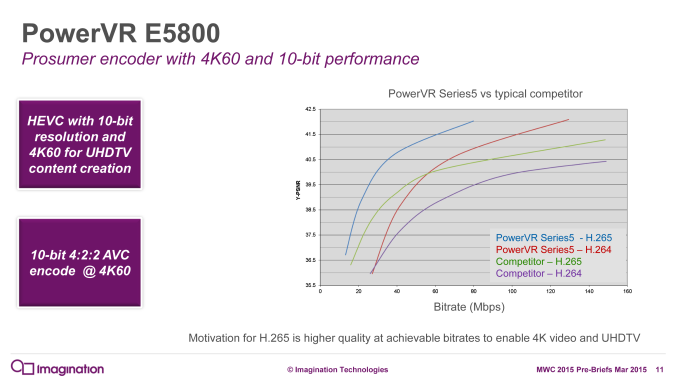
While Imagination’s testing methodology and resulting numbers to get here are open to interpretation – PSNR is important, though not the end-all of encoder measurements – HEVC encoders are still a fledgling field. There is still ample opportunity to improve on HEVC encoders and reach the same kind of highly tuned status that H.264 encoders have evolved to.

Wrapping things up, both new PowerVR products are now available for licensing.
Audience Announces NUE N100 Multisensor Processor

Audience Announces NUE N100 Multisensor Processor

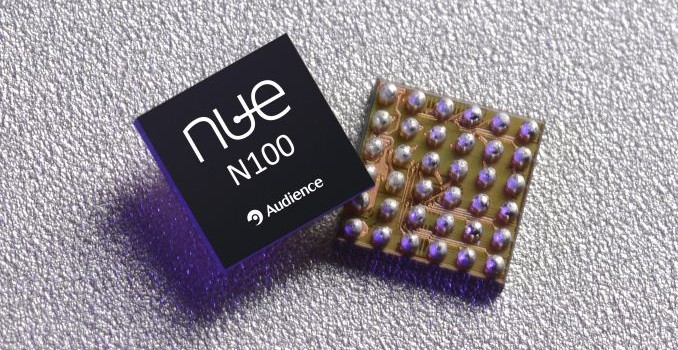
While Audience is traditionally focused on voice products, today they’re attempting to make their first moves into combined voice recognition and sensor hub products that leverage sensor fusion and neural networks. The NUE N100 is the first of t…

Audience Announces NUE N100 Multisensor Processor

Audience Announces NUE N100 Multisensor Processor

While Audience is traditionally focused on voice products, today they’re attempting to make their first moves into combined voice recognition and sensor hub products that leverage sensor fusion and neural networks. The NUE N100 is the first of t…

Imagination Announces PowerVR G6020 GPU & PowerVR Series 5 Video Encoder

Imagination Announces PowerVR G6020 GPU & PowerVR Series 5 Video Encoder

With Mobile World Congress 2015 now in full swing, Imagination Technologies is taking to the show today to announce a couple of new additions to the PowerVR family of video products.

First off is a new low-end GPU in the PowerVR Series6XE family, the G6020. The G6020 is aimed at entry-level mobile devices, embedded computers, and high-end wearables, and is intended to be Imagination’s new entry-level Series6XE part.

From a design perspective, the G6020 is aimed at very simple desktop workloads – the Android UI, wearable interfaces, etc. Imagination has essentially built the bare minimum GPU needed to drive a 720p60 display, taking out any hardware not necessary to that goal such as compute and quite a bit of geometry throughput. What remains is enough of a ROP backend (pixel co-processor) to drive 720p, and the FP16 shading resources to go with it.

Meanwhile from a hardware perspective this is basically a significantly cut down 6XE part. G6020 drops to just a single 4 pipeline USC, versus the 8 pipeline USC found in the G6050, and 16 pipelines as found in a “complete” USC. The number of FP32 ALUs in each pipeline has also been reduced, going from the 6XE standard of 2 per pipeline to 1 for G6020, while the number of FP16 ALUs remains unchanged at 4. Along with scaling down the USCs, Imagination has also stripped down the G6020 in other ways, such as by taking out the compute data master.

PowerVR Series6/6XE “Rogue”
GPU # of Clusters # of FP32 Ops # of FP16 Ops Optimization
G6020 0.25 8 32 Area + Bandwidth
G6050 0.5 32 64 Area
G6060 0.5 32 64 Area + Bandwidth
G6100 1 64 96 Area
G6100 (XE) 1 64 128 Area
G6110 1 64 128 Area + Bandwidth

The end result of their efforts is designed to be an incredibly small and incredibly low power OpenGL ES 3.0 GPU for devices that fall in the cheap/small range. G6020 is only 2.2mm2 in size on 28nm, making it similar in size to ARM’s Cortex-A7 CPU cores (a likely pairing target). And power consumption is low enough that it should be able to just fit into high-end wearables.

PowerVR Series 5 Video Encoder

Meanwhile Imagination’s second PowerVR announcement of the day is the announcement of their new PowerVR Series 5 family of video encoders.  This is Imagination’s entry into the HEVC (H.265) hardware encoder market, offering scalable designs for encoding H.264 and HEVC video.

In terms of designs Imagination will be offering 3 designs, the E5800, E5505, and E5300, targeted at progressively lower-end markets. The E5800 is the largest configuration and is aimed at the prosumer market, offering 4Kp60 encoding with 10-bit color and 4:2:2 chroma sampling (twice the sampling of standard 4:2:0 video). Below that is the E5505, the mainstream/premium mobile part with support for encoding up to 4Kp30, along with VP8 encoding and even MJPEG for certain legacy applications. Finally at the bottom of the list is the E5300, which is a small, low power encoder for 1080p30 applications (cameras/sensors/IoT and the like).

PowerVR Series 5 HEVC Encoders
Encoder Max Resolution Chroma Subsampling Market
E5800 4Kp60 4:2:2 Prosumer/Pro-Cameras
E5505 4Kp30 4:2:0 Mobile
E5300 1080p30 4:2:0 Sensor/IoT/Security Cameras

From a competitive standpoint, along with the expected synergy between the PowerVR encoders and PowerVR GPUs –support for directly handing off compressed memory, in particular – Imagination is also banking on being able to win a quality war with other mobile HEVC encoders.  By Imagination’s estimates they can offer equivalent quality at just 70% of the bitrate, which would give them a significant advantage. The company says that this is a result of having a newer encoder that is better tuned than competing encoders, and one that implements more HEVC features (e.g. 10-bit color), allowing them to achieve better compression and the resulting reduction in bitrates.

While Imagination’s testing methodology and resulting numbers to get here are open to interpretation – PSNR is important, though not the end-all of encoder measurements – HEVC encoders are still a fledgling field. There is still ample opportunity to improve on HEVC encoders and reach the same kind of highly tuned status that H.264 encoders have evolved to.

Wrapping things up, both new PowerVR products are now available for licensing.
Sony Announces the Xperia Z4 Tablet

Sony Announces the Xperia Z4 Tablet

Although much of the focus on Sony’s work in the mobile space is on their smartphones, they have been a player in the tablet segment of the market for quite some time. In fact, Sony has been responsible for some of the more unique tablet designs, such as the Sony Tablet P which had two displays and folded much like a Nintendo DS.

When focusing on what we traditionally think of as a tablet, one will see that the flagship device in Sony’s lineup has always been their 10.1″ tablet offering. These devices are usually named in the same “Xperia Z” format as Sony’s flagship smartphones, and although the tablet released last year was the Xperia Z2 Tablet, the release of the Xperia Z3 Compact Tablet late last year means that this year’s release moves ahead to Z4. The Xperia Z4 tablet is Sony’s flagship tablet, and the first of 2015’s high end Android tablets. To give an overview of the Z4 Tablet on paper, I’ve laid out its core specifications below.

  Sony Xperia Tablet Z2 Sony Xperia Tablet Z4
SoC 2.3GHz Snapdragon 801 (APQ8074AB) with 4 x Krait 400 + Adreno 330 Snapdragon 810 with 4 x Cortex-A57 at 2.0GHz and 4 x Cortex-A53 at 1.6GHz + Adreno 430
RAM/NAND 3GB LPDDR3 + 16/32GB NAND + MicroSD 3 GB LPDDR4 + 32GB NAND + MicroSD (SDXC)
Display 10.1″ 1920×1200 LCD 10.1″ 2560×1600 LCD
Network WiFi only or 2G / 3G / 4G LTE SKU WiFi only or 2G / 3G / 4G LTE SKU
Dimensions 266 x 172 x 6.4 mm, 426g 254 x 167 x 6.1mm thick, 389g WiFi, 393g LTE
Camera 13MP Rear Facing with F/2.0 aperture and OIS, 2MP FFC
4K video recording
8MP Rear Facing, 5MP Front Facing
Battery 6000 mAh (22.8 Whr) 6000 mAh (22.8 Whr)
OS Android 4.4.2 KitKat Android 5.0 Lollipop
Connectivity 2×2 802.11a/b/g/n/ac + BT 4.0, USB2.0, GPS/GNSS, MHL, NFC WiFi + BT 4.1, USB2.0, GPS/GNSS, ?, NFC

Inside the Xperia Z4 Tablet we have Qualcomm’s Snapdragon 810 SoC, which has four Cortex-A57 cores and four Cortex-A53 cores running at 2.0GHz and 1.6GHz respectively, along with Qualcomm’s new Adreno 430 GPU. The internal battery remains the same capacity as the Z2 Tablet at 6000mAh (22.8Wh), but the tablet has been slimmed down to 6.1mm which puts it on par with Apple’s iPad Air 2.

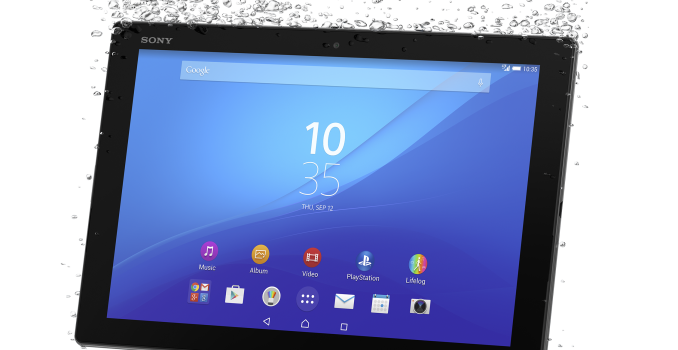
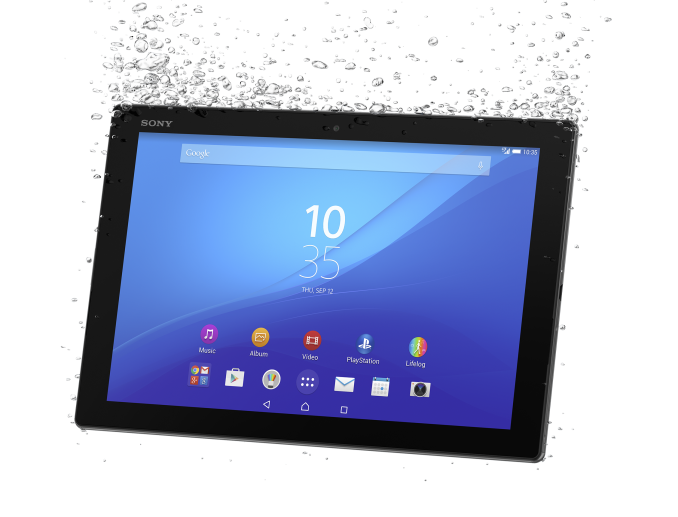
Moving to the outside of the tablet, we see that Sony has placed an 8MP camera on the rear, and a 5.1MP camera on the front. The front of the device is also home to the 10.1″ 2560×1600 LCD display. Like many of Sony’s recent devices, the Z4 Tablet is both dust and water resistant. It has an IP68 rating for which Sony specifies an immersion depth of up to 1.5 meters for up to thirty minutes, which goes a bit beyond the typical 1 meter for 30 minutes IP67 rating on many other mobile devices

According to Sony, the Xperia Z4 Tablet will be launching globally in June. It will come in both WiFi and LTE variants, with pricing yet to be revealed.

Source: Sony