News


ASUS Goes USB 3.1: Motherboards, PCIe Cards and Enclosures Tested

ASUS Goes USB 3.1: Motherboards, PCIe Cards and Enclosures Tested

As the motherboard reviewer at AnandTech, I speak to my contacts at the motherboard manufacturers on a regular basis. All the recent talk has had a heavy sprinkling about thoughts, opinions and implementations of USB 3.1. To add to our recent testing, ASUS is today announcing the launch of their USB 3.1 PCIe card along with a variety of motherboard bundles either featuring onboard USB 3.1 or a bundled USB 3.1 card. We stuck the card in the Rampage V Extreme to run the numbers with an ASUS dual mSATA USB 3.1 enclosure.

The ASUS Plan Of Attack

As we expressed in our previous piece, USB 3.1 adoption will take an excruciating long time, especially as USB 3.0 is only now reaching price party with USB 2.0. But as with USB 3.0 we will first start to see USB 3.1 adopted on PCIe cards and extra controllers first on desktops followed by high end laptops before it becomes part of the chipset standard. Even then, with a ubiquity of ports available, it takes time for the devices to appear in the market with sufficient quantity to become cost effective for all but the early adopters.

Nevertheless, motherboard manufacturers want to tackle this head on. As far as we can tell there are a handful of IC manufactures that can provide controllers to be placed in products, but ASMedia are more ready than others to actually sell the components. ASUS’ close relationship with ASMedia allows them to approach the market in two different ways – either by an onboard controller or via a bundled PCIe card.

At this point in time, all the implementations from ASUS will be via the Type-A interface. A couple of high end motherboards will be offered with USB 3.1 PCIe cards, while those lower down the stack will be modified for the onboard controller for about a dozen in total. There will be a USB Type-C card released at a later date, available only as a separate purchase.

One tack that ASUS is implemented differently is the color of the USB 3.1 Type-A ports. Standard procedure for USB 2.0 is a black port, with USB 3.0 as blue. This is not a hard and fast rule, as we see red ports on some motherboards for gaming or green ports on the Razer Blade, but as if yet there is no clear definition for USB 3.1. In this instance, ASUS is going with a teal blue to represent USB 3.1, and offers enough contrast from USB 3.0.
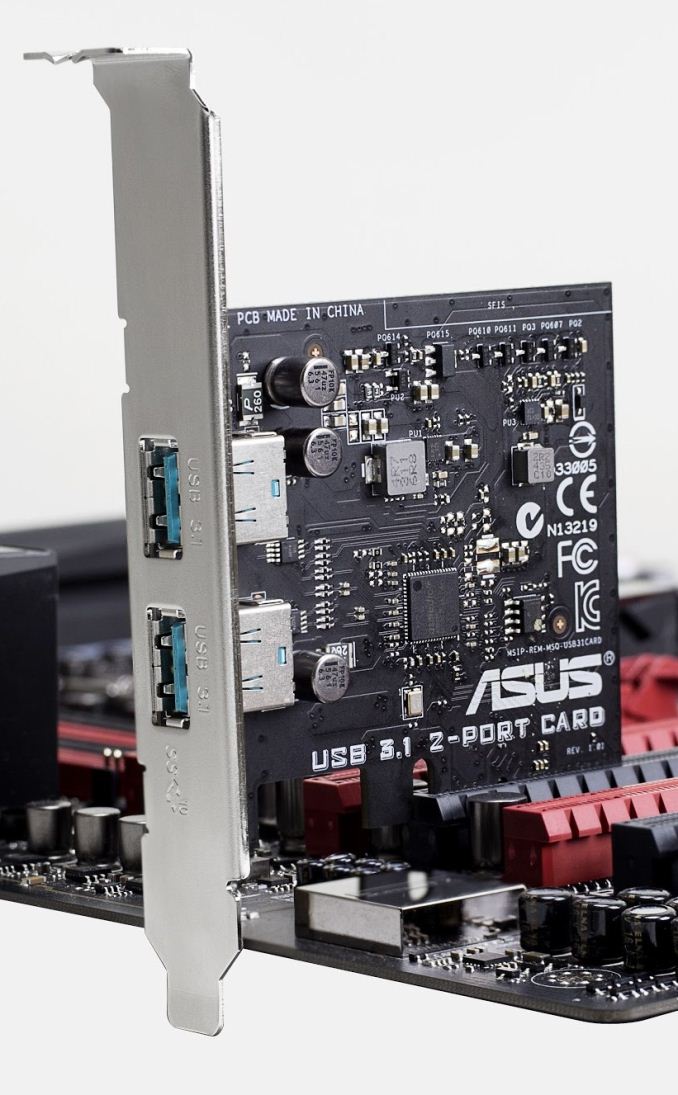
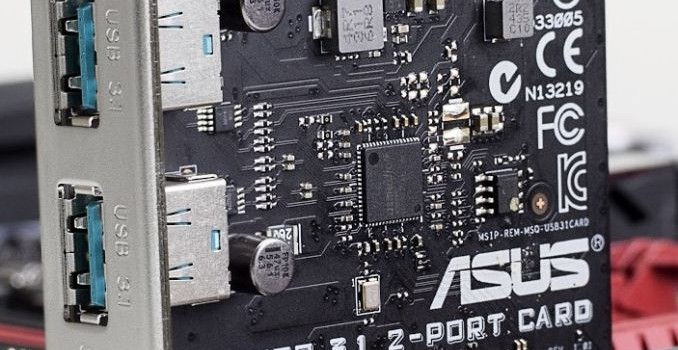
The card itself uses the ASMedia ASM1142 controller in a PCIe 2.0 x2 form factor. This should provide the 10 Gbps data rate for the USB 3.1 standard. The Type-A versions will support 900 mA charging at 5V, whereas Type-C will do 3A at 5V, suitable for 15W. In order to get the 100W charging and implement the enhanced power standard, the power delivery delivery has to be built into the power module around the USB 3.1 controller. With PCIe cards this makes more sense, although it would require the card to have an extra power connector (either SATA, molex or PCIe). When the USB 3.1 port is on the rear panel of a motherboard, it makes it more difficult to apply the approach power planes, especially on cheaper motherboards, as well as drawing power directly from the 24-pin ATX and directing the appropriate power around the processor. Thus if we ever see 100W charging on motherboards, PCIe cards might be the way forward.

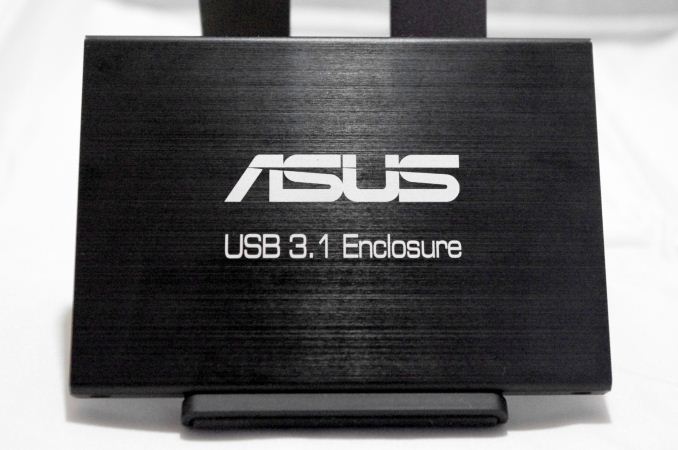
As part of the testing bundle, ASUS supplied a near-final version of a USB 3.1 storage device. This small form factor uses two 256 GB Samsung 840 EVO mSATA drives in RAID-0 for maximum throughput.
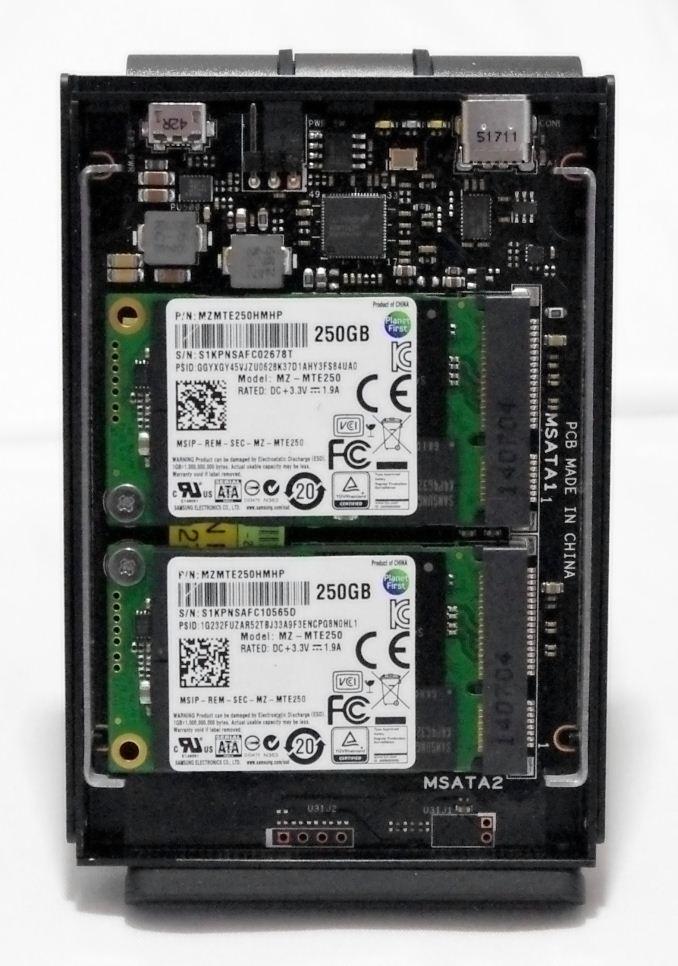
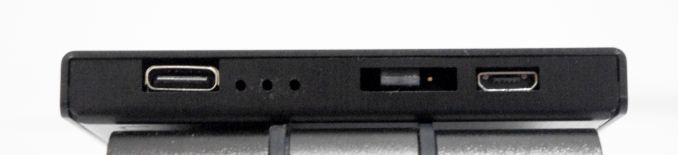
In order to keep the size of the device down, it uses a Type-C connector for data along with a micro-USB for power. This means that the device requires two USB ports in all, which is understandable for a dual mSATA device that requires power but perhaps somewhat limiting for devices with only one USB port. It is unknown if ASUS will sell this enclosure separately at this point.
Both the card and the enclosure are still in development, and we had a difficult time to get it to work. For example, with the Rampage V Extreme and the USB 3.1 card, the enclosure had to be plugged in at power up, with power and data both connected to the card. Without this, the system would not recognize the device or it would enter a speed mode indicative of PCIe 2.0 x1 data transfers eventually ending up in an IO error. Also, our setup did not want to work in USB 2.0 mode at all. But when we installed the right drivers, and booted the system with the cables set up as required, we got great performance. There was a little coil whine during system writes, but as mentioned this device is still in development, and hopefully all these issues can be ironed out.
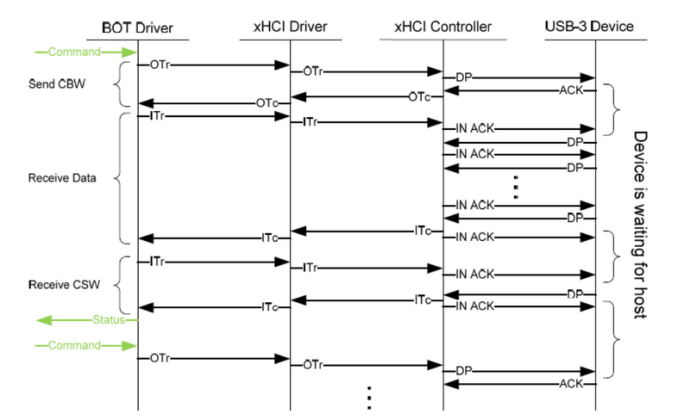
Unfortunately all the hardware for our previous USB 3.1 testing had to be sent back which means we cannot do a direct comparison due to different enclosures, but it is still interesting to see where the numbers land. ASUS is also touting an updated USB 3.0 Boost as well, dubbed USB 3.1 Boost, to help with transfers. The current state of play with USB transfer speeds is a miasma from XP drivers, base Intel drivers for Windows 7 and then UASP implementations in Windows 8.  The basic mode in Windows 7 means that Bulk Only Transfer (BOT) is par for the course:
UASP, or USB Attached SCSI Protocol, allows transfers to occur by multitasking the transfers without the need for constant iterations up and down the stack for each read or write command.
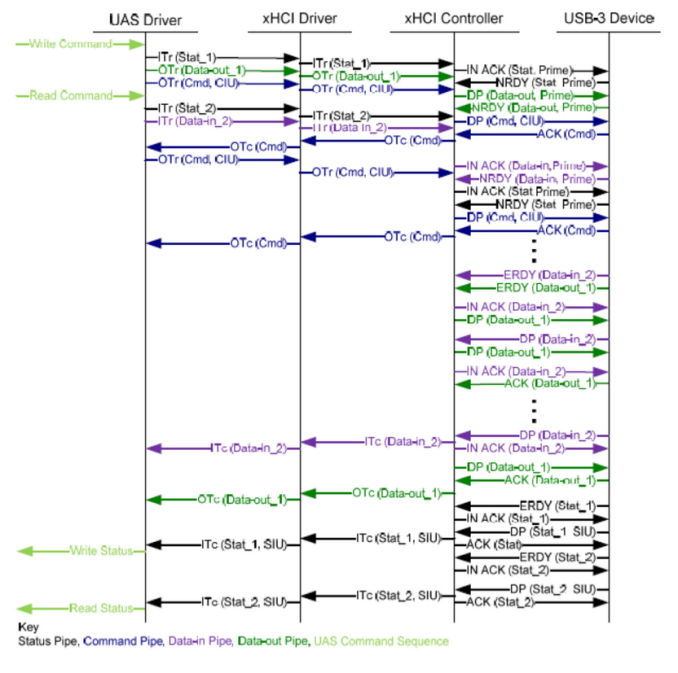
Windows 8 offers a good version of UASP, however ASUS’ customized driver for Intel and ASMedia based ports goes one better through optimization. Normally such processes sacrifice latency for peak speeds, although we are rarely latency limited with a USB drive. Windows 7 also gets a similar driver, which represents a bigger boost from the base driver there.

Test Setup

Test Setup
Processor Intel Core i7-5960X ES
8 Cores, 16 Threads, 3.0 GHz (3.5 GHz Turbo)
Motherboards ASUS Rampage V Extreme
Cooling Cooler Master Nepton 140XL
Power Supply OCZ 1250W Gold ZX Series
Corsair AX1200i Platinum PSU
Memory Corsair DDR4-2133 C15 4×8 GB 1.2V
G.Skill Ripjaws 4 DDR4-2133 C15 4×8 GB 1.2V
Memory Settings JEDEC @ 2133
Video Cards MSI GTX 770 Lightning 2GB (1150/1202 Boost)
Video Drivers NVIDIA Drivers 332.21
Hard Drive Crucial MX200 1TB CT1000MX200SSD1
Optical Drive LG GH22NS50
Case Open Test Bed
Operating System Windows 7 64-bit SP1
USB 2/3 Testing ASUS USB 3.1 Enclosure


The Results

For the setup, we tested the USB 3.1 enclosure in the USB 3.1 Type-A card installed into a red slot on the Rampage V Extreme (a CPU PEG slot), the Intel PCH based USB 3.0 ports and the ASMedia controller based USB 3.0 ports. In each of these scenarios, USB 3.1 Boost is applied for a second set of data. Due to our initial issues (our first USB 3.1 card was DOA), ASUS sent a spare set of hardware and another enclosure – we can confirm that the second enclosure exhibited the same speeds, confirming a level of consistency.
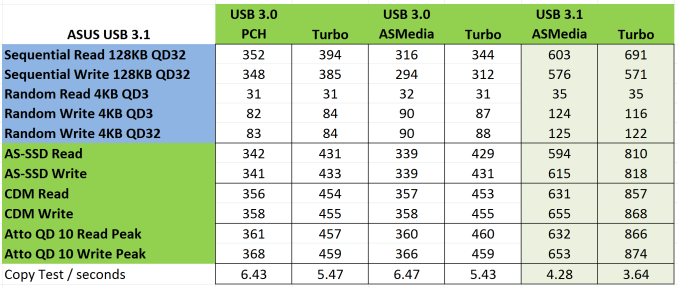
Due to some issues getting IOmeter to recognize the drives without a partition, the IOmeter results for peak throughput seem low compared to the AS-SSD and CrystalDiskMark testing. But on the other hand, we easily show a ~50% boost in random write speeds, as moving from 84 MBps to 125 MBps (Intel 3.0 -> ASMedia 3.1) marks a significant shift. Our copy test shows a similar gain, even more so when USB 3.1 Boost is factored in.

When?!

As of the official announcement in the US today, a number of SKUs will be available for users to purchase (as long as you don’t mind waiting for USB 3.1 devices to come along). These motherboards will be split into two sections:
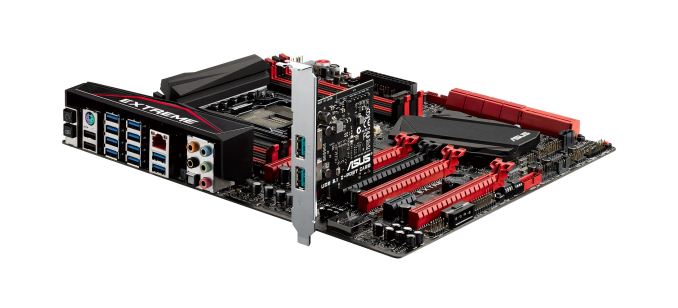
Motherboards with Bundled USB 3.1 Cards (Type-A for now):

Rampage V Extreme/U3.1 ($519, ETA 2/27)
X99-Deluxe/U3.1 ($409, ETA 3/3)
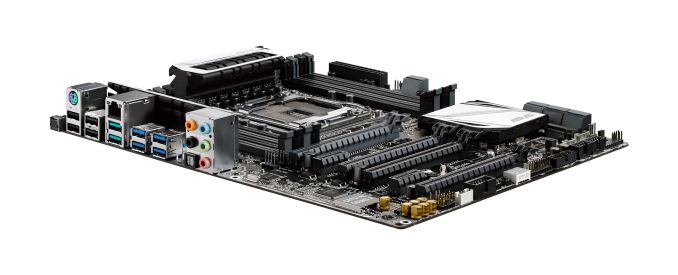
Motherboards with USB 3.1 Type-A Built-In:

X99-Pro/USB 3.1 ($339, ETA 2/27)
X99-A/USB 3.1 ($279, ETA 3/10)
X99-E WS/USB 3.1
Z97-Deluxe/USB 3.1 ($299, ETA 3/3)
Z97-PRO(Wi-Fi ac)/USB 3.1 ($229, ETA 3/3)
Z97-A/USB 3.1 ($159, ETA 3/10)
Z97-E/USB 3.1
Z97-K/USB 3.1
Sabertooth Z97 Mark 1/USB 3.1 ($259, ETA 3/3)
B85M-G PLUS/USB 3.1
B85-PLUS/USB 3.1

The USB 3.1 card, with the appropriate driver update, will be $39 and have an ETA of 3/10. Both cards should be compatible in the following motherboards:
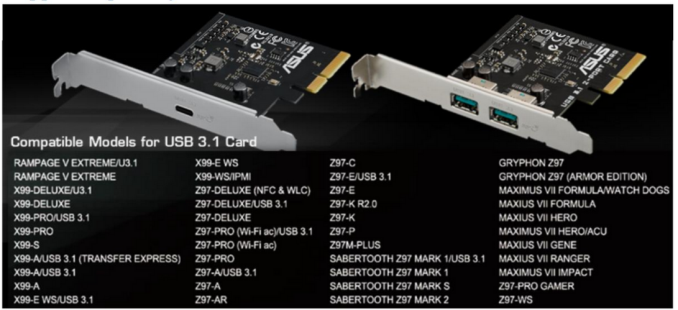
Technically ASUS would prefer that these cards are used solely for use in ASUS motherboards and are being validated as such. A full validation list should be available on the product page for the USB 3.1 cards when it becomes available. Performance on any other motherboard is not guaranteed, but we wouldn’t say it was impossible. The official specifications are:
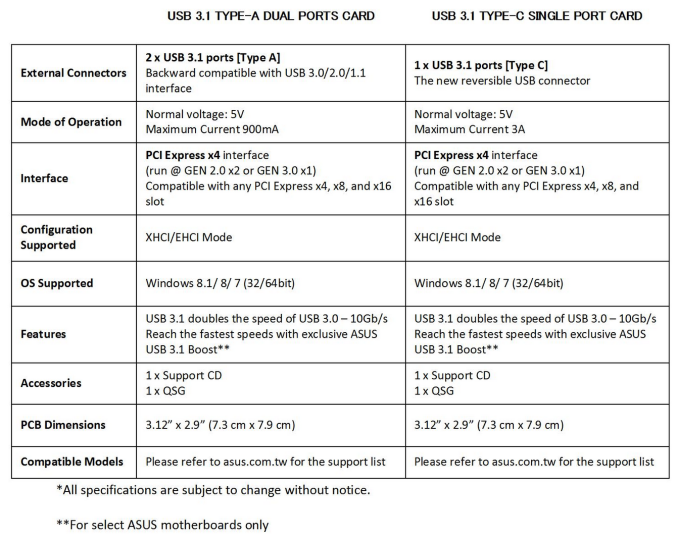
Most manufacturers will go all in with Type-A to begin with, as Type-C is still new to the market. Type-A can still be used with current devices and drives, whereas Type-C cables are still new. Given that the controller requires two PCIe 2.0 lanes, it makes interesting reading as to how freely USB 3.1 might be implemented on Intel’s next desktop platform. USB 3.1 will also be a differentiator in the laptop and notebook space, and I suspect several companies will market the functionality and charge for the privilege, despite the lack of enclosures right now. The fact that ASUS is going to sell its USB 3.1 card for $39 means that implementation costs should be low for notebook manufacturers.

As part of this release, ASUS also sent us a list of USB 3.1 devices that they plan of validating with the USB 3.1 ports. Most of the company names come from Asia and might represent a few of the ODMs that the more consumer-oriented brands use, but the list totals 34 items (Hubs, enclosures, cables) with availability for a few of them from March. I suspect that Computex time (June) will be ramping up the USB 3.1 ecosystem for the early adopters for sure.


Valve to Showcase SteamVR Hardware, Steam Machines, & More at GDC 2015

Valve to Showcase SteamVR Hardware, Steam Machines, & More at GDC 2015

Typically we don’t do announcements of announcements. However in Valve’s case it’s not entirely clear if there’s actually going to be an announcement at GDC, so let’s take a quick look at what Valve is up to.

Valve has put out a press release today announcing that the company will be at GDC and will be showing off several hardware initiatives at GDC. Among them will be the final version of the Steam Controller, more Steam Machines, “new living room devices”, and the eye-catcher of the group, a new hardware system Valve is calling SteamVR.

Valve of course has been working on all of those initiatives for some time now, very publicly in the case of the Steam Machines and Steam Controller, and much more quietly on SteamVR. In the case of Steam Machines and Steam controller, 2014 came and left without a release of either, leaving some ambiguity over the state of those projects. Meanwhile we know that Valve has been experimenting with VR for several years now, and although Valve’s press release doesn’t offer any details on what SteamVR may be, they have a GDC programming session scheduled whose description offers a bit more insight:

Valve has been creating advanced prototype VR HMD’s since mid-2013 that are more advanced than other developers currently have access to, and this head start has allowed us to gain a ton of VR-specific rendering knowledge that we’d like to share with developers who are actively working on VR or plan to in the near future.

This may mean that Valve is working on their own VR headset. Then again it may be an ecosystem/specification/initiative similar to Steam Machines.

Anyhow, for the moment it’s unknown whether SteamVR will be revealed to the public at GDC. Valve already held a press-free event in Washington in January, and their GDC press release does not include any details about a session/event where SteamVR would be announced. Instead Valve is inviting only “developers and publishers” to sign up for demos of SteamVR at GDC through the Steam Universe page, in which case this may be all we hear on SteamVR for now.

February 23, 2015 – Valve will show a family of new Steam devices at next week’s Game Developers Conference (GDC) in San Francisco, CA. Products being demonstrated at GDC include Steam Machines with the final Steam Controller, new living room devices, and a previously-unannounced SteamVR hardware system.

Developers and publishers interested in experiencing the new SteamVR hardware may request to schedule a GDC demo at http://www.steampowered.com/universe.

GDC 2015 will mark the 13th anniversary of Valve’s first public announcement of Steam, which has since become the leading platform for PC, Mac, and Linux games and software.

In the last year, Steam added new services and features – including In-Home Streaming, Broadcasting, Music, and user created stores – as it grew to over 125 million active accounts worldwide.

Steam now offers 4500 games, with 400 million pieces of user-generated content contributed by members of the Steam Community.

Valve to Showcase SteamVR Hardware, Steam Machines, & More at GDC 2015

Valve to Showcase SteamVR Hardware, Steam Machines, & More at GDC 2015

Typically we don’t do announcements of announcements. However in Valve’s case it’s not entirely clear if there’s actually going to be an announcement at GDC, so let’s take a quick look at what Valve is up to.

Valve has put out a press release today announcing that the company will be at GDC and will be showing off several hardware initiatives at GDC. Among them will be the final version of the Steam Controller, more Steam Machines, “new living room devices”, and the eye-catcher of the group, a new hardware system Valve is calling SteamVR.

Valve of course has been working on all of those initiatives for some time now, very publicly in the case of the Steam Machines and Steam Controller, and much more quietly on SteamVR. In the case of Steam Machines and Steam controller, 2014 came and left without a release of either, leaving some ambiguity over the state of those projects. Meanwhile we know that Valve has been experimenting with VR for several years now, and although Valve’s press release doesn’t offer any details on what SteamVR may be, they have a GDC programming session scheduled whose description offers a bit more insight:

Valve has been creating advanced prototype VR HMD’s since mid-2013 that are more advanced than other developers currently have access to, and this head start has allowed us to gain a ton of VR-specific rendering knowledge that we’d like to share with developers who are actively working on VR or plan to in the near future.

This may mean that Valve is working on their own VR headset. Then again it may be an ecosystem/specification/initiative similar to Steam Machines.

Anyhow, for the moment it’s unknown whether SteamVR will be revealed to the public at GDC. Valve already held a press-free event in Washington in January, and their GDC press release does not include any details about a session/event where SteamVR would be announced. Instead Valve is inviting only “developers and publishers” to sign up for demos of SteamVR at GDC through the Steam Universe page, in which case this may be all we hear on SteamVR for now.

February 23, 2015 – Valve will show a family of new Steam devices at next week’s Game Developers Conference (GDC) in San Francisco, CA. Products being demonstrated at GDC include Steam Machines with the final Steam Controller, new living room devices, and a previously-unannounced SteamVR hardware system.

Developers and publishers interested in experiencing the new SteamVR hardware may request to schedule a GDC demo at http://www.steampowered.com/universe.

GDC 2015 will mark the 13th anniversary of Valve’s first public announcement of Steam, which has since become the leading platform for PC, Mac, and Linux games and software.

In the last year, Steam added new services and features – including In-Home Streaming, Broadcasting, Music, and user created stores – as it grew to over 125 million active accounts worldwide.

Steam now offers 4500 games, with 400 million pieces of user-generated content contributed by members of the Steam Community.

AMD at ISSCC 2015: Carrizo and Excavator Details

AMD at ISSCC 2015: Carrizo and Excavator Details

AMD is using the International Solid-State Circuits Conference this week to present a paper and announce some interesting developments regarding the next iteration of the Bulldozer architecture, codenamed ‘Excavator’, as well as other details regarding the CPU range that it will be placed in called ‘Carrizo’.

At the tail end of 2014 we reported on Carrizo and AMD’s announcement for its next generation of APUs, and more recently the discussion surrounding Carrizo not coming to desktop. In those announcements AMD revealed that Carrizo will be aimed at the laptop and notebook community first and foremost, a first for the company as previous APU designs have been aimed at both the desktop and mobile markets.

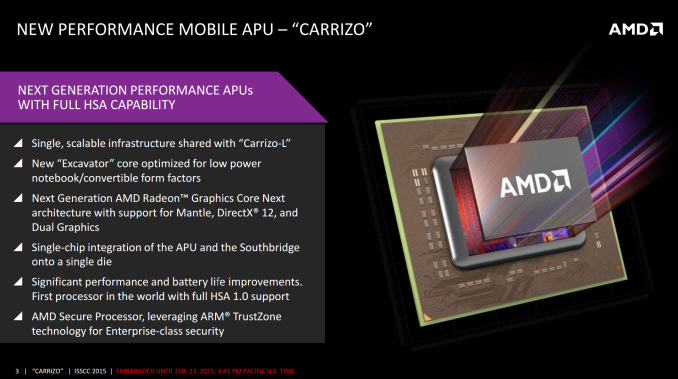
From a hardware standpoint, Carrizo will be combining a number of Excavator modules, AMD’s R-Series GCN GPUs, and the chipset/Fusion Controller Hub into a single package, bringing with it full HSA compatibility, TrueAudio, and ARM Trustzone compatibility. As with Kaveri before it, Carrizo will be built on Global Foundries’ 28nm Super High Performance (28SHP) node, making Carrizo a pure architecture upgrade without any manufacturing changes. Today’s ISSCC paper in turn builds on these revelations, showing some of the data from AMD’s internal silicon testing.

AMD’s presentation confirms that the new Excavator cores are low power optimized rather than desktop optimized. Support for Mantle and DirectX 12 should go without saying, and Dual Graphics support is something AMD has been working on for a number of generations. The next point is interesting from my perspective:

“Single-chip integration of the APU and the Southbridge onto a single die”

In our pre-briefing call, AMD confirmed that the Southbridge/FCH is no longer a separate chip, and is being moved on to the CPU from its previously separate package. In fact not only is the south bridge going to part of the CPU with Carrizo, but it’s being fully integrated into the APU die itself. This is a first for AMD, and even Intel by comparison still uses two separate dies on the same package for their similar Broadwell-Y/U processors. As a result, AMD explained, this advances the Southbridge from the older 65nm/45nm processes to 28nm and 28SHP, reducing power consumption and operating voltage. It also allows the APU to accurately control power gating, further saving power, and reduces the length of HyperTransport interconnects between the APU and the I/O. On the flip side, it does move the soutb bridge’s power consumption onto the APU, as well as the extra transistors it would otherwise occupy. This is explained in detail below.

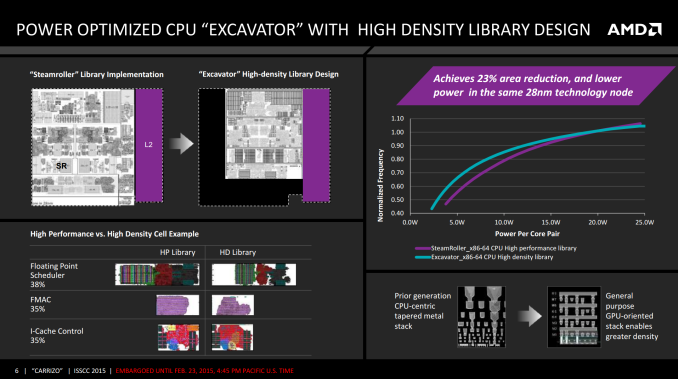
The key element to Excavator’s design is a reduction in die area. Fundamentally everything is the same in terms of operation compared to Kaveri, but the internal units such as the FP scheduler and cache control have been re-engineered to take up less room on the same 28nm SHP process node. It seems a little odd applying a ‘high-density’ design to a ‘high-performance’ process node, but AMD is stating that part of this has been driven by the GPU team sharing its experiences and knowledge of small, efficient die components with the CPU team, allowing the lessons learned there to benefit AMD’s CPU designs. This is combined with a “GPU-oriented” design stack on the CPU, which AMD is showing provides significant power savings at the same frequency, or higher frequency at the same power.

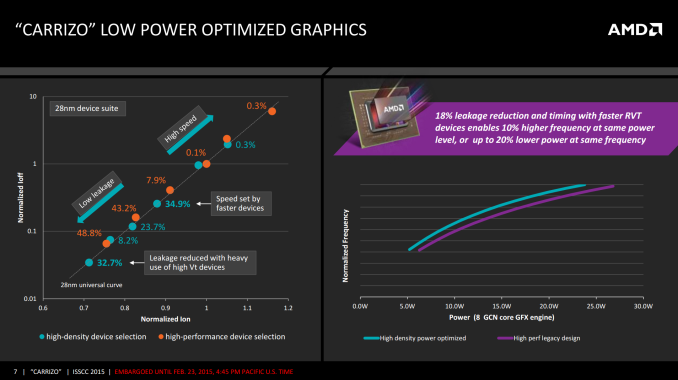
The high density, power optimized design also plays a role in the GPU segment of Carrizo, offering lower leakage at high voltages as well as allowing a full 8 GCN core design at 20W. This is an improvement from Kaveri, which due to power consumption only allowed a 6 GCN design at the same power without compromising performance.

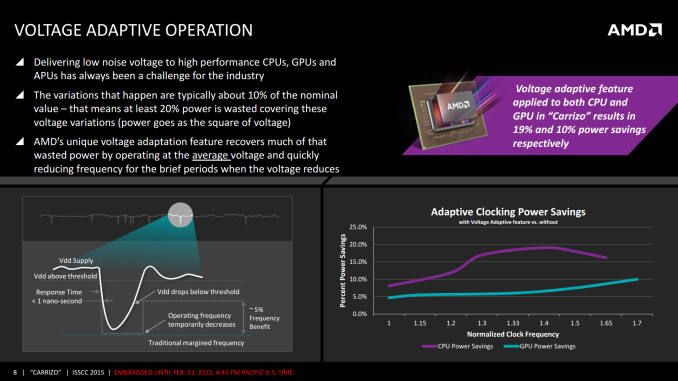
AMD revealed Voltage Adaptive Operation back with Kaveri, and it makes a reappearance in Carrizo with its next iteration. The principle here is that with a high noise line, the excess voltage will cause power to rise. If the system reduces the frequency of the CPU during high noise/voltage segments – as power is proportional to voltage squared – power consumption will be reduced and then frequency can be restored when noise returns to normal. This happens inside the CPU over nanoseconds, resulting in no serious performance loss but it helps keep the power consumption of the APU down. In the case of Carrizo, AMD is quoting a 10-20% reduction in power consumption versus what a theoretical Carrizo would look like without this technology.

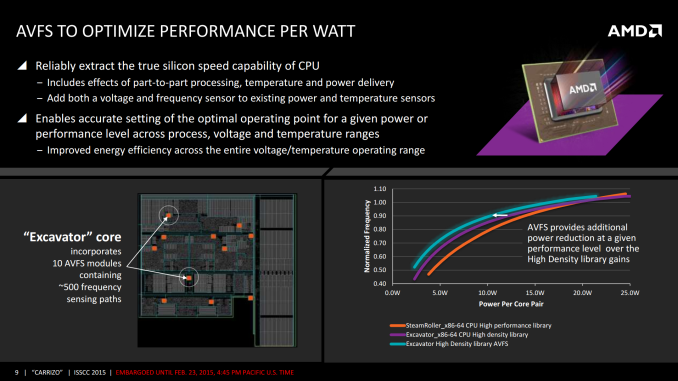
Another new addition to Excavator comes in the form of Adaptive Voltage-Frequency Scaling modules. Carrizo uses 10 in each Excavator ‘core’, and these modules can adjust the frequency and voltage of individual components depending on power requirements, temperature and other external factors in order to improve either performance, power consumption, or efficiency. With this in mind, AMD is claiming a 29% frequency increase at 10W, or if frequency is held constant then there is a 40-50% power decrease at the same 10W. At 20W, as the graph shows, there is almost no difference between the two, indicating that Excavator is truly built for lower TDP devices.

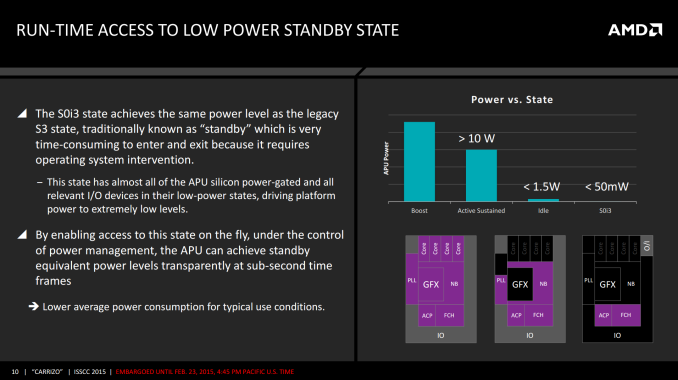
AMD is also presenting news on improvements to their ability to quickly enter and exit sleep states. With Excavator, AMD can now go from a sub-50mW S0i3 state to an active state in under a second. This should allow Carrizo devices to quickly reach and better sustain near-standby power levels, improving idle and low-load power consumption. As shown in the slide, at the S0i3 state only the ACP, PCH, and a small I/O segment are still active, while the rest of the device is completely power gated.

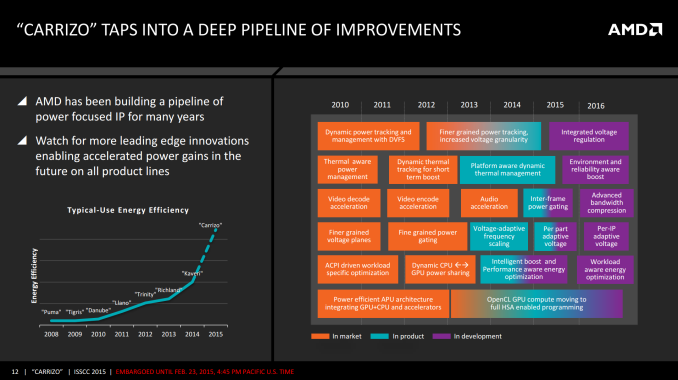
Meanwhile AMD is also once again showing off their technology timeline to illustrate their progress in implementing new technologies over the years. We confirmed that an interesting feature, inter-frame power gating, is active in Carrizo. This in a nutshell allows the GPU to go to a low frequency mode when the frame buffers are full. Though only a few milliseconds of power savings per instance, over time this can add up to larger increases battery life.

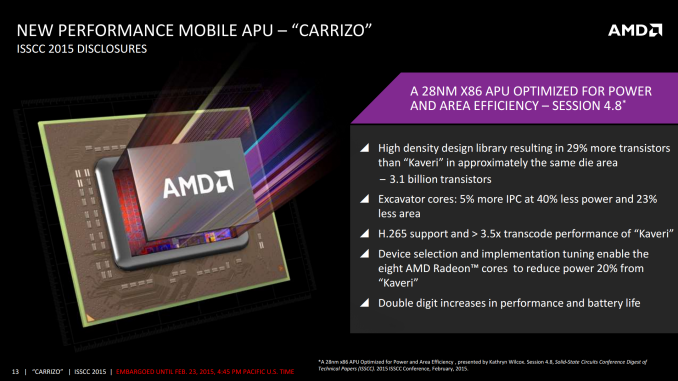
Wrapping up the hardware aspects of their ISSCC presentation, AMD is also disclosing the die size and transistor counts for Carrizo. Whereas Kaveri weighed in at 2.3 billion transistors in a 245mm2 die, Carrizo will come in at a much larger 3.1 billion transistors in a 250mm2 die. This a significant increase in transistor density for AMD, with Carrizo packing in 29% more transistors for only a marginal increase in die size. Though AMD is not explaining where all of the transistor increases come from at this time, part of the increase comes from the Southbridge/FCH being moved on-die, which AMD tells us will take up 5.5% of Carrizo’s die. As for the Excavator cores themselves, AMD is starting that they consume 40% less power and take up 23% less die area, thanks to the combination of transistor density improvements, AVFS technology, and bringing the FCH on-die.

Moving on, although AMD’s ISSCC presentation is not going to be diving deep into the Excavator architecture, AMD is claiming that Excavator will also bring with it a 5% IPC boost. We understand that this increase in IPC comes from a doubling of the L1 data cache from 64KB to 128KB, as well as further payoffs from the power improvements. Meanwhile on the fixed-function side of matters, Carrizo will be introducing a full H.265 hardware decoder. This is the first AMD part (CPU or GPU) to offer any kind of hardware support for H.265 decoding, and in the process it will be the first x86 CPU/APU to offer full hardware decode capabilities, as Intel still relies on a hybrid decode approach at this time.

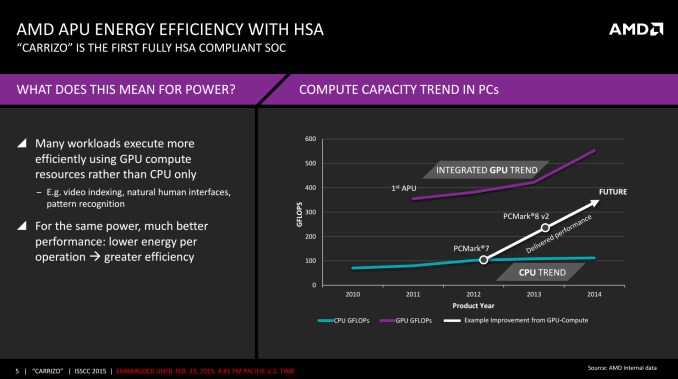
Finally, AMD is also rolling out some new Heterogeneous System Architecture (HSA) functionality as part of Carrizo. HSA is seen as one of the next key factors in personal computing over the next decade. We have seen an almost ubiquitous shift in recent years towards almost every consumer processor having on-die graphics, and the ability to optimize a workload for each part of the system improves the experience. AMD has been riding this wave, announcing Kaveri as ‘HSA Ready’ and now Carrizo as ‘HSA Compliant’, fully adhering to HSA 1.0 specifications. At the moment the biggest benchmark showing off this power is PCMark, something AMD likes to promote.  With regards the difference between HSA Ready and Compliant, I asked AMD what made Kaveri different in that regard. The answer was straightforward enough: Carrizo is able to perform GPU context switching, allowing a GPU state-save and state-restore, something Kaveri is unable to do and offering a solid hint that Carrizo’s GPU is based on AMD’s GCN 1.2 architecture.

Wrapping things up, the combination of a 5% IPC boost and 40% power savings means that AMD has a range of options for Carrizo parts, picking between increased clockspeeds at the same power levels or holding clockspeeds constant for a larger battery life gain. We expect that actual retail parts will be somewhere in the middle, as the graphs in the slides indicate that best efficiency occurs around the 10W scenario.

We did ask about absolute design numbers regarding battery life, processor frequencies and time to market. As expected, AMD is keeping its cards close to its chest, especially in a more academic environment such as ISSCC. At this point in time we were told that Carrizo is expected to come to market within Q2. With Computex taking place towards the end of Q2, this should mean that a number of Carrizo devices will either be on the market or at least on display for us to examine.


AMD at ISSCC 2015: Carrizo and Excavator Details

AMD at ISSCC 2015: Carrizo and Excavator Details

AMD is using the International Solid-State Circuits Conference this week to present a paper and announce some interesting developments regarding the next iteration of the Bulldozer architecture, codenamed ‘Excavator’, as well as other details regarding the CPU range that it will be placed in called ‘Carrizo’.

At the tail end of 2014 we reported on Carrizo and AMD’s announcement for its next generation of APUs, and more recently the discussion surrounding Carrizo not coming to desktop. In those announcements AMD revealed that Carrizo will be aimed at the laptop and notebook community first and foremost, a first for the company as previous APU designs have been aimed at both the desktop and mobile markets.

From a hardware standpoint, Carrizo will be combining a number of Excavator modules, AMD’s R-Series GCN GPUs, and the chipset/Fusion Controller Hub into a single package, bringing with it full HSA compatibility, TrueAudio, and ARM Trustzone compatibility. As with Kaveri before it, Carrizo will be built on Global Foundries’ 28nm Super High Performance (28SHP) node, making Carrizo a pure architecture upgrade without any manufacturing changes. Today’s ISSCC paper in turn builds on these revelations, showing some of the data from AMD’s internal silicon testing.

AMD’s presentation confirms that the new Excavator cores are low power optimized rather than desktop optimized. Support for Mantle and DirectX 12 should go without saying, and Dual Graphics support is something AMD has been working on for a number of generations. The next point is interesting from my perspective:

“Single-chip integration of the APU and the Southbridge onto a single die”

In our pre-briefing call, AMD confirmed that the Southbridge/FCH is no longer a separate chip, and is being moved on to the CPU from its previously separate package. In fact not only is the south bridge going to part of the CPU with Carrizo, but it’s being fully integrated into the APU die itself. This is a first for AMD, and even Intel by comparison still uses two separate dies on the same package for their similar Broadwell-Y/U processors. As a result, AMD explained, this advances the Southbridge from the older 65nm/45nm processes to 28nm and 28SHP, reducing power consumption and operating voltage. It also allows the APU to accurately control power gating, further saving power, and reduces the length of HyperTransport interconnects between the APU and the I/O. On the flip side, it does move the soutb bridge’s power consumption onto the APU, as well as the extra transistors it would otherwise occupy. This is explained in detail below.

The key element to Excavator’s design is a reduction in die area. Fundamentally everything is the same in terms of operation compared to Kaveri, but the internal units such as the FP scheduler and cache control have been re-engineered to take up less room on the same 28nm SHP process node. It seems a little odd applying a ‘high-density’ design to a ‘high-performance’ process node, but AMD is stating that part of this has been driven by the GPU team sharing its experiences and knowledge of small, efficient die components with the CPU team, allowing the lessons learned there to benefit AMD’s CPU designs. This is combined with a “GPU-oriented” design stack on the CPU, which AMD is showing provides significant power savings at the same frequency, or higher frequency at the same power.

The high density, power optimized design also plays a role in the GPU segment of Carrizo, offering lower leakage at high voltages as well as allowing a full 8 GCN core design at 20W. This is an improvement from Kaveri, which due to power consumption only allowed a 6 GCN design at the same power without compromising performance.

AMD revealed Voltage Adaptive Operation back with Kaveri, and it makes a reappearance in Carrizo with its next iteration. The principle here is that with a high noise line, the excess voltage will cause power to rise. If the system reduces the frequency of the CPU during high noise/voltage segments – as power is proportional to voltage squared – power consumption will be reduced and then frequency can be restored when noise returns to normal. This happens inside the CPU over nanoseconds, resulting in no serious performance loss but it helps keep the power consumption of the APU down. In the case of Carrizo, AMD is quoting a 10-20% reduction in power consumption versus what a theoretical Carrizo would look like without this technology.

Another new addition to Excavator comes in the form of Adaptive Voltage-Frequency Scaling modules. Carrizo uses 10 in each Excavator ‘core’, and these modules can adjust the frequency and voltage of individual components depending on power requirements, temperature and other external factors in order to improve either performance, power consumption, or efficiency. With this in mind, AMD is claiming a 29% frequency increase at 10W, or if frequency is held constant then there is a 40-50% power decrease at the same 10W. At 20W, as the graph shows, there is almost no difference between the two, indicating that Excavator is truly built for lower TDP devices.

AMD is also presenting news on improvements to their ability to quickly enter and exit sleep states. With Excavator, AMD can now go from a sub-50mW S0i3 state to an active state in under a second. This should allow Carrizo devices to quickly reach and better sustain near-standby power levels, improving idle and low-load power consumption. As shown in the slide, at the S0i3 state only the ACP, PCH, and a small I/O segment are still active, while the rest of the device is completely power gated.

Meanwhile AMD is also once again showing off their technology timeline to illustrate their progress in implementing new technologies over the years. We confirmed that an interesting feature, inter-frame power gating, is active in Carrizo. This in a nutshell allows the GPU to go to a low frequency mode when the frame buffers are full. Though only a few milliseconds of power savings per instance, over time this can add up to larger increases battery life.

Wrapping up the hardware aspects of their ISSCC presentation, AMD is also disclosing the die size and transistor counts for Carrizo. Whereas Kaveri weighed in at 2.3 billion transistors in a 245mm2 die, Carrizo will come in at a much larger 3.1 billion transistors in a 250mm2 die. This a significant increase in transistor density for AMD, with Carrizo packing in 29% more transistors for only a marginal increase in die size. Though AMD is not explaining where all of the transistor increases come from at this time, part of the increase comes from the Southbridge/FCH being moved on-die, which AMD tells us will take up 5.5% of Carrizo’s die. As for the Excavator cores themselves, AMD is starting that they consume 40% less power and take up 23% less die area, thanks to the combination of transistor density improvements, AVFS technology, and bringing the FCH on-die.

Moving on, although AMD’s ISSCC presentation is not going to be diving deep into the Excavator architecture, AMD is claiming that Excavator will also bring with it a 5% IPC boost. We understand that this increase in IPC comes from a doubling of the L1 data cache from 64KB to 128KB, as well as further payoffs from the power improvements. Meanwhile on the fixed-function side of matters, Carrizo will be introducing a full H.265 hardware decoder. This is the first AMD part (CPU or GPU) to offer any kind of hardware support for H.265 decoding, and in the process it will be the first x86 CPU/APU to offer full hardware decode capabilities, as Intel still relies on a hybrid decode approach at this time.

Finally, AMD is also rolling out some new Heterogeneous System Architecture (HSA) functionality as part of Carrizo. HSA is seen as one of the next key factors in personal computing over the next decade. We have seen an almost ubiquitous shift in recent years towards almost every consumer processor having on-die graphics, and the ability to optimize a workload for each part of the system improves the experience. AMD has been riding this wave, announcing Kaveri as ‘HSA Ready’ and now Carrizo as ‘HSA Compliant’, fully adhering to HSA 1.0 specifications. At the moment the biggest benchmark showing off this power is PCMark, something AMD likes to promote.  With regards the difference between HSA Ready and Compliant, I asked AMD what made Kaveri different in that regard. The answer was straightforward enough: Carrizo is able to perform GPU context switching, allowing a GPU state-save and state-restore, something Kaveri is unable to do and offering a solid hint that Carrizo’s GPU is based on AMD’s GCN 1.2 architecture.

Wrapping things up, the combination of a 5% IPC boost and 40% power savings means that AMD has a range of options for Carrizo parts, picking between increased clockspeeds at the same power levels or holding clockspeeds constant for a larger battery life gain. We expect that actual retail parts will be somewhere in the middle, as the graphs in the slides indicate that best efficiency occurs around the 10W scenario.

We did ask about absolute design numbers regarding battery life, processor frequencies and time to market. As expected, AMD is keeping its cards close to its chest, especially in a more academic environment such as ISSCC. At this point in time we were told that Carrizo is expected to come to market within Q2. With Computex taking place towards the end of Q2, this should mean that a number of Carrizo devices will either be on the market or at least on display for us to examine.