News


Toshiba announces new Chromebook 2 line

Toshiba announces new Chromebook 2 line

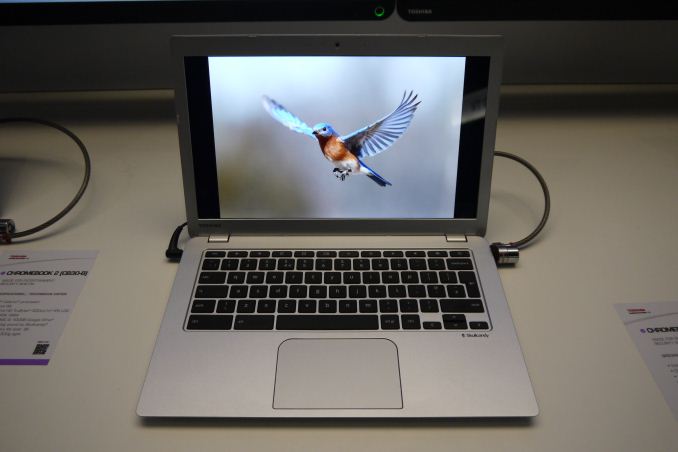
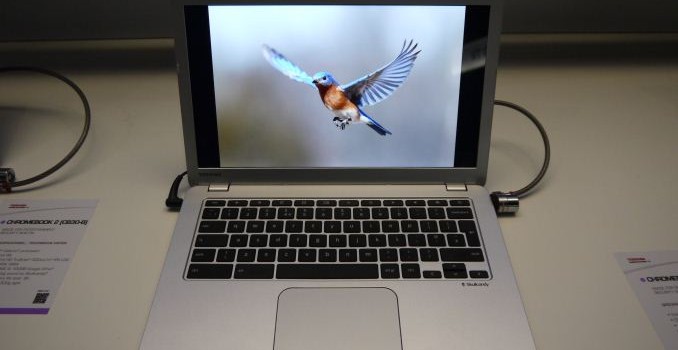
Expanding its Chromebook lineup, Toshiba is updating its original model by releasing the Chromebook 2. During my time with the device the most immediate difference on this new model is the display, as it now offers some very good colours and viewing angles. Toshiba now provides a 1080p IPS screen on the higher end model that is worlds apart from the screen used in their original Chromebook. Toshiba is planning to also offer a 720p matte screen display in a lower end edition, but this wasn’t on display.

The specs are pretty modest; the Chromebook 2 comes with an Intel Celeron Bay-Trail processor which according to Toshiba may be subject to change due to device’s later release date, so the exact model number was not provided. This creates a bit of anbiguity on how performant the final hardware will be. Main memory comes in at 4GB DDR3L at 1600MHz for the 1080p model, or 2GB for the 720p model. Toshiba advertises 11.5h and 9h usage times for the low end and high end model on a non-replaceable battery.

Connectivity is provided by 1x HDMI-out, 1x USB 2.0, 1x USB 3.0 (including Sleep-and-Charge), SD/SDHC slot, headphone/mic combo jack connectors, and a Kensington security lock. The device sports 801.11ac+agn WiFi capabilities with BT 4.0 and a HD webcam with dual microphones. 

Toshiba representatives told me they tried to improve on the main issues their user-base reported on the predecesor model, which beyond the screen was also the form factor, and indeed the Chomebook 2 shaves off a lot of weight and size while still retaining the same 13.3″ screen size.

There was a noticeable lack of visible speakers anywhere on the device and that’s because they were built-in into the device. The sound was quite acceptable for laptop speakers and plenty loud.

The Chromebook 2 isn’t scheduled to be available until in Q1 2015 in Europe. While again Toshiba didn’t comment on the price, I expect something similar to the current models which hover around 300€.

Sony Announces the SmartWatch 3 and SmartBand Talk at IFA

Sony Announces the SmartWatch 3 and SmartBand Talk at IFA

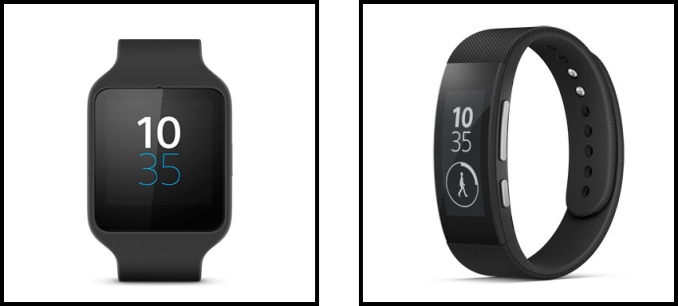
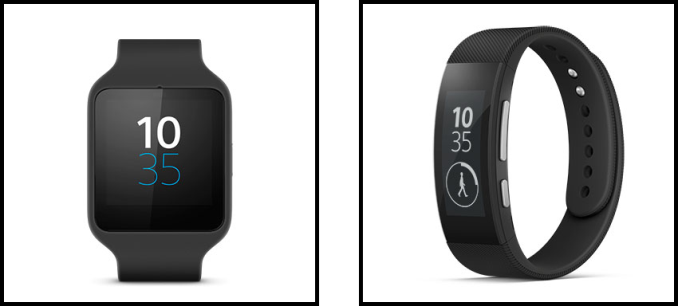
Sony is no stranger to wearable devices. But today they are launching their first device that runs Google’s Android Wear operating system. The first is the Smartwatch 3, pictured on the left above. The SmartWatch 3 is similar to the other Android Wear devices launched by other manufacturers. It sports a 1.6″ 320×320 LCD display, and is powered by Qualcomm’s APQ8026 quad Cortex-A7 part running at 1.2GHz, paired with an Adreno 305 and 512MB of RAM plus 4GB of NAND. The SmartWatch 3 is IP68 rated for submersion in water up to 2 meter deep for 30 minutes. The 420mAh battery is also slightly larger than competing watches like LG’s G Watch which is 400mAh.

My concern is that the SmartWatch 3 doesn’t really bring anything spectacular compared to competing devices and doesn’t have the visual appeal or design of watches like the LG G Watch R. Pricing has yet to be announced but hopefully the SmartWatch 3 is price competitive.

The second announced device is the SmartBand Talk. It’s more like some of the fitness bands that we’ve seen launched, with a 1.4″ e-paper  display at 192dpi that integrates into the band itself. Sony hasn’t given any specifics about what’s inside the SmartBand Talk, but they have said that it will have an integrated speaker and mic for voice calls when paired with a smartphone. It’s not clear if the SmartBand Talk is also powered by Android Wear.

The SmartWatch 3 will be available in black and green, while the SmartBand Talk will come in black and white. Both devices are slated to launch in the fall, and pricing is currently unknown.

NVIDIA Announces GAME24 - 24 Hour Live Gaming Celebration

NVIDIA Announces GAME24 – 24 Hour Live Gaming Celebration

It seems company sponsored live events are becoming more popular. Not long after AMD hosted their own gaming celebration, NVIDIA is upping the ante with a 24 hour live streamed event with several physical locations around the world, which they’re calling GAME24.

NVIDIA describes GAME24 as a celebration of gaming, and several gaming studios will also be involved in the event. However, NVIDIA has not yet announced the studio names. GAME24 will feature eSports competitions, record-breaking gaming stunt competitions, exclusive game demos, prizes, and developer interviews. And of course, along with a focus on gaming products and partnerships, there will be a significant amount of actual gaming taking place both remotely and in-person.

The event will take place starrting 6 PM PST on Thursday, September 18th, and it will last until the same time the next day. Streaming will be provided from start to finish via Twitch. To attend the event, register at http://www.game24.nvidia.com/. Attendance and registration are free. Registration ends at 5 PM PDT the day of the event but NVIDIA warns seats are limited, so it’s first come first served.

Confirmed locations include:

  • Los Angeles:  Hangar 8, 3021 Airport Avenue, Santa Monica, California. 18 and up only.
  • Chicago: Ignite Gaming Lounge, 3341 N. Elston Ave., Chicago, Illinois.
  • Indianapolis: eBash Indianapolis Video Game Center, 6609 East 82nd St., Indianapolis, Indiana.
  • Mission Viejo, California: 27741 Crown Valley Pkwy, Ste. 223, Mission Viejo, California.
  • London: Location TBA
  • Shanghai: Location TBA
  • Stockhom: Location TBA

I have personally attended a few regional celebration events like this before, and I’ve always had a good time. Between the gaming, merchandise giveaways, and just the social aspects it should be a fun event.

Source: NVIDIA

Samsung Announces Gear VR: A VR Harness For Your Note 4

Samsung Announces Gear VR: A VR Harness For Your Note 4

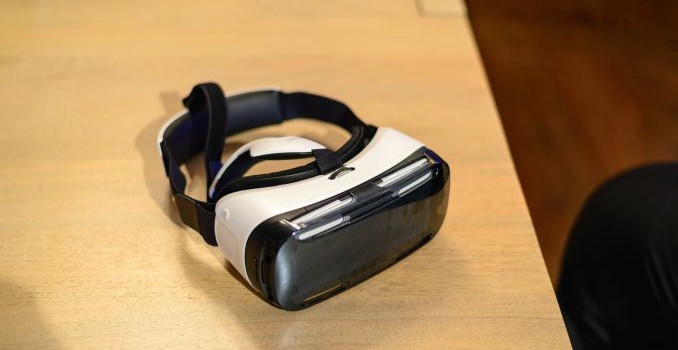
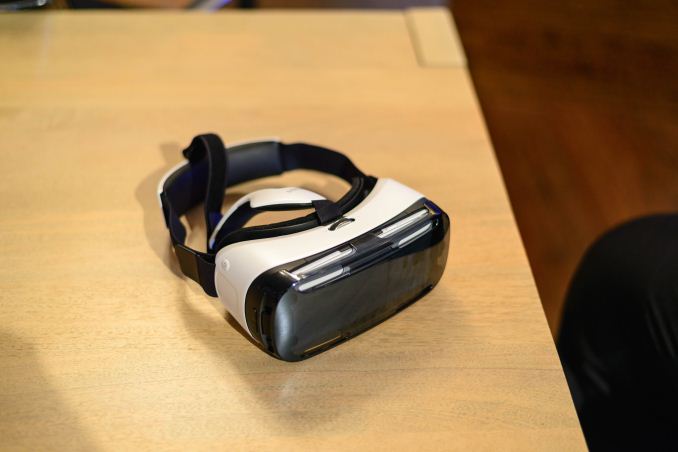
Alongside today’s announcement of the Galaxy Note 4, Samsung also used the occasion to announce that they intend to break into the nascent VR headset market with their own device. Dubbed the Gear VR, Samsung is making a very different and very smartphone-centric take on the VR headset concept. For that reason the fact that this device was announced at the same time as the Note 4 was no mistake or even a convenience. Instead the Gear VR is functionally a peripheral for the Note 4; the Note 4 itself is the heart of the device, and the Gear VR is the harness to utilize the Note 4 as a VR headset.

The idea of using a phone or phablet as the basis of a VR headset is not new, but Samsung’s Gear VR project is the most serious and complete implementation of the idea yet. Gear VR follows up on Google’s Cardboard VR concept, replacing the hacked together DIY construction with a retail grade manufactured harness. Otherwise the idea is similar in execution: phones and phablets already have the screens, sensors, and gyroscopes necessary to build a basic VR headset, so why not? And the Note 4 in turn is the newest and most advanced of these devices.

Meanwhile Samsung for their part already has an interest in VR headsets and a business relationship to help make it a reality. Samsung is the manufacturer behind the display used in the Oculus Rift DK2, which uses the 1080p SAMOLED screen from the Note 3. With Samsung already involved in VR headset manufacturing, it’s only a slight extension on their part to take advantage of their in-house technology to go it alone and build their own headset out of the newer Note 4 hardware. As Samsung Display Corp. seems to only be willing to provide the latest and greatest SAMOLED panels to Samsung Mobile, there is potential to ship a VR display more compelling than anything else on the market.
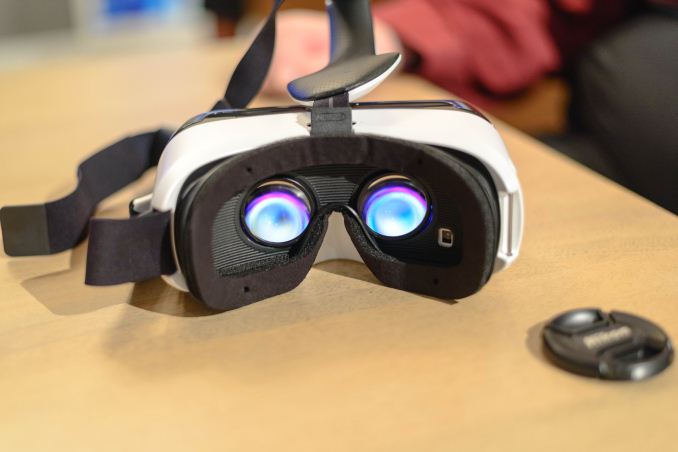
So how does the Gear VR work? With the Note 4 proving the heart of the device – the display, the processing, and the sensors – the Gear VR harness itself provides the mechanism to hold the phone in place, including the lenses necessary to focus on the Note 4 at such a close distance and to adjust that focus. However the Gear VR is also an I/O device of its own to allow access to the Note 4, since the phablet and its touchscreen are inaccessible while it’s locked into the harness.
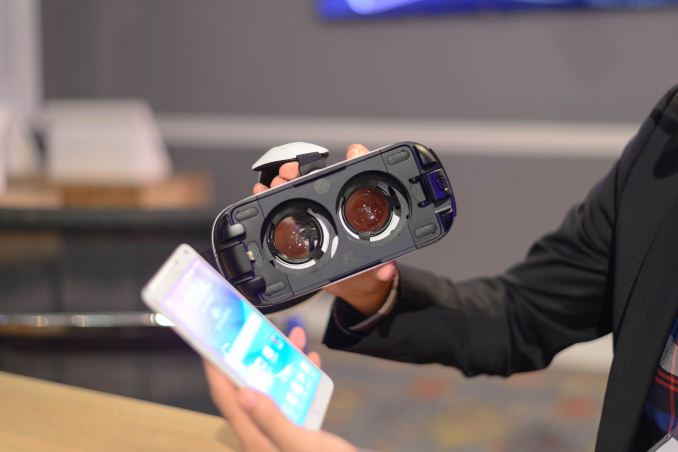
Utilizing the micro-USB connection at the bottom of the Note 4, the Gear VR grants the combined setup a small touchpad and a back button to allow basic operation and navigation, along with additional controls for volume (note that audio either comes from the Note 4 or an external headset, the harness has no speakers of its own). This setup isn’t a full replacement for the Note 4’s buttons and touchscreen, but it’s meant to offer a basic interface that’s used in conjunction with pointing-by-viewing to allow simple controller-free operation of the headset. It’s also worth noting that the harness doesn’t have a power source of its own, so it’s drawing from the Note 4’s own power supply.
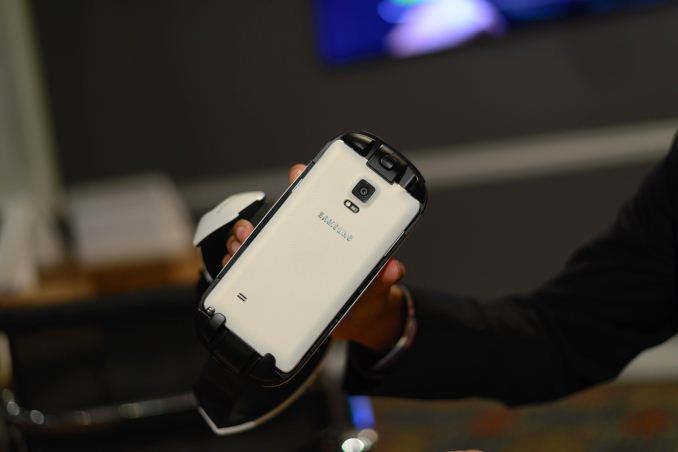
Meanwhile one thing that is important to note is that unlike other VR headsets such as the Oculus Rift and Sony’s Project Morpheus, the combined Gear VR headset is designed to be a stand-alone device. It’s not merely a display and I/O interface for an external game console or PC, but as in the Google Cardboard concept is a complete and self-contained device.

This is an important distinction because it sets a baseline for what kind of content Samsung can reasonably offer and support on the headset. The Note 4 is a modern and high performance phablet, but at the end of the day it’s powered by an SoC-class GPU that offers a fraction of the performance of a game console or PC. Which is not to say that you can’t game on it, but given the hardware it’s clear that Samsung is not in direct conflict with Oculus VR or Sony for the hardcore gaming market.

Consequently the bulk of Samsung’s demos were focused on panoramic 3D video playback, which is a low intensity task that the Note 4 isn’t challenged by. In this case the headset can be used to look around the panorama, making it seem as if the viewer is in the middle of the action. Along with the panoramic videos, Samsung also had an Iron Man themed demo to showcase the device’s interactivity potential, using the Gear VR setup to look around a mockup of Tony Stark’s lab and to activate certain gimmicks and informational displays. Finally a simple space sim dubbed Escape Velocity was present to demonstrate the gaming possibilities for the device, though gameplay was limited to looking and shooting due in part to the limits imposed by the hardware and I/O options. In the longer term all of these are closer to technical demos than complete products, so Samsung will need Android developers to embrace the Gear VR setup if they wish to round up a good collection of content.
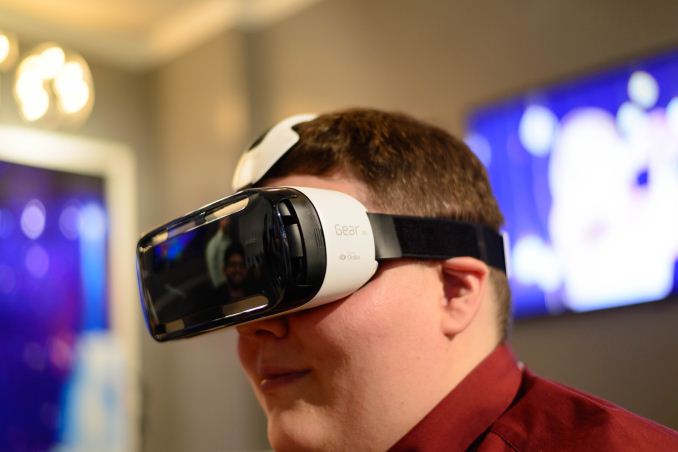
Meanwhile the hardware itself was solid. In our brief look at the demo units it’s impractical to do a proper side-by-side comparison with any other VR headsets, but Samsung has put together a solid piece of kit. The adjustable headstraps offer enough range to fit most heads – even my own (if just barely) – and the adjustable focus means just about anyone with good vision should be able to make the headset work. However, correction seems to be limited to around -3.5 diopters for those that are near-sighted. In addition, no correction is possible for those with astigmatism. The headset also does not accommodate for glasses.
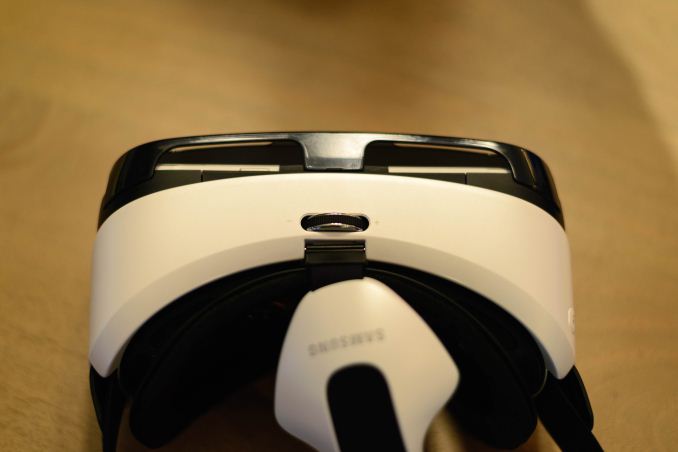
Elsewhere the inputs live up to their stated goals of providing limited I/O for the Gear VR, though I did manage to accidentally hit the back button more than once. Overall the Note 4 gives the overall setup some heft, but not enough to make the setup heavy or uncomfortable, at least for short periods of use.
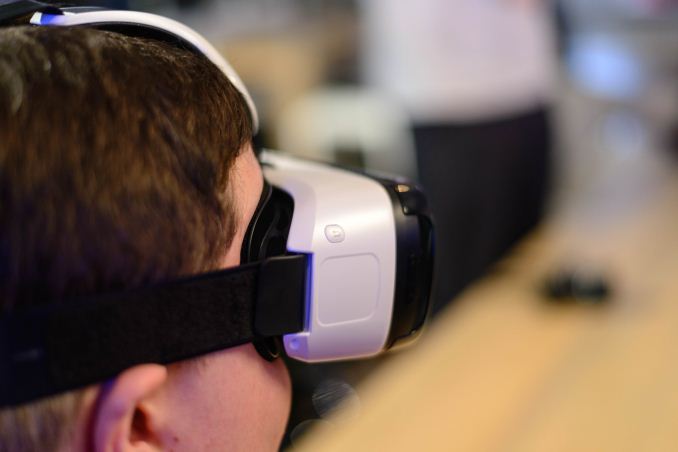
Which on that note, Samsung is suggesting a 30/15 rule for the device: 30 minutes of use, followed by a 15 minute break. This limited playing window avoids any concerns about extended use of VR headsets while also bypassing any battery life concerns since the Note 4 needs to power every aspect of the combined setup.

Otherwise the star of the Gear VR is the Note 4’s display, which is currently unparalleled among SAMOLED displays. At 2560×1440 pixels (Quad HD) and with the rapid response time of OLED, the Note 4’s display is a natural fit for a VR headset. With the Note 4 packing a 5.7” screen, the pixel density on the Note 4’s panel works out to roughly 515 PPI, one of the highest pixel densities yet and a good fit for an application that is so density-sensitive. However this is complicated by the now typical use of a pentile subpixel arrangement in a Samsung OLED display. The 515 PPI density makes the pixels harder than ever to see, but they are still visible and the subpixel layout exacerbates this to some degree. Based on our experience this may very well be better than any other VR headset display so far, but the holy grail for VR headsets may be a 4K display in similar dimensions.

Meanwhile it’s interesting to note that while this is a Samsung device it is being promoted as a product of a “deep technical partnership” with Oculus VR. The press release Samsung will be sending out with today’s announcement even specifically notes that the Gear VR is “powered by Oculus technology”. Unfortunately Samsung isn’t going into any real detail on what that partnership entails at this time. Since Samsung is building all of the hardware, the most likely collaboration is on the software and/or the optics. Though in either case any presence that Oculus VR has in the development of the Gear VR is not immediately obvious when you use it.
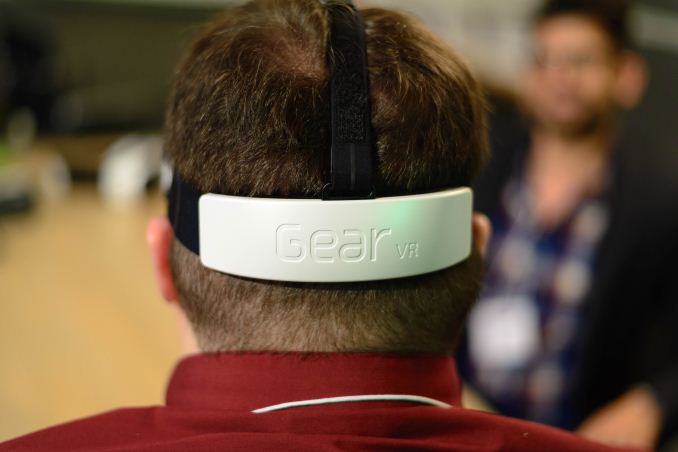
Wrapping things up, in the longer term we do have some concerns about the viability of the Gear VR compared to other VR headsets, but with the modern incarnation of the VR headset industry so new, these are questions that only development time and consumer adoption can answer. Which is also why Samsung is wisely approaching this in an Oculus Rift-like manner by pitching this first iteration of Gear VR at early adopters under the product title “Samsung Gear VR Innovator Edition.” The difference is somewhat semantic – Samsung and even certain carriers will be selling the Gear VR harness to anyone that wants it – but Samsung does make it clear that they’re not shooting for wide consumer adoption quite yet.

On the hardware side, one of the biggest technical questions that Gear VR raises is whether the sensor suite on a smartphone is really good enough for this line of use. Oculus VR for their part has been focusing on very low input latency as a major component of VR headsets, for example. And even though this is an early adopter product this is something Samsung has paid more attention to than we would have expected. Samsung is specifically listing the device’s “Motion to Photon” latency in their product specifications, which for the Gear VR is stated to be less than 20ms. 20ms is a particularly important threshold for VR headset latency, since among other things this is the maximum amount of latency that John Carmack has stated he feels is acceptable.

Meanwhile on the consumer side there’s the question of consumer interest. Does a Note 4 converted into a VR headset offer enough functionality to satisfy consumers? Gaming still seems like the killer app for VR headsets, and that’s the area where an SoC-powered device like the Gear VR is going to be the most handicapped.

For the answer to these questions and more, we’ll have to see what happens with the Gear VR once the Innovator Edition begins shipping. Like the Note 4 itself, Samsung isn’t committing to a date or a price at this time, but their best estimate for a launch date for the Gear VR is this fall with a price to be determined.

Samsung Announces Galaxy Note 4: Hands On

Samsung Announces Galaxy Note 4: Hands On

By now, most people seem to have accepted the concept of a phablet. At first, I was also skeptical, as I wanted a phone that could easily be used with one hand. However, with time I’ve really come to appreciate the value that comes with the larger display size and S-Pen/Wacom stylus. Simply put, even though the larger size precludes the possibility of easily using the phone with one hand, the increased multitasking capabilities and improved media experience can be well worth the trade-off. While I also find unfortunate that Android OEMs seem to believe that every phone should be a phablet, it’s hard to ignore the incredible success that Samsung continues to have with the Galaxy Note phablets. It’s also increasingly difficult to nail down just what a phablet is. I still firmly believe that a smartphone should be easy to use with one hand, and a phablet requires two. However, the distinction between phablet and tablet is a matter of whether the device can be easily carried in a pocket. Of course, none of that really gives a firm, clear answer. After all, everyone is different, and differences in hand size and thumb length determine what those limits are.

At any rate, this takes us to the Galaxy Note 4. Surprisingly, Samsung has stopped their march of ever-increasing display size for the Note phablets. The Galaxy Note 4 has a 5.7” AMOLED display, with QHD/1440p resolution. This comes out to 515 PPI, which should be high enough for general smartphone usage but in my experience with the Gear VR it isn’t enough for VR usage, which holds the display as close as possible to the eye. Samsung also disclosed that they have a 2.7 GHz quad-core processor for some variants, which points squarely towards Snapdragon 805 for the US. There’s also a 1.9/1.3 GHz octa-core version, which should be an Exynos 5433 SoC. For those that have spent any amount of time following Samsung Systems LSI’s SoC nomenclature, it should be patently obvious that there are four Cortex A15s on the big cluster and four Cortex A7s on the little cluster. I’ve included a spec table below to get a better idea of how things stand.

  Samsung Galaxy Note 3 Samsung Galaxy Note 4
SoC

2.26 GHz Snapdragon 800

2.7 GHz Snapdragon 805
RAM/NAND 3 GB LPDDR3, 32/64GB NAND + microSD 3GB LPDDR3, 32GB NAND + microSD
Display 5.7” 1080p Super AMOLED 5.7” 1440p Super AMOLED
Network 2G / 3G / 4G LTE (Qualcomm MDM9x25 IP block UE Category 4 LTE) 2G / 3G / 4G LTE (Qualcomm MDM9x35 UE Category 6 LTE)
Dimensions 151.2 x 79.2 x 8.3mm, 168 grams 153.5 x 78.6 x 8.5 mm, 176 grams
Camera

13MP Rear Facing, 1/3.06″ CMOS size (Sony IMX135), 2.1MP FFC
 

16MP Rear Facing w/ OIS, 1/2.6″ CMOS size (Sony IMX240), F/2.0, 3.7MP FFC w/ F/1.9 aperture
Battery 3200 mAh, 3.8V, 12.1 Whr 3220 mAh, 3.85V, 12.397 Whr
OS Android 4.4.2 with TouchWiz UX Android 4.4.4 with TouchWiz UX
Connectivity 802.11a/b/g/n/ac + BT 4.0, USB3.0, GPS/GNSS, MHL, DLNA, NFC 802.11a/b/g/n/ac + BT 4.1, USB2.0, GPS/GNSS, MHL, DLNA, NFC
SIM Size MicroSIM MicroSIM

Possibly the most important spec of note is the camera. As with the Galaxy S5 LTE-A, we see a Sony IMX240 camera sensor. Unlike the LTE-A variant, Samsung has also added OIS to the module. In practice, the accommodation angle of the system and general stability was quite strong. While I don’t have an exact value for how much deviation the system can sustain, it felt quite close to the Lumia Icon. While we’re still on the subject of cameras, the front facing camera appears to be upgraded to keep pace with the display resolution, with the same 3.7MP resolution and 16:9 aspect ratio. Samsung emphasized that this camera was wide angle, although short focal lengths will cause fish-eye effects.

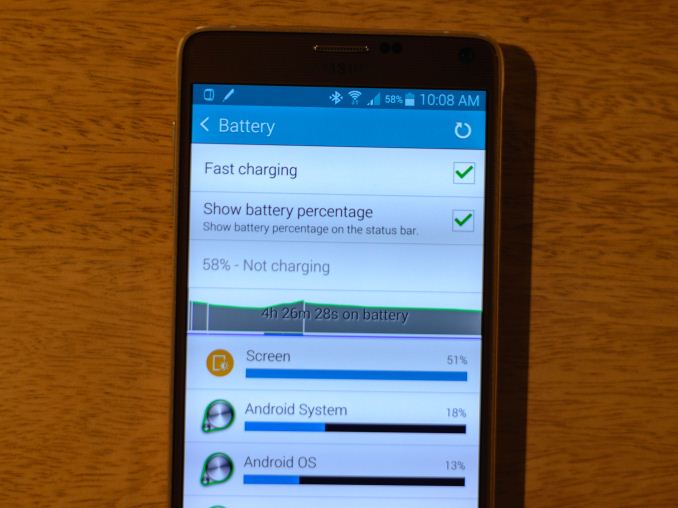
A noticeable spec omission was the lack of water resistance, which was implemented quite successfully on the Galaxy S5 line. The only other notable regression was a move back to the microUSB 2.0 connector, but it’s likely that this was done out of practicality as the microUSB 3.0 connector is quite cumbersome to use. This doesn’t result in worse charging capabilities though, as Samsung advertised that their charger would charge the Note 4’s battery to 50% in half an hour compared to the hour that it would take the Note 3. Interestingly enough there is a toggle to enable or disable this feature, presumably for heat and battery longevity concerns.

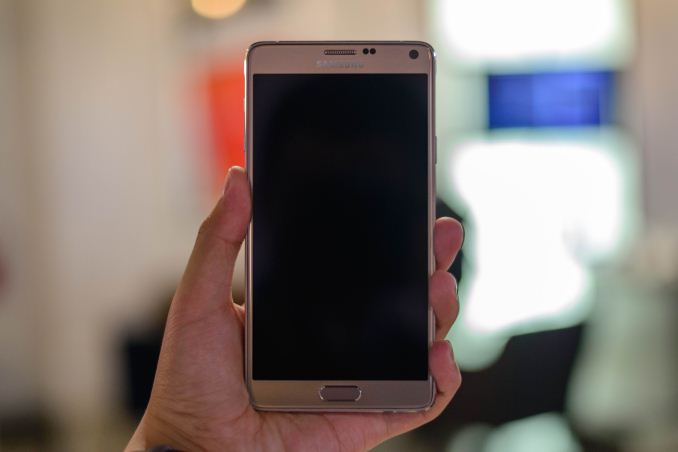
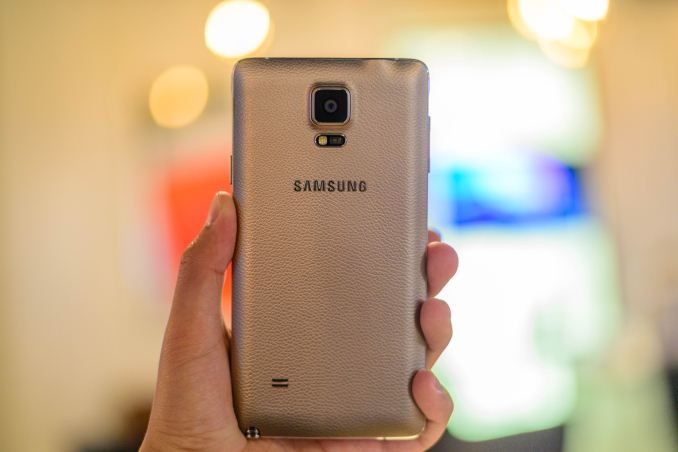
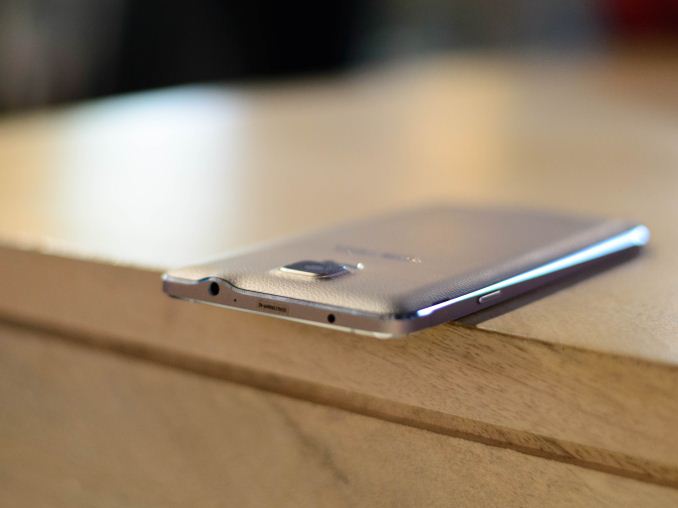
Of course, there’s a lot more to the Galaxy Note 4 than just specs, and one of the major areas where Samsung has iterated for this generation is the design. Much like the Galaxy Alpha, we see a metal frame with chamfered edges running around the side of the phone. As previously discussed in our article on material choices and in Samsung’s official blog, this move helps to improve drop resistance due to the increased rigidity of the metal frame. This move also greatly improves in-hand feel as it’s no longer glossy plastic, which also helps to improve the overall look. In addition to the new metal ring, the back cover is noticeably different from the Note 3. While still soft-touch for the black model, the stitching pattern has been removed and the back cover now molds closely to the metal sides instead of noticeably protruding. Finally, there’s a noticeable change to the button feel for this generation, with much less slack in the power and volume buttons, and the actuation both feels and sounds much more clean and crisp. The home button is also noticeably larger than what we saw on the Galaxy S5, and it seems that this may be due to an improved fingerprint sensor.

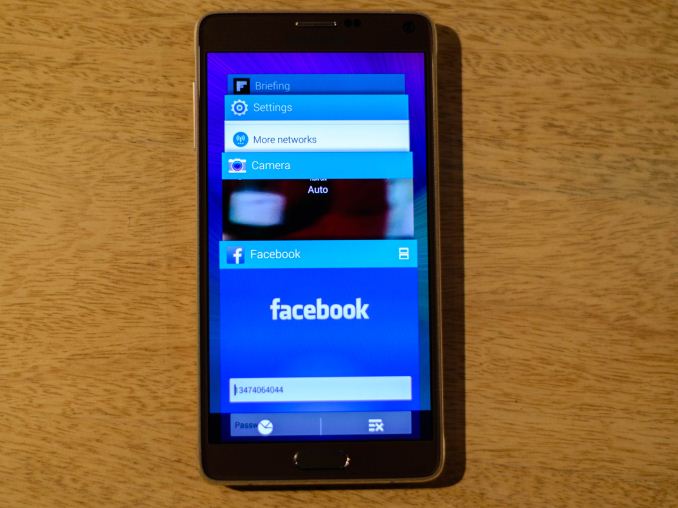
However, there’s more to the Note 4 than just hardware changes. Samsung is also emphasizing new software features. While Samsung is emphasized a more mouse-like experience for S-Pen in the form of easy drag and drop/highlight modes by pressing the stylus button, I found that the improved Multi Window system is really the most noteworthy change. First, the need to long press the back button to bring up the menu is effectively deprecated. Instead, Multi Window is now integrated into the Android L-esque multitasking menu. If an application supports Multi Window, an icon will appear on the top right of the app’s card in the multitasking menu, and tapping it will automatically open it as a second window.

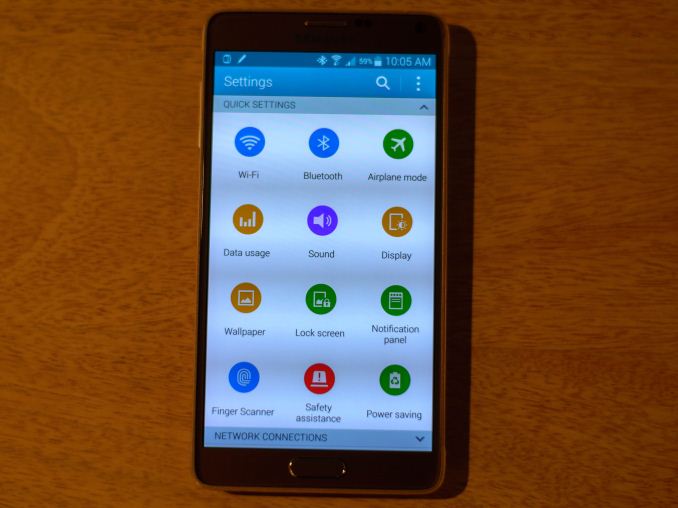
In addition, dragging a window from the corner will automatically turn the application into a floating window if it’s supported. There are no real changes to the appearance of TouchWiz UX, although some aspects have been altered. For example, the settings menus have replaced black backgrounds with white ones. It’s likely that this was done to prevent purple smearing effects that come from transitions to a lit pixel from a fully black one.

To recap, the Note 4 has the latest and greatest SoC and RF. The camera is better for low light with its hardware optical image stabilization. The industrial design is noticeably more restrained and tasteful compared to past designs. The material design is noticeably better for in-hand feel and protecting the phone, and if the GS5 LTE-A was any indication the display of the Note 4 should be head and shoulders above the Note 3. The software continues to be the best I’ve seen in the phablet space in terms of functionality. Overall, if you have bought into the concept of a phablet, the Note 4 should continue Samsung’s lead in this space. Of course, this is merely based upon first impressions. It will take a full review to make a final judgment on the Galaxy Note 4.

The Note 4 will be available in Charcoal Black, Frost White, Bronze Gold, and Blossom Pink in global markets starting in October. In the US, it will be available on AT&T, T-Mobile, Verizon, Sprint, and US Cellular.