
News


Huawei Announces The Honor 5A

Huawei Announces The Honor 5A

Today Huawei announced a new member to the Honor 5 series, the Honor 5A, which brings a number of upgrades to the Honor 4A it replaces. The 5A comes with either a Qualcomm Snapdragon 617 SoC, which includes a 64-bit octa-core CPU based on ARM’s Cortex-A53 cores and Adreno 405 GPU built on the 28nm LP node, for the model specific to China Netcom, or a HiSilicon Kirin 620 SoC, which also includes an A53-based octa-core CPU and ARM’s Mali-450MP4 GPU built on a 28nm process. All versions include 2GB of LPDDR3 RAM, just like the Honor 4A and 5X, and 16GB of internal storage that’s expandable with a microSD card.

Screen size increases from 5-inches on the Honor 4A to 5.5-inches for the 5A, but the resolution for the IPS LCD panel remains at 720p, giving the 5A a pixel density of 267ppi. The upgraded hardware in the 5A is actually very similar now to the previously announced Honor 5X that we looked at previously this year. One important distinction between the two is display resolution: The Honor 5X’s 5.5-inch display has a higher 1080p resolution.

Honor 5 Series
  Honor 5A Honor 5C Honor 5X
SoC

CAM-AL00 (China Netcom)

Qualcomm Snapdragon 617
(MSM8952)

4x Cortex-A53 @ 1.5GHz
4x Cortex-A53 @ 1.2GHz
Adreno 405

Hisilicon Kirin 650

4x Cortex-A53 @ 2.0GHz
4x Cortex-A53 @ 1.7GHz
ARM Mali-T830MP2

Qualcomm Snapdragon 616
(MSM8939)

4x Cortex-A53 @ 1.5GHz
4x Cortex-A53 @ 1.2GHz
Adreno 405

HiSilicon Kirin 620

8x Cortex-A53 @ 1.2GHz
ARM Mali-450MP4

RAM 2GB LPDDR3 2GB LPDDR3 2GB LPDDR3
NAND 16GB
+ microSD
16GB
+ microSD
16GB
+ microSD
Display 5.5-inch 1280×720 IPS LCD 5.2-inch 1920×1080 IPS LCD 5.5-inch 1920×1080 IPS LCD
Dimensions 154.3 x 77.1 x 8.45 mm
168 grams
147.1 x 73.8 x 8.30 mm
156 grams
151.3 x 76.3 x 8.15 mm
158 grams
Modem

CAM-AL00 (China Netcom)

Qualcomm X8 (Integrated)
2G / 3G / 4G LTE (Category 7)
HiSilicon Balong (Integrated)
2G / 3G / 4G LTE (Category 6)
Qualcomm X5 (Integrated)
2G / 3G / 4G LTE (Category 4)
HiSilicon Balong (Integrated)
2G / 3G / 4G LTE (Category 4)
SIM Size MicroSIM NanoSIM MicroSIM
Front Camera 8MP 8MP, f/2.0 5MP, 1/4″ OmniVision OV5648, 1.4µm pixels, f/2.4
Rear Camera 13MP, Sony, f/2.0, AF, HDR, LED flash 13MP, f/2.0, AF, HDR, LED flash 13MP, 1/3.06″ Sony IMX214 Exmor RS, 1.12µm pixels, f/2.0, AF, LED flash
Battery 3100 mAh
non-removable
3000 mAh 3000 mAh
non-removable
Connectivity 802.11a/b/g/n (2.4GHz only), BT 4.0, GPS/GNSS, microUSB 2.0 802.11a/b/g/n (2.4GHz only), BT 4.1, GPS/GNSS, microUSB 2.0 802.11a/b/g/n (2.4GHz only), BT 4.1, GPS/GNSS, microUSB 2.0
Launch OS Android 6 with EMUI 4.1 Android 6 with EMUI 4.1 Android 5.1 with EMUI 3.1

Both the front and rear cameras also receive significant upgrades. The rear camera increases from 8MP on the 4A to 13MP. It’s not clear if the Honor 5A is using the same 13MP Sony IMX214 Exmor RS sensor that the Honor 5X uses, however. Sitting atop the rear camera is a 5-element, 28mm wide-angle lens array with an f/2.0 aperture. The front camera sees a sizeable increase in resolution too, jumping to 8MP from the 4A’s rather low 2MP.

Because the Honor series targets cost-sensitive consumers, some features need to be sacrificed. The Honor 5A does not include a fingerprint sensor or NFC support, for instance. It also does not support 802.11ac Wi-Fi.

Overall the Honor 5A is a significant upgrade over the 4A, with specs that rival the Honor 5X. Moving to an octa-core CPU with a max frequency of either 1.5GHz or 1.2GHz should yield a small uptick in performance over the 4A’s quad-core Snapdragon 210 SoC, and the significantly larger 3100mAh battery should noticeably extend battery life beyond what the 4A’s 2200mAh battery provides. Whether the larger display is an improvement is a matter of personal taste, but the regression in pixel density is unfortunate.


Image from tech.163.com

The Honor 5A is available in six colors, including white, black, blue, pink, yellow, and gold. It will be available for purchase in China this summer for a price of ¥ 699 (USD $106).

Gallery: Honor 5A

AMD Teases Future Radeon RX 470 & Radeon RX 460 Cards

AMD Teases Future Radeon RX 470 & Radeon RX 460 Cards

With the annual Electronic Entertainment Expo once again upon us, this week has been a flood of gaming hardware and software news. On the PC front, AMD is once again sponsoring PC Gamer’s PC Gaming Show, and while the company isn’t making …

AMD Teases Future Radeon RX 470 & Radeon RX 460 Cards

AMD Teases Future Radeon RX 470 & Radeon RX 460 Cards

With the annual Electronic Entertainment Expo once again upon us, this week has been a flood of gaming hardware and software news. On the PC front, AMD is once again sponsoring PC Gamer’s PC Gaming Show, and while the company isn’t making …

Microsoft Teases Project Scorpio for 2017: 8 cores, 6 TeraFLOPs, Backwards Compatible with Xbox. Zen or Jaguar?!

Microsoft Teases Project Scorpio for 2017: 8 cores, 6 TeraFLOPs, Backwards Compatible with Xbox. Zen or Jaguar?!

This news piece contains speculation, and suggests silicon implementation based on released products and roadmaps.The only elements confirmed for Project Scorpio are the eight cores, >6 TFLOPs, 320 GB/s, it’s built by AMD, and it is coming in 2017. If anyone wants to officially correct any speculation, please get in touch. 

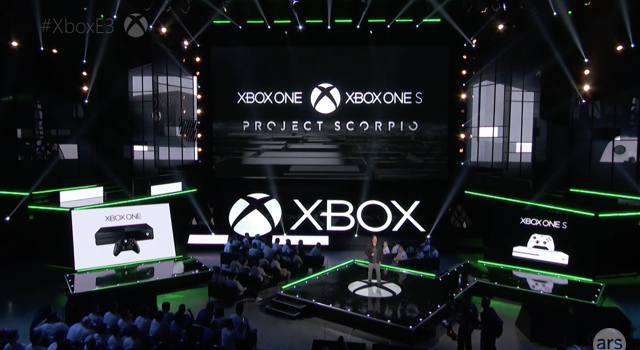
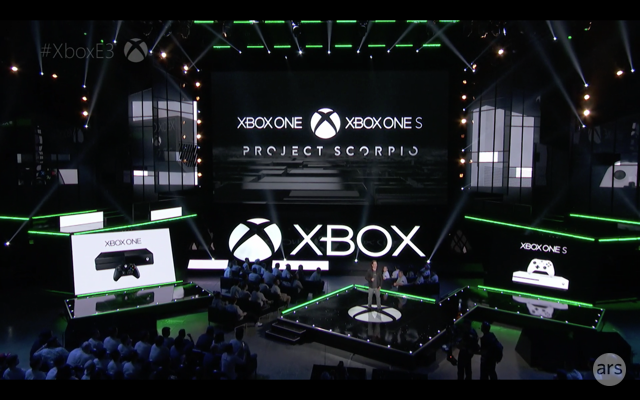
Here’s an announcement at E3 for you. Microsoft just announced Project Scorpio, an internal project to develop the next generation Xbox set to be released in 2017. Project Scorpio is to be backwards compatible with Xbox One, and seems to be directly in line to compete with whatever Sony are supposedly releasing in the near future. But here’s some specifications for you that has my mind in a twist.

In the presentation, Microsoft states that the Project Scorpio SoC will have eight cores, up to 320 GB/s of memory bandwidth, and over 6 TeraFLOPs of power. To put this into context, this is more processing power than the recently announced AMD RX 480 GPU using a GCN 4 based architecture, set to be launched later this month. Microsoft specifically announced that Project Scorpio is to be launched next year, which puts a few things together worth mentioning.

By this time next year, we expect AMD’s Zen microarchitecture to be in full swing, and AMD has already showcased a silicon sample of an 8-core Zen processor. However, the current Xbox line relies on AMD’s ‘cat’ core architecture, which according to current AMD roadmaps doesn’t seem to feature anywhere for 2017. Without a direct confirmation, it’s hard to tell if Project Scorpio is the same Jaguar cores as the Xbox One, or the newer Zen microarchitecture. I would assume we won’t find out until later next year.

Microsoft Console Specification Comparison
  Xbox 360 Xbox One Project Scorpio
CPU Cores/Threads 3/6 8/8 8 / ?
CPU Frequency 3.2GHz 1.6GHz (est) ?
CPU µArch IBM PowerPC AMD Jaguar ?
Shared L2 Cache 1MB 2 x 2MB ?
GPU Cores   768 ?
Peak Shader Throughput 0.24 TFLOPS 1.23 TFLOPS >6 TFLOPs
Embedded Memory 10MB eDRAM 32MB eSRAM ?
Embedded Memory Bandwidth 32GB/s 102GB/s ?
System Memory 512MB 1400MHz GDDR3 8GB 2133MHz DDR3 ?
System Memory Bus 128-bits 256-bits ?
System Memory Bandwidth 22.4 GB/s 68.3 GB/s 320 GB/s
Manufacturing Process   28nm ?

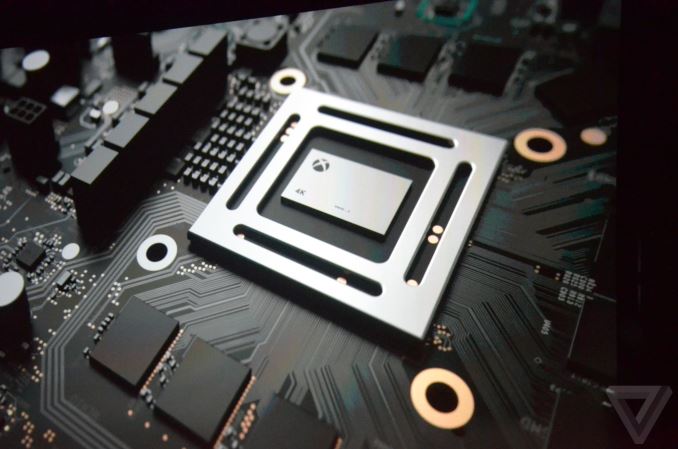
On the GPU side, the current Xbox One uses a 16 CU implementation in the SoC, with two disabled giving 14 CUs. We already know that AMD’s RX 480, running at 5 TFLOPs and built on Global Foundries 14nm FinFET process, runs in at 36 CUs. So Project Scorpio will have easily have more CUs than Xbox One, and judging by the shots in the video, the die size is relatively small. The Xbox One was built on TSMC’s 28nm HP process. At this point it’s still not confirmed if this is an AMD win, however judging by the comments towards backwards compatibility and SoC integration (where CPU and GPU are on the same silicon (or package)), all fingers would point in that direction.

AMD Radeon GPU Specification Comparison
  AMD Radeon RX 480 AMD Radeon R9 390X AMD Radeon R9 390 AMD Radeon R9 380
Stream Processors 2304
(36 CUs)
2816
(44 CUs)
2560
(40 CUs)
1792
(28 CUs)
Texture Units (Many) 176 160 112
ROPs (A Positive Integer) 64 64 32
TFLOPs (FMA) >5 TFLOPs 5.9 TFLOPs 5.1 TFLOPs 3.5 TFLOPs
Boost Clock >1.08GHz 1050MHz 1000MHz 970MHz
Memory Clock 8Gbps GDDR5 5Gbps GDDR5 5Gbps GDDR5 5.5Gbps GDDR5
Memory Bus Width 256-bit 512-bit 512-bit 256-bit
VRAM 4GB/8GB 8GB 8GB 2GB
Transistor Count ? 6.2B 6.2B 5.0B
Typical Board Power 150W 275W 275W 190W
Manufacturing Process GloFo 14nm FinFET TSMC 28nm TSMC 28nm TSMC 28nm
Architecture GCN 4 GCN 1.1 GCN 1.1 GCN 1.2
GPU Polaris 10? Hawaii Hawaii Tonga
Launch Date 06/29/16 06/18/15 06/18/15 06/18/15
Launch Price $199 $429 $329 $199

The memory bandwidth of Project Scorpio, 320 GB/s, is also relatively interesting given the current rates of the RX 480 topping out at 256 GB/s. The 320 GB/s number seems round enough to be a GPU only figure, but given previous embedded memory designs is likely to include some form of embedded memory. How much is impossible to say at this point.

AMD has stated that the RX 480 is a VR Gaming capable card, so given what we’ve said about the Xbox One S tackling VR, it’s clear that Project Scorpio is right on the money. AMD’s business plan as of late is to expand its custom SoC business, and thus sticking Zen and a GCN 4 based architecture on a combined package or die for Microsoft makes a lot of sense. At the RX 480 announcement, it was stated that AMD wants to power the first 100 million VR users, and this would help towards that goal.

It’s worth noting that this news piece contains a decent amount of speculation based on knowledge of the market, and the only elements confirmed for Project Scorpio are the eight cores, >6 TFLOPs, 320 GB/s, and it is coming in 2017. If anyone wants to officially correct any speculation, please get in touch. 

Sources: Ars Technica (Carousel Image), Verge Live Blog (Video Screen Capture)

Additional: We can confirm that Scorpio will be an AMD based design, as expected.

Microsoft Teases Project Scorpio for 2017: 8 cores, 6 TeraFLOPs, Backwards Compatible with Xbox. Zen or Jaguar?!

Microsoft Teases Project Scorpio for 2017: 8 cores, 6 TeraFLOPs, Backwards Compatible with Xbox. Zen or Jaguar?!

This news piece contains speculation, and suggests silicon implementation based on released products and roadmaps.The only elements confirmed for Project Scorpio are the eight cores, >6 TFLOPs, 320 GB/s, it’s built by AMD, and it is coming in 2017. If anyone wants to officially correct any speculation, please get in touch. 

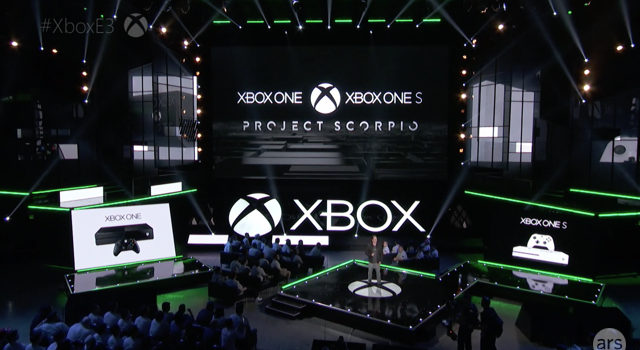
Here’s an announcement at E3 for you. Microsoft just announced Project Scorpio, an internal project to develop the next generation Xbox set to be released in 2017. Project Scorpio is to be backwards compatible with Xbox One, and seems to be directly in line to compete with whatever Sony are supposedly releasing in the near future. But here’s some specifications for you that has my mind in a twist.

In the presentation, Microsoft states that the Project Scorpio SoC will have eight cores, up to 320 GB/s of memory bandwidth, and over 6 TeraFLOPs of power. To put this into context, this is more processing power than the recently announced AMD RX 480 GPU using a GCN 4 based architecture, set to be launched later this month. Microsoft specifically announced that Project Scorpio is to be launched next year, which puts a few things together worth mentioning.

By this time next year, we expect AMD’s Zen microarchitecture to be in full swing, and AMD has already showcased a silicon sample of an 8-core Zen processor. However, the current Xbox line relies on AMD’s ‘cat’ core architecture, which according to current AMD roadmaps doesn’t seem to feature anywhere for 2017. Without a direct confirmation, it’s hard to tell if Project Scorpio is the same Jaguar cores as the Xbox One, or the newer Zen microarchitecture. I would assume we won’t find out until later next year.

Microsoft Console Specification Comparison
  Xbox 360 Xbox One Project Scorpio
CPU Cores/Threads 3/6 8/8 8 / ?
CPU Frequency 3.2GHz 1.6GHz (est) ?
CPU µArch IBM PowerPC AMD Jaguar ?
Shared L2 Cache 1MB 2 x 2MB ?
GPU Cores   768 ?
Peak Shader Throughput 0.24 TFLOPS 1.23 TFLOPS >6 TFLOPs
Embedded Memory 10MB eDRAM 32MB eSRAM ?
Embedded Memory Bandwidth 32GB/s 102GB/s ?
System Memory 512MB 1400MHz GDDR3 8GB 2133MHz DDR3 ?
System Memory Bus 128-bits 256-bits ?
System Memory Bandwidth 22.4 GB/s 68.3 GB/s 320 GB/s
Manufacturing Process   28nm ?

On the GPU side, the current Xbox One uses a 16 CU implementation in the SoC, with two disabled giving 14 CUs. We already know that AMD’s RX 480, running at 5 TFLOPs and built on Global Foundries 14nm FinFET process, runs in at 36 CUs. So Project Scorpio will have easily have more CUs than Xbox One, and judging by the shots in the video, the die size is relatively small. The Xbox One was built on TSMC’s 28nm HP process. At this point it’s still not confirmed if this is an AMD win, however judging by the comments towards backwards compatibility and SoC integration (where CPU and GPU are on the same silicon (or package)), all fingers would point in that direction.

AMD Radeon GPU Specification Comparison
  AMD Radeon RX 480 AMD Radeon R9 390X AMD Radeon R9 390 AMD Radeon R9 380
Stream Processors 2304
(36 CUs)
2816
(44 CUs)
2560
(40 CUs)
1792
(28 CUs)
Texture Units (Many) 176 160 112
ROPs (A Positive Integer) 64 64 32
TFLOPs (FMA) >5 TFLOPs 5.9 TFLOPs 5.1 TFLOPs 3.5 TFLOPs
Boost Clock >1.08GHz 1050MHz 1000MHz 970MHz
Memory Clock 8Gbps GDDR5 5Gbps GDDR5 5Gbps GDDR5 5.5Gbps GDDR5
Memory Bus Width 256-bit 512-bit 512-bit 256-bit
VRAM 4GB/8GB 8GB 8GB 2GB
Transistor Count ? 6.2B 6.2B 5.0B
Typical Board Power 150W 275W 275W 190W
Manufacturing Process GloFo 14nm FinFET TSMC 28nm TSMC 28nm TSMC 28nm
Architecture GCN 4 GCN 1.1 GCN 1.1 GCN 1.2
GPU Polaris 10? Hawaii Hawaii Tonga
Launch Date 06/29/16 06/18/15 06/18/15 06/18/15
Launch Price $199 $429 $329 $199

The memory bandwidth of Project Scorpio, 320 GB/s, is also relatively interesting given the current rates of the RX 480 topping out at 256 GB/s. The 320 GB/s number seems round enough to be a GPU only figure, but given previous embedded memory designs is likely to include some form of embedded memory. How much is impossible to say at this point.

AMD has stated that the RX 480 is a VR Gaming capable card, so given what we’ve said about the Xbox One S tackling VR, it’s clear that Project Scorpio is right on the money. AMD’s business plan as of late is to expand its custom SoC business, and thus sticking Zen and a GCN 4 based architecture on a combined package or die for Microsoft makes a lot of sense. At the RX 480 announcement, it was stated that AMD wants to power the first 100 million VR users, and this would help towards that goal.

It’s worth noting that this news piece contains a decent amount of speculation based on knowledge of the market, and the only elements confirmed for Project Scorpio are the eight cores, >6 TFLOPs, 320 GB/s, and it is coming in 2017. If anyone wants to officially correct any speculation, please get in touch. 

Sources: Ars Technica (Carousel Image), Verge Live Blog (Video Screen Capture)

Additional: We can confirm that Scorpio will be an AMD based design, as expected.