News


Apple Announces Q2 Fiscal Year 2016 Results: iPhone Sales Slowed But Services Gain
Apple Announces Q2 Fiscal Year 2016 Results: iPhone Sales Slowed But Services Gain

This afternoon, Apple released their Q2 earnings for fiscal year 2016, which ended on March 26. The company saw revenues decline for the first time since Q1 2003, according to CNN. The results today did not meet expectations, but that was quite a run to go over 13 years without a year-over-year decline in revenue. Revenue for the quarter was $50.56 billion, which is 10% lower than the $58.01 billion announced a year ago. Gross margin was $19.9 billion, or 39.4%, which was down from the 40.8% gross margin in Q2 2015. Net income was down 22.5% as well, coming in at $10.5 billion for the quarter. This resulted in earnings per share of $1.90, down from $2.33 a year ago.

Apple Q2 2016 Financial Results (GAAP)
  Q2’2016 Q1’2015 Q2’2015
Revenue (in Billions USD) $50.557 $75.872 $58.010
Gross Margin (in Billions USD) $19.921 $30.423 $23.656
Operating Income (in Billions USD) $13.987 $24.171 $18.278
Net Income (in Billions USD) $10.516 $18.361 $13.569
Margins 39.4% 40.1% 40.8%
Earnings per Share (in USD) $1.90 $3.30 $2.33

iPhone sales have certainly slowed, but Apple was almost destined to falter after reporting such strong quarters a year ago. The launch of the larger iPhone 6 and 6 Plus triggered year-over-year growth in iPhone sales of 40% a year ago, and 46% growth the quarter before that. Strong growth in China helped fuel a lot of that gain, since it was practically an untapped market for Apple, but revenue from China fell 26% from a year ago. With Apple being a company that has struggled to expand it’s market outside of iPhone, when the one segment falters it can make a big impact on the results, which is exactly what happened here.

Pretty much every earnings report, sales of the iPhone dominate the discussion, and today is not really any different. Apple sold 51.2 million iPhones this quarter, which is a drop of 16% year-over-year. That brought in revenue of $32.86 billion for the quarter, which is a drop of 18% year-over-year. A larger revenue drop than unit sales means that of the iPhones it is selling, the average selling price is also down. Apple still gets 65% of its revenue from the iPhone, even on a down quarter, but the other segments are not pulling up the slack.

iPad sales continue their downward trajectory, with sales of 10.251 million units this quarter, which is down 19% from a year ago. Revenue for the iPad was $4.4 billion, also down 19%. This has been a common trend with the iPad over the last year or two, and what originally looked to be another strong growth segment for Apple has quickly become a market where sales keep declining. Eventually they will bottom, but even with the solid new entries in the iPad Pro, the smaller iPad Pro 9.7, and even the new iPad Mini, the Apple tablet market has quickly reached a point where people are not upgrading as quickly as the iPhone market does, and you have to start to wonder when sales of the iPad are going to bottom out.

The PC market is certainly declining, but the Mac has soldiered on, generally outperforming the PC market even in the down times. That trend also stopped this quarter, with Mac sales down 12% year-over-year, to 4.0 million devices. Revenue for the Mac was $5.1 billion, which is down 9% compared to last year, so the average selling price has increased a bit while sales have fallen. We’ve not seen Apple refresh the Mac for some time though, with only the MacBook getting Skylake, so sales may be affected by this as well.

Services, which include internet services, AppleCare, Apple Pay, and others, are now the second largest revenue source for Apple, with revenues up this quarter 20% over last year, for a total of just a hair under $6 billion for the quarter. Even compared to the holiday quarter, which was Q1, sales were pretty much flat, and all of the other segments dropped significantly (and expectedly) compared to last quarter. You likely don’t think of Apple as a services company, but iTunes sales, Apple Music, and their other services are now the number two product at Apple, and that’s pretty surprising. It may not be number two next quarter, but with Apple having over a billion people using their services now, sales here should stay strong.

The final segment from Apple is “Other Products” which includes Apple Watch, Apple TV, iPod, Beats, and accessories. This segment also grew significantly year-over-year, to $2.2 billion, which is up 30%. Although Apple doesn’t break down the products inside here, the addition of Apple Watch likely makes up a good portion of this, since it wasn’t part of the category a year ago.

Apple Q2 2016 Device Sales (thousands)
  Q2’2016 Q1’2016 Q2’2015 Seq Change Year/Year Change
iPhone 51,193 74,779 61,170 -32% -16%
iPad 10,251 16,122 12,623 -36% -19%
Mac 4,034 5,312 4,563 -24% -12%

Apple announced they were going to be adding an additional $50 billion to their capital return program, bringing the program up to $250 billion in cash returned to shareholders by the end of March 2018. The dividend will be increased to $0.57 per share, and they will buy back $175 billion in shares, up from the original goal of $140 billion in shares.

They also announced guidance for the next quarter, where they expect revenue between $41 and $43 billion (Q3 2015 revenue was $49.6 billion) and gross margin is expected to drop again to between 37.5 and 38%. With this guidance, next quarter may be very similar to this one.

Apple Q2 2016 Revenue by Product (billions)
  Q2’2016 Q1’2016 Q2’2015 Revenue for current quarter
iPhone $32.857 $51.635 $40.282 65.0%
iPad $4.413 $7.084 $5.428 8.7%
Mac $5.107 $6.746 $5.615 10.1%
iTunes/Software/Services $5.991 $6.056 $4.996 11.8%
Other Products $2.189 $4.351 $1.689 4.3%

I don’t think we have to worry about Apple going bankrupt just yet, but today’s earnings are a big change in what we’ve gotten used to in the last 13 years or so. All things must come to an end, and today it was Apple’s amazing track record over the last decade or more. They are certainly not alone in having their struggles this quarter, but the drop is pretty significant nonetheless.

Source: Apple Investor Relations
Intel Proposes to Use USB Type-C Digital Audio Technology

Intel Proposes to Use USB Type-C Digital Audio Technology

USB Type-C has a number of chances to become the standard for data and charging connector for smartphones and tablets running either Android or Windows. However, in the long-term future, Intel wants USB-C to be even more universal (and therefore pervasive) than it is going to be, which is why at IDF Shenzhen part of one of the talks evolved around using Type-C for audio.

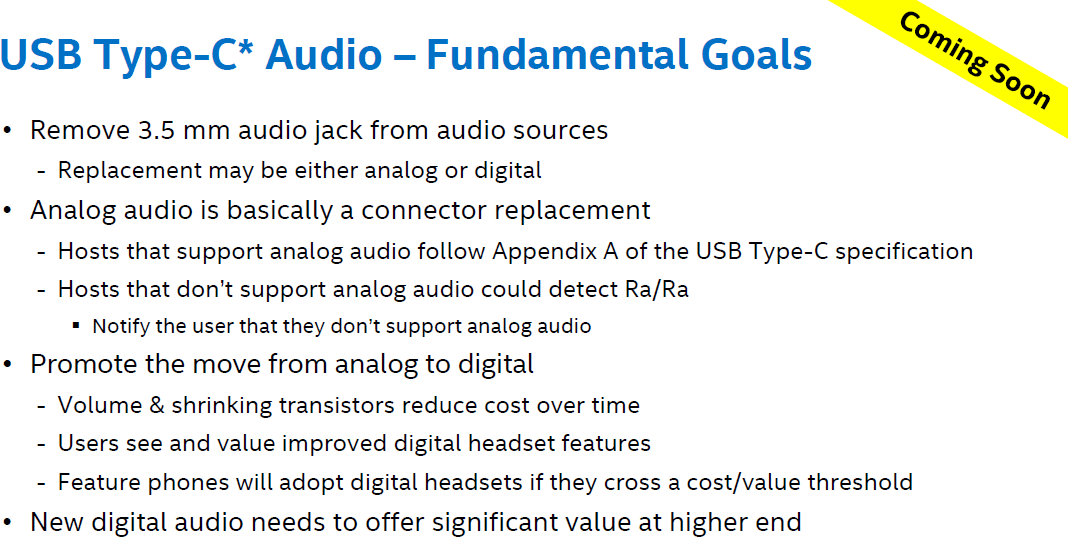
Audio receptacles on PCs and mobile equipment are virtually the last remaining analog interfaces of modern devices, requiring certain techniques to maintain a high audio quality and remove interference. Intel proposes to replace things like 3.5 mm mini-jack with USB Type-C which will help to add features to headsets and will simplify connections of multi-channel audio equipment to various gadgets. This is not the first time a company has proposed to replace analog audio on PCs and mobile devices, but so far, nobody has succeeded due to the ubiquity of 3.5mm. Since the industry may still not be ready to go all-digital, there seems to be a backup plan.

Various types of audio jacks to connect headphones to audio equipment have been around for decades. For example, the original 6.35 mm connector, which is still widely used by audio equipment, was invented in 1878. Meanwhile, two-conductor miniature 3.5 mm audio connector (which is the most widely used audio connector at present) has been around since 1960s. Headphone jacks have evolved; they have gained contacts to support microphones and even basic programmable capabilities to enable remote controls. However, fundamentally, the ability to listen to audio through a speaker has remained the same for over a hundred years: completely analog and barely any smart functionality. Today’s smartphones are used for all sorts of different purposes and are connected to a variety of devices, which requires sophisticated interconnection technologies with high data-rates. At the same time, as phones and devices get thinner, or even to simplify some of the internal design, it gets harder to install multiple ports for various purposes. If there were to be a universal connector that does it all, including audio, Intel and some other players want USB Type-C to be that universal connector.

In fact, USB-C can be used to transfer analog audio in accordance with the specification of the connector. It all comes down as to how that audio is transmitted.

The USB-C has sideband use pins (SBU1 and SBU2) which can be used for analog audio in audio adapter accessory mode. Use of the sideband pins should not impact data transfers and other vital functionality of USB-C cables, which should make them relatively simple from the engineering point of view. In this case, the USB-C connector will just replace the 3.5 mm mini jack and may even gain some additional features, such as a thermal sensor in an earpiece could measure temperature for fitness tracking.

The concept is not completely new and we saw it years ago – back in the 2000s, Motorola used the mini-USB connector on its feature phones to enable charging, data transfers and a headset connection. The idea to use one connector for everything was not entirely bad, however, it left users without a choice of headsets. However, if the makers of devices (as well as producers of audio listening equipment) adopt USB-C, the is potential that the problem will not occur again. In the advent of digital signal transfer, this allows the headset to drive the digital-to-analog conversion, removing electronic interference from the host and potentially offering a wide array of audio results.

However, transferring analog audio using USB-C’s SBU pins is not the only thing that Intel is working on.

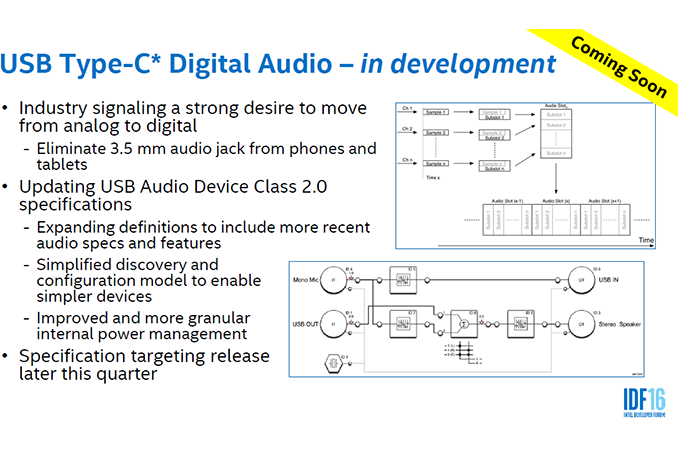
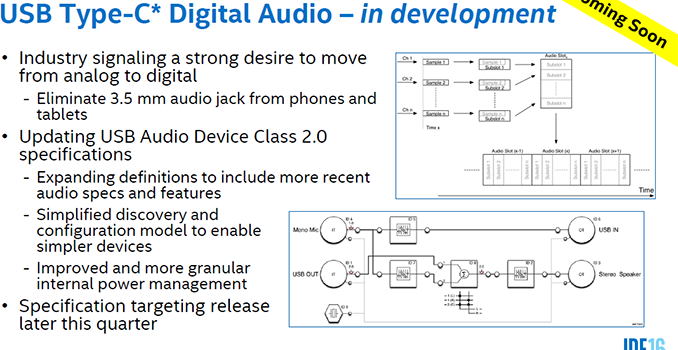
At present, Intel is finalizing the USB Type-C Digital Audio technology and plans to release its specification later in Q2. The company does not reveal a lot about the standard right now, but notes that it is working on updating the USB Audio Device Class 2.0 specifications to support new connector, expand the list of recent audio specifications and features, improve power management and simplify the discovery and configuration model to make the upcoming headsets as easy to use as today’s headsets.

In fact, one of the important issues with streaming audio over USB is the synchronization of data streams from the host to the receiver. The USB Audio Device Class specification solved the problem in the past and because Intel mentioned the USB Audio Device Class 2.0 in its presentation at IDF, this may mean that the new the USB-C Digital Audio spec will rely on this synchronization mechanism as well. Intel wants its USB-S Digital Audio to be backward-compatible with USB Audio (1.0 and 2.0), but naturally plans to add support for new music formats.

Usage of digital audio means that headsets should gain their own amplifiers, DACs and various other logic, which is currently located inside smartphones. Intel proposes to install special multi-function processing units (MPUs), which will perform beam forming, noise suppression, acoustic echo suppression (AES), acoustic echo cancellation (AEC), non-linear processing and other operations. The MPUs will also support HDCP technology, hence, it will not be possible to make digital copies of records using USB-C digital headset outputs. It is unlikely that audio processing will be offloaded to external headsets completely, but the latter will clearly gain their own chips. This may, however, see a spike in cost, especially at the super-low end.

A good thing about USB Type-C headsets with MPUs is that they are going to be software upgradeable and could gain functionality over their lifespan. Intel admits that such MPUs will make digital headsets more expensive compared to analog devices, but high volumes and new process technologies will help to reduce the cost of digital headsets over time. In fact, USB Audio headsets and audio chips for them are not something completely new. For example, Plantronics Audio 655 DSP headset costs $49.99, whereas CMedia’s HS-100 chip for headsets is available $1. Therefore, from the cost perspective, digital headphones should not be too much more expensive in general. Meanwhile, Intel wants USB-C digital audio headsets to offer “significant value at higher end” and have improved functionality in a bid to become popular among consumers.

The industry has successfully replaced analog cables with HDMI for video equipment in the living room and in the coming years will retire the D-Sub interconnection for computer displays. However, audio jacks have survived multiple generations as other standards have changed. In fact, Intel itself eliminated analog audio jacks in its first-generation NUCs PCs, but had to return them in subsequent generations. With USB-C Digital Audio Intel may not be alone. Google’s Android 5.0 already supports USB DAC devices and thus digital headsets. Moreover, last week LeEco released several smartphones without audio jacks, so, there are attempts to eliminate them from mobile devices already. One maker will not make any difference, but a coordinated move by market leaders, such as Samsung, LG or HTC, could have a significant impact.

Intel Proposes to Use USB Type-C Digital Audio Technology

Intel Proposes to Use USB Type-C Digital Audio Technology

USB Type-C has a number of chances to become the standard for data and charging connector for smartphones and tablets running either Android or Windows. However, in the long-term future, Intel wants USB-C to be even more universal (and therefore pervasive) than it is going to be, which is why at IDF Shenzhen part of one of the talks evolved around using Type-C for audio.

Audio receptacles on PCs and mobile equipment are virtually the last remaining analog interfaces of modern devices, requiring certain techniques to maintain a high audio quality and remove interference. Intel proposes to replace things like 3.5 mm mini-jack with USB Type-C which will help to add features to headsets and will simplify connections of multi-channel audio equipment to various gadgets. This is not the first time a company has proposed to replace analog audio on PCs and mobile devices, but so far, nobody has succeeded due to the ubiquity of 3.5mm. Since the industry may still not be ready to go all-digital, there seems to be a backup plan.

Various types of audio jacks to connect headphones to audio equipment have been around for decades. For example, the original 6.35 mm connector, which is still widely used by audio equipment, was invented in 1878. Meanwhile, two-conductor miniature 3.5 mm audio connector (which is the most widely used audio connector at present) has been around since 1960s. Headphone jacks have evolved; they have gained contacts to support microphones and even basic programmable capabilities to enable remote controls. However, fundamentally, the ability to listen to audio through a speaker has remained the same for over a hundred years: completely analog and barely any smart functionality. Today’s smartphones are used for all sorts of different purposes and are connected to a variety of devices, which requires sophisticated interconnection technologies with high data-rates. At the same time, as phones and devices get thinner, or even to simplify some of the internal design, it gets harder to install multiple ports for various purposes. If there were to be a universal connector that does it all, including audio, Intel and some other players want USB Type-C to be that universal connector.

In fact, USB-C can be used to transfer analog audio in accordance with the specification of the connector. It all comes down as to how that audio is transmitted.

The USB-C has sideband use pins (SBU1 and SBU2) which can be used for analog audio in audio adapter accessory mode. Use of the sideband pins should not impact data transfers and other vital functionality of USB-C cables, which should make them relatively simple from the engineering point of view. In this case, the USB-C connector will just replace the 3.5 mm mini jack and may even gain some additional features, such as a thermal sensor in an earpiece could measure temperature for fitness tracking.

The concept is not completely new and we saw it years ago – back in the 2000s, Motorola used the mini-USB connector on its feature phones to enable charging, data transfers and a headset connection. The idea to use one connector for everything was not entirely bad, however, it left users without a choice of headsets. However, if the makers of devices (as well as producers of audio listening equipment) adopt USB-C, the is potential that the problem will not occur again. In the advent of digital signal transfer, this allows the headset to drive the digital-to-analog conversion, removing electronic interference from the host and potentially offering a wide array of audio results.

However, transferring analog audio using USB-C’s SBU pins is not the only thing that Intel is working on.

At present, Intel is finalizing the USB Type-C Digital Audio technology and plans to release its specification later in Q2. The company does not reveal a lot about the standard right now, but notes that it is working on updating the USB Audio Device Class 2.0 specifications to support new connector, expand the list of recent audio specifications and features, improve power management and simplify the discovery and configuration model to make the upcoming headsets as easy to use as today’s headsets.

In fact, one of the important issues with streaming audio over USB is the synchronization of data streams from the host to the receiver. The USB Audio Device Class specification solved the problem in the past and because Intel mentioned the USB Audio Device Class 2.0 in its presentation at IDF, this may mean that the new the USB-C Digital Audio spec will rely on this synchronization mechanism as well. Intel wants its USB-S Digital Audio to be backward-compatible with USB Audio (1.0 and 2.0), but naturally plans to add support for new music formats.

Usage of digital audio means that headsets should gain their own amplifiers, DACs and various other logic, which is currently located inside smartphones. Intel proposes to install special multi-function processing units (MPUs), which will perform beam forming, noise suppression, acoustic echo suppression (AES), acoustic echo cancellation (AEC), non-linear processing and other operations. The MPUs will also support HDCP technology, hence, it will not be possible to make digital copies of records using USB-C digital headset outputs. It is unlikely that audio processing will be offloaded to external headsets completely, but the latter will clearly gain their own chips. This may, however, see a spike in cost, especially at the super-low end.

A good thing about USB Type-C headsets with MPUs is that they are going to be software upgradeable and could gain functionality over their lifespan. Intel admits that such MPUs will make digital headsets more expensive compared to analog devices, but high volumes and new process technologies will help to reduce the cost of digital headsets over time. In fact, USB Audio headsets and audio chips for them are not something completely new. For example, Plantronics Audio 655 DSP headset costs $49.99, whereas CMedia’s HS-100 chip for headsets is available $1. Therefore, from the cost perspective, digital headphones should not be too much more expensive in general. Meanwhile, Intel wants USB-C digital audio headsets to offer “significant value at higher end” and have improved functionality in a bid to become popular among consumers.

The industry has successfully replaced analog cables with HDMI for video equipment in the living room and in the coming years will retire the D-Sub interconnection for computer displays. However, audio jacks have survived multiple generations as other standards have changed. In fact, Intel itself eliminated analog audio jacks in its first-generation NUCs PCs, but had to return them in subsequent generations. With USB-C Digital Audio Intel may not be alone. Google’s Android 5.0 already supports USB DAC devices and thus digital headsets. Moreover, last week LeEco released several smartphones without audio jacks, so, there are attempts to eliminate them from mobile devices already. One maker will not make any difference, but a coordinated move by market leaders, such as Samsung, LG or HTC, could have a significant impact.

The Riotoro Prism CR1280 Case Review

In this review we are having our first encounter with Riotoro, a new manufacturer of PC cases and peripherals. The Prism CR1280 that we are putting to the test today is the world’s first RGB case, a very large tower primarily designed for advanc…

The Riotoro Prism CR1280 Case Review

In this review we are having our first encounter with Riotoro, a new manufacturer of PC cases and peripherals. The Prism CR1280 that we are putting to the test today is the world’s first RGB case, a very large tower primarily designed for advanc…