
News


Philips Begins Shipments of LCD Monitors with Quantum Dot Technology
Philips Begins Shipments of LCD Monitors with Quantum Dot Technology

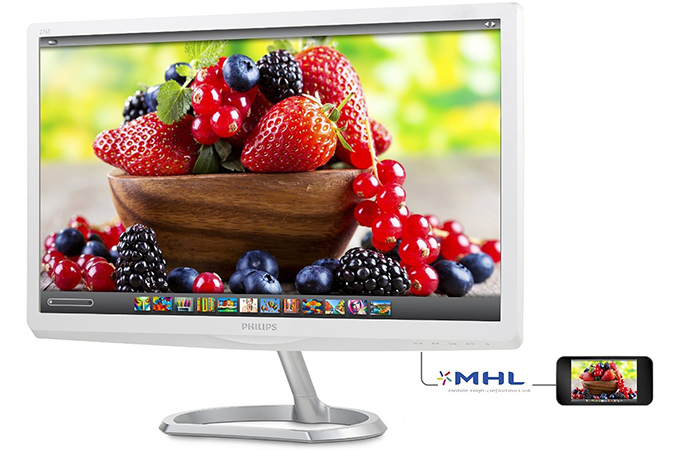
TPV Technology, the company that produces monitors under Philips brand, has started to sell displays with QD Vision’s Color IQ quantum dot technology. What makes this notable is that QD Vision’s technology is one such method being developed to significantly and inexpensively increase color gamut that displays can produce. The new 27” monitor can cover 99% of Adobe RGB color space, and is launcing at just $299.

The quality of LCD monitors as well as their ability to accurately display colors depends on multiple factors, including the quality of their panels as well as backlighting. While there are panels which can cover very wide color gamuts, since typical LED backlights usually do not produce whites with a broad underlying color spectrum, color accuracy of actual mainstream monitors gets limited. Several companies, including 3M and QD Vision, propose to apply special quantum dot filters on the backlights to make them as “white” (and therefore as broad) as possible.

QD Vision’s Color IQ quantum dot technology is based on cadmium selenide semiconductor nanocrystals, which can very precisely control spectral output of LED backlighting, essentially allowing light to be shifted to other wavelengths in a controlled manner. The quantum dots can be made to emit at any wavelength beyond the source wavelength with very high efficiency and narrow spectral distribution, which helps to make backlighting cleaner and thus enhance color gamut of displays. Applying quantum dot filters in any form is a relatively cost efficient task because it is basically a process step in assembly of an LCD module. However, those filters have to survive temperatures produced by LEDs, which is why they are not applied everywhere.

The Philips 276E6ADSS monitor is based on a 27″ IPS-ADS panel with 1920×1080 resolution, 178°/178° horizontal/vertical viewing angles, 1000:1 contrast ratio (20M:1 dynamic contrast ratio), 300 cd/m2 brightness, 5 ms gray-to-gray response time and 60 Hz refresh rate. The display features a D-Sub, a DVI and an HDMI with MHL connectors along with audio in and out. Thanks to quantum dot film on the backlight of the monitor, the 276E can cover 99% of Adobe RGB color space, whereas typically inexpensive displays only show around 70% of the Adobe spectrum. The new Philips 276E monitor is made of plastic and uses a rather calm white/silver color scheme.

Specifications of Philips Quantum Dot Display
  Philips 276E6ADSS
Panel 27″ IPS-ADS
Resolution 1920 x 1080
Refresh Rate 60 Hz
Response Time 5 ms gray to gray
Brightness 300 cd/m²
Contrast 1000:1
Viewing Angles 178°/178° horizontal/vertical
Color Saturation 99%  Adobe RGB

While the Philips 276E display is a product with a rather unique combination of low price and wide color gamut, for TPV Technology it is also a test vehicle for quantum dot technology from QD Vision. Since this is the first ever display with QD Vision’s Color IQ tech, some of its early samples had teething problems. The review unit received by AnandTech did not support constraining to the sRGB color gamut. As soon as we mentioned this fact to the manufacturer we were told that later versions should have a proper sRGB operating mode.

The new monitor is already available at Amazon, B&H and some other retailers for $299.

AMD Updates Gaming Evolved Client

AMD Updates Gaming Evolved Client

Game streaming and recording has continued to be both a growing hobby and profession for many in recent years. Anytime there is growing interest in anything from society there comes a growing number of people willing to make tools to facilitate said interest. In this vein AMD and second-party developer Raptr have brought a few updates to their Gaming Evolved client in an effort to provide a more accessible means to record and share gameplay footage.

The first of these additions is what AMD is calling the Replay feature, which is a new recording mode for the Gaming Evolved client. Replay mode will start recording the moment the game starts (or when the designated hotkey is pressed), and will then record the whole gameplay session. The significance/difference of this is that it’s automatic recording of a whole gameplay session, rather than a rolling buffer for recording the last couple of minutes of gameplay, as what already happens in other modes. Though for those who want to capture both entire sessions and selected clips of the last 30 seconds, the updated client also includes a bookmark feature to do just that. All of this, by the way, flawlessly captured a video of our GTAV benchmark when I did a test run.

Going hand-in-hand with the new whote-session recording functionality, the latest update to the client also adds a basic video editor to handle the resulting video. The editor aims to make it easy to create highlight reel by simply selecting clips marked during gameplay, particularly when combined with the afformentioned benchmarks.

Finally, the Gaming Evolved client had also added a set of unique integration features with both League of Legends and Counter-Strike: Global Offensive. For these games the client can use live match data to automatically identify important points and create highlights featuring all kills, deaths, and other shenanigans. And it sounds like AMD/Raptr aren’t done here, as integration for further games is said to be coming soon.

If you already have the Gaming Evolved client you can update new version by simply restarting your client. It’s also available to download over at AMD’s website.

AMD Updates Gaming Evolved Client

AMD Updates Gaming Evolved Client

Game streaming and recording has continued to be both a growing hobby and profession for many in recent years. Anytime there is growing interest in anything from society there comes a growing number of people willing to make tools to facilitate said interest. In this vein AMD and second-party developer Raptr have brought a few updates to their Gaming Evolved client in an effort to provide a more accessible means to record and share gameplay footage.

The first of these additions is what AMD is calling the Replay feature, which is a new recording mode for the Gaming Evolved client. Replay mode will start recording the moment the game starts (or when the designated hotkey is pressed), and will then record the whole gameplay session. The significance/difference of this is that it’s automatic recording of a whole gameplay session, rather than a rolling buffer for recording the last couple of minutes of gameplay, as what already happens in other modes. Though for those who want to capture both entire sessions and selected clips of the last 30 seconds, the updated client also includes a bookmark feature to do just that. All of this, by the way, flawlessly captured a video of our GTAV benchmark when I did a test run.

Going hand-in-hand with the new whote-session recording functionality, the latest update to the client also adds a basic video editor to handle the resulting video. The editor aims to make it easy to create highlight reel by simply selecting clips marked during gameplay, particularly when combined with the afformentioned benchmarks.

Finally, the Gaming Evolved client had also added a set of unique integration features with both League of Legends and Counter-Strike: Global Offensive. For these games the client can use live match data to automatically identify important points and create highlights featuring all kills, deaths, and other shenanigans. And it sounds like AMD/Raptr aren’t done here, as integration for further games is said to be coming soon.

If you already have the Gaming Evolved client you can update new version by simply restarting your client. It’s also available to download over at AMD’s website.

AMD Releases Radeon Software Crimson Edition 16.3.1 Hotfix

AMD Releases Radeon Software Crimson Edition 16.3.1 Hotfix

Following last week’s release of Radeon Software 16.3 Hotfix, AMD is back again with a quick update to their driver set, bringing it to 16.3.1 Hotfix.

The list of resolved issues this week is brief compared to the last few months of updates. Among the resolved issues is a problem where installed and played games were not showing up in the Radeon Settings “Gaming” tab. Meanwhile a hang in Unreal Engine 4 games has been fixed, along with issues installing the Radeon Software driver set via command line. Lastly, AMD notes that DirectX 12 applications are no longer locked to the refresh rate of the display.

Alongside these fixes there is also driver support for the new Need for Speed, and a Crossfire profile update for Hitman.

As always, those interested in reading more or installing the updated hotfix drivers for AMD’s desktop, mobile, and integrated GPUs can find them either under the driver update section in Radeon Settings or on AMDs Radeon Software Crimson Edition download page.

AMD Releases Radeon Software Crimson Edition 16.3.1 Hotfix

AMD Releases Radeon Software Crimson Edition 16.3.1 Hotfix

Following last week’s release of Radeon Software 16.3 Hotfix, AMD is back again with a quick update to their driver set, bringing it to 16.3.1 Hotfix.

The list of resolved issues this week is brief compared to the last few months of updates. Among the resolved issues is a problem where installed and played games were not showing up in the Radeon Settings “Gaming” tab. Meanwhile a hang in Unreal Engine 4 games has been fixed, along with issues installing the Radeon Software driver set via command line. Lastly, AMD notes that DirectX 12 applications are no longer locked to the refresh rate of the display.

Alongside these fixes there is also driver support for the new Need for Speed, and a Crossfire profile update for Hitman.

As always, those interested in reading more or installing the updated hotfix drivers for AMD’s desktop, mobile, and integrated GPUs can find them either under the driver update section in Radeon Settings or on AMDs Radeon Software Crimson Edition download page.