News


AMD Releases Radeon Software Crimson Edition 16.3 Hotfix: Support for Vulkan and TB3 Enclosures

AMD Releases Radeon Software Crimson Edition 16.3 Hotfix: Support for Vulkan and TB3 Enclosures

With the driver update floodgates not closing yet, we are given a massive update from AMD that brings Radeon Software Crimson Edition to version 16.3 (driver version 16.15). Incoming this week is a good list of bug fixes, a large list of new features which include a couple of surprises, and some performance numbers to let us know how these cards have been improving.

On the list of resolved issues, AMD has fixed an issue with cards not sustaining steady clock speeds, which had been leading to choppy performance. AMD also fixed a random crash in Rise of the Tomb Raider caused on launch of the game when Tessellation is enabled. And possibly most interesting of the fixes is the Ashes of the Singularity 2.0 Benchmark now supports DirectFlip, the absence of which limited AMD’s ability to allow screen tearing for lower latency in that game.

More significantly, a large number of features have been added to the driver and Radeon Settings application this time around. First is official support for Vulkan which AMD notes will bring the driver to Vulkan 1.0 compliance. Support has also been added for Per-Game Display Scaling. Which can be handy for those instances where a monitor or laptop may not always scale a game to fill the screen while not running at native resolution.

In a new technology announcement, 16.3 adds support for what AMD calls XConnect technology. XConnect appears to be AMD’s trademark name for supporting external Thunderbolt 3 GPU enclosures with Radeon R9 300 series GPUs, and includes supporting GPU plug’n’play. However AMD also notes that the base system will need to have BIOS support to connect to an external GPU, which implies that XConnect won’t work with any and every TB3-equipped system.

Finally, AMD also posted a list of performance numbers:

  • Rise of the Tomb Raider™(2)
    • ​Up to 16% on AMD Radeon™ R9 Fury X Series vs AMD Radeon™ Software Crimson Edition 16.2.
  • ​Gears of War Ultimate Edition(3)
    • Up to 60% on AMD Radeon™ R9 Fury X series vs AMD Radeon™ Software Crimson Edition 16.2.1
    • Up to 44% on AMD Radeon™ R9 380 series vs AMD Radeon™ Software Crimson Edition 16.2.1

While initially these are some stellar performance improvements, AMD states that the Tomb Raider numbers were tested at 1080p, while Gears of War Ultimate Edition was running at UHD (4K). These numbers also came from two different machines running different CPUs. Performance improvements are always good but internal validation has to be taken with a grain of salt, and a list this size can only give a small piece of the picture.

As always, those interested in reading more or installing the updated hotfix drivers for AMD’s desktop, mobile, and integrated GPUs can find them either under the driver update section in Radeon Settings or on AMDs Radeon Software Crimson Edition download page.

OWC Introduces SSD Upgrade for MacBook Pro and MacBook Air PCIe SSDs

OWC Introduces SSD Upgrade for MacBook Pro and MacBook Air PCIe SSDs

Apple’s Retina MacBook Pro and all but the earliest MacBook Air models have relied solely on SSDs for internal storage, as Apple slimmed down the designs to the point that even a 1.8″ hard drive was too bulky. Rather than adopt the mSATA or later M.2 form factor, Apple’s SSDs have used custom form factors and pinouts. This has contributed to keeping the market for third-party upgrades very small. Only a few companies have produced SSDs in Apple-specific form factors, most notably Other World Computing (OWC) and Transcend. Transcend has generally used Silicon Motion controllers while OWC has used SandForce controllers, but until now their offerings have been limited to SATA-based SSDs.

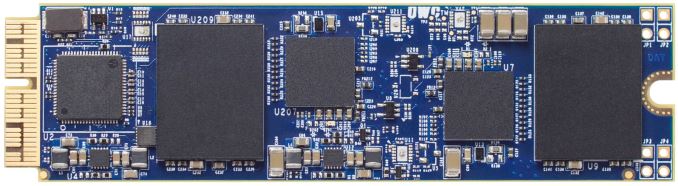
Apple migrated their notebook SSDs to PCIe-based interfaces in 2013 and has been using drives supplied by Toshiba, SanDisk, and Samsung. OWC has finally devised a compatible replacement and released it as part of their Aura SSD product line. Like the Apple originals, the OWC Aura PCIe SSD uses the AHCI protocol; Apple so far only supports and uses NVMe on the Retina MacBook that doesn’t have a removable SSD. The requirement to use AHCI instead of NVMe limited OWC’s choices for SSD controller. While Apple is a big enough customer to convince Samsung to make the SM951 in a custom form factor, OWC is not. Marvell has shipped several AHCI-compatible PCIe SSD controllers, but their typical business model is to sell just the controller and leave it up to the customer to write their own firmware or license from a third party, either of which is a substantial up-front expense.

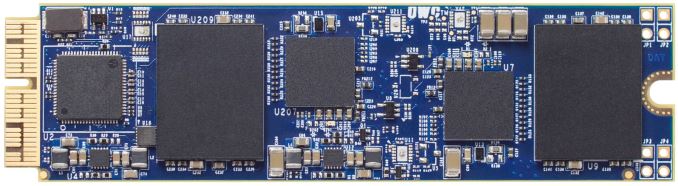
In order to keep costs under control, OWC has opted to not use a native PCIe SSD controller. Instead, the PCIe Aura SSD uses a Marvell 9230 SATA RAID controller and a pair of Silicon Motion SM2256 SATA SSD controllers. The Marvell 9230 has a PCIe 2.0 x2 host interface, so the PCIe Aura SSD has the potential to outperform SATA SSDs but won’t be able to approach the peak transfer rates of the recent Samsung SM951-based Apple originals. The Silicon Motion SM2256 controllers mean the PCIe Aura SSD is almost certainly using TLC flash, which is less expensive but also performs worse and draws more power than MLC flash. The PCIe Aura SSD’s RAID design unfortunately does not support passing through TRIM commands nor retrieving SMART information from the individual SSD controllers.

OWC Aura PCIe SSDs
  480GB 1TB
Usable Capacity 480GB 960GB
Controllers Marvell 9230 + 2x SM2256
Interface Apple custom PCIe x4 @ PCIe 2.0 x2
Peak Read Speed 763 MB/s
Peak Write Speed 446 MB/s
TRIM support No
Price (drive only) $347.99 $597.99
Price (upgrade kit) $399.00 $649.00
Warranty 3 years

Based on OWC’s measurements of the first PCIe SSDs Apple used back in 2013, the Aura SSD’s peak performance is slightly better than the slowest 128GB SanDisk/Marvell drive, but without TRIM the Aura’s write performance advantage could easily disappear over time. That leaves the PCIe Aura SSD with capacity as its only strong selling point. The MacBook Air can be configured with up to 512GB of storage from Apple, but the Aura SSD can provide up to 960GB. Many Apple customers are put off by the steep price of build-to-order SSD upgrades: $200 to upgrade from 128GB to 256GB, another $300 to move up to 512GB, and another $500 to move up to 1TB for the MacBook Pro. At $347.99 for 480GB and $597.99 for 960GB, OWC’s Aura manages to be both much cheaper than Apple’s SSD upgrades and much more expensive than single-controller drives with a standard form factor.

The Aura SSD is sold either as a bare drive or an upgrade kit that includes the necessary screwdrivers to install the SSD and a USB 3.0 enclosure to facilitate data migration. The drive is expected to start shipping in late March.

OWC Introduces SSD Upgrade for MacBook Pro and MacBook Air PCIe SSDs

OWC Introduces SSD Upgrade for MacBook Pro and MacBook Air PCIe SSDs

Apple’s Retina MacBook Pro and all but the earliest MacBook Air models have relied solely on SSDs for internal storage, as Apple slimmed down the designs to the point that even a 1.8″ hard drive was too bulky. Rather than adopt the mSATA or later M.2 form factor, Apple’s SSDs have used custom form factors and pinouts. This has contributed to keeping the market for third-party upgrades very small. Only a few companies have produced SSDs in Apple-specific form factors, most notably Other World Computing (OWC) and Transcend. Transcend has generally used Silicon Motion controllers while OWC has used SandForce controllers, but until now their offerings have been limited to SATA-based SSDs.

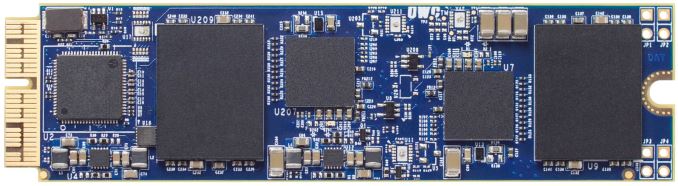
Apple migrated their notebook SSDs to PCIe-based interfaces in 2013 and has been using drives supplied by Toshiba, SanDisk, and Samsung. OWC has finally devised a compatible replacement and released it as part of their Aura SSD product line. Like the Apple originals, the OWC Aura PCIe SSD uses the AHCI protocol; Apple so far only supports and uses NVMe on the Retina MacBook that doesn’t have a removable SSD. The requirement to use AHCI instead of NVMe limited OWC’s choices for SSD controller. While Apple is a big enough customer to convince Samsung to make the SM951 in a custom form factor, OWC is not. Marvell has shipped several AHCI-compatible PCIe SSD controllers, but their typical business model is to sell just the controller and leave it up to the customer to write their own firmware or license from a third party, either of which is a substantial up-front expense.

In order to keep costs under control, OWC has opted to not use a native PCIe SSD controller. Instead, the PCIe Aura SSD uses a Marvell 9230 SATA RAID controller and a pair of Silicon Motion SM2256 SATA SSD controllers. The Marvell 9230 has a PCIe 2.0 x2 host interface, so the PCIe Aura SSD has the potential to outperform SATA SSDs but won’t be able to approach the peak transfer rates of the recent Samsung SM951-based Apple originals. The Silicon Motion SM2256 controllers mean the PCIe Aura SSD is almost certainly using TLC flash, which is less expensive but also performs worse and draws more power than MLC flash. The PCIe Aura SSD’s RAID design unfortunately does not support passing through TRIM commands nor retrieving SMART information from the individual SSD controllers.

OWC Aura PCIe SSDs
  480GB 1TB
Usable Capacity 480GB 960GB
Controllers Marvell 9230 + 2x SM2256
Interface Apple custom PCIe x4 @ PCIe 2.0 x2
Peak Read Speed 763 MB/s
Peak Write Speed 446 MB/s
TRIM support No
Price (drive only) $347.99 $597.99
Price (upgrade kit) $399.00 $649.00
Warranty 3 years

Based on OWC’s measurements of the first PCIe SSDs Apple used back in 2013, the Aura SSD’s peak performance is slightly better than the slowest 128GB SanDisk/Marvell drive, but without TRIM the Aura’s write performance advantage could easily disappear over time. That leaves the PCIe Aura SSD with capacity as its only strong selling point. The MacBook Air can be configured with up to 512GB of storage from Apple, but the Aura SSD can provide up to 960GB. Many Apple customers are put off by the steep price of build-to-order SSD upgrades: $200 to upgrade from 128GB to 256GB, another $300 to move up to 512GB, and another $500 to move up to 1TB for the MacBook Pro. At $347.99 for 480GB and $597.99 for 960GB, OWC’s Aura manages to be both much cheaper than Apple’s SSD upgrades and much more expensive than single-controller drives with a standard form factor.

The Aura SSD is sold either as a bare drive or an upgrade kit that includes the necessary screwdrivers to install the SSD and a USB 3.0 enclosure to facilitate data migration. The drive is expected to start shipping in late March.

An AnandTech Round Table with ASUS: 10 Years of the Republic of Gamers

An AnandTech Round Table with ASUS: 10 Years of the Republic of Gamers

Earlier this year before CES 2016, we approached ASUS with an idea: as the Republic of Gamers brand is now in its 10th year of operation, we wanted to get together and discuss the feeling and utility of ROG a decade on, record it, have a question and answer session from our readers, and publish the video. The Republic of Gamers brand from ASUS has been difficult to ignore, both from an engineering perspective when it comes to motherboards and graphics cards, but also the origin story, integration with users, and the expansion out to many different product lines. I felt it was important to hear from the source, and see what makes the mind tick of some of the integral cogs behind the ROG experience.

For long time AnandTech readers, you will know that very few people in this industry stay in one position – in recent times, Dustin has moved to Corsair, Vivek now works with Razer, and Anand works at Apple. I started as Senior Motherboard Editor back in 2011, when my predecessor Rajinder Gill took a position within ASUS’ technical team. His predecessor, Gary Key, is also with ASUS and currently sits as Director of Marketing for ASUS USA.

Vivian Lien

Chief Marketing Officer, ASUS USA

ASUS Marketing
from 2006/2007

Gary Key

Director of Marketing, ASUS USA

AnandTech Motherboard Senior Editor 2005-2008

Rajinder ‘Raja’ Gill

Technical PR Manager, ASUS USA

AnandTech Motherboard Senior Editor 2008-2010

Ian Cutress

10 Years of ROG Round Table Chair

Current AnandTech Motherboard Senior Editor from 2011

At the time when Gary, Raja and Kris Boughton (another former motherboard editor for AnandTech) were probing the original models, Vivian was one of their direct ASUS contacts, ensuring that direct line of communication and filling them in on the details. Then when Gary joined ASUS, Raja had Gary as his main contact, and so on, meaning that for this discussion we have the ASUS-AnandTech contact line right from the initial ROG launch.

Between the AnandTech motherboard reviewing staff, we have covered the Republic of Gamers brand from its inception, with both Gary and Raja now involved in various levels with members of the team that designs, develops, tests and pushes the ROG ecosystem, then managing the perception of it as part of the ASUS brand within North America.

If we look back at AnandTech’s content history, the deep dives from both Gary and Raja into those products are still insights into motherboard design and complexity. They are certainly worth a read several years on, along with Kris Boughton’s reviews, who worked alongside Gary in 07/08. For those interested, here’s every ROG motherboard we’ve ever tested:

07-2007: ASUS ROG at Computex – Gary Key
11-2007: Maximus Formula Review – Rajinder Gill
12-2007: Maximus Extreme Review – Rajinder Gill
01-2008: Rampage Formula Review – Kris Boughton
03-2008: Striker II Formula Review – Rajinder Gill
04-2008: Striker II Extreme Review – Kris Boughton
10-2008: Rampage II Extreme Review – Gary Key
11-2009: Maximus III Formula Review – Rajinder Gill
04-2010: Maximus III Extreme Review – Rajinder Gill
07-2010: Rampage III Extreme Review – Rajinder Gill
04-2012: Crosshair V Formula Review – Ian Cutress
08-2012: Rampage IV Gene, Formula and Extreme Review – Ian Cutress
03-2013: Maximus V Formula Review – Ian Cutress
05-2013: Maximus V Gene Review – Ian Cutress
11-2013: Maximus VI Impact Review – Ian Cutress
01-2014: Rampage IV Black Edition Review – Ian Cutress
12-2014: Maximus VII Impact Review – Ian Cutress
06-2015: Rampage V Extreme Review – Ian Cutress
12-2015: Maximus VIII Impact Review – Ian Cutress

You may remember we interviewed Dr Albert Chang, Senior Division Director of ASUS Motherboard Business Unit Research and Development back in 2014 about the general path for motherboard design, and how the ROG team is designed to be that skunkworks element of engineering. Raja assists ROG’s internal impromptu extreme overclocking events with top overclockers as well as community management, so we picked his brains on how design ideas from the forums and events assist product design.

As a result of the ASUS ROG push, we end up meeting with ASUS frequently at events (much like other companies), but a round table was a great chance to get a decade of AnandTech Senior Motherboard Editors in front of the camera with Vivien Lien, the CMO of ASUS USA who was part of the team that supplied the first set of ROG motherboards we tested to AnandTech. We also posted an open Q&A pipeline, inviting questions from readers. I took the best part of a dozen of those questions for the round table.

Audio only download: MP3

Timestamps MM:SS

00:06 – Intro
02:50 – Starting with the Rampage Extreme
04:20 – How to begin a gaming focused brand
05:55 – Several years for ROG profitability, the changing nature of Gaming
07:25 – Engineering and Overclocking
09:50 – The X79 motherboard that was never sold, but helped future platforms
13:30 – Evolution of the OC Panel
14:45 – Custom hardware development and implementation
16:15 – Republic of Gamers in 2006/07: Teething Issues
18:35 – ASUS sends an engineer to Gary’s house to fix it             
19:45 – Translating an issue, that needs an ASUS engineer to fix, into feedback for the future
22:13 – ROG Forums and ASUS’ official presence on other major forums for support/feedback
23:25 – Start of Q&A
24:00 – Q1 from zodiacfml: Make an ASUS ROG Smartphone!
25:35 – Q2 from jjj: What makes ROG worth the cost?
31:50 – Q3 from jasonelmore: Is $500 too much for a Z170 motherboard?
34:05 – Q4 from 7amood: Any future plans for waterproofing?
34:45 – Q5 from dreamer77dd: Will we see a dual socket ROG platform?
36:03 – Q6 from boeush: Will ASUS compete with MSI’s GT80?
37:35 – Q7 from boeush: Is there demand for larger laptops (18”+) or 16:10 screens?
38:55 – Q8 from iamkyle: Will we see customizable NICs/codecs?
41:45 – Q9 from Ian: Is there 10GBase-T on the brain?
43:46 – Q10 from Shadow7037932: How does ASUS evolve when an i7 920 still offers good performance?
45:40 – Outro
46:02 – FIN

An AnandTech Round Table with ASUS: 10 Years of the Republic of Gamers

An AnandTech Round Table with ASUS: 10 Years of the Republic of Gamers

Earlier this year before CES 2016, we approached ASUS with an idea: as the Republic of Gamers brand is now in its 10th year of operation, we wanted to get together and discuss the feeling and utility of ROG a decade on, record it, have a question and answer session from our readers, and publish the video. The Republic of Gamers brand from ASUS has been difficult to ignore, both from an engineering perspective when it comes to motherboards and graphics cards, but also the origin story, integration with users, and the expansion out to many different product lines. I felt it was important to hear from the source, and see what makes the mind tick of some of the integral cogs behind the ROG experience.

For long time AnandTech readers, you will know that very few people in this industry stay in one position – in recent times, Dustin has moved to Corsair, Vivek now works with Razer, and Anand works at Apple. I started as Senior Motherboard Editor back in 2011, when my predecessor Rajinder Gill took a position within ASUS’ technical team. His predecessor, Gary Key, is also with ASUS and currently sits as Director of Marketing for ASUS USA.

Vivian Lien

Chief Marketing Officer, ASUS USA

ASUS Marketing
from 2006/2007

Gary Key

Director of Marketing, ASUS USA

AnandTech Motherboard Senior Editor 2005-2008

Rajinder ‘Raja’ Gill

Technical PR Manager, ASUS USA

AnandTech Motherboard Senior Editor 2008-2010

Ian Cutress

10 Years of ROG Round Table Chair

Current AnandTech Motherboard Senior Editor from 2011

At the time when Gary, Raja and Kris Boughton (another former motherboard editor for AnandTech) were probing the original models, Vivian was one of their direct ASUS contacts, ensuring that direct line of communication and filling them in on the details. Then when Gary joined ASUS, Raja had Gary as his main contact, and so on, meaning that for this discussion we have the ASUS-AnandTech contact line right from the initial ROG launch.

Between the AnandTech motherboard reviewing staff, we have covered the Republic of Gamers brand from its inception, with both Gary and Raja now involved in various levels with members of the team that designs, develops, tests and pushes the ROG ecosystem, then managing the perception of it as part of the ASUS brand within North America.

If we look back at AnandTech’s content history, the deep dives from both Gary and Raja into those products are still insights into motherboard design and complexity. They are certainly worth a read several years on, along with Kris Boughton’s reviews, who worked alongside Gary in 07/08. For those interested, here’s every ROG motherboard we’ve ever tested:

07-2007: ASUS ROG at Computex – Gary Key
11-2007: Maximus Formula Review – Rajinder Gill
12-2007: Maximus Extreme Review – Rajinder Gill
01-2008: Rampage Formula Review – Kris Boughton
03-2008: Striker II Formula Review – Rajinder Gill
04-2008: Striker II Extreme Review – Kris Boughton
10-2008: Rampage II Extreme Review – Gary Key
11-2009: Maximus III Formula Review – Rajinder Gill
04-2010: Maximus III Extreme Review – Rajinder Gill
07-2010: Rampage III Extreme Review – Rajinder Gill
04-2012: Crosshair V Formula Review – Ian Cutress
08-2012: Rampage IV Gene, Formula and Extreme Review – Ian Cutress
03-2013: Maximus V Formula Review – Ian Cutress
05-2013: Maximus V Gene Review – Ian Cutress
11-2013: Maximus VI Impact Review – Ian Cutress
01-2014: Rampage IV Black Edition Review – Ian Cutress
12-2014: Maximus VII Impact Review – Ian Cutress
06-2015: Rampage V Extreme Review – Ian Cutress
12-2015: Maximus VIII Impact Review – Ian Cutress

You may remember we interviewed Dr Albert Chang, Senior Division Director of ASUS Motherboard Business Unit Research and Development back in 2014 about the general path for motherboard design, and how the ROG team is designed to be that skunkworks element of engineering. Raja assists ROG’s internal impromptu extreme overclocking events with top overclockers as well as community management, so we picked his brains on how design ideas from the forums and events assist product design.

As a result of the ASUS ROG push, we end up meeting with ASUS frequently at events (much like other companies), but a round table was a great chance to get a decade of AnandTech Senior Motherboard Editors in front of the camera with Vivien Lien, the CMO of ASUS USA who was part of the team that supplied the first set of ROG motherboards we tested to AnandTech. We also posted an open Q&A pipeline, inviting questions from readers. I took the best part of a dozen of those questions for the round table.

Audio only download: MP3

Timestamps MM:SS

00:06 – Intro
02:50 – Starting with the Rampage Extreme
04:20 – How to begin a gaming focused brand
05:55 – Several years for ROG profitability, the changing nature of Gaming
07:25 – Engineering and Overclocking
09:50 – The X79 motherboard that was never sold, but helped future platforms
13:30 – Evolution of the OC Panel
14:45 – Custom hardware development and implementation
16:15 – Republic of Gamers in 2006/07: Teething Issues
18:35 – ASUS sends an engineer to Gary’s house to fix it             
19:45 – Translating an issue, that needs an ASUS engineer to fix, into feedback for the future
22:13 – ROG Forums and ASUS’ official presence on other major forums for support/feedback
23:25 – Start of Q&A
24:00 – Q1 from zodiacfml: Make an ASUS ROG Smartphone!
25:35 – Q2 from jjj: What makes ROG worth the cost?
31:50 – Q3 from jasonelmore: Is $500 too much for a Z170 motherboard?
34:05 – Q4 from 7amood: Any future plans for waterproofing?
34:45 – Q5 from dreamer77dd: Will we see a dual socket ROG platform?
36:03 – Q6 from boeush: Will ASUS compete with MSI’s GT80?
37:35 – Q7 from boeush: Is there demand for larger laptops (18”+) or 16:10 screens?
38:55 – Q8 from iamkyle: Will we see customizable NICs/codecs?
41:45 – Q9 from Ian: Is there 10GBase-T on the brain?
43:46 – Q10 from Shadow7037932: How does ASUS evolve when an i7 920 still offers good performance?
45:40 – Outro
46:02 – FIN