News


Revisiting The Google Pixel C – Better, But Not There Yet

Last month I published my review of the Pixel C. While I thought it was a very interesting tablet, in the end I was unable to give it any sort of recommendation due to the severe software bugs that were present. To me, this was quite surprising, as Google has a fairly good track record when it comes to the software on the Nexus devices. During the review process I reached out to Google to voice my concerns about the issues. What both concerns me and gives me hope for the Pixel C is that Google was readily aware of most of the problems I brought up. It concerns me because I think the appropriate decision would have been to delay its release, but it gives me hope that these issues will be fixed. 

During my discussions with Google, I was offered the chance to test a new unit that would run a new unreleased build containing fixes that Google plans to release to the public in the future. Given the fact that the Pixel C has solid hardware let down by buggy software, the chance to see Google’s improvements before they are officially released presented a great opportunity to revisit the Pixel C and determine if Google’s upcoming changes can change my original verdict about the device. Read on to see what Google has changed, and if it’s enough to turn things around for the Pixel C.

Samsung Releases 750 EVO SATA SSD

Samsung Releases 750 EVO SATA SSD

After an accidental leak in November that was spotted by our friends at Tom’s Hardware, the Samsung 750 EVO has now officially launched worldwide. Since the introduction of their first consumer TLC SSD with the 840, Samsung’s consumer/retail SATA SSD lineup has consisted of two product families: the MLC-based Pro drives, and the TLC-based 840 and EVO drives. With the 750 EVO, Samsung is creating a new budget-oriented product line that makes them a participant in the race to the bottom that they had been avoiding by positioning the 850 EVO as a mid-range SSD.

There are several design choices that help minimize the cost of the 750 EVO, aside from the expected choice of TLC over MLC. The MGX controller it borrows from the lower capacity 850 EVOs is a dual-core version of Samsung’s usual triple-core architecture. The 750 EVO will only be available in 120GB and 250GB sizes, so there won’t be any sticker shock of higher capacities and the PCB only needs to be large enough to accommodate the needs of the 250GB model. Both capacities are listed as having 256MB of DRAM, where the 850 EVO 250GB has 512MB of DRAM. But the most significant aspect of the 750 EVO is that it doesn’t use 3D NAND.

It may come as a surprise that the 750 EVO marks a return to planar NAND. Samsung has proudly led the industry in transitioning to 3D NAND, but they haven’t entirely abandoned the development of planar NAND flash. Earlier this month they made two presentations at ISSCC of their R&D accomplishments: one about a 256Gb TLC built on their 48-layer third generation V-NAND process, and one about a 128Gb MLC built on a 14nm process. The 750 EVO uses a 128Gb 16nm TLC, a larger die based on the same process as the 64Gb MLC we found in the SM951.

The 16nm TLC NAND is the successor to Samsung’s 19nm TLC that had a troubled tenure in the 840 EVO. More than a year after launch, 840 EVO owners started reporting degraded read speed when accessing old data that had not been written recently. Samsung acknowledged the issue, then provided a firmware update and Performance Restoration tool less than a month later, but had to issue a second firmware update six months after that. The 750 EVO inherits the results of all the work Samsung did to mitigate the read speed degradation, and there’s no reason to expect it to be any more susceptible than the competition using similarly dense planar TLC built on Toshiba’s 15nm process or Micron’s 16nm process.

Samsung TLC SATA SSD Comparison
Drive 750 EVO 120GB 750 EVO 250GB 850 EVO 120GB 850 EVO 250GB
Controller MGX MGX
NAND Samsung 16nm TLC Samsung 32-layer 128Gbit TLC V-NAND
DRAM 256MB 256MB 256MB 512MB
Sequential Read 540MB/s 540MB/s 540MB/s 540MB/s
Sequential Write 520MB/s 520MB/s 520MB/s 520MB/s
4KB Random Read 94K IOPS 97K IOPS 94K IOPS 97K IOPS
4KB Random Write 88K IOPS 88K IOPS 88K IOPS 88K IOPS
4KB Random Read QD1 10K IOPS 10K IOPS 10K IOPS 10K IOPS
4KB Random Write QD1 35K IOPS 35K IOPS 40K IOPS 40K IOPS
DevSleep Power  6mW 2mW
Slumber Power  50mW 50mW
Active Power (Read/Write) 2.1W / 2.4W (Average) 2.4W / 2.8W (Average) Max 3.7W / 4.4W
Encryption AES-256, TCG Opal 2.0, IEEE-1667 (eDrive) AES-256, TCG Opal 2.0, IEEE-1667 (eDrive)
Endurance 35TB 70TB 75TB
Warranty Three years Five years

The 750 EVO’s performance specifications are almost identical to the 850 EVOs of the same capacity. The 4kB random write latency is a little bit worse, but read speeds are the same and any other differences in the write performance of the 15nm flash are masked by the SLC write cache. The reduced warranty period of three years is typical for this product segment, and while the write endurance specifications may look quite low, they’re sufficient given the capacity and intended use. It’s nice to see that the 750 EVO keeps the encryption capabilities fully enabled, as many budget drives lack hardware encryption support.

Given the aforementioned similarities with the 850 EVO, it should come as no surprise that the 750 EVO is in part a replacement. The previously announced and now imminent migration to Samsung’s 48-layer V-NAND won’t apply to the 120GB 850 EVO, as the 256Gb per die capacity would mean building a drive with only four flash chips. That is undesirable from both a performance standpoint and from a packaging standpoint—Samsung will otherwise have no reason to stack fewer than 8 dies per package.

A few online retailers are listing the 750 EVO already, albeit with limited or no stock. The MSRP of $54.99 for the 120GB model and $74.99 for the 250GB model is about $10 cheaper than what the 850 EVO is currently going for, and any sales below MSRP will make for a very competitive price.


Samsung Releases 750 EVO SATA SSD

Samsung Releases 750 EVO SATA SSD

After an accidental leak in November that was spotted by our friends at Tom’s Hardware, the Samsung 750 EVO has now officially launched worldwide. Since the introduction of their first consumer TLC SSD with the 840, Samsung’s consumer/retail SATA SSD lineup has consisted of two product families: the MLC-based Pro drives, and the TLC-based 840 and EVO drives. With the 750 EVO, Samsung is creating a new budget-oriented product line that makes them a participant in the race to the bottom that they had been avoiding by positioning the 850 EVO as a mid-range SSD.

There are several design choices that help minimize the cost of the 750 EVO, aside from the expected choice of TLC over MLC. The MGX controller it borrows from the lower capacity 850 EVOs is a dual-core version of Samsung’s usual triple-core architecture. The 750 EVO will only be available in 120GB and 250GB sizes, so there won’t be any sticker shock of higher capacities and the PCB only needs to be large enough to accommodate the needs of the 250GB model. Both capacities are listed as having 256MB of DRAM, where the 850 EVO 250GB has 512MB of DRAM. But the most significant aspect of the 750 EVO is that it doesn’t use 3D NAND.

It may come as a surprise that the 750 EVO marks a return to planar NAND. Samsung has proudly led the industry in transitioning to 3D NAND, but they haven’t entirely abandoned the development of planar NAND flash. Earlier this month they made two presentations at ISSCC of their R&D accomplishments: one about a 256Gb TLC built on their 48-layer third generation V-NAND process, and one about a 128Gb MLC built on a 14nm process. The 750 EVO uses a 128Gb 16nm TLC, a larger die based on the same process as the 64Gb MLC we found in the SM951.

The 16nm TLC NAND is the successor to Samsung’s 19nm TLC that had a troubled tenure in the 840 EVO. More than a year after launch, 840 EVO owners started reporting degraded read speed when accessing old data that had not been written recently. Samsung acknowledged the issue, then provided a firmware update and Performance Restoration tool less than a month later, but had to issue a second firmware update six months after that. The 750 EVO inherits the results of all the work Samsung did to mitigate the read speed degradation, and there’s no reason to expect it to be any more susceptible than the competition using similarly dense planar TLC built on Toshiba’s 15nm process or Micron’s 16nm process.

Samsung TLC SATA SSD Comparison
Drive 750 EVO 120GB 750 EVO 250GB 850 EVO 120GB 850 EVO 250GB
Controller MGX MGX
NAND Samsung 16nm TLC Samsung 32-layer 128Gbit TLC V-NAND
DRAM 256MB 256MB 256MB 512MB
Sequential Read 540MB/s 540MB/s 540MB/s 540MB/s
Sequential Write 520MB/s 520MB/s 520MB/s 520MB/s
4KB Random Read 94K IOPS 97K IOPS 94K IOPS 97K IOPS
4KB Random Write 88K IOPS 88K IOPS 88K IOPS 88K IOPS
4KB Random Read QD1 10K IOPS 10K IOPS 10K IOPS 10K IOPS
4KB Random Write QD1 35K IOPS 35K IOPS 40K IOPS 40K IOPS
DevSleep Power  6mW 2mW
Slumber Power  50mW 50mW
Active Power (Read/Write) 2.1W / 2.4W (Average) 2.4W / 2.8W (Average) Max 3.7W / 4.4W
Encryption AES-256, TCG Opal 2.0, IEEE-1667 (eDrive) AES-256, TCG Opal 2.0, IEEE-1667 (eDrive)
Endurance 35TB 70TB 75TB
Warranty Three years Five years

The 750 EVO’s performance specifications are almost identical to the 850 EVOs of the same capacity. The 4kB random write latency is a little bit worse, but read speeds are the same and any other differences in the write performance of the 15nm flash are masked by the SLC write cache. The reduced warranty period of three years is typical for this product segment, and while the write endurance specifications may look quite low, they’re sufficient given the capacity and intended use. It’s nice to see that the 750 EVO keeps the encryption capabilities fully enabled, as many budget drives lack hardware encryption support.

Given the aforementioned similarities with the 850 EVO, it should come as no surprise that the 750 EVO is in part a replacement. The previously announced and now imminent migration to Samsung’s 48-layer V-NAND won’t apply to the 120GB 850 EVO, as the 256Gb per die capacity would mean building a drive with only four flash chips. That is undesirable from both a performance standpoint and from a packaging standpoint—Samsung will otherwise have no reason to stack fewer than 8 dies per package.

A few online retailers are listing the 750 EVO already, albeit with limited or no stock. The MSRP of $54.99 for the 120GB model and $74.99 for the 250GB model is about $10 cheaper than what the 850 EVO is currently going for, and any sales below MSRP will make for a very competitive price.

Samsung Announces New Exynos 7870 Mid-Range 14nm SoC

Samsung Announces New Exynos 7870 Mid-Range 14nm SoC

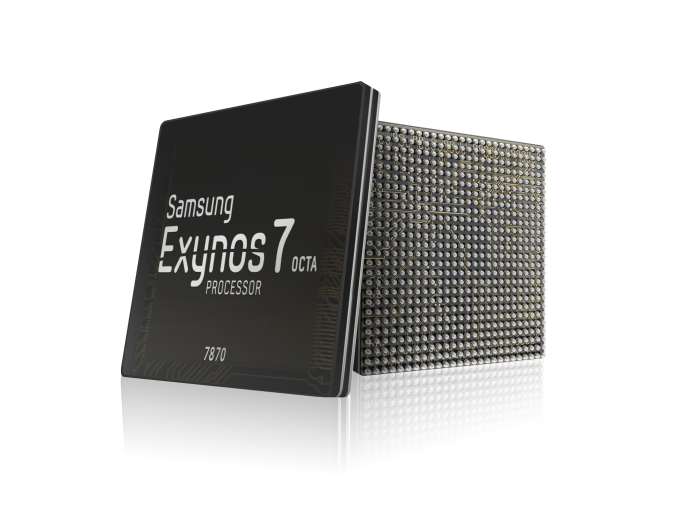
Today Samsung announced a new mid-range SoC called the Exynos 7870. The new SKU sports 8x Cortex A53s running at up to 1.6GHz. The GPU should be an ARM Mali T830 although we have no information on core-count or frequencies used. The part extends Samsung’s ModAP lineup of SoCs with integrated modems as we see an integrated UE Category 6 modem integrated, delivering up to 300Mbps with FDD-TDD joint carrier aggregation.

Upcoming 14nm Mid-Range SoCs
SoC Exynos 7580 Exynos 7870 Snapdragon 625
(MSM8953)
CPU 8x A53 @ 1.6GHz 8x A53 @ 1.6GHz 4x A53 @ 2.0GHz

4x A53 @ ? GHz

GPU Mali T720MP3
@ 600MHz
Mali T830MP? Adreno 506
Encode/
Decode
1080p60
H.264 
2160p
H.264 & HEVC (Decode)
Camera/ISP Dual ISP
16MP / (8+8)
Dual ISP
16MP / (8+8)
Dual ISP
24MP
Integrated
Modem
Cat. 6
300Mbps DL ?Mbps UL

2x20MHz C.A.

Cat. 6
300Mbps DL ?Mbps UL

2x20MHz C.A.

“X9 LTE” Cat. 7
300Mbps DL 150Mbps UL

2x20MHz C.A. 
(DL & UL)

Mfc. Process 28nm HKMG 14nm 14nm LPP

More interestingly, is that the new SoC is manufactured on a 14nm FinFET process which promises to reduce power consumption by over 30% over similar SoCs such as the Exynos 7580. Only a few days ago we were discussing our surprise with the introduction of Qualcomm’s Snapdragon 625 which is also manufactured in a 14nm LPP process, a great sign for the manufacturing process given that these mid-range parts are very price-sensitive. Samsung discloses that the Exynos 7870 will be in mass production in the first quarter of 2016 so we’re essentially very close to device availability in the following months.

Samsung Announces New Exynos 7870 Mid-Range 14nm SoC

Samsung Announces New Exynos 7870 Mid-Range 14nm SoC

Today Samsung announced a new mid-range SoC called the Exynos 7870. The new SKU sports 8x Cortex A53s running at up to 1.6GHz. The GPU should be an ARM Mali T830 although we have no information on core-count or frequencies used. The part extends Samsung’s ModAP lineup of SoCs with integrated modems as we see an integrated UE Category 6 modem integrated, delivering up to 300Mbps with FDD-TDD joint carrier aggregation.

Upcoming 14nm Mid-Range SoCs
SoC Exynos 7580 Exynos 7870 Snapdragon 625
(MSM8953)
CPU 8x A53 @ 1.6GHz 8x A53 @ 1.6GHz 4x A53 @ 2.0GHz

4x A53 @ ? GHz

GPU Mali T720MP3
@ 600MHz
Mali T830MP? Adreno 506
Encode/
Decode
1080p60
H.264 
2160p
H.264 & HEVC (Decode)
Camera/ISP Dual ISP
16MP / (8+8)
Dual ISP
16MP / (8+8)
Dual ISP
24MP
Integrated
Modem
Cat. 6
300Mbps DL ?Mbps UL

2x20MHz C.A.

Cat. 6
300Mbps DL ?Mbps UL

2x20MHz C.A.

“X9 LTE” Cat. 7
300Mbps DL 150Mbps UL

2x20MHz C.A. 
(DL & UL)

Mfc. Process 28nm HKMG 14nm 14nm LPP

More interestingly, is that the new SoC is manufactured on a 14nm FinFET process which promises to reduce power consumption by over 30% over similar SoCs such as the Exynos 7580. Only a few days ago we were discussing our surprise with the introduction of Qualcomm’s Snapdragon 625 which is also manufactured in a 14nm LPP process, a great sign for the manufacturing process given that these mid-range parts are very price-sensitive. Samsung discloses that the Exynos 7870 will be in mass production in the first quarter of 2016 so we’re essentially very close to device availability in the following months.