News


Thermal Imaging at CES - FLIR and Seek Thermal

Thermal Imaging at CES – FLIR and Seek Thermal

Thermal imaging has become more accessible to the average consumer, thanks to advances in the development of low-cost infrared sensors / microbolometers. FLIR was one of the first to make a breakthrough in this segment with the development of the low-cost Lepton sensor (80×60) that was used in the first-generation FLIR One Thermal Imager for iPhone 5/5s. In the meanwhile, Seek Thermal, a startup, debuted their low-cost microbolometer (206×156) in the Seek Thermal Infrared Camera.

In 2015, FLIR continued to make advancements in the sensor space with the launch of the Lepton 3, a 160×120 microbolometer. This sensor was used in the second-generation FLIR One cameras (including the Android version that we have been using in our reviews of mini-PCs). Seek Thermal, on the other hand, had entered the market with a higher resolution sensor. So, their focus has been on developing new products to widen the appeal / addressable market for that sensor. At CES 2016, FLIR demonstrated a couple of new products based on the Lepton sensors, while Seek Thermal showed the products introduced through the course of 2015.

FLIR

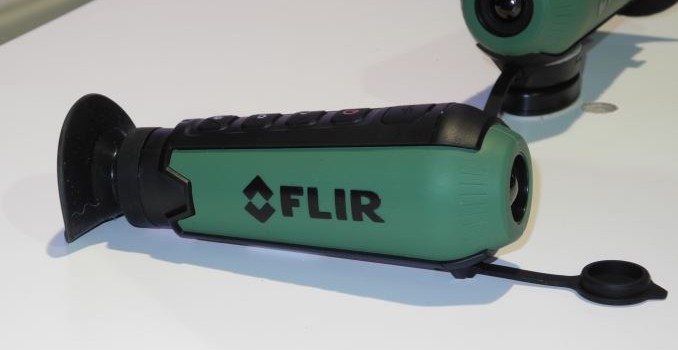
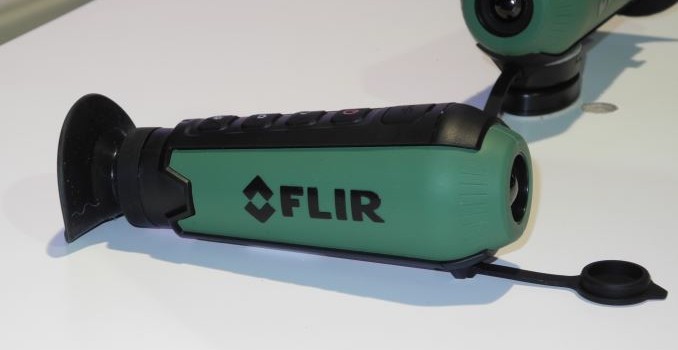
The FLIR Scout TK is a stand-alone and rugged thermal camera with specifications similar to the FLIR ONE (i.e, the same 160×120 Lepton 3 sensor), but, meant for outdoor use. It comes with storage for photos and videos, and they can be transferred to a computer for further review. The FoV is narrow, meant more for viewing objects / animals up to 90m away. There is a 640×480 LCD display on one end, and the industrial design allows for one handed operation. The intended use-case is outdoor enthusiasts who want to spot wildlife in the night or in low light situations, as well as those interested in personal and home security. The product uses an internal Li-ion battery that is rechargeable. It can support up to 5 hours of continuous operation with a fully charged battery.

The TG130, a entry-level spot thermal camera for home and small businesses. It is based on the first-generation Lepton core (80×60 sensor). It is targeted at home users who want to find out insulation issues (places of heat loss in a house). It can also help in determining correctness of HVAC operation, electrical equipment troubleshooting, and refrigerator maintenance. There is no storage media to record to, as the usage involves pointing and clicking to freeze the image with the temperature being part of the OSD. The product uses 3xAAA batteries. It can support up to 4 hours of continuous operation with one set of fully charged batteries.

At the FLIR booth, we had the chance to see working models of both the Scout TK as well as the TG130 along with a host of other thermal imagers from FLIR targeting the professional market. The Scout TK and TG130 are both slated to ship later this quarter.

The Scout TK will be priced at $599, while the TG130 will be priced more economically at $249 due to the use of the first-generation Lepton sensor and lack of any recording capabilities.

Seek Thermal

Seek Thermal was showing off the camera models introduced over the course of 2015 at CES. These included the Compact and Compact XR thermal imaging cameras. The Compact is suited for indoor analysis while the Compact XR is suitable for outdoor use. They are both available in iOS and Android versions. The main difference between the first-generation Seek Thermal Infrared camera that we reviewed and the Seek Thermal Compact / Compact XR is the availability of zooming capabilities for better focus on the area of interest in the latter. The availability of the ‘optical’ zooming feature enables the Compact to have a range of 300m and the Compact XR to have a range of 550m (compared to the 90m range of the equivalent FLIR cameras). The Compact (indoor use) has a 36 degree FoV, while the Compact XR (outdoor use) has a 20 degree FoV.

Seek Compact

Seek CompactXR

In addition, Seek Thermal also demonstrated the Seek Reveal, which is very similar to the FLIR TG130 in terms of use-cases. The added capabilities include a 300 lm. integrated LED flashlight, ruggedness and the ability to withstand submergence in water. The LCD display has a 240×320 resolution. A micro-USB cable can be used to transfer recorded images. The device has a range of around 150m and has a 36 degree FoV similar to the Compact. All of the Seek Thermal offerings are still based on the original 206×156 thermal sensor. While the Compact and CompactXR retail for $249 and $299 respectively, the Reveal, with its in-built display and smartphone-free operation, retails for $399.

Seek Reveal

Concluding Remarks

The offerings from FLIR and Seek Thermal have given consumers a wide range of thermal imaging products to choose from, depending on the intended use-case. We would like to see FLIR improve their Android app for better compatibility with a wider range of mobile devices. Hopefully, a future update to the Lepton series would help them achieve resolution-parity with the Seek Thermal sensor. That said, FLIR’s MSX (one of the proprietary features of some of FLIR’s cameras that blends the output of an image sensor and the output of the thermal sensor) seems to make up for the disappointing thermal sensor resolution to some extent. On the other side, we would like to see if Seek Thermal can bring in thermal sensors with better resolution at similar price points. On a common note, government restrictions still prevent thermal imagers from offering greater than 9 FPS for videos without going through extensive paperwork. Hopefully, the advent of low-cost thermal imagers like the ones from FLIR and Seek Thermal can help in making this situation better.

The Google Pixel C Review

In early 2010, Google and HTC launched the Nexus One. While it was designed in a partnership between Google and HTC, it represented Google’s first step into the arena of smartphone hardware design. Since that time, having a Nexus device designed and manufactured in partnership with another OEM has been something of a tradition for Google, and there have been many partnerships and products released in the six years since the Nexus One launched. While the Nexus program has remained strong, the products were technically branded by their respective manufacturers, even with Google’s heavy involvement in the design process.

In 2013 Google made an exception to the trend set by the Nexus devices. The device was not an Android device, but a Chrome OS device instead. It was the original Chromebook Pixel, and it was entirely designed, branded, and supported by Google. Last year the original Chromebook Pixel received a successor in the form of the Chromebook Pixel (2015). Google was clearly testing the waters of hardware design and cooperating with companies only for hardware assembly, but they were still yet to ship an Android device that was entirely Google made and branded. The Google Pixel C bucks the trend, and provides the first Android experience which is solely in Google’s hands. Read on for the full review of the Google Pixel C.

Thermal Imaging at CES - FLIR and Seek Thermal

Thermal Imaging at CES – FLIR and Seek Thermal

Thermal imaging has become more accessible to the average consumer, thanks to advances in the development of low-cost infrared sensors / microbolometers. FLIR was one of the first to make a breakthrough in this segment with the development of the low-cost Lepton sensor (80×60) that was used in the first-generation FLIR One Thermal Imager for iPhone 5/5s. In the meanwhile, Seek Thermal, a startup, debuted their low-cost microbolometer (206×156) in the Seek Thermal Infrared Camera.

In 2015, FLIR continued to make advancements in the sensor space with the launch of the Lepton 3, a 160×120 microbolometer. This sensor was used in the second-generation FLIR One cameras (including the Android version that we have been using in our reviews of mini-PCs). Seek Thermal, on the other hand, had entered the market with a higher resolution sensor. So, their focus has been on developing new products to widen the appeal / addressable market for that sensor. At CES 2016, FLIR demonstrated a couple of new products based on the Lepton sensors, while Seek Thermal showed the products introduced through the course of 2015.

FLIR

The FLIR Scout TK is a stand-alone and rugged thermal camera with specifications similar to the FLIR ONE (i.e, the same 160×120 Lepton 3 sensor), but, meant for outdoor use. It comes with storage for photos and videos, and they can be transferred to a computer for further review. The FoV is narrow, meant more for viewing objects / animals up to 90m away. There is a 640×480 LCD display on one end, and the industrial design allows for one handed operation. The intended use-case is outdoor enthusiasts who want to spot wildlife in the night or in low light situations, as well as those interested in personal and home security. The product uses an internal Li-ion battery that is rechargeable. It can support up to 5 hours of continuous operation with a fully charged battery.

The TG130, a entry-level spot thermal camera for home and small businesses. It is based on the first-generation Lepton core (80×60 sensor). It is targeted at home users who want to find out insulation issues (places of heat loss in a house). It can also help in determining correctness of HVAC operation, electrical equipment troubleshooting, and refrigerator maintenance. There is no storage media to record to, as the usage involves pointing and clicking to freeze the image with the temperature being part of the OSD. The product uses 3xAAA batteries. It can support up to 4 hours of continuous operation with one set of fully charged batteries.

At the FLIR booth, we had the chance to see working models of both the Scout TK as well as the TG130 along with a host of other thermal imagers from FLIR targeting the professional market. The Scout TK and TG130 are both slated to ship later this quarter.

The Scout TK will be priced at $599, while the TG130 will be priced more economically at $249 due to the use of the first-generation Lepton sensor and lack of any recording capabilities.

Seek Thermal

Seek Thermal was showing off the camera models introduced over the course of 2015 at CES. These included the Compact and Compact XR thermal imaging cameras. The Compact is suited for indoor analysis while the Compact XR is suitable for outdoor use. They are both available in iOS and Android versions. The main difference between the first-generation Seek Thermal Infrared camera that we reviewed and the Seek Thermal Compact / Compact XR is the availability of zooming capabilities for better focus on the area of interest in the latter. The availability of the ‘optical’ zooming feature enables the Compact to have a range of 300m and the Compact XR to have a range of 550m (compared to the 90m range of the equivalent FLIR cameras). The Compact (indoor use) has a 36 degree FoV, while the Compact XR (outdoor use) has a 20 degree FoV.

Seek Compact

Seek CompactXR

In addition, Seek Thermal also demonstrated the Seek Reveal, which is very similar to the FLIR TG130 in terms of use-cases. The added capabilities include a 300 lm. integrated LED flashlight, ruggedness and the ability to withstand submergence in water. The LCD display has a 240×320 resolution. A micro-USB cable can be used to transfer recorded images. The device has a range of around 150m and has a 36 degree FoV similar to the Compact. All of the Seek Thermal offerings are still based on the original 206×156 thermal sensor. While the Compact and CompactXR retail for $249 and $299 respectively, the Reveal, with its in-built display and smartphone-free operation, retails for $399.

Seek Reveal

Concluding Remarks

The offerings from FLIR and Seek Thermal have given consumers a wide range of thermal imaging products to choose from, depending on the intended use-case. We would like to see FLIR improve their Android app for better compatibility with a wider range of mobile devices. Hopefully, a future update to the Lepton series would help them achieve resolution-parity with the Seek Thermal sensor. That said, FLIR’s MSX (one of the proprietary features of some of FLIR’s cameras that blends the output of an image sensor and the output of the thermal sensor) seems to make up for the disappointing thermal sensor resolution to some extent. On the other side, we would like to see if Seek Thermal can bring in thermal sensors with better resolution at similar price points. On a common note, government restrictions still prevent thermal imagers from offering greater than 9 FPS for videos without going through extensive paperwork. Hopefully, the advent of low-cost thermal imagers like the ones from FLIR and Seek Thermal can help in making this situation better.

The Google Pixel C Review

In early 2010, Google and HTC launched the Nexus One. While it was designed in a partnership between Google and HTC, it represented Google’s first step into the arena of smartphone hardware design. Since that time, having a Nexus device designed and manufactured in partnership with another OEM has been something of a tradition for Google, and there have been many partnerships and products released in the six years since the Nexus One launched. While the Nexus program has remained strong, the products were technically branded by their respective manufacturers, even with Google’s heavy involvement in the design process.

In 2013 Google made an exception to the trend set by the Nexus devices. The device was not an Android device, but a Chrome OS device instead. It was the original Chromebook Pixel, and it was entirely designed, branded, and supported by Google. Last year the original Chromebook Pixel received a successor in the form of the Chromebook Pixel (2015). Google was clearly testing the waters of hardware design and cooperating with companies only for hardware assembly, but they were still yet to ship an Android device that was entirely Google made and branded. The Google Pixel C bucks the trend, and provides the first Android experience which is solely in Google’s hands. Read on for the full review of the Google Pixel C.

GDDR5X Standard Finalized by JEDEC: New Graphics Memory up to 14 Gbps

GDDR5X Standard Finalized by JEDEC: New Graphics Memory up to 14 Gbps

In Q4 2015, JEDEC (a major semiconductor engineering trade organization that sets standards for dynamic random access memory, or DRAM) finalized the GDDR5X specification, with accompianing white papers. This is the memory specification which is expected to be used for next-generation graphics cards and other devices. The new technology is designed to improve bandwidth available to high-performance graphics processing units without fundamentally changing the memory architecture of graphics cards or memory technology itself, similar to other generations of GDDR, although these new specifications are arguably pushing the phyiscal limits of the technology and hardware in its current form.

The GDDR5X SGRAM (synchronous graphics random access memory) standard is based on the GDDR5 technology introduced in 2007 and first used in 2008. The GDDR5X standard brings three key improvements to the well-established GDDR5: it increases data-rates by up to a factor of two, it improves energy efficiency of high-end memory, and it defines new capacities of memory chips to enable denser memory configurations of add-in graphics boards or other devices. What is very important for developers of chips and makers of graphics cards is that the GDDR5X should not require drastic changes to designs of graphics cards, and the general feature-set of GDDR5 remains unchanged (and hence why it is not being called GDDR6).

Performance Improvements

Nowadays highly binned GDDR5 memory chips can operate at 7 Gbps to 8 Gbps data rates. While it is possible to increase performance of the GDDR5 interface for command, address and data in general, according to Micron Technology, one of the key designers of GDDR5X, there are limitations when it comes to array speed and command/address protocols. In a bid to improve performance of the GDDR5 memory, engineers had to change internal architecture of memory chips significantly.
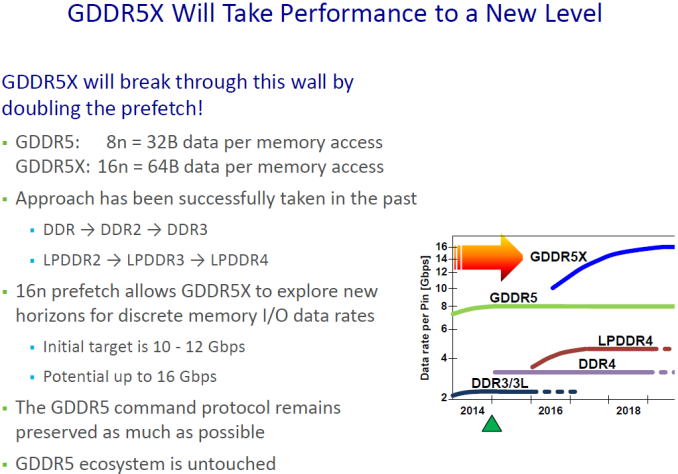
The key improvement of the GDDR5X standard compared to the predecessor is its all-new 16n prefetch architecture, which enables up to 512 bit (64 Bytes) per array read or write access. By contrast, the GDDR5 technology features 8n prefetch architecture and can read or write up to 256 bit (32 Bytes) of data per cycle. Doubled prefetch and increased data transfer rates are expected to double effective memory bandwidth of GDDR5X sub-systems. However, actual performance of graphics cards will depend not just on DRAM architecture and frequencies, but also on memory controllers and applications. Therefore, we will need to test actual hardware to find out actual real-world benefits of the new memory.

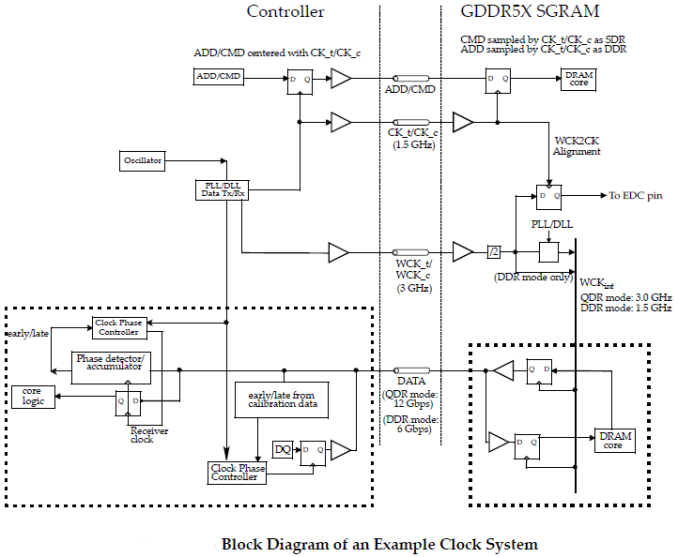
Just like the predecessor, GDDR5X functions with two different clock types – a differential command clock (CK) to where address and command inputs are referenced, as well as a forwarded differential write clock (WCK) where read and write data are referenced to. WCK runs at a frequency that is two times higher than the CK. The data can be transmitted at double data rate (DDR) or quad data rate (QDR) relative to the differential write clock (WCK), depending whether 8n prefetch or 16n prefetch architecture and protocols are used. Accordingly, if makers of chips manage to increase CK clock to 1.5 GHz, then data rate in QDR/16n mode will rise to 12 Gbps.
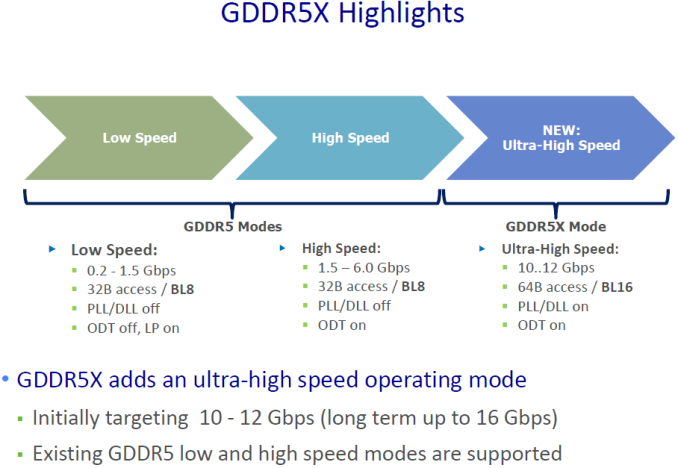
Since the GDDR5X protocol and interface training sequence are similar to those of the GDDR5, it should be relatively easy for developers of chips to adjust their memory controllers to the new type of memory. However, since the QDR mode (which is called Ultra High Speed mode in Micron’s materials) mandates usage of PLLs/DLLs (Phase Locked Loops, Delay Locked Loops), there will be certain design changes to design of high-end memory chips.
JEDEC’s GDDR5X SGRAM announcement discusses data rates from 10 to 14 Gbps, but Micron believes that eventually they could be increased to 16 Gbps. It is hard to say whether commercial chips will actually hit such data rates, keeping in mind that there are new types of memory incoming. However, even a 256-bit GDDR5X memory sub-systems running at 14 Gbps could provide up to 448 GBps of memory bandwidth, just 12.5% lower compared to that of AMD’s Radeon R9 Fury X (which uses first-gen HBM).

GPU Memory Math
  AMD Radeon
R9-290X
NVIDIA GeForce
GTX 980 Ti
NVIDIA GeForce
GTX 960
AMD Radeon
R9 Fury X
Samsung’s 4-Stack HBM2 based on 8 Gb DRAM Theoretical GDDR5X 256-bit
sub-system
Theoretical GDDR5X 128-bit
sub-system
Total Capacity 4 GB 6 GB 2 GB 4 GB 16 GB 8 GB 4 GB
B/W Per Pin 5 Gb/s 7 Gb/s 7 Gb/s 1 Gb/s 2 Gb/s 14 Gb/s 14 Gb/s
Chip capacity 2 Gb 4 Gb 4 Gb 1 GB 4 GB 1 GB
(8 Gb)
1 GB
(8 Gb)
No. Chips/Stacks 16 12 4 4 4 8 4
B/W Per Chip/Stack 20
GB/s
28
GB/s
28
GB/s
128
GB/s
256
GB/s
56
GB/s
56
GB/s
Bus Width 512-bit 384-bit 128-bit 4096-bit 4096-bit 256-bit 128-bit
Total B/W 320
GB/s
336
GB/s
112
GB/s
512
GB/s
1
TB/s
448
GB/s
224
GB/s
Estimated DRAM
Power Consumption
30 W 31.5 W 10 W 14.6 W n/a 20 W 10 W

Capacity Improvements

Performance was not the only thing that developers of the GDDR5X had to address. Many applications require not only high-performance memory, but a lot of high-performance memory. Increased capacities of GDDR5X chips will enable their adoption by broader sets of devices in addition to graphics/compute cards, game consoles and network equipment as well as other areas. Initially one would expect the high density configurations to be slightly conservative on frequency to begin with.

The GDDR5 standard covered memory chips with 512 Mb, 1 Gb, 2 Gb, 4 Gb and 8 Gb capacities. The GDDR5X standard defines devices with 4 Gb, 6 Gb, 8 Gb, 12 Gb and 16 Gb capacities. Typically, mainstream DRAM industry tends to double capacities of memory chips because of economic and technological reasons. However, with GDDR5X the industry decided to ratify SGRAM configurations with rather unusual capacities — 6Gb and 12Gb.

The mobile industry already uses LPDDR devices with 3 Gb, 6 Gb and 12 Gb capacities in a bid to maximize flexibility of memory configurations for portable electronics. As it appears, companies developing standards for graphics DRAM also wanted to capitalize on flexibility. A GDDR5X chip with 16 Gb capacity made using 20 nm or 16/18 nm process technology would have a rather large die size and thus high cost. However, the size and cost of a 12 Gb DRAM IC should be considerably lower and such a chip could arguably address broader market segments purely on cost.

Just like in case of the GDDR5, the GDDR5X standard fully supports clamshell mode, which allows two 32-bit memory chips to be driven by one 32-bit memory controller by sharing address and command bus while reducing the number of DRAM IC’s I/Os to 16. Such operation has no impact on system bandwidth, but allows doubling the amount of memory components per channel. For example, it should be theoretically possible to build a graphics card with 64 GB of GDDR5X using one GPU with a 512-bit memory bus as well as 32 16 Gb GDDR5X memory chips.

Unusual capacities will help GDDR5X to better address all market segments, including graphics cards, HPC (high performance computing), game consoles, network equipment and so on. However, it should be noted that the GDDR5X has extremely potent rival, the second-gen HBM, which offers a number of advantages, especially in the high-end segment of the graphics and HPC markets.

Energy Efficiency

Power consumption and heat dissipation are two major limiting factors of compute performance nowadays. When developing the GDDR5X standard, the industry implemented a number of ways to keep power consumption of the new graphics DRAM in check.

Supply voltage and I/O voltages of the GDDR5X were decreased from 1.5V on today’s high-end GDDR5 memory devices to 1.35V. Reduction of Vdd and Vddq should help to cut power consumption of the new memory by up to 10%, which is important for high-performance and mobile devices where the memory can take a sizable chunk of the available power budget.
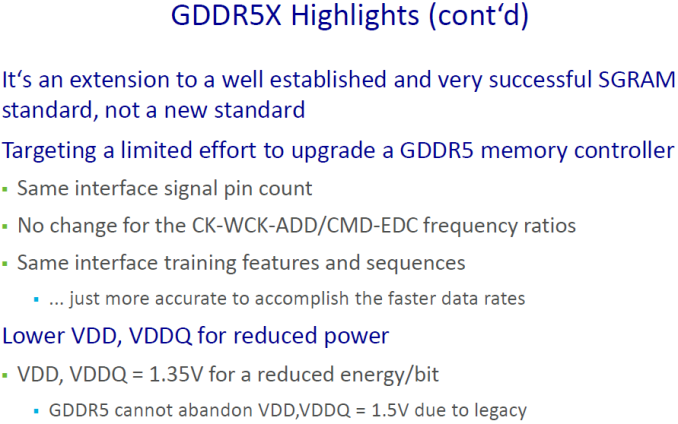
The reduction of supply and I/O voltages is not the only measure to cut power consumption of the new memory. The GDDR5X standard makes temperature sensor controlled refresh rate a compulsory feature of the technology, something that could help to optimize power consumption in certain scenarios. Moreover, there are a number of other features and commands, such as per-bank self refresh, hibernate self refresh, partial array self refresh and other, that were designed to shrink the energy consumption of the new SGRAM.

Due to lower voltages and a set of new features, power consumption of a GDDR5X chip should be lower compared to that of a GDDR5 chip at the same clock-rates. However, if we talk about target data rates of the GDDR5X, then power consumption of the new memory should be similar or slightly higher than that of GDDR5, according to Micron. The company says that GDDR5X’s power consumption is 2-2.5W per DRAM component and 10-30W per board. Even with similar/slightly higher power consumption compared to the GDDR5, the GDDR5X is being listed as considerably more energy efficient due to its improved theoretical performance.

We do not know specifications of next-generation graphics adapters (for desktops and laptops) from AMD and NVIDIA, but if developers of GPUs and DRAMs can actually hit 14 Gb/s data-rates with GDDR5X memory, they will double the bandwidth available to graphics processors vs GDDR5 without significantly increasing power consumption. Eventually, more efficient data-rates and unusual capacities of the GDDR5X could help to actually decrease power consumption of certain memory sub-systems.

Implementation

While internally a GDDR5X chip is different from a GDDR5 one, the transition of the industry to GDDR5X is a less radical step than the upcoming transition to the HBM (high-bandwidth memory) DRAM. Moreover, even the transition from the GDDR3/GDDR4 to the GDDR5 years ago was considerably harder than transition to the GDDR5X is going to be in the coming years.

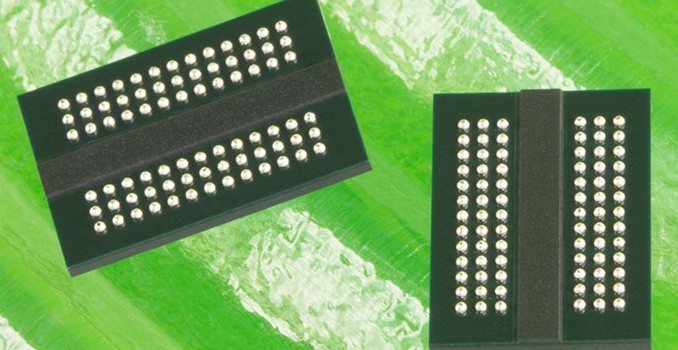
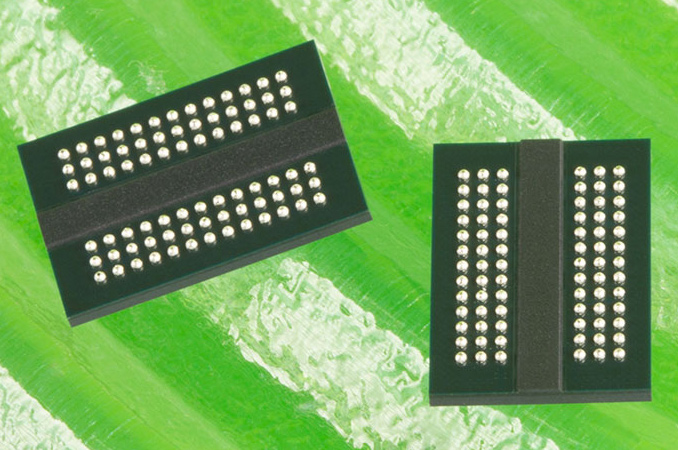
The GDDR5X-compliant memory chips will come in 190-ball grid array packaging (as compared to 170-ball packaging used for current GDDR5), thus, they will not be pin-to-pin compatible with existing GDDR5 ICs or PCBs for modern graphics cards. But while the GDDR5X will require development of new PCBs and upgrades to memory controllers, everything else works exactly like in case of the GDDR5: the interface signal training features and sequences are the same, error detection is similar, protocols have a lot of resemblances, even existing GDDR5 low and high speed modes are supported to enable mainstream and low-power applications. BGA packages are inexpensive, and they do not need silicon interposers nor use die-stacking techniques which HBM requires.

Implementation of GDDR5X should not be too expensive both from R&D and production perspectives; at least, this is something that Micron implied several months ago when it revealed the first details about the technology.

Industry Support

The GDDR5X is a JEDEC standard supported by its members. The JEDEC’s document covering the technology contains vendor IDs for three major DRAM manufacturers: Micron, Samsung and SK Hynix. Identification of the memory producers are needed for controllers to to differentiate between various vendors and different devices, and listing the memory makers demonstrates that they participated in development, considered features and balloted on them at JEDEC’s meetings, which may indicate their interest in supporting the technology. Unfortunately, exact plans for each of the companies regarding GDDR5X production are unknown, though we would expect GDDR5X parts to fit between the current GDDR5 high end and anything implementing HBM, or for implementing higher memory capacity on lower end GPUs. Micron plans to start mass production of its GDDR5X memory chips in mid-2016, so we might see actual GDDR5X-based memory sub-systems in less than six months from now.

NVIDIA, currently the world’s largest supplier of discrete graphics processors, said that that as a member of JEDEC it participates in the development of industry standards like GDDR5X. AMD is also a member of JEDEC and it usually plays a key role in development of memory standards. Both of these companies also employ compression algorithms to allieviate the stress on texture transfers between the GPU and memory, and thus an increase in bandwidth (as shown by Fiji) plus an increase in density can see benefits in texture rich or memory bound compute scenarios.

While specific plans of various companies regarding the GDDR5X are unclear, the technology has a great potential if the numbers are accurate (it has to be, it’s a standard) and has all chances to be adopted by the industry. The main rival of the GDDR5X, second-generation HBM, can offer higher bandwidth, lower power consumption and smaller form-factors, but at the cost of design and manufacturing complexities. In fact, what remains to be seen is whether the HBM and the GDDR5X will actually compete directly against each other or will just become two complementary types of memory. Different applications nowadays have different requirements, and an HBM memory sub-system with 1 TBps of bandwidth makes a perfect sense for a high-end graphics adapter. However mainstream video cards should work perfectly with GDDR5X, and chances are we will see both in play at different market focal points.