News


Amped Wireless Launches APOLLO IP Cameras and Updates Networking Lineup at CES
Amped Wireless Launches APOLLO IP Cameras and Updates Networking Lineup at CES

Amped Wireless is popular for marketing equipment with long range, high-performance power amplifiers and high-gain antennas. At CES, they had the usual updates to the networking lineup – new Wi-Fi routers and range extenders. In addition, they also announced their entry into the IP camera space with two Wi-Fi cameras.

The APOLLO IP Camera Lineup

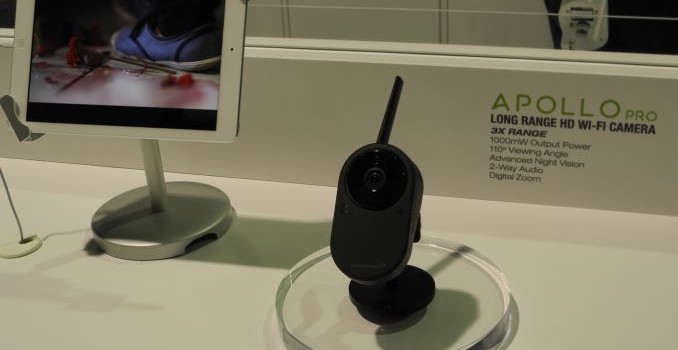
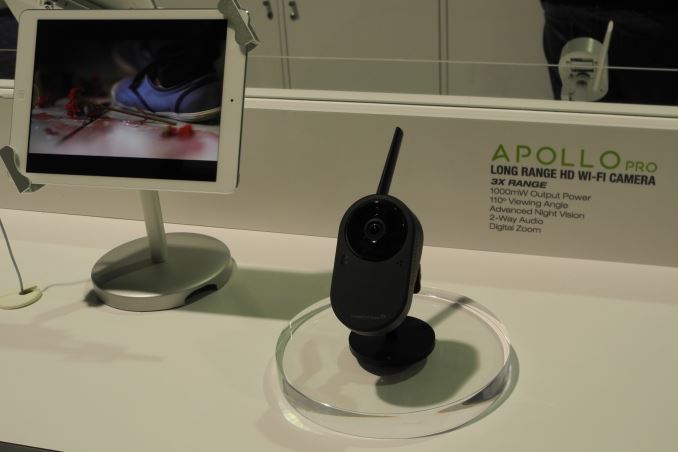
The lineup consists of two members, the APOLLO and the APOLLO PRO. They both have wireless capabilities. Amped Wireless claims that these models can be placed 3x the distance away compared to the average Wi-Ficamera. While the APOLLO will have a 80 degree viewing angle and a 1-way microphone, the APOLLO PRO will have a 110 degree viewing angle and 2-way microphone and speaker. Both cameras have a 720p resolution and night vision is available. The external 3.5dBi antenna is detachable on both models.

The setup as well as day to day operation is geared towards the average consumer by the usage of mobile apps and a cloud recording backend. The cameras are priced at $150 and $180 respectively, and will be available towards the end of this quarter.

ARTEMIS AC1300 Family

The ARTEMIS lineup of networking products includes a router, range extender (ARTEMIS-EX) and an access point (ARTEMIS-AP). Priced at $130, these products come with up to 5 GbE ports and a USB 3.0 port. MU-MIMO is supported out of the box, pointing to a Qualcomm Atheros platform.

Based on the specifications and the cost, it appears that the product line uses the IPQ40x8/x9 SoC.

ATHENA AC2600 Family

The ATHENA lineup includes the ATHENA-R2 router and the ATHENA-EX Wi-Fi extender, both with advanced MU-MIMO capabilities. Compared to the first generation MU-MIMO routers, this device can support up to four simultaneous MU-MIMO clients. It also supports 160 MHz channels.

Based on the specifications, it appears that the units are based on the QCA9984 radio. The SoC is not clear – as the brochure given to the press indicates a 1.3 GHz quad-core processor for the router (RTA2600-R2) and a dual-core processor for the range extender (RE2600M). Note that the Nighthawk X4S from Netgear which has the QCA9984 radio uses a 1.7GHz IPQ8065 SoC. The ATHENA router will be priced at $240, while the extender will be $220 when they launch at the end of this quarter.

REC22P Range Extender

This is an interesting product in the sense that it bundles a rapid charging USB Type-A port as well as a passthrough power outlet in the device. The range extender effectively doesn’t use up a wall outlet. It is a AC1200 device (867 Mbps in the 5 GHz and 300 Mbps in the 2.4 GHz – a 2×2 configuration).

The REC22P will be available in late February for $100.

The specifications of the various routers, access points and range extenders currently marketed by Amped Wireless are reproduced from the press brochure in the gallery below.

On the whole, it is pleasing to see Amped Wireless trying to move beyond the core networking devices (such as routers / access points / range extenders) and on to allied products such as IP cameras. For mass acceptance, IP cameras need to be backed up by good user experience, and Amped Wireless seems to be focusing more on that rather than the hardware specifications alone. On the core side, Amped Wireless seems to be all in on the Qualcomm Atheros platforms for their flagship ATHENA lineup and the ARTEMIS value play.

Amped Wireless Launches APOLLO IP Cameras and Updates Networking Lineup at CES

Amped Wireless Launches APOLLO IP Cameras and Updates Networking Lineup at CES

Amped Wireless is popular for marketing equipment with long range, high-performance power amplifiers and high-gain antennas. At CES, they had the usual updates to the networking lineup – new Wi-Fi routers and range extenders. In addition, they also announced their entry into the IP camera space with two Wi-Fi cameras.

The APOLLO IP Camera Lineup

The lineup consists of two members, the APOLLO and the APOLLO PRO. They both have wireless capabilities. Amped Wireless claims that these models can be placed 3x the distance away compared to the average Wi-Ficamera. While the APOLLO will have a 80 degree viewing angle and a 1-way microphone, the APOLLO PRO will have a 110 degree viewing angle and 2-way microphone and speaker. Both cameras have a 720p resolution and night vision is available. The external 3.5dBi antenna is detachable on both models.

The setup as well as day to day operation is geared towards the average consumer by the usage of mobile apps and a cloud recording backend. The cameras are priced at $150 and $180 respectively, and will be available towards the end of this quarter.

ARTEMIS AC1300 Family

The ARTEMIS lineup of networking products includes a router, range extender (ARTEMIS-EX) and an access point (ARTEMIS-AP). Priced at $130, these products come with up to 5 GbE ports and a USB 3.0 port. MU-MIMO is supported out of the box, pointing to a Qualcomm Atheros platform.

Based on the specifications and the cost, it appears that the product line uses the IPQ40x8/x9 SoC.

ATHENA AC2600 Family

The ATHENA lineup includes the ATHENA-R2 router and the ATHENA-EX Wi-Fi extender, both with advanced MU-MIMO capabilities. Compared to the first generation MU-MIMO routers, this device can support up to four simultaneous MU-MIMO clients. It also supports 160 MHz channels.

Based on the specifications, it appears that the units are based on the QCA9984 radio. The SoC is not clear – as the brochure given to the press indicates a 1.3 GHz quad-core processor for the router (RTA2600-R2) and a dual-core processor for the range extender (RE2600M). Note that the Nighthawk X4S from Netgear which has the QCA9984 radio uses a 1.7GHz IPQ8065 SoC. The ATHENA router will be priced at $240, while the extender will be $220 when they launch at the end of this quarter.

REC22P Range Extender

This is an interesting product in the sense that it bundles a rapid charging USB Type-A port as well as a passthrough power outlet in the device. The range extender effectively doesn’t use up a wall outlet. It is a AC1200 device (867 Mbps in the 5 GHz and 300 Mbps in the 2.4 GHz – a 2×2 configuration).

The REC22P will be available in late February for $100.

The specifications of the various routers, access points and range extenders currently marketed by Amped Wireless are reproduced from the press brochure in the gallery below.

On the whole, it is pleasing to see Amped Wireless trying to move beyond the core networking devices (such as routers / access points / range extenders) and on to allied products such as IP cameras. For mass acceptance, IP cameras need to be backed up by good user experience, and Amped Wireless seems to be focusing more on that rather than the hardware specifications alone. On the core side, Amped Wireless seems to be all in on the Qualcomm Atheros platforms for their flagship ATHENA lineup and the ARTEMIS value play.
G-Technology Demonstrates G-SPEED Shuttle XL Thunderbolt 2 DAS at CES

G-Technology Demonstrates G-SPEED Shuttle XL Thunderbolt 2 DAS at CES

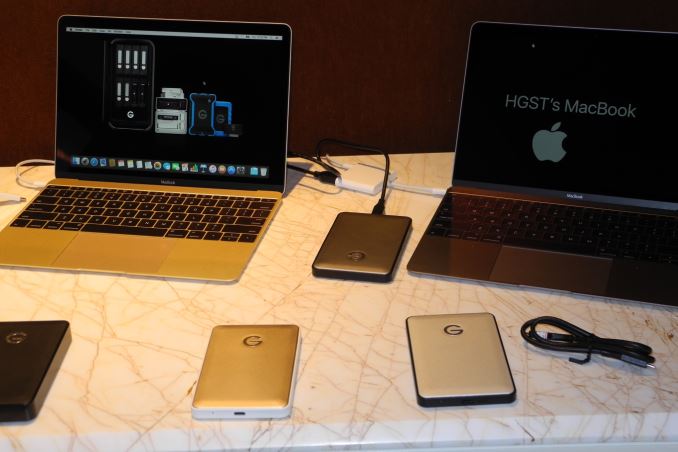
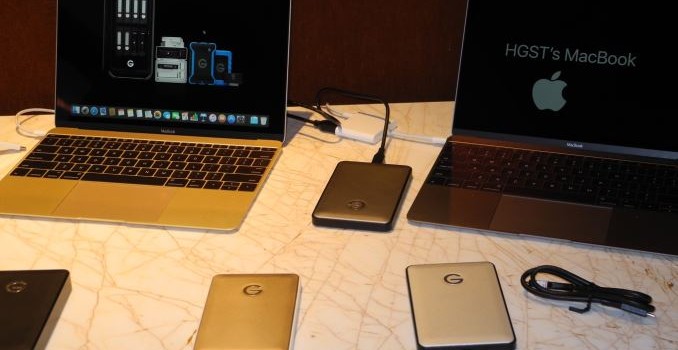
As part of every CES trip, I make it a point to visit G-Technology and see what they are introducing into the DAS (direct attached storage) market. This year, there were no major announcements except for the introduction of a Type-C interface for some of their external hard drives. These are still USB 3.0 drives, as there is not much to gain by moving to a USB 3.1 interface for hard drives. However, it must be noted that these 2.5″ drives are 7200 RPM ones providing that extra bit of performance compared to the 5400 RPM drives used by most vendors. G-Technology expects the 1TB version to have a MSRP of $130 when it launches in February.

Coming back to the more impressive part of my visit to the suite, G-Technology showed the various features of the G-SPEED Shuttle XL. This 8-bay hardware RAID solution comes with two Thunderbolt 2 ports. The platform itself is very similar to the G-SPEED Studio XL introduced by G-Technology at IBC 2015 in September. This product also has two ev Series Bay Adapters which enable support for the G-DRIVE ev modules. These modules can easily be swapped across different interface modules for use in rugged environments, or just for portability, or even with high-capacity arrays like the G-SPEED Studio / Shuttle XL.

The Shuttle XL can be oriented either vertically or horizontally. In the horizontal configuration, it can even be used as a stand for the notebook (to which it may connect). G-Technology also has an adapter for a RED MINI-MAG so that it can be read into the computer directly through the Shuttle XL. A RED MINI-MAG and a G-DRIVE ev SSD are shown connected to the Shuttle XL using the two ev Series Bay Adapters in the above picture. The Shuttle XL also has a custom-designed transportation case for portability across different work locations.

Claimed transfer rates are around 1350 MBps. The disks can be configured in RAID 0,1,5,6,10 and 50. The unit is sold with enterprise-class hard drives with pricing ranging from $3500 for 24TB to $8000 for 64TB. G-Technology provides a 3-year warranty for the product.

We saw LaCie launch a 8-bay Thunderbolt 2 1U rackmount unit, the 8big Rack Thunderbolt 2 a couple of years back. It is interesting to see G-Technology have a ‘portable’ take on the8-bay hardware RAID Thunderbolt 2 enclosure market.  From an end-user perspective, it is great to have both choices and one can let the usage model dictate the suitable solution.


G-Technology Demonstrates G-SPEED Shuttle XL Thunderbolt 2 DAS at CES

G-Technology Demonstrates G-SPEED Shuttle XL Thunderbolt 2 DAS at CES

As part of every CES trip, I make it a point to visit G-Technology and see what they are introducing into the DAS (direct attached storage) market. This year, there were no major announcements except for the introduction of a Type-C interface for some of their external hard drives. These are still USB 3.0 drives, as there is not much to gain by moving to a USB 3.1 interface for hard drives. However, it must be noted that these 2.5″ drives are 7200 RPM ones providing that extra bit of performance compared to the 5400 RPM drives used by most vendors. G-Technology expects the 1TB version to have a MSRP of $130 when it launches in February.

Coming back to the more impressive part of my visit to the suite, G-Technology showed the various features of the G-SPEED Shuttle XL. This 8-bay hardware RAID solution comes with two Thunderbolt 2 ports. The platform itself is very similar to the G-SPEED Studio XL introduced by G-Technology at IBC 2015 in September. This product also has two ev Series Bay Adapters which enable support for the G-DRIVE ev modules. These modules can easily be swapped across different interface modules for use in rugged environments, or just for portability, or even with high-capacity arrays like the G-SPEED Studio / Shuttle XL.

The Shuttle XL can be oriented either vertically or horizontally. In the horizontal configuration, it can even be used as a stand for the notebook (to which it may connect). G-Technology also has an adapter for a RED MINI-MAG so that it can be read into the computer directly through the Shuttle XL. A RED MINI-MAG and a G-DRIVE ev SSD are shown connected to the Shuttle XL using the two ev Series Bay Adapters in the above picture. The Shuttle XL also has a custom-designed transportation case for portability across different work locations.

Claimed transfer rates are around 1350 MBps. The disks can be configured in RAID 0,1,5,6,10 and 50. The unit is sold with enterprise-class hard drives with pricing ranging from $3500 for 24TB to $8000 for 64TB. G-Technology provides a 3-year warranty for the product.

We saw LaCie launch a 8-bay Thunderbolt 2 1U rackmount unit, the 8big Rack Thunderbolt 2 a couple of years back. It is interesting to see G-Technology have a ‘portable’ take on the8-bay hardware RAID Thunderbolt 2 enclosure market.  From an end-user perspective, it is great to have both choices and one can let the usage model dictate the suitable solution.


Zotac Updates ZBOX mini-PC Lineup at CES

Zotac Updates ZBOX mini-PC Lineup at CES

Zotac had announcements in multiple segments at CES. Obviously, the SSD entry was the big talking point with the PCIe variant boasting good performance numbers. Zotac also had a home automation announcement, the Cozee Smart Home Kit. The lineup will have ZigBee sensors, an IP camera and a gateway.The hardware and software / apps are not final and still being worked on. Therefore, I will postpone detailed coverage of that announcement and concentrate on the updates made by Zotac in the mini-PC space in this article.

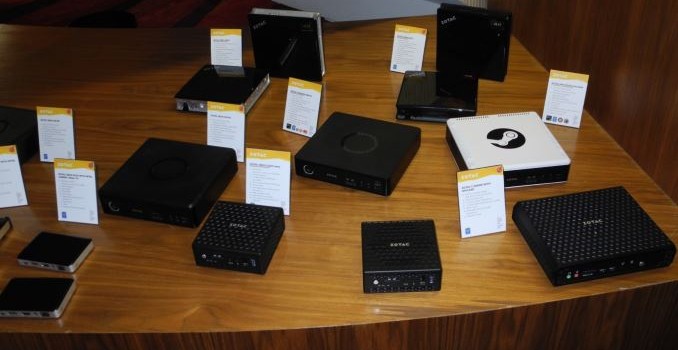
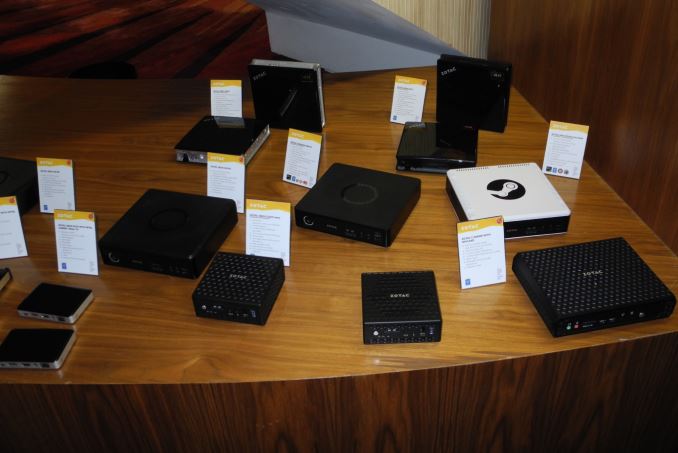
Zotac had all their mini-PC models neatly arranged out in their suite. These included models such as the Steam Machine NEN that was announced back in November and the MI551 Skylake mini-PC announced last month. The number of models made my head swim (in a good way). In order to help navigate the available models, Zotac provided the press with a table which lists various features and the models that support them. The list is reproduced in the picture below. More information about the models that launched at CES is available below the picture. Pricing for these units is not available yet.

C-Series with Skylake

We reviewed almost all of the Zotac C-series PCs that started appearing in the market towards the end of 2014. Using the Y-series processors in a fanless chassis, they provided very good performance for users looking for compact and silent solutions. With Skylake, Zotac is going for a slightly larger and heavier solution, but the platform will support higher TDP CPUs (Skylake-U). The currently planned specifications are as below:

  • Intel Core i5-6300U
  • Intel HD Graphics 520
  • 2.5″ SATA slot
  • 2x DDR3L-1600 SODIMM
  • USB 3.1 Type-C
  • Dual GbE LAN, 802.11ac Wi-Fi, BT 4.0
  • DisplayPort and HDMI

The gallery below provides some pictures of the chassis.

The Skylake C-Series is at least a quarter away from launch. So, it is possible that specifications might change before it comes to the market.

PC Stick

We reviewed the Cherry Trail Compute Stick recently, and Zotac’s version has a slight variation. The USB 3.0 port in the Intel Cherry Trail Compute Stick is replaced by a 10/100 Mbps LAN port. Other than that, all the specifications are the same.

  • Intel Atom x5-Z8300
  • Intel HD Graphics
  • 32GB eMMC, 2GB DDR3L RAM
  • 1x USB 2.0, 1x microSD
  • 10/100 Mbps RJ-45 and 802.11ac Wi-Fi, BT 4.0
  • HDMI output (male)

The gallery below provides some pictures of the exterior:

Gallery: Zotac PC Stick

ZBOX MA761 and ZBOX EA740

These two products have similar specifications, but target different market segments. The MA761 has 6 DisplayPort outputs and targets the digital signage market. The EA740 has 3 DisplayPort outputs and targets the gaming market (similar to the EN970 that we reviewed last year) All the other specifications (including the GPU model) are the same.

  • Intel Core i3-6100T
  • AMD Radeon R9 M365X with 2GB GDDR5
  • 2x DDR3L-1600 SODIMM
  • 2.5″ SATA and a M.2 SSD slot
  • USB 3.0 Type-C
  • SDXC UHS-II card reader
  • Dual GbE LAN, 802.11ac Wi-Fi, BT 4.0

The gallery below provides some pictures of the chassis of both units:

ZBOX EI751

The EI751 is the follow-up product to the ZBOX EI750, one of the Haswell Crystal Well-based mini-PCs equipped with Iris Pro graphics. The EI751 makes the move from Haswell to Broadwell while retaining an Iris Pro-equipped SKU. The full specifications are provided below:

  • Intel Core i7-5775R
  • Intel Iris Pro Graphics 6200
  • 2x DDR3L-1866 SODIMM
  • 2.5″ SATA and a mSATA slot
  • SDXC card reader
  • Dual GbE LAN, 802.11ac Wi-Fi, BT 4.0
  • 2x Display Port, DVI-D (Single Link)

The gallery below provides some pictures of the exterior:

ZBOX PICO with Cherry Trail T3 & T4

The platforrm is similar to that of the PC Stick mentioned before (i.e, a Cherry Trail tablet board, but, in a pocket-sized form factor). The only difference is the chassis design and the availability of some extra display and I/O ports. The full specifications are provided below:

  • Intel Atom x5-Z8300 (T3) / Intel Atom x7-Z8700 (T4)
  • Intel HD Graphics
  • 32GB eMMC, 2GB LPDDR3
  • 3x USB 2.0 (T3), 3x USB 3.0 – (2x Type-A + 1x Type-C) (T4)
  • 10/100 Mbps RJ-45 (T3) / 1 GbE RJ45 (T4)
  • 802.11ac, BT 4.0
  • HDMI, DisplayPort
  • microSD Slot
  • Windows 10 Home Preinstalled

The gallery below shows the chassis of the Pico x7 (T4)

At CES, Zotac announced mini-PC models targeting every segment in the market space – from gaming enthusiasts to users looking for silent and compact HTPCs. They have, without doubt, the widest mini-PC lineup in the whole industry. It is hardly surprising, given that their ZBOX nano xs mini-PCs had come to the market even before the first Intel NUC. We are looking forward to having some of the announced units in for review over the next few months.