News


Intel Reports Q4 FY 2015 Results: Record Revenue For Q4
Intel Reports Q4 FY 2015 Results: Record Revenue For Q4

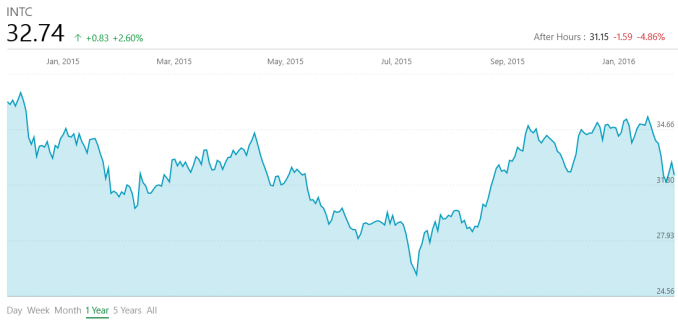
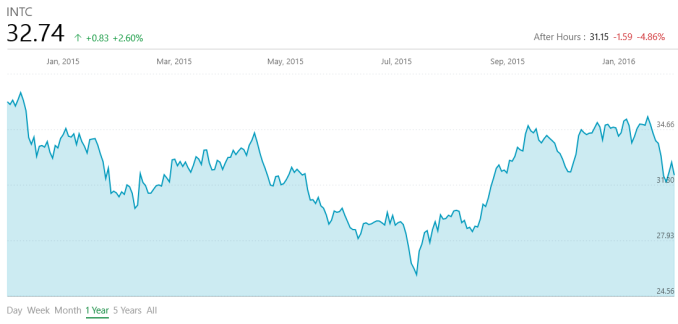
Today Intel announced their earnings for the fourth quarter of fiscal year 2015. The year ended strong, with record revenues of $14.9 billion. This is up 1% of Q4 of 2014, and up 3% over last quarter. Intel’s margins did drop a 1.1%, but are still a healthy 64.3% for the quarter. Operating income for the last quarter of the year was $4.3 billion, and net income came in at $3.6 billion. These results are down 3$ and 1% respectively, compared to Q4 of 2014. Earnings per share was flat at $0.74 per share.

For the full fiscal year 2015, revenues were $55.4 billion, which is down 1% compared to 2014. Gross margin was down 1.1% to 62.6% for the year. Operating income was $14.0 billion, down 9% compared to 2014, and net income was down 2% to $11.4 billion.

Intel Q4 2015 Financial Results (GAAP)
  Q4’2015 Q3’2015 Q4’2014
Revenue $14.9B $14.5B $14.7B
Operating Income $4.3B $4.2B $4.4B
Net Income $3.6B $3.1B $3.6B
Gross Margin 64.3% 63.0% 65.4%
Client Computing Group Revenue $8.8B +3% -1%
Data Center Group Revenue $4.3B +4% +5%
Internet of Things Revenue $625M +8% +6%
Software and Services Revenue $543M -2% -3%
All Other Revenue $682M flat +11%

For the full year, Intel’s largest division, the Client Computing Group, was down 8% in revenue to $32.2 billion, but for Q4 2015 the group was down just 1% year-over-year. Intel is currently shipping 14 nm parts based on Skylake, and as of November, 14 nm parts made up over 50% of the Client Computing Group’s unit sales. The move to 14 nm has been pretty slow by Intel’s standards, and even many of the Skylake chips are in short supply still, but Intel did say that yields have improved to the point where they feel they have an oversupply at the moment so hopefully some of the high demand parts find their way to retailers for stock. With the drop in the overall PC market, it’s not too surprising that this group has dropped, but although total device numbers have dropped, average selling price has increased.

Intel’s record revenue came from the Data Center group, which had record revenue for FY 2015 of $16.0 billion, up 11% compared to 2014. For the quarter, Data Center revenue grew 5% year-over-year to $4.3 billion. The move to cloud computing is going to drive some growth here, and offset some of the weakness in the PC market for companies like Intel. Margins are generally better in this group, so it is less difficult to offset the PC drop with a high margin area like Data Center. Intel is pretty much unchallenged in this space for a lot of computing needs, at least at the moment. There was some struggle in China’s market, but the overall market was enough to overcome this.

Internet of Things also had record revenue for the fiscal year. For FY 2015, this segment’s revenue was up 7% to $2.3 billion. It’s still pretty small potatoes compared to the other segments of Intel, but this is one area where they are keen to not fall behind ARM like they did in the mobile space. There is a lot of room for growth here, although it’s going to be at a much lower margin than Intel is accustomed to. For Q4, this division grew 6% year-over-year to $625 million.

Software and Services, which consists of products like McAfee Antivirus, was down 2% for the full year to $2.2 billion. For Q4, revenues were down 3% compared to Q4 2014, coming in at $543 million.

The final segment is Non-Volatile Memory Solutions, and for 2015 this segment had record full-year revenue, up 21% compared to 2014. Unfortunately, Intel does not break this out individually, but it on the conference call they announced revenues of $2.6 billion for FY 2015. Intel announced their 3D X-Point memory, and shipments should start later this year.

For the full year, Intel paid $7.6 billion back to shareholders, with $4.6 billion in dividends and $3.0 billion used to repurchase stock. Intel has announced an increase in dividends to $1.04-per-share on an annual basis.

Intel also announced that they have completed the acquisition of Altera and they took on about $9.5 billion in debt to finance this.

Looking towards FY 2016, Intel is expecting mid to high single digit revenue growth as a percentage compared to 2015, which is an increase over their guidance issued in November. This increase is being attributed to the FPGA business which they have just acquired through Altera. Gross margin is expected to be 63%.

Source: Intel Investor Relations

CES 2016: MSI’s Vortex Gaming PC on Display and It Looks Almost Like a Mac Pro

CES 2016: MSI’s Vortex Gaming PC on Display and It Looks Almost Like a Mac Pro

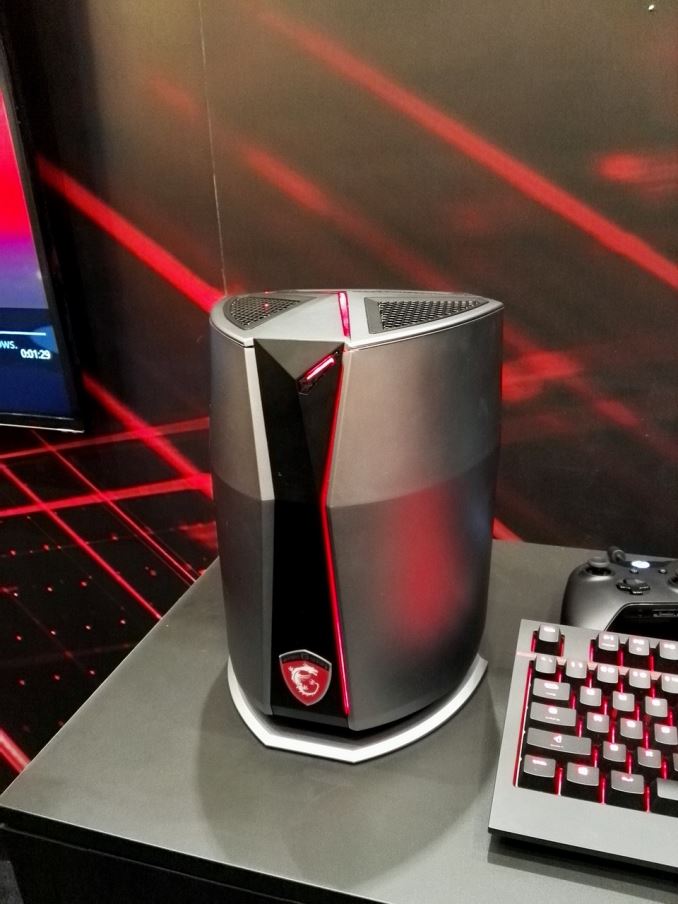
One of the most interesting PC designs to come out in recent years was that of the Mac Pro. Sure, it looked like a cylinder into which one might throw discarded objects, or its size/power limitations has meant it can’t extend into that high end workstation that some users require, but in terms of performance per liter, it caused quite a stir. Well it turns out that MSI has done something similar, but this time focused on the gaming community.

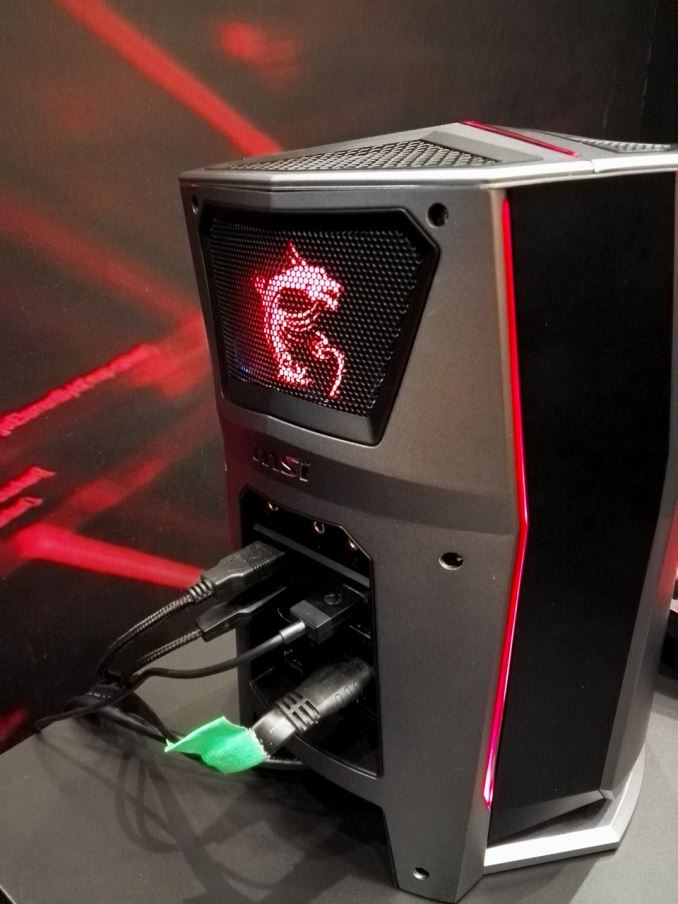
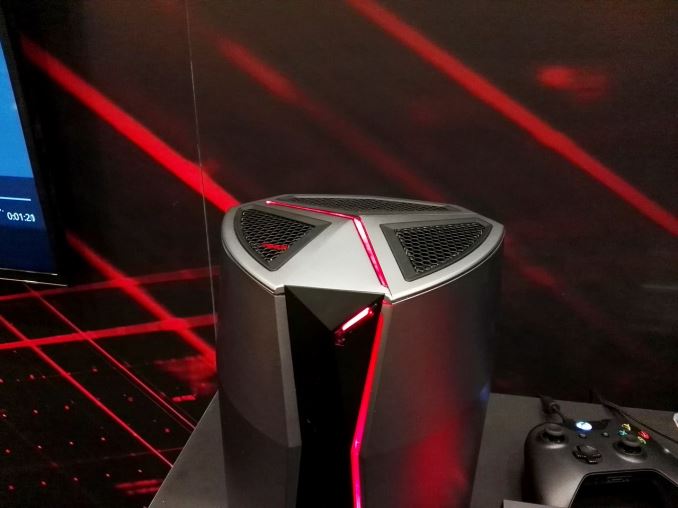
The Vortex isn’t new for CES, and there have been murmurings and images floating around for a while, although I must admit it has not been on my radar as of late and it wasn’t even mentioned when I visited MSI’s headquarters last year during Computex. But the design is similar to the Mac Pro – a custom internal design with one CPU and two GPUs in a triangle arrangement, sharing a heatsink arrangement that uses a single fan to extract the heat generated. I was told that the final designs would feature SLI configurations using GTX 960s, GTX 980s and GTX 980 Tis, and I would assume at this point there would be a high end Intel CPU using the Z170 chipset (because you can’t get SLI on other chipsets).

Connectivity is also similar to the Apple product, in that we have multiple Thunderbolt chips in play. These are combined with HDMI 2.0 to give three displays or users can daisy chain out to hubs and storage. The device looks plastic, but I am told is actually a thin metal despite that fact it also feels like plastic. But regardless of the material, the design is fetching for a ‘mini’ gaming machine. It is about the same size as the Mac Pro, and is stepped up from the ground to give an entry point for air to be drawn up through the device.

Because the fan is on top blowing up, there is no real fan filter to speak of. I postulated to MSI that my cat might sit on the top because it is warm, or during extended periods of ‘off’ time that dust would fall in and settle. I was told it shouldn’t be an issue, but the engineer did have a good think about it. If MSI have done all their work internally, it shouldn’t be too difficult for them to create a professional variant of this with ECC and FirePro/Tesla cards in an aluminium chassis for the prosumer ground.

I would like to get some hands on with the internals, and have requested a test unit along with the VR headset they were promoting alongside it, just to see how far a machine this size could push some of the more demanding VR titles. On pricing, if they do intend putting in dual GTX 980 Tis, we could easily see the top model push $1600-$2000, depending on the other internals.

CES 2016: MSI’s Vortex Gaming PC on Display and It Looks Almost Like a Mac Pro

CES 2016: MSI’s Vortex Gaming PC on Display and It Looks Almost Like a Mac Pro

One of the most interesting PC designs to come out in recent years was that of the Mac Pro. Sure, it looked like a cylinder into which one might throw discarded objects, or its size/power limitations has meant it can’t extend into that high end workstation that some users require, but in terms of performance per liter, it caused quite a stir. Well it turns out that MSI has done something similar, but this time focused on the gaming community.

The Vortex isn’t new for CES, and there have been murmurings and images floating around for a while, although I must admit it has not been on my radar as of late and it wasn’t even mentioned when I visited MSI’s headquarters last year during Computex. But the design is similar to the Mac Pro – a custom internal design with one CPU and two GPUs in a triangle arrangement, sharing a heatsink arrangement that uses a single fan to extract the heat generated. I was told that the final designs would feature SLI configurations using GTX 960s, GTX 980s and GTX 980 Tis, and I would assume at this point there would be a high end Intel CPU using the Z170 chipset (because you can’t get SLI on other chipsets).

Connectivity is also similar to the Apple product, in that we have multiple Thunderbolt chips in play. These are combined with HDMI 2.0 to give three displays or users can daisy chain out to hubs and storage. The device looks plastic, but I am told is actually a thin metal despite that fact it also feels like plastic. But regardless of the material, the design is fetching for a ‘mini’ gaming machine. It is about the same size as the Mac Pro, and is stepped up from the ground to give an entry point for air to be drawn up through the device.

Because the fan is on top blowing up, there is no real fan filter to speak of. I postulated to MSI that my cat might sit on the top because it is warm, or during extended periods of ‘off’ time that dust would fall in and settle. I was told it shouldn’t be an issue, but the engineer did have a good think about it. If MSI have done all their work internally, it shouldn’t be too difficult for them to create a professional variant of this with ECC and FirePro/Tesla cards in an aluminium chassis for the prosumer ground.

I would like to get some hands on with the internals, and have requested a test unit along with the VR headset they were promoting alongside it, just to see how far a machine this size could push some of the more demanding VR titles. On pricing, if they do intend putting in dual GTX 980 Tis, we could easily see the top model push $1600-$2000, depending on the other internals.

The Silver Lining of the Late AMD Opteron A1100 Arrival

The Silver Lining of the Late AMD Opteron A1100 Arrival

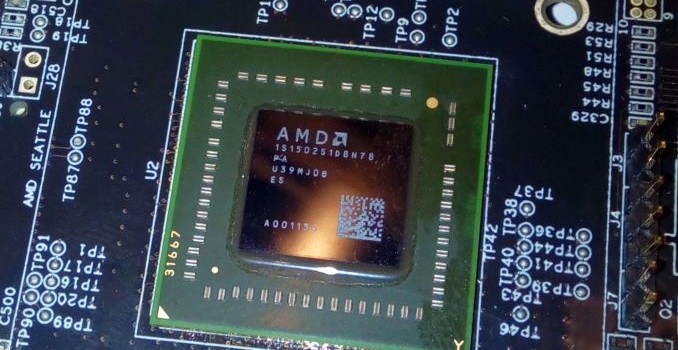
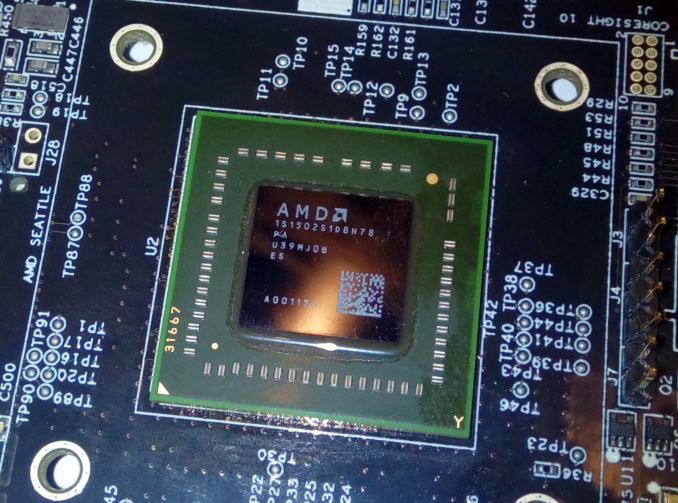
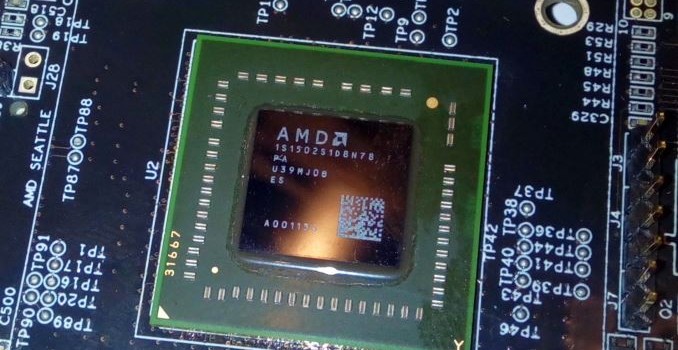
AMD announced their ARM server SoC plans at the end of 2012. At the beginning of 2014, AMD was ready “to accelerate the ARM Server Ecosystem with the first ARM-based server SoC” with a development kit. Around March 2014, the A1100 SoCs  started sampling. But the quad core dev kits were not only expensive ($3000!), they also had quite a bit of teething problems as performance did not meet expectations, some of the peripheral hardware did not work properly  and the software ecosystem was far from ready. We were expecting to see Opteron A1100 based servers at the end of 2014, but instead we got more than a year of almost complete silence. Frustratingly long for anyone who was hoping that AMD would finally bring something competitive to the server world.

Today, AMD is finally announcing that their Octal core Opteron A1100 server SoC and platform is fully ready, “a right sized option for the edge of the datacenter”. A few smaller partners are even shipping it but there is no sign of tier 1 OEMs yet. Most people following this part of the semiconductor part are thinking “too little, too late”. We are pretty sure that includes you, dear reader. But there is more than meets the eye or we would not bother to write this article. 

The Silver Lining of the Late AMD Opteron A1100 Arrival

The Silver Lining of the Late AMD Opteron A1100 Arrival

AMD announced their ARM server SoC plans at the end of 2012. At the beginning of 2014, AMD was ready “to accelerate the ARM Server Ecosystem with the first ARM-based server SoC” with a development kit. Around March 2014, the A1100 SoCs  started sampling. But the quad core dev kits were not only expensive ($3000!), they also had quite a bit of teething problems as performance did not meet expectations, some of the peripheral hardware did not work properly  and the software ecosystem was far from ready. We were expecting to see Opteron A1100 based servers at the end of 2014, but instead we got more than a year of almost complete silence. Frustratingly long for anyone who was hoping that AMD would finally bring something competitive to the server world.

Today, AMD is finally announcing that their Octal core Opteron A1100 server SoC and platform is fully ready, “a right sized option for the edge of the datacenter”. A few smaller partners are even shipping it but there is no sign of tier 1 OEMs yet. Most people following this part of the semiconductor part are thinking “too little, too late”. We are pretty sure that includes you, dear reader. But there is more than meets the eye or we would not bother to write this article.