

News


Compulab Rolls-Out Passively-Cooled Airtop Systems

Compulab Rolls-Out Passively-Cooled Airtop Systems

Compulab, a maker of miniature and small form-factor computers, is introducing its first desktop system called Airtop today. The new computer can be equipped with rather high-performance components, but is completely fanless and only uses the company’s proprietary natural air-flow (NAF) cooling technology.

Compulab’s Airtop is a compact 7.5-liter desktop system that can dissipate up to 200W of heat using only passive cooling methods. The Airtop utilizes various industry-standard components and can be configured as a gaming PC, a server or a workstation. The system is based on a proprietary motherboard featuring Intel’s C226 platform controller hub (PCH) designed specifically for the Airtop with NAF cooling. The mainboard places CPU socket, DIMM slots, PCI Express x16 slot and other components in a way to enable the most efficient dissipation of heat. To eliminate hot components from the case, the Airtop uses an external PSU with a mini-DIN connector.

The proprietary Airtop mainboard is compatible with Intel Core i7 and Intel Xeon E3 v4 microprocessors based on Intel’s Haswell or Broadwell micro-architectures (LGA1150 packaging) as well as various graphics cards, including NVIDIA’s GeForce GTX 950 and Quadro M4000.

The Airtop can be equipped with up to 32 GB of DDR3-1866 memory, four 2.5-inch Serial ATA HDDs/SSDs, one M.2 solid-state drive and one mSATA solid-state drive. The system features two Gigabit Ethernet network controllers (four more may be added using an extension card), a 802.11ac Wi-Fi card with two SIM card sockets, four SMA antennas, four USB 3.0 ports on rear panel, six USB 2.0 ports in total, three RS232 ports, multi-channel audio and so on. While the system utilizes its own mainboard, all the other components are industry-standard and can be upgraded when and if needed.

The NAF heat-exchange system uses two special side-panels, each of which can dissipate up to 100W of heat. The side-panels are equipped with traditional flat copper heat-pipe arrays (with micro-channels) that take away heat from the hottest components (i.e., the CPU and the GPU) and spread it across the side-panel. The heat from the heat-pipe arrays is removed by the special air-tube panels consisting of 14 tubes with air inside. Once the air gets hot, it starts to rise up, removing heat from the side panels (see Compulab’s video for details). Everything happens naturally (via convection) and completely silently. The air tubes are open on both ends and efficiency of convection depends on the movement of air through them. For efficient cooling, owners of Compulab’s Airtop will have to ensure that the tubes are not clogged with dust, which is common in industrial and other environments.

While Compulab’s Airtop is in many ways unique, it reminds us of Zalman’s TNN 500 and TNN 300 fanless cases released about a decade ago. Those cases were considerably bigger and acted like giant heatsinks with a lot of heat-pipes inside, but they combined the same cooling techniques as the Airtop.

Compulab claims that it took years to develop the NAF heat-exchange technology and three years to design the Airtop system. Right now, the desktop is only compatible with previous-generation Intel microprocessors and does not support modern technologies like NVMe or USB 3.1, but eventually the company could develop a more advanced motherboard for the latest-generation Skylake and the upcoming Kaby Lake chips in LGA1151 packaging.

The Airtop is relatively small, its dimensions are 10 cm (w) x 30 cm (h) x 25.5 cm (d) – 4” (w) x 12” (h) x 10” (d). The weight of the PC depends on configuration and can be between 4 and 7 kilograms.

The Compulab Airtop is available as a pre-configured system or as a barebone SFF PC for DIY enthusiasts. Since the system is unique and uses numerous components designed specifically for the Airtop, it naturally is not affordable. The Airtop barebone costs $1128, the Airtop-S passively-cooled server (featuring the Intel Xeon E3-1285L v4 CPU) starts at $1810, the Airtop-G gaming PC (with the Intel Core i7-5775C and the NVIDIA GeForce GTX 950 graphics card) is priced at $1968, whereas the Airtop-W workstation (with Intel’s Xeon E3-1285L v4 chip and NVIDIA’s Quadro M4000 graphics adapter) costs $2999. The systems will be available in Q1 2016.

Compulab Rolls-Out Passively-Cooled Airtop Systems

Compulab Rolls-Out Passively-Cooled Airtop Systems

Compulab, a maker of miniature and small form-factor computers, is introducing its first desktop system called Airtop today. The new computer can be equipped with rather high-performance components, but is completely fanless and only uses the company’s proprietary natural air-flow (NAF) cooling technology.

Compulab’s Airtop is a compact 7.5-liter desktop system that can dissipate up to 200W of heat using only passive cooling methods. The Airtop utilizes various industry-standard components and can be configured as a gaming PC, a server or a workstation. The system is based on a proprietary motherboard featuring Intel’s C226 platform controller hub (PCH) designed specifically for the Airtop with NAF cooling. The mainboard places CPU socket, DIMM slots, PCI Express x16 slot and other components in a way to enable the most efficient dissipation of heat. To eliminate hot components from the case, the Airtop uses an external PSU with a mini-DIN connector.

The proprietary Airtop mainboard is compatible with Intel Core i7 and Intel Xeon E3 v4 microprocessors based on Intel’s Haswell or Broadwell micro-architectures (LGA1150 packaging) as well as various graphics cards, including NVIDIA’s GeForce GTX 950 and Quadro M4000.

The Airtop can be equipped with up to 32 GB of DDR3-1866 memory, four 2.5-inch Serial ATA HDDs/SSDs, one M.2 solid-state drive and one mSATA solid-state drive. The system features two Gigabit Ethernet network controllers (four more may be added using an extension card), a 802.11ac Wi-Fi card with two SIM card sockets, four SMA antennas, four USB 3.0 ports on rear panel, six USB 2.0 ports in total, three RS232 ports, multi-channel audio and so on. While the system utilizes its own mainboard, all the other components are industry-standard and can be upgraded when and if needed.

The NAF heat-exchange system uses two special side-panels, each of which can dissipate up to 100W of heat. The side-panels are equipped with traditional flat copper heat-pipe arrays (with micro-channels) that take away heat from the hottest components (i.e., the CPU and the GPU) and spread it across the side-panel. The heat from the heat-pipe arrays is removed by the special air-tube panels consisting of 14 tubes with air inside. Once the air gets hot, it starts to rise up, removing heat from the side panels (see Compulab’s video for details). Everything happens naturally (via convection) and completely silently. The air tubes are open on both ends and efficiency of convection depends on the movement of air through them. For efficient cooling, owners of Compulab’s Airtop will have to ensure that the tubes are not clogged with dust, which is common in industrial and other environments.

While Compulab’s Airtop is in many ways unique, it reminds us of Zalman’s TNN 500 and TNN 300 fanless cases released about a decade ago. Those cases were considerably bigger and acted like giant heatsinks with a lot of heat-pipes inside, but they combined the same cooling techniques as the Airtop.

Compulab claims that it took years to develop the NAF heat-exchange technology and three years to design the Airtop system. Right now, the desktop is only compatible with previous-generation Intel microprocessors and does not support modern technologies like NVMe or USB 3.1, but eventually the company could develop a more advanced motherboard for the latest-generation Skylake and the upcoming Kaby Lake chips in LGA1151 packaging.

The Airtop is relatively small, its dimensions are 10 cm (w) x 30 cm (h) x 25.5 cm (d) – 4” (w) x 12” (h) x 10” (d). The weight of the PC depends on configuration and can be between 4 and 7 kilograms.

The Compulab Airtop is available as a pre-configured system or as a barebone SFF PC for DIY enthusiasts. Since the system is unique and uses numerous components designed specifically for the Airtop, it naturally is not affordable. The Airtop barebone costs $1128, the Airtop-S passively-cooled server (featuring the Intel Xeon E3-1285L v4 CPU) starts at $1810, the Airtop-G gaming PC (with the Intel Core i7-5775C and the NVIDIA GeForce GTX 950 graphics card) is priced at $1968, whereas the Airtop-W workstation (with Intel’s Xeon E3-1285L v4 chip and NVIDIA’s Quadro M4000 graphics adapter) costs $2999. The systems will be available in Q1 2016.

Conexant Announces New Audio Processing Solutions At CES

Conexant Announces New Audio Processing Solutions At CES

At CES, Conexant gave me a demo of some of the audio processing technology that they’ve been working on. Conexant is a company that probably has their technology in a product you own without you knowing it, and they focus a lot on SoCs for doing audio processing in everything from TVs, to smartphones, to IoT devices.

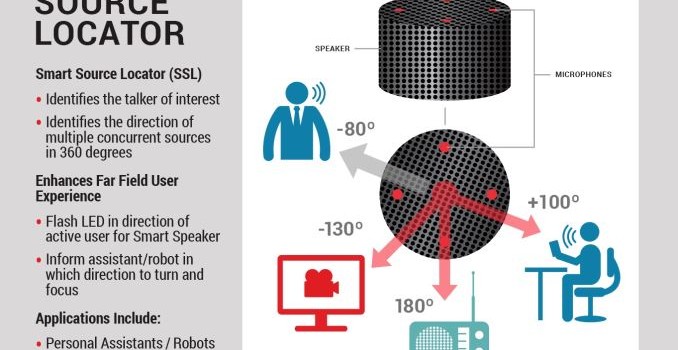
One of the most interesting demos shown by Conexant is of their 4 microphone voice system to provide 360 degree direction detection. The company’s CX20924 DSP enables this, and in their demo it worked quite well regardless of the angle you were at, and it even worked properly with multiple users speaking at the same time. While many devices can do this kind of detection, they often require arrays with 6-8 microphones, which can be cost prohibitive. Conexant claims that the system can work at a range of up to five meters, and it’s able to tune out background noise in order to properly interpret your voice. This system could be used to drive down the cost of voice-activated devices by reducing the amount of hardware needed, and in my mind I can think of products like the Amazon Echo being brought to lower price points without sacrificing functionality.

The second major announcement from Conexant is their CX20926 audio and sensor SoC. The chip consists of a Cortex M0+, along with Conexant’s own audio DSP for voice processing. This chip is aimed at IoT applications and other battery powered devices like smartphones where a vendor is looking to implement always-on voice detection with minimal idle power consumption.

The last announcement from Conexant is their RoomAware Optimizer sound processing for televisions. This feature has been included on LG’s 2016 OLED and QD TVs, under the name Magic Sound Tuning. The technology uses microphones to analyze the acoustic characteristics of the room in order to tune the sound produced by the TV’s speakers. While I wasn’t able to get a demo of this feature, the fact that Conexant has already gotten adoption from LG shows that there’s clearly interest in this type of tech from manufacturers and consumers.

CES 2016: MSI’s Golden Idea for Motherboards

CES 2016: MSI’s Golden Idea for Motherboards

The problem with a gold motherboard color is that it often looks too much like copper, and several companies have tried it in recent years (ASUS on Z77, ECS’ Golden Series) with limited success. Back during Z77 launch, one group of users seems t…

CES 2016: Deepcool’s Genome is a Water Cooling Equipped Case with a Helix Reservoir

CES 2016: Deepcool’s Genome is a Water Cooling Equipped Case with a Helix Reservoir

We’ve dealt with closed loop liquid coolers for computer processors for the best part of five years now, and there are users different sides of the fence regarding their utility, ease-of-use or performance. There are chassis being designed with these CLLCs in mind, such that users have enough space to cool multiple CPUs or GPUs with plenty of mounting points. Deepcool, via their brand Gamer Storm, had a case on display designed to fit their specific cooler which aims more towards the aesthetic of the boring black CLLCs we have had up to this point.

The cooler has an additional stage compared to other CLLCs, with a combination waterblock/pump, a triple 120mm radiator and then a helix shaped reservoir. The whole arrangement is designed to fit only in the Genome chassis, with the helix proudly on display on the outside, and the top of the chassis designed to accommodate the radiator.

For example here we have the white Genome chassis with a limited edition ASUS Z97 Mark S motherboard (read our review here) and white Avexir DRAM specifically built for the motherboard. I pointed out to Deepcool that here the CPU block and pipes should be white as well, to which they produced a model with that in mind but it wasn’t ready to be installed. The CPU block/pump has a design which splits them into semi-modular parts that allows Deepcool’s design team to avoid patent issues and produce new models in the future which can be an upgrade of one or the other.

I was told by Deepcool that the block has a variety of mounting mechanisms for all the major sockets, but they are currently working on an updated version to make it easier.

The chassis itself is an ATX case with a special area at the front of the case to give more room for cable routing but also for airflow. There is a bracket that can be removed for super long GPUs, and due to the design SSDs and HDDs are mounted at the bottom with the power supply.

I tell you what, the design is simple and effective. I have seen this sort of helix reservoir before so Deepcool is not unique in this, but the cooler and chassis is designed to be sold as a set in various color combinations yet to be decided. The price at retail for both should be around the $250 mark, which really puts $150-$180 in the triple-radiator cooler (with fans) and $70-$100 in the case.