News


Toshiba’s DynaPad Tablet to Hit Stores in Late January
Toshiba’s DynaPad Tablet to Hit Stores in Late January

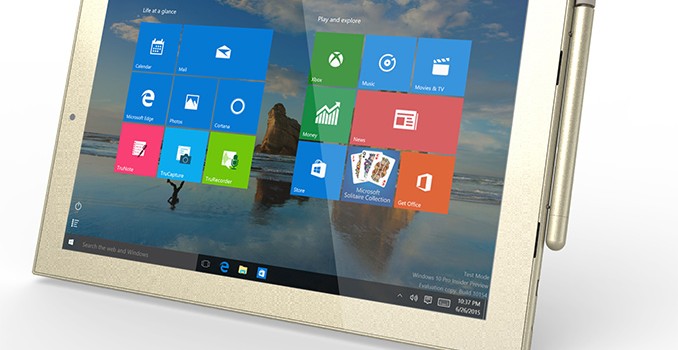
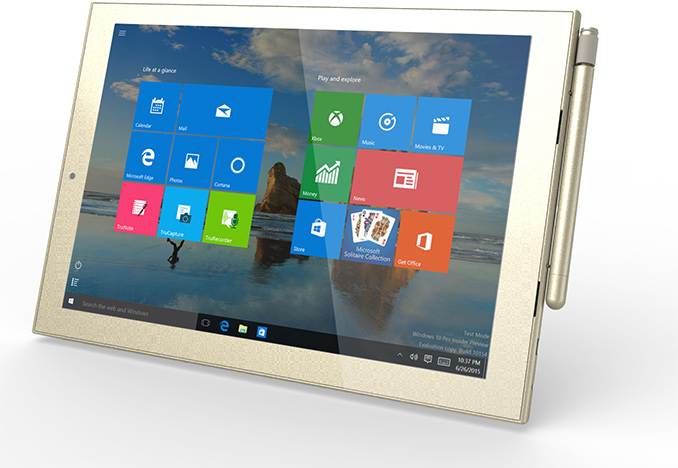
Toshiba showcased its ultra-thin dynaPad tablet in September, 2015, at IFA in Berlin, Germany, and then formally introduced it in mid-October. At the International CES 2016, the company finally revealed that the dynaPad will hit the U.S. market later this month. Toshiba says that its new 12-inch tablet is among the thinnest Windows 10-based devices of such kind.

The Toshiba dynaPad tablet features a 12-inch display with 1920×1280 resolution, which is covered with Corning’s Gorilla Glass 3 as well as with a special anti-fingerprint coating. The device is equipped with Toshiba’s active electrostatics (ES) stylus with Wacom Feel technology that supports 2048 levels of pressure sensitivity. The digitizer pen can last for more than 1000 hours on one charge and can be used for note taking, sketching and drawing. In addition, Toshiba offers a special keyboard dock for its dynaPad, which can be used to convert the slate into a laptop.

The dynaPad tablet from Toshiba uses Microsoft Windows 10 operating system and is based on the Intel Atom x5 Z8300 system-on-chip (four cores, 2MB cache, 1.44 GHz – 1.84 GHz clock-rate, built-in Intel HD Graphics core with 12 execution units, 2 W thermal design power, 14 nm process technology). The SoC of the dynaPad is similar to that used by Microsoft’s Surface 3, but it runs at a lower frequency and thus has lower performance.

Toshiba’s dynaPad also comes with up to 4 GB of DDR3L RAM, up to 64 GB of NAND flash storage, Wi-Fi (802.11ac) and Bluetooth 4.0 wireless technologies, a 2 MP front-facing and an 8 MP back-facing cameras, various sensors and so on. The dynaPad sports two micro USB 2.0 ports, a microSD card slot and a micro HDMI port for connecting to external displays. Toshiba yet has to reveal precise specifications and configurations of its dynaPad.

The new tablet from Toshiba weighs 580 grams (1.28 pounds) and measures about 6.9 mm (0.27 inch) thin. When the keyboard is attached, the weight increases to around 1000 grams (2.2 pounds). Toshiba has not released precise details about battery life of its new tablet.

Toshiba plans to start selling its dynaPad online and at Microsoft Stores in late January. The most affordable version will cost $569.99.
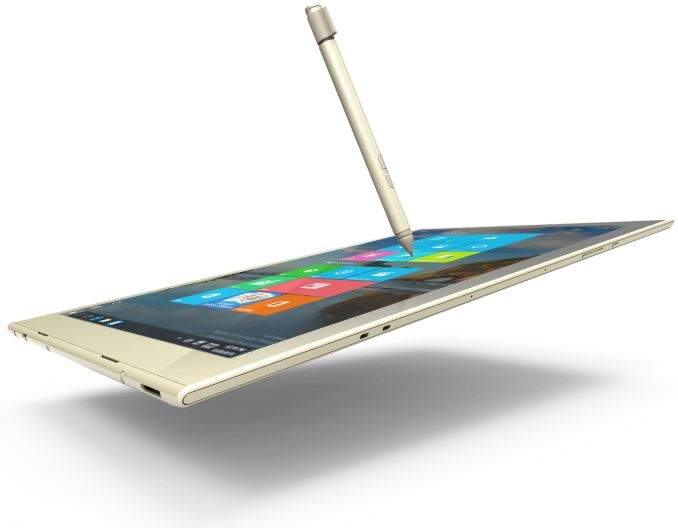
The Toshiba dynaPad looks like a relatively powerful solution for various tasks usually performed on tablets. It has a fine 12-inch display and comes with a digitizer pen. By contrast, Microsoft’s Surface 3 sports a 10.1-inch screen and does not come with a stylus (it has to be bought separately). Moreover, Toshiba’s tablet is also thinner and lighter than Microsoft’s Surface 3. In fact, thickness is the dynaPad is similar to that of Apple’s iPad Pro, which also has a 12-inch display, but the latter weighs considerably more (713 grams, 1.572 pounds).

Even though Toshiba has been trying to refocus its PC business and concentrate on business and enterprise customers, it continues to release consumer devices that look very interesting, at least, on paper. The dynaBook with its rather low weight, relatively low price, advanced stylus and decent capabilities looks like a viable rival not only for Microsoft’s Surface 3, but also for Apple’s iPad Air and iPad Pro.

Seagate Updates DAS Portfolio at CES 2016

Seagate Updates DAS Portfolio at CES 2016

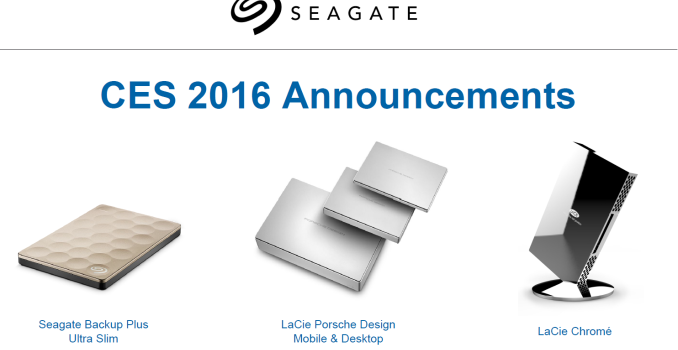
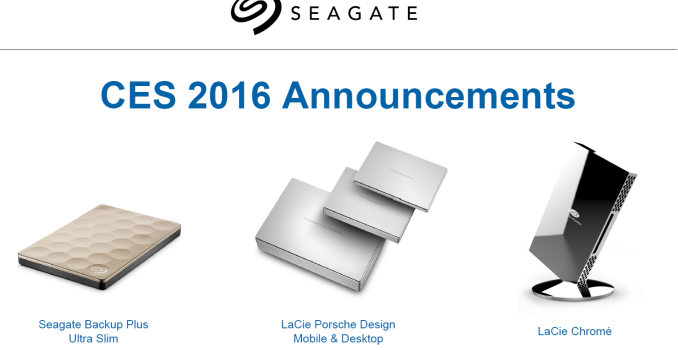
Seagate has announced four new DAS (direct attached storage) products at CES 2016. Three of them target the premium / luxury market under the LaCie brand name.

  • Seagate Backup Plus Ultra Slim USB 3.0 bus-powered external hard drive
  • LaCie Porsche Design USB 3.0 Type-C bus-powered external hard drive (mobile model)
  • LaCie Porsche Design USB 3.0 Type-C external hard drive (desktop model) with power delivery
  • LaCie Chrome USB 3.1 Type-C external SSD

The LaCie Chrome USB 3.1 Type-C external SSD is easily the most impressive announcement of the four.
Obviously, one of the key points of the LaCie products is the striking industrial design, and the Chrome is no exception.

The product contains two 512GB M.2 SATA SSDs in RAID-0 (effective user capacity is 1TB). It can support data rates of up to 940 MBps, thanks to the integrated ASMedia ASM1352R dual SATA to USB 3.1 Gen 2 bridge chip.

Seagate touts the aluminium enclosure, efficient triple cooling system, magnetized cable management (it is similar to the 2big Thunderbolt 2 product in this respect) and a removable magnetized display stand as unique features for this product.

It must be noted that the Chrome does need an external power connector (understandable due to the need to power two M.2 SSDs). The above gallery shows us the various external aspects of the Chrome unit.
The unit will retail for $1100 and be available later this quarter.

The LaCie Porsche Design USB 3.0 Type-C external hard drives have a new industrial design for the aluminium enclosure and come with a Type-C connector. Other than that, there is nothing too striking about them. The desktop model needs external power, but, it also does power delivery over its Type-C port (making it ideal for devices like the MacBook). Both the Mobile and Desktop versions come with an USB Type-A to USB Type-C cable also (in addition to the Type-C to Type-C cable). This enables compatibility with a wider variety of systems.

The Mobile version comes in 1TB, 2TB and 4TB capacities, starting at $110. The Desktop Drive comes in 4TB, 5TB and 8TB capacities, starting at $210.

Rounding up the product launches is the Seagate Backup Plus Ultra Slim. It is a 2.5″ hard drive, and the firmware features are similar to the Seagate Backup Plus we reviewed last August. This implies the integration of a Seagate Dashboard for providing more features compared to a standard external hard drive. The device also comes with 200GB of OneDrive cloud storage valid for two years. It is also compatible with the Lyve photo management software.

The technically interesting aspects include the 9.6mm thickness (Seagate indicated that it is the thinnest external hard drive in its capacity class in the market right now). It comes in 1TB and 2TB capacities with a two-platter design. Cross-platform compatibility is enabled by a free Paragon driver download (enabling Macs to read drives formatted in NTFS and Windows PCs to read drives formatted in HFS+).

The Seagate Backup Plus Ultra Slim comes in 1TB and 2TB capacities. We don’t have pricing details yet, but, availability is slated for later this quarter.

Seagate Updates DAS Portfolio at CES 2016

Seagate Updates DAS Portfolio at CES 2016

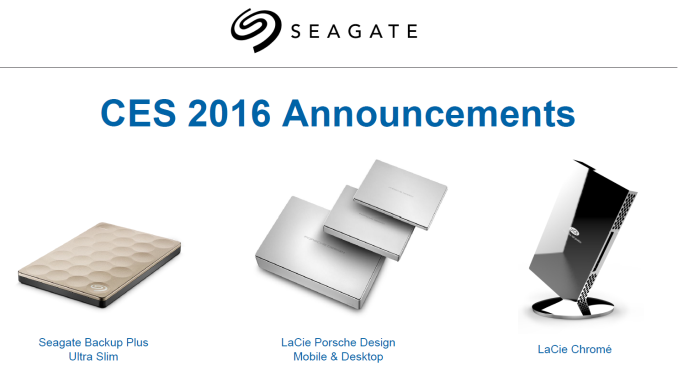
Seagate has announced four new DAS (direct attached storage) products at CES 2016. Three of them target the premium / luxury market under the LaCie brand name.

  • Seagate Backup Plus Ultra Slim USB 3.0 bus-powered external hard drive
  • LaCie Porsche Design USB 3.0 Type-C bus-powered external hard drive (mobile model)
  • LaCie Porsche Design USB 3.0 Type-C external hard drive (desktop model) with power delivery
  • LaCie Chrome USB 3.1 Type-C external SSD

The LaCie Chrome USB 3.1 Type-C external SSD is easily the most impressive announcement of the four.
Obviously, one of the key points of the LaCie products is the striking industrial design, and the Chrome is no exception.

The product contains two 512GB M.2 SATA SSDs in RAID-0 (effective user capacity is 1TB). It can support data rates of up to 940 MBps, thanks to the integrated ASMedia ASM1352R dual SATA to USB 3.1 Gen 2 bridge chip.

Seagate touts the aluminium enclosure, efficient triple cooling system, magnetized cable management (it is similar to the 2big Thunderbolt 2 product in this respect) and a removable magnetized display stand as unique features for this product.

It must be noted that the Chrome does need an external power connector (understandable due to the need to power two M.2 SSDs). The above gallery shows us the various external aspects of the Chrome unit.
The unit will retail for $1100 and be available later this quarter.

The LaCie Porsche Design USB 3.0 Type-C external hard drives have a new industrial design for the aluminium enclosure and come with a Type-C connector. Other than that, there is nothing too striking about them. The desktop model needs external power, but, it also does power delivery over its Type-C port (making it ideal for devices like the MacBook). Both the Mobile and Desktop versions come with an USB Type-A to USB Type-C cable also (in addition to the Type-C to Type-C cable). This enables compatibility with a wider variety of systems.

The Mobile version comes in 1TB, 2TB and 4TB capacities, starting at $110. The Desktop Drive comes in 4TB, 5TB and 8TB capacities, starting at $210.

Rounding up the product launches is the Seagate Backup Plus Ultra Slim. It is a 2.5″ hard drive, and the firmware features are similar to the Seagate Backup Plus we reviewed last August. This implies the integration of a Seagate Dashboard for providing more features compared to a standard external hard drive. The device also comes with 200GB of OneDrive cloud storage valid for two years. It is also compatible with the Lyve photo management software.

The technically interesting aspects include the 9.6mm thickness (Seagate indicated that it is the thinnest external hard drive in its capacity class in the market right now). It comes in 1TB and 2TB capacities with a two-platter design. Cross-platform compatibility is enabled by a free Paragon driver download (enabling Macs to read drives formatted in NTFS and Windows PCs to read drives formatted in HFS+).

The Seagate Backup Plus Ultra Slim comes in 1TB and 2TB capacities. We don’t have pricing details yet, but, availability is slated for later this quarter.

HTC Unveils the Vive Pre Dev Kit

HTC Unveils the Vive Pre Dev Kit

Today HTC has taken the wraps off of the second generation version of the HTC Vive. As you probably know, the HTC Vive is a virtual reality head-mounted display designed and made jointly by HTC and Valve. The consumer launch date for the Vive Pre has been pushed back a couple times now, but certain developers have had access to developer versions of the headset for some time now in order to develop new titles for it or work on adapting existing ones. The new Vive Pre is the second version of the Vive developer kit, and it comes with a number of improvements that bring the Vive closer toward its eventual commercial launch which will be occurring this year.

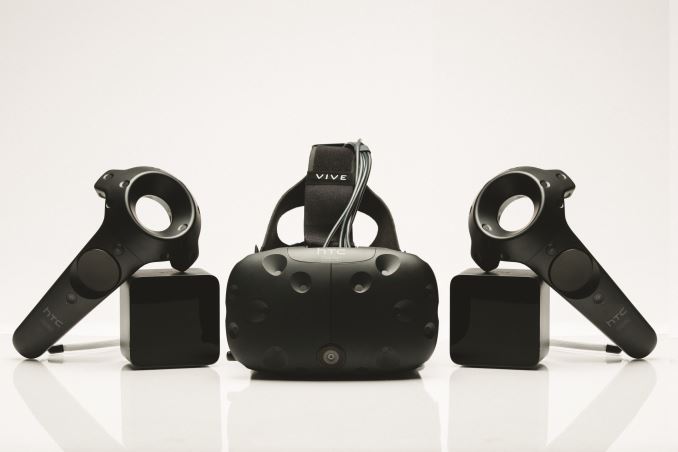
The Vive Pre makes some notable additions to the earlier version. First and foremost are the improvements to ergonomics. According to HTC, the headset has basically been redesigned from the ground up to be more compact and fit more comfortably onto your head while also being more stable. The displays have been made brighter and refinements to the entire display and lens stack have improved clarity over the existing model. Finally, there has been a front camera added to the headset. This may seem strange at first, but what the camera allows for is augmented reality experiences where a feed of the real world can be shown to the user and illusions can be projected onto that space by the headset.

As for the controllers, the design has been overhauled to make them more ergonomic. The buttons have been textured to make them easier to find, and the trigger has been changed to a dual stage switch which allows for interactions with multiple states, such as holding or squeezing something. There’s also haptic feedback to go along with interactions, and this is something that can really help the experience when implemented in a proper and subtle manner. Finally, the tracking stations for the controllers have been made smaller and more precise.

I had a chance to try the new Vive Pre earlier, and it marked my first experience with a virtual reality headset, with the exception of the Nintendo Virtual Boy. While I can’t make any statements that compare the new Vive to the old dev kit or to other VR headsets like the Oculus Rift, I can say that the experience with the headset and the controllers was unlike anything I’ve experienced before. The demo consisted of a virtual environment that simulated some of the challenges one would encounter when climbing Mount Everest. It included very theatrical sweeping shots where you looked over the mountains as though you were flying in the air or riding on a helicopter, as well as interactive segments that simulated crossing over a large pit, and climbing up a ladder.

What amazed me was how quickly I forgot about the fact that I was just in a hotel room wearing a rather large helmet and holding some controllers, and I found myself too frightened to look right over the edge of a cliff, and felt a strange feeling when I climbed the ladder as though I was nervous with my increasing height, even though I knew very well that I was standing on the floor the entire time. Head tracking latency was also very low, and to be honest the only thing that ever took me out of the experience was the limited resolution of the displays. That’s a technology issue that will be improved with time, but even with that barrier to total immersion the experience is still extremely compelling and unlike anything else.

As of right now, the HTC Vive is scheduled to launch commercially in April of this year. Whether or not that date will be pushed back again is unknown, but what I can say is that I think the Vive and other VR headsets will have been worth the wait. 

HTC Unveils the Vive Pre Dev Kit

HTC Unveils the Vive Pre Dev Kit

Today HTC has taken the wraps off of the second generation version of the HTC Vive. As you probably know, the HTC Vive is a virtual reality head-mounted display designed and made jointly by HTC and Valve. The consumer launch date for the Vive Pre has been pushed back a couple times now, but certain developers have had access to developer versions of the headset for some time now in order to develop new titles for it or work on adapting existing ones. The new Vive Pre is the second version of the Vive developer kit, and it comes with a number of improvements that bring the Vive closer toward its eventual commercial launch which will be occurring this year.

The Vive Pre makes some notable additions to the earlier version. First and foremost are the improvements to ergonomics. According to HTC, the headset has basically been redesigned from the ground up to be more compact and fit more comfortably onto your head while also being more stable. The displays have been made brighter and refinements to the entire display and lens stack have improved clarity over the existing model. Finally, there has been a front camera added to the headset. This may seem strange at first, but what the camera allows for is augmented reality experiences where a feed of the real world can be shown to the user and illusions can be projected onto that space by the headset.

As for the controllers, the design has been overhauled to make them more ergonomic. The buttons have been textured to make them easier to find, and the trigger has been changed to a dual stage switch which allows for interactions with multiple states, such as holding or squeezing something. There’s also haptic feedback to go along with interactions, and this is something that can really help the experience when implemented in a proper and subtle manner. Finally, the tracking stations for the controllers have been made smaller and more precise.

I had a chance to try the new Vive Pre earlier, and it marked my first experience with a virtual reality headset, with the exception of the Nintendo Virtual Boy. While I can’t make any statements that compare the new Vive to the old dev kit or to other VR headsets like the Oculus Rift, I can say that the experience with the headset and the controllers was unlike anything I’ve experienced before. The demo consisted of a virtual environment that simulated some of the challenges one would encounter when climbing Mount Everest. It included very theatrical sweeping shots where you looked over the mountains as though you were flying in the air or riding on a helicopter, as well as interactive segments that simulated crossing over a large pit, and climbing up a ladder.

What amazed me was how quickly I forgot about the fact that I was just in a hotel room wearing a rather large helmet and holding some controllers, and I found myself too frightened to look right over the edge of a cliff, and felt a strange feeling when I climbed the ladder as though I was nervous with my increasing height, even though I knew very well that I was standing on the floor the entire time. Head tracking latency was also very low, and to be honest the only thing that ever took me out of the experience was the limited resolution of the displays. That’s a technology issue that will be improved with time, but even with that barrier to total immersion the experience is still extremely compelling and unlike anything else.

As of right now, the HTC Vive is scheduled to launch commercially in April of this year. Whether or not that date will be pushed back again is unknown, but what I can say is that I think the Vive and other VR headsets will have been worth the wait.