News


ASUS Announces February Launch For The ZenFone Zoom
ASUS Announces February Launch For The ZenFone Zoom

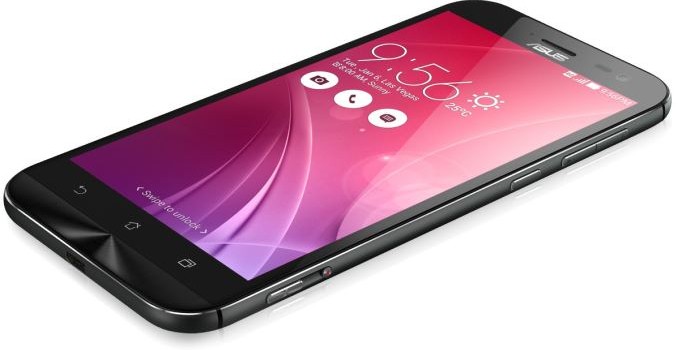
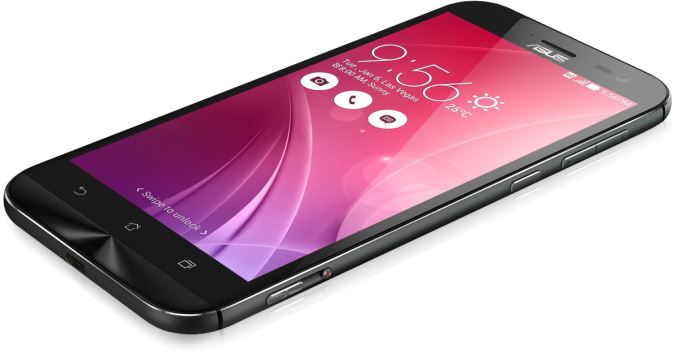
Today at CES ASUS showcased their upcoming ZenFone Zoom, and confirmed that it will be coming to the United States this February. ASUS has teased the ZenFone Zoom a couple of times, and most notably showed it at IFA last year. It was also mentioned during their CES keynote last year, and so it has taken quite some time for it to get to market. Just as a refresher, you can find the ZenFone Zoom’s specs in the table below.

  ZenFone Zoom
SoC Intel Atom Z3580/Z3590 Quad Core 2.3/2.5GHz
PowerVR G6430 GPU
RAM 4GB LPDDR3
NAND 64/128GB NAND
Display 5.5” 1080p
IPS
Network 2G / 3G / 4G LTE (Category 4 LTE)
Dimensions 158.9 x 78.84 x 5-11.9mm, 185g
Camera 13MP Rear Facing, 3x optical zoom, 28-84mm
F/2.7-F/4.8, OIS
5MP Front Facing
Battery 3000 mAh (11.4 Whr)
OS Android 5.1 w/ ZenUI
Connectivity 802.11a/b/g/n/ac + BT 4.0, USB2.0, GPS/GNSS, NFC
SIM 1 x MicroSIM
Launch Price $399 (Z3580/64GB)

The ZenFone Zoom is very similar to the ZenFone 2 as far as the internal specs go. In the 128GB model there is a bump in clock speed, as the SoC moves from Atom Z3580 to Z3590, but the phone remains the same otherwise. Obviously the big attraction is the rear-facing camera with optical zoom. It’s not clear exactly which camera sensor is used in the ZenFone Zoom, but I wouldn’t be surprised to find that it’s the same Toshiba sensor from the ZenFone 2. I hope that ASUS has put a lot of work into improving their camera processing from the state it was in on the ZenFone 2, as hardware has never really been the issue with photo quality on ASUS devices.

The ZenFone Zoom will be launching in the United States this February, with a starting price of $399 for the 64GB model. Pricing for the 128GB model with the Z3590 SoC is currently unknown.
ASUS Announces February Launch For The ZenFone Zoom

ASUS Announces February Launch For The ZenFone Zoom

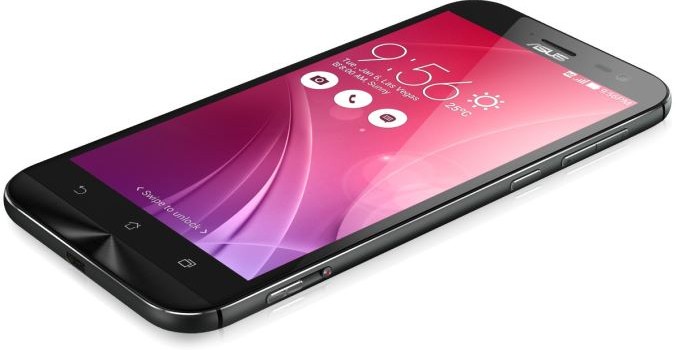
Today at CES ASUS showcased their upcoming ZenFone Zoom, and confirmed that it will be coming to the United States this February. ASUS has teased the ZenFone Zoom a couple of times, and most notably showed it at IFA last year. It was also mentioned during their CES keynote last year, and so it has taken quite some time for it to get to market. Just as a refresher, you can find the ZenFone Zoom’s specs in the table below.

  ZenFone Zoom
SoC Intel Atom Z3580/Z3590 Quad Core 2.3/2.5GHz
PowerVR G6430 GPU
RAM 4GB LPDDR3
NAND 64/128GB NAND
Display 5.5” 1080p
IPS
Network 2G / 3G / 4G LTE (Category 4 LTE)
Dimensions 158.9 x 78.84 x 5-11.9mm, 185g
Camera 13MP Rear Facing, 3x optical zoom, 28-84mm
F/2.7-F/4.8, OIS
5MP Front Facing
Battery 3000 mAh (11.4 Whr)
OS Android 5.1 w/ ZenUI
Connectivity 802.11a/b/g/n/ac + BT 4.0, USB2.0, GPS/GNSS, NFC
SIM 1 x MicroSIM
Launch Price $399 (Z3580/64GB)

The ZenFone Zoom is very similar to the ZenFone 2 as far as the internal specs go. In the 128GB model there is a bump in clock speed, as the SoC moves from Atom Z3580 to Z3590, but the phone remains the same otherwise. Obviously the big attraction is the rear-facing camera with optical zoom. It’s not clear exactly which camera sensor is used in the ZenFone Zoom, but I wouldn’t be surprised to find that it’s the same Toshiba sensor from the ZenFone 2. I hope that ASUS has put a lot of work into improving their camera processing from the state it was in on the ZenFone 2, as hardware has never really been the issue with photo quality on ASUS devices.

The ZenFone Zoom will be launching in the United States this February, with a starting price of $399 for the 64GB model. Pricing for the 128GB model with the Z3590 SoC is currently unknown.
Samsung Introduces Portable SSD T3

Samsung Introduces Portable SSD T3

In recent years a new category of portable storage devices has emerged. Based on the same controllers and flash used in 2.5″ SATA SSDs, portable SSDs offer much higher performance and capacities than typical of USB thumb drives. The use of SATA to USB3 bridge chips allows portable SSDs to be used with almost any devices, as opposed to relying on the rare eSATA standard. Most portable SSDs also support the USB Attached SCSI Protocol (UASP) to cut down on the overhead relative to a direct SATA connection. Portable SSDs usually can’t match the performance of their SATA counterparts, but they are closer to the native performance than to normal thumb drive speeds.

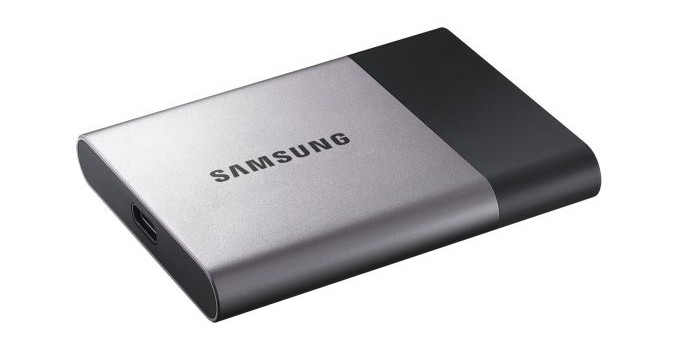
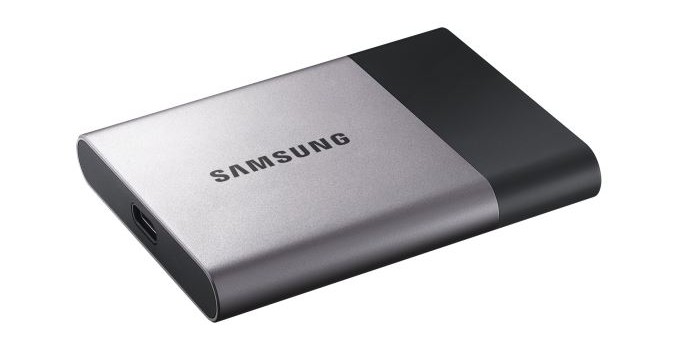
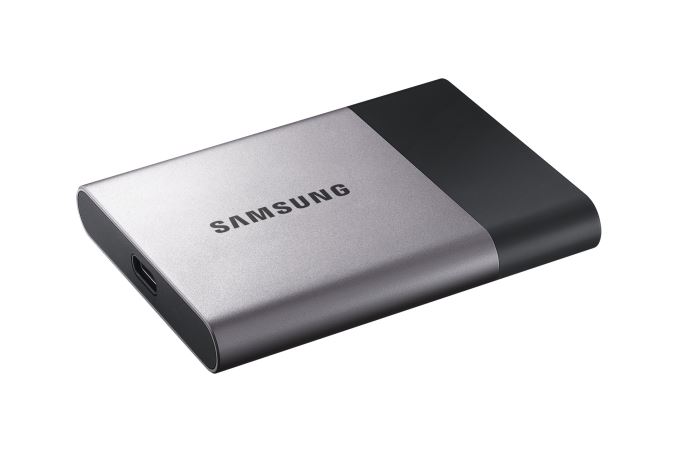
At last year’s CES, Samsung introduced their Portable SSD T1, their first foray into this market. This year they’ve got a successor, the Portable SSD T3. Externally, the biggest difference is that the T3 switches to a metal case from the black plastic of the T1. This doubles the overall mass, bringing it up to 51 grams. The T3 also adopts the reversible Type C USB port, replacing the T1’s micro USB 3 Type B port. The T3 includes a Type C to Type A cable.

We don’t have much information on what’s changed internally. The T1 used the same controller and TLC 3D NAND as the 850 EVO. After the launch of the T1, the 850 EVO and Pro product lines gained 2TB models thanks to Samsung’s newer MHX controller, which expanded the amount of RAM that could be accessed and allowed the drives to manage twice as much flash. The Portable SSD T3 introduces a 2TB option so we’re pretty sure it is also adopting the MHX controller for at least that capacity. Like the 850 EVO and Pro, the smaller capacities may be using the earlier MEX and MGX controllers, but that shouldn’t hinder their performance.

The Portable SSD T3 will be available in early March. Pricing has not been announced.

Samsung Introduces Portable SSD T3

Samsung Introduces Portable SSD T3

In recent years a new category of portable storage devices has emerged. Based on the same controllers and flash used in 2.5″ SATA SSDs, portable SSDs offer much higher performance and capacities than typical of USB thumb drives. The use of SATA to USB3 bridge chips allows portable SSDs to be used with almost any devices, as opposed to relying on the rare eSATA standard. Most portable SSDs also support the USB Attached SCSI Protocol (UASP) to cut down on the overhead relative to a direct SATA connection. Portable SSDs usually can’t match the performance of their SATA counterparts, but they are closer to the native performance than to normal thumb drive speeds.

At last year’s CES, Samsung introduced their Portable SSD T1, their first foray into this market. This year they’ve got a successor, the Portable SSD T3. Externally, the biggest difference is that the T3 switches to a metal case from the black plastic of the T1. This doubles the overall mass, bringing it up to 51 grams. The T3 also adopts the reversible Type C USB port, replacing the T1’s micro USB 3 Type B port. The T3 includes a Type C to Type A cable.

We don’t have much information on what’s changed internally. The T1 used the same controller and TLC 3D NAND as the 850 EVO. After the launch of the T1, the 850 EVO and Pro product lines gained 2TB models thanks to Samsung’s newer MHX controller, which expanded the amount of RAM that could be accessed and allowed the drives to manage twice as much flash. The Portable SSD T3 introduces a 2TB option so we’re pretty sure it is also adopting the MHX controller for at least that capacity. Like the 850 EVO and Pro, the smaller capacities may be using the earlier MEX and MGX controllers, but that shouldn’t hinder their performance.

The Portable SSD T3 will be available in early March. Pricing has not been announced.