
News


AMD's 2016 Linux Driver Plans & GPUOpen Family of Dev Tools: Investing In Open Source

AMD’s 2016 Linux Driver Plans & GPUOpen Family of Dev Tools: Investing In Open Source

Earlier this month AMD’s Radeon Technologies Group held an event to brief the press of their plans for 2016. Part of a larger shift for RTG as they work to develop their own identity and avoid the mistakes of the past, RTG has set about being more transparent and forthcoming in their roadmap plans, offering the press and ultimately the public a high-level overview of what the group plans to accomplish in 2016. The first part of this look into RTG’s roadmap was released last week, when the company unveiled their plans for their visual technologies – DisplayPort/HDMI, FreeSync, and HDR support.  

Following up on that, today RTG is unveiling the next part of their roadmap. Today’s release is focused around Linux and RTG’s developer relations strategy, with RTG’s laying out their plans to improve support on the former and to better empower developers on the latter. Both RTG’s Linux support and developer relations have suffered some from RTG’s much smaller market share and more limited resources compared to NVIDIA, and while I don’t think even RTG expects to right everything overnight, they do have a clear idea over where they have gone wrong and what are some of the things they can do to correct this.

Linux Driver Support: AMDGPU for Open & Closed Source

The story of RTG’s Linux driver support is a long one, and to put it kindly it has frequently not been a happy story. Both in the professional space and the consumer space RTG has struggled to put out solid drivers that are competitive with their Windows drivers, which has served to only further cement the highly favorable view of NVIDIA’s driver quality in the Linux market. Though I don’t expect RTG will agree with this, there has certainly been a very consistent element of their Linux driver being a second-class citizen in recent years.

To that end, RTG has been embarking on developing a new driver over the past year to serve their needs in both the consumer and professional spaces, and for this driver to be a true first-class driver. This driver, AMDGPU, was released in its earliest form back in April, but it’s only this month that RTG has finally begun discussing it with the larger (non-Linux) technical press. As such there’s not a great deal of new information here, but I do want to spend a moment highlighting RTG’s plans thus far.

AMDGPU is part of a larger effort for RTG to unify all of their Linux graphic driver needs behind a single driver. AMDGPU itself is an open source kernel space driver – the heart of a graphics driver in terms of Linux driver design – and is intended to be used for all RTG/AMD GPUs, consumer and professional. On the consumer side it replaces the previously awkward arrangement of RTG maintaining two different drivers, their open source driver and their proprietary driver, with the open source driver often suffering for it.

With AMDGPU, RTG will be producing both a fully open source and a mixed open/closed source driver, both using the AMDGPU kernel space driver as their core. The pure open source driver will fulfill the need for a fully open driver for distros that only ship open source or for users who specifically want/need all open source. Meanwhile RTG’s closed driver, the successor to the previous Catalyst/fglrx driver, will build off of AMDGPU but add RTG’s closed user mode driver components such as their (typically superior) OpenGL and multimedia runtimes.
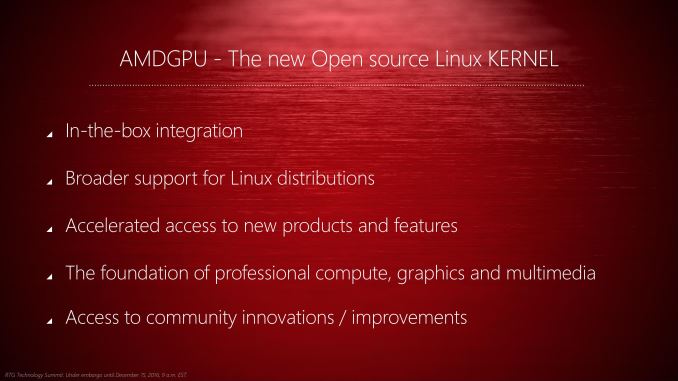
The significant change here is that by having the RTG closed source driver based around the open source driver, the company is now only maintaining a single code base, is pushing as much as possible into open source, and that the open source driver is receiving these features far sooner than it was previously. This greatly improves the quality of life for open source driver users, but it’s also reciprocal for RTG: it’s a lot easier to keep up to date with Linux kernel changes with an open source kernel mode driver than a closed source driver, and quickly integrate improvements submitted by other developers.

This driver is also at the heart of RTG’s plans for the professional and HPC markets. At SC15 AMD announced their Boltzmann initiative to develop a CUDA source code shim and the Heterogeneous Compute Compiler for their GPUs, all of which will be built on top of their new Linux driver and the headless + HSA abilities it will be able to provide. And it’s also here where RTG is also looking to capitalize on the open source nature of the driver, giving HPC users and developers far greater access than what they’re accustomed to with NVIDIA’s closed-source driver and allowing them to see the code behind the driver that’s interpreting and executing their programs.

GPUOpen: RTG’s SDKs, Libraries, & Tools To Go Open Source

The second half of RTG’s briefing was focused on developer relations. Here the company has several needs and initiatives, ranging from countering NVIDIA and their GameWorks SDKs/libraries to developing tools to better utilize RTG’s hardware and the heterogeneous system architecture. At the same time the group is also looking to better leverage their sweep of the current generation consoles, and turn those wins into a distinct advantage within the PC space.
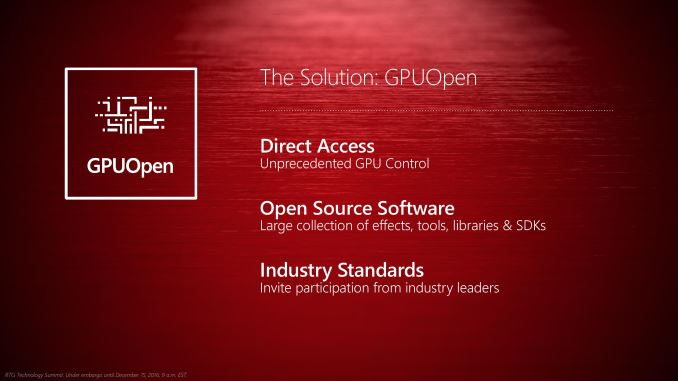
To that end, not unlike the RTG’s Linux efforts, the group is embarking on a new, more open direction for GPU SDK and library development. Being announced today is RTG’s GPUOpen initiative, which will combine RTG’s various SDKs and libraries under the single GPUOpen umbrella, and then take all of these components open source.
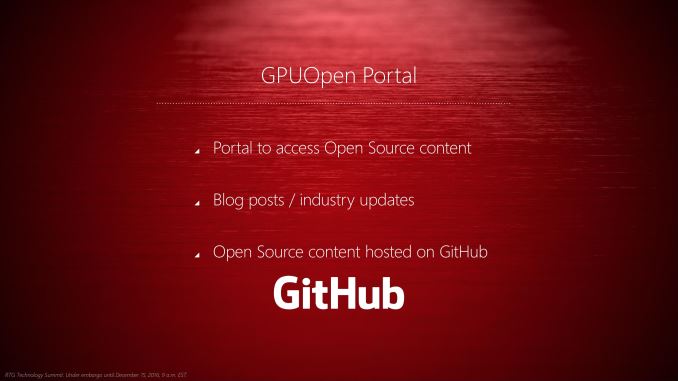
Starting first with the umbrella aspect of GPUOpen, with GPUOpen we’re going to see RTG travel down the same path of bundled tools and developer portals that NVIDIA has been following for the last couple of years with GameWorks. To NVIDIA’s credit they have been very successful in reaching developers via this method – both in terms of SDKs and in terms of branding – so it makes a great deal of sense for RTG to develop something similar. Consequently, GPUOpen will be bringing RTG’s various SDKs, tools, and libraries such as TressFX, LiquidVR, CodeXL, and their DirectX code samples underneath the GPUOpen branding umbrella. At the same time the RTG is developing a GPUOpen portal to make all of these resources available from a single location, and will also be using that portal to publish news and industry updates for game developers.

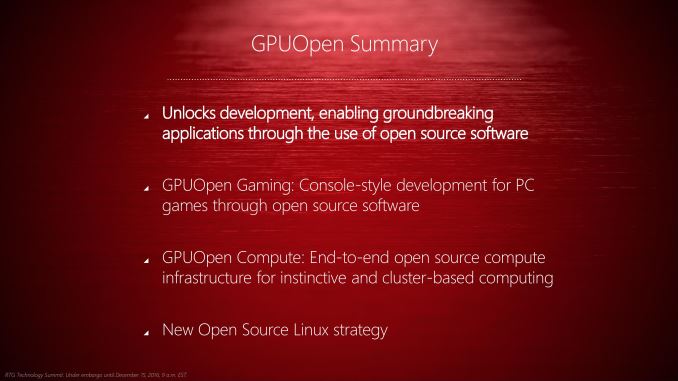
But more interesting than just bringing all of RTG’s developer resources under the GPUOpen brand is what RTG is going to do with those resources: set it free. While the group has dabbled with open source over the last several years, beginning with GPUOpen in 2016 they will be fully committed to it. Everything at the GPUOpen portal will be open source and licensed under the highly permissive MIT license, allowing developers to not only see the code behind RTG’s tools and libraries, but to integrate that code into open and closed source projects as they see fit.
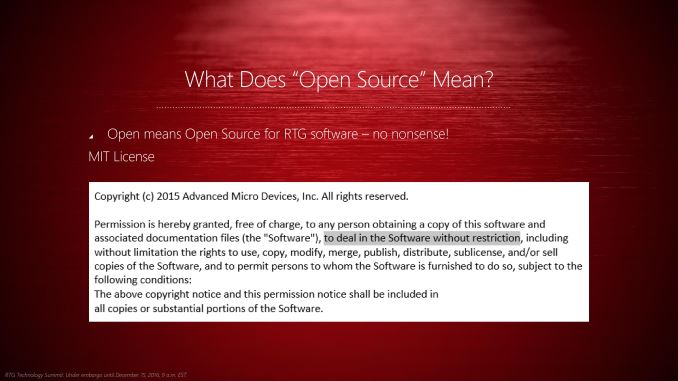
Previously RTG had offered some bits and pieces of their code on an open source basis, but those projects were typically using more restrictive licenses than MIT. GPUOpen on the other hand will see the code behind these projects become available to developers under one of the most permissive licenses out there (short of public domain), which in turn allows developers to essentially do whatever they please while also avoiding any compatibility issues with other open source licenses (e.g. GPL).

Otherwise the fact that RTG is going to be placing so much of their code into the open source ecosystem is a big step for the group. Ultimately they believe that there is much to gain both from letting developers freely use this code, and from allowing them to submit their own improvements and additions back to RTG. In a sense this is the anti-GameWorks: whereas NVIDIA favors closed source libraries or limited sharing, RTG is placing everything out there in hope that their development efforts coupled with the ability for other developers to contribute via open source development will produce a better product.
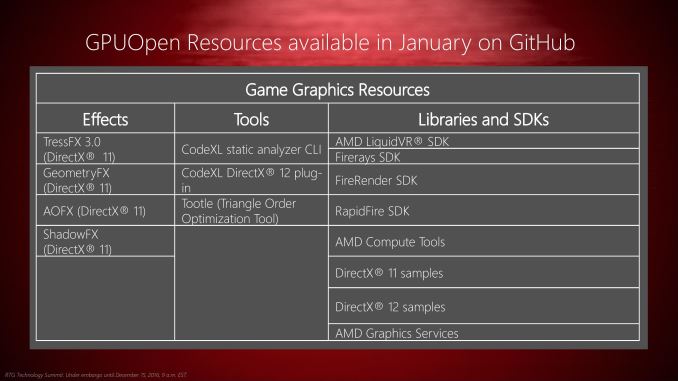
Finally, as part of the GPUOpen portal and RTG’s open source efforts, the company will be hosting these projects on the ever-popular GitHub platform, allowing developers to fork the projects and submit changes as they see fit. The portal and the GitHub repositories for the initial projects will be launching in January. And though RTG didn’t offer much in the way of details for their future plans, they have strongly hinted that this is just the beginning for them, and that they are developing additional effects libraries and code samples that will be made available in the not-too-distant future. Ultimately with the first DirectX 12 games shipping next year and with Vulkan expected to be finalized in 2016 as well, I wouldn’t be surprised to see the GPUOpen portal become the focal-point of RTG’s developer relations efforts for low-level GPU programming, while further leveraging the similarities between console development and low-level PC developer.
The EKWB EK-XLC Predator 240 Liquid Cooler Review

Today we are having a look at the EK-XLC Predator 240, the first AIO liquid cooling solution from EKWB. EKWB is a company that specializes in and is known by their custom liquid cooling products, but with the EK-XLC Predator 240, the company is t…

Workstation Love at SuperComputing 15

Workstation Love at SuperComputing 15

One of the interesting angles at Supercomputing 15 was workstations. In a show where high performance computing is paramount, most situations involve an offload of software onto a small cluster or an off-site mega-behemoth funded environment. However there were a few interesting under-the-desk systems offered by system integrators outside the usual Dell/HP/Lenovo conglomerates to tackle the taste buds of workstation aficionados, including high performance computing, networking and visualization.

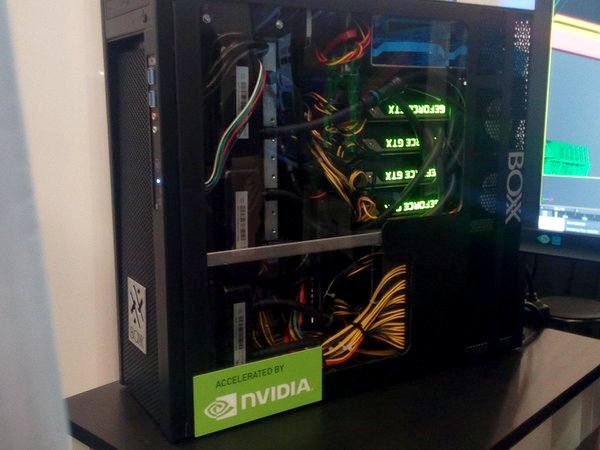
First is a system that a few of my twitter followers saw – a pre-overclocked box from BOXX. Not only was it odd to see an overclocked system at a supercomputing conference (although some financial environments crave low latency), but here BOXX had pushed it to the near extreme.

To get more than a few MHz, the system needs to move away from Xeon, which this does, at the expense of ECC memory for the usual reasons. But here is an i7-5960X overclocked to a modest 4.1 GHz, 128GB of DDR4-2800 memory, and four GTX Titan X cards. Each of these cards is overclocked by around 10-15%, and both the CPU and GPUs are water cooled into a massive custom case. The side window panel is optional. Obviously to get the best of everything is still a little out of the reach for PCIe NVMe SSDs as well, but the case offers enough storage capacity for a set of drives in a mix of RAID 0/1/5/10 or JBOD.

They had the system attached to a 2×2 wall of 4K monitors, all performing various 3D graphics and rendering workloads. Of course, the system aims to be a workstation wet dream so the goal here is to show off what Boxx can do with off the shelf parts before going fully custom in that internal water loop. I discussed with the agent about the range of overclocks, and they said it has to balance between speed and repair, such that if a part fails it needs to be a less often as well as quick and easy – hence why the CPU and GPUs were not on the bleeding edge. It makes sense.

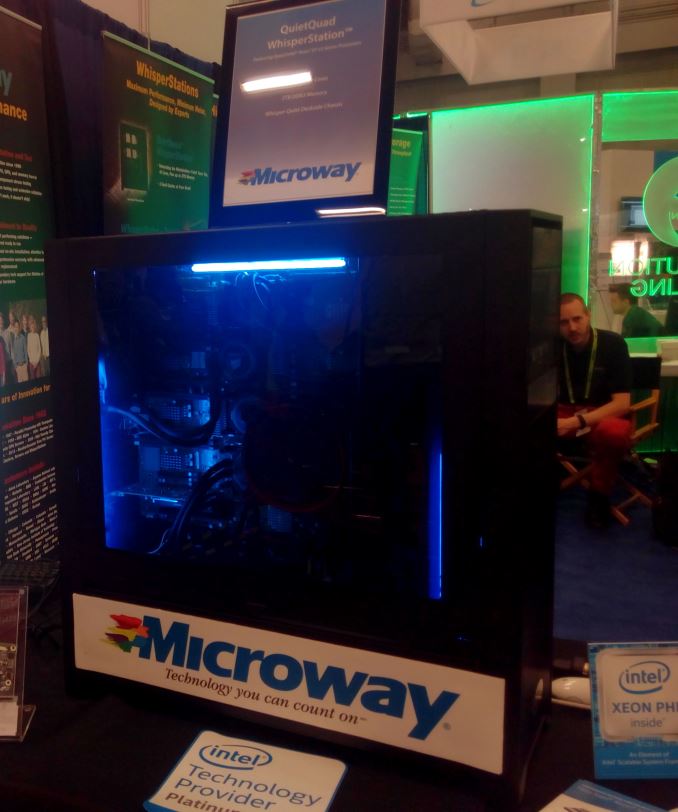
Microway also had a beast on show. What actually drew me to Microway in the first place was that they were the first company I saw showing a new Knights Landing (link) motherboard and chip, but right next to it was essentially a proper server in a workstation.

Initially I thought it was an AMD setup, as I had seen quad Magny Cours/Istanbul/Abu Dhabi based systems in workstation like cases before. But no, that is a set of four E5-4600 v3 series CPUs in a SuperMicro motherboard. The motherboard is aimed at servers, but Microway has put it in a case, and each socket has a closed loop liquid cooler. Because these are v3 CPUs, there is scope for up to 72 cores / 144 threads using E7 v3 processors, which is more similar to what you would see in a 4U rack based arrangement. Because this is in a case, and the board arrangement is such, PCIe coprocessor support is varied based in which PCIe root hub it comes from, but I was told that it will be offered with the standard range of PCIe devices as well as Intel’s Omni-Path when those cards come to retail. Welcome to the node under the desk. You need a tall desk. I’m reaching out to Microway to get one for review, if only for perverse curiosity into workstation CPU compute power.

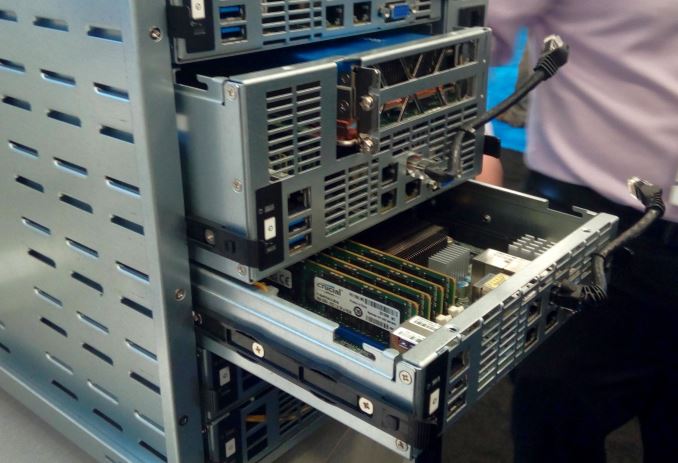
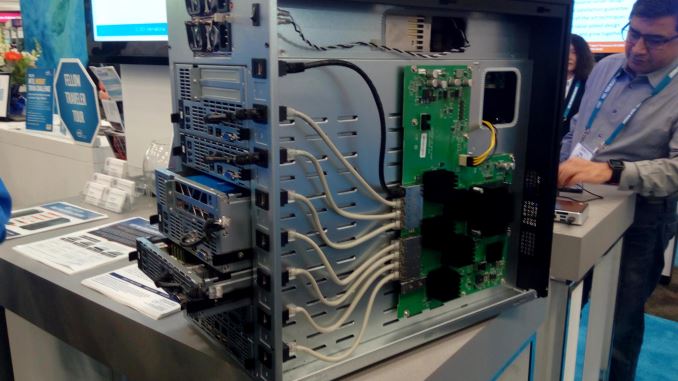
So there’s one node in a case – how about seven? In collaboration with Intel, International Computer Concepts Inc has developed an 8U half-width chassis that will take any half-width server unit up to a specific length.

Each 1U has access to a 10GBase-T port and an internal custom 10G switch with either copper or fibre outputs depending on how you order it. In the example show to us, each 1U was supported by dual Xeon D nodes, which will offer up to 64 threads x 16 when fully populated with the next Xeon-D generation. Of course, some parts of the system can be replaced with storage nodes, or full-fat Xeon nodes. Cooling wasn’t really discussed here, but I was told that the system should be populated to keep noise in mind – so giving each 1U a pair of GPUs probably isn’t a good idea. The system carries it’s own power backplane as well with dual redundant supplies up to 1200W if I remember correctly.

With this amount of versatility, particularly when testing for a larger cluster (or even as an SMB deployment), it certainly sounds impressive. I’m pretty sure Ganesh wants one for his NAS testing.

Workstation Love at SuperComputing 15

Workstation Love at SuperComputing 15

One of the interesting angles at Supercomputing 15 was workstations. In a show where high performance computing is paramount, most situations involve an offload of software onto a small cluster or an off-site mega-behemoth funded environment. However there were a few interesting under-the-desk systems offered by system integrators outside the usual Dell/HP/Lenovo conglomerates to tackle the taste buds of workstation aficionados, including high performance computing, networking and visualization.

First is a system that a few of my twitter followers saw – a pre-overclocked box from BOXX. Not only was it odd to see an overclocked system at a supercomputing conference (although some financial environments crave low latency), but here BOXX had pushed it to the near extreme.

To get more than a few MHz, the system needs to move away from Xeon, which this does, at the expense of ECC memory for the usual reasons. But here is an i7-5960X overclocked to a modest 4.1 GHz, 128GB of DDR4-2800 memory, and four GTX Titan X cards. Each of these cards is overclocked by around 10-15%, and both the CPU and GPUs are water cooled into a massive custom case. The side window panel is optional. Obviously to get the best of everything is still a little out of the reach for PCIe NVMe SSDs as well, but the case offers enough storage capacity for a set of drives in a mix of RAID 0/1/5/10 or JBOD.

They had the system attached to a 2×2 wall of 4K monitors, all performing various 3D graphics and rendering workloads. Of course, the system aims to be a workstation wet dream so the goal here is to show off what Boxx can do with off the shelf parts before going fully custom in that internal water loop. I discussed with the agent about the range of overclocks, and they said it has to balance between speed and repair, such that if a part fails it needs to be a less often as well as quick and easy – hence why the CPU and GPUs were not on the bleeding edge. It makes sense.

Microway also had a beast on show. What actually drew me to Microway in the first place was that they were the first company I saw showing a new Knights Landing (link) motherboard and chip, but right next to it was essentially a proper server in a workstation.

Initially I thought it was an AMD setup, as I had seen quad Magny Cours/Istanbul/Abu Dhabi based systems in workstation like cases before. But no, that is a set of four E5-4600 v3 series CPUs in a SuperMicro motherboard. The motherboard is aimed at servers, but Microway has put it in a case, and each socket has a closed loop liquid cooler. Because these are v3 CPUs, there is scope for up to 72 cores / 144 threads using E7 v3 processors, which is more similar to what you would see in a 4U rack based arrangement. Because this is in a case, and the board arrangement is such, PCIe coprocessor support is varied based in which PCIe root hub it comes from, but I was told that it will be offered with the standard range of PCIe devices as well as Intel’s Omni-Path when those cards come to retail. Welcome to the node under the desk. You need a tall desk. I’m reaching out to Microway to get one for review, if only for perverse curiosity into workstation CPU compute power.

So there’s one node in a case – how about seven? In collaboration with Intel, International Computer Concepts Inc has developed an 8U half-width chassis that will take any half-width server unit up to a specific length.

Each 1U has access to a 10GBase-T port and an internal custom 10G switch with either copper or fibre outputs depending on how you order it. In the example show to us, each 1U was supported by dual Xeon D nodes, which will offer up to 64 threads x 16 when fully populated with the next Xeon-D generation. Of course, some parts of the system can be replaced with storage nodes, or full-fat Xeon nodes. Cooling wasn’t really discussed here, but I was told that the system should be populated to keep noise in mind – so giving each 1U a pair of GPUs probably isn’t a good idea. The system carries it’s own power backplane as well with dual redundant supplies up to 1200W if I remember correctly.

With this amount of versatility, particularly when testing for a larger cluster (or even as an SMB deployment), it certainly sounds impressive. I’m pretty sure Ganesh wants one for his NAS testing.

The OnePlus 2 Review

In early 2014, there was a lot of excitement among Android enthusiasts for an upcoming smartphone called the OnePlus One. The company producing it was a Chinese manufacturer, and they were a new entrant to the smartphone space. OnePlus’s marketing campaign was structured to generate excitement over the prospect of receiving similar specifications to a high end smartphone in a device that was priced substantially lower. Once the device launched, it was clear that OnePlus had delivered on that promise in some respects, but not as much in others. The performance and display quality were superb for a $300-350 device, but parts of the software and the camera processing were clearly lacking.

While the OnePlus One wasn’t perfect, there really aren’t any smartphones that are. For $300-350, it certainly offered users shopping on a budget a lot of power for their money. With many aspects of the phone already being executed well, one would expect that OnePlus’s next phone would serve to iron out the issues and improve on some of the original’s failings. That brings us to 2015, with the OnePlus 2 serving as the new flagship smartphone from OnePlus. Read on for the full review of the OnePlus 2, and find out if it holds up as well as its predecessor.