
News


Apple Open Sources The Swift Programming Language

Apple Open Sources The Swift Programming Language

Back in June at WWDC 2015 Apple surprised a number of people by announcing that they would be making their Swift programming language open source in the near future. Swift is, in a way, a successor to Apple’s Objective-C programming language. It opens up development for iOS and OS X to developers that may have struggled with some of the idiosyncrasies of Objective-C, while also including a number of features that have become common among modern programming languages.

Today it appears that everything relating to licensing has been sorted out, and with version 2.2 the Swift programming language will now be made available under the Apache License 2.0, which is the same open source license used by the Android operating system. With Swift going open source, any member of the community can now propose additions to the language. The project is now available on the Apple Github account, along with some other repositories that are home to supporting tools like versions of the LLVM compiler and LLDB debugger for Swift.

Along with today’s announcement of Swift going open source, there are some notices regarding the development of Swift 3. With Swift still being very much in development, Apple is giving developers a heads up that anything they write now is liable to break with future updates and will need to be fixed to support new coding styles, syntax, etc. There are some other announcements as well, such as a new package manager for sharing and distributing Swift code which would be great to see integrated into OS X in the future. Developers who are interested in some of today’s Swift-related developments can get more info from the official Swift website.


Scott Wasson Announces His Retirement From The Tech Report

Scott Wasson Announces His Retirement From The Tech Report

Congratulations are in order this evening for one of AnandTech’s most esteemed colleagues and peers, Scott Wasson. Scott founded The Tech Report back in 1999 and has lead it since, and in those years has operated one of the best deep technical websites in the business. However after 16 years at the helm of The Tech Report, this evening Scott has announced that he is retiring from the site at the start of next year and will be joining AMD.

Among his accomplishment, Scott was instrumental in bringing the matter of GPU frame pacing and overall frame rate consistency to the attention of the wider world of technology. And at the same time he has been equally responsible for holding AMD to task on the subject – a position that isn’t always easy – ultimately driving AMD to improve their drivers and frame delivery mechanisms to the benefit of all users. So to find out that he is joining AMD, though undoubtedly a loss to technical journalism, is wonderful news for both parties, as now AMD will have a strong advocate for quality and user experience within their ranks who can push for even more.

So with that in mind, I wish Scott congratulations and the best of luck in his new position.

As for The Tech Report, Scott has announced that his managing editor and right-hand man Jeff Kampman will be taking over the site. Jeff has done a great deal for the site since joining, so I am happy to hear that Jeff will be continuing the Report’s tradition of quality journalism.

Scott Wasson Announces His Retirement From The Tech Report

Scott Wasson Announces His Retirement From The Tech Report

Congratulations are in order this evening for one of AnandTech’s most esteemed colleagues and peers, Scott Wasson. Scott founded The Tech Report back in 1999 and has lead it since, and in those years has operated one of the best deep technical websites in the business. However after 16 years at the helm of The Tech Report, this evening Scott has announced that he is retiring from the site at the start of next year and will be joining AMD.

Among his accomplishment, Scott was instrumental in bringing the matter of GPU frame pacing and overall frame rate consistency to the attention of the wider world of technology. And at the same time he has been equally responsible for holding AMD to task on the subject – a position that isn’t always easy – ultimately driving AMD to improve their drivers and frame delivery mechanisms to the benefit of all users. So to find out that he is joining AMD, though undoubtedly a loss to technical journalism, is wonderful news for both parties, as now AMD will have a strong advocate for quality and user experience within their ranks who can push for even more.

So with that in mind, I wish Scott congratulations and the best of luck in his new position.

As for The Tech Report, Scott has announced that his managing editor and right-hand man Jeff Kampman will be taking over the site. Jeff has done a great deal for the site since joining, so I am happy to hear that Jeff will be continuing the Report’s tradition of quality journalism.

Samsung Announces Updated Versions of the Galaxy A3, A5, and A7

Samsung Announces Updated Versions of the Galaxy A3, A5, and A7

Today Samsung announced that updated versions of their Galaxy A3, A5, and A7 smartphones are about to be released. The original Galaxy A7 launched at the very beginning of this year, and both it and the other Galaxy A smartphones represented Samsung’s attempt at bringing quality smartphone construction and design to lower price points than what you would pay for a flagship phone like the Galaxy S6. With it being nearly a year since the original announcement of the Galaxy A7, it makes sense that Samsung would want to refresh the lineup. Below you can find the specs for all three of Samsung’s new smartphones.

  Samsung Galaxy A3 Samsung Galaxy A5 Samsung Galaxy A7
SoC 1.5GHz Quad Core 1.6GHz Octa Core
RAM 1.5GB 2GB 3GB
NAND 16GB NAND + microSD
Display 4.7″ 1280×720 AMOLED 5.2″ 1920×1080 AMOLED 5.5″ 1920×1080 AMOLED
Camera 13MP Rear-facing, F/1.9, OIS on A5 and A7
5MP Front-facing, F/1.9
Dimensions / Mass 134.5 x 65.2 x 7.3mm
132g
144.8 x 71.0 x 7.3mm 155g 151.5 x 74.1 x 7.3mm 172g
Battery 2300 mAh 2900 mAh 3300 mAh
OS Android 5.1 Lollipop
Network Category 4 LTE Category 6 LTE
Other Connectivity 2.4GHz 802.11b/g/n + BT 4.1, USB2.0, NFC, GPS/GNSS 2.4 / 5GHz 802.11a/b/g/n + BT 4.1, USB2.0, NFC, GPS/GNSS, MST for Samsung Pay
Fingerprint scanner No Yes Yes

As you can see, all three devices have a degree of similarity. The Galaxy A5 and A7 in particular seem to be the most closely related, with many of the differences simply coming down to the difference in size between the two, and the drop to 2GB of RAM on the A5. The Galaxy A3 is clearly the more low end device, with a 4.7″ 1280×720 display, no 5GHz WiFi support, and additional reductions to RAM, the SoC, and the cellular connectivity. Because the Galaxy A3 omits the fingerprint scanner present on the A5 and A7 it’s also unable to use Samsung Pay.

Of course, some details like the specific SoCs in use are unknown, although one can speculate based on the limited number of offerings on the market that fit the descriptions. Whether or not the Galaxy A3’s display uses a PenTile subpixel arrangement will also be an important detail to consider once it’s revealed.

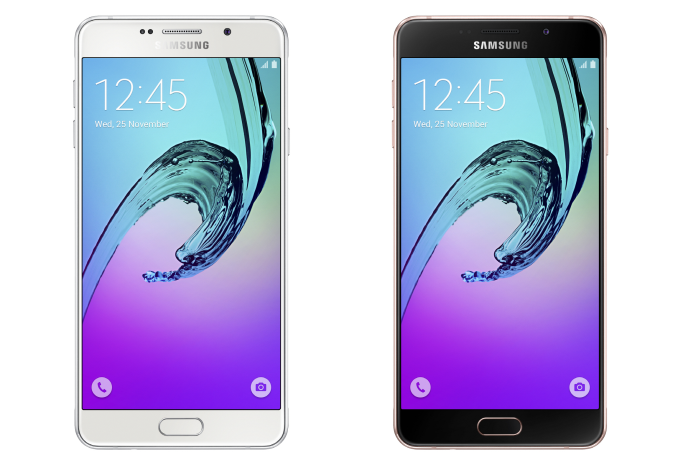
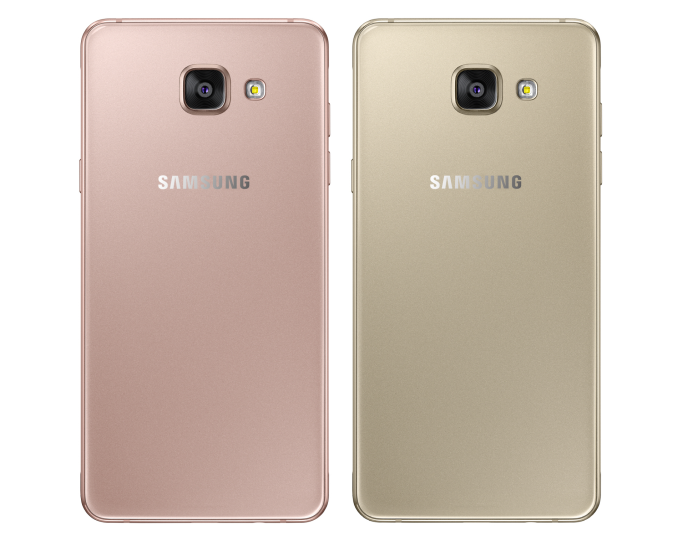
As for the design of the phones, they take inspiration from the industrial design of the previous Galaxy A devices but adopt some of the changes made with Samsung’s Galaxy S6 and Galaxy Note5, such as the use of glass on both the front and back of the devices. All of the phones are quite thin, and both the design and materials used mean that these definitely won’t be targeting the sub-$100 part of the smartphone market. Samsung is also introducing a pink gold color which wasn’t available with the last generation models.

While I don’t think any of these phones are going to have extremely low prices, it’s clear that they’ll be competing at price brackets lower than the one occupied by Samsung’s flagship phones. The launch prices for the Galaxy A3, A5, and A7 are currently unknown. According to Samsung, the phones will be launching in China later this month, with an expansion to global markets coming in 2016. We’ll have to wait and see how much the phones go on sale for in the Chinese market before we’re able to guess how much they’ll cost elsewhere, and interested buyers will have to wait and see when their availability expands to their country.

Source: Samsung

Samsung Announces Updated Versions of the Galaxy A3, A5, and A7

Samsung Announces Updated Versions of the Galaxy A3, A5, and A7

Today Samsung announced that updated versions of their Galaxy A3, A5, and A7 smartphones are about to be released. The original Galaxy A7 launched at the very beginning of this year, and both it and the other Galaxy A smartphones represented Samsung’s attempt at bringing quality smartphone construction and design to lower price points than what you would pay for a flagship phone like the Galaxy S6. With it being nearly a year since the original announcement of the Galaxy A7, it makes sense that Samsung would want to refresh the lineup. Below you can find the specs for all three of Samsung’s new smartphones.

  Samsung Galaxy A3 Samsung Galaxy A5 Samsung Galaxy A7
SoC 1.5GHz Quad Core 1.6GHz Octa Core
RAM 1.5GB 2GB 3GB
NAND 16GB NAND + microSD
Display 4.7″ 1280×720 AMOLED 5.2″ 1920×1080 AMOLED 5.5″ 1920×1080 AMOLED
Camera 13MP Rear-facing, F/1.9, OIS on A5 and A7
5MP Front-facing, F/1.9
Dimensions / Mass 134.5 x 65.2 x 7.3mm
132g
144.8 x 71.0 x 7.3mm 155g 151.5 x 74.1 x 7.3mm 172g
Battery 2300 mAh 2900 mAh 3300 mAh
OS Android 5.1 Lollipop
Network Category 4 LTE Category 6 LTE
Other Connectivity 2.4GHz 802.11b/g/n + BT 4.1, USB2.0, NFC, GPS/GNSS 2.4 / 5GHz 802.11a/b/g/n + BT 4.1, USB2.0, NFC, GPS/GNSS, MST for Samsung Pay
Fingerprint scanner No Yes Yes

As you can see, all three devices have a degree of similarity. The Galaxy A5 and A7 in particular seem to be the most closely related, with many of the differences simply coming down to the difference in size between the two, and the drop to 2GB of RAM on the A5. The Galaxy A3 is clearly the more low end device, with a 4.7″ 1280×720 display, no 5GHz WiFi support, and additional reductions to RAM, the SoC, and the cellular connectivity. Because the Galaxy A3 omits the fingerprint scanner present on the A5 and A7 it’s also unable to use Samsung Pay.

Of course, some details like the specific SoCs in use are unknown, although one can speculate based on the limited number of offerings on the market that fit the descriptions. Whether or not the Galaxy A3’s display uses a PenTile subpixel arrangement will also be an important detail to consider once it’s revealed.

As for the design of the phones, they take inspiration from the industrial design of the previous Galaxy A devices but adopt some of the changes made with Samsung’s Galaxy S6 and Galaxy Note5, such as the use of glass on both the front and back of the devices. All of the phones are quite thin, and both the design and materials used mean that these definitely won’t be targeting the sub-$100 part of the smartphone market. Samsung is also introducing a pink gold color which wasn’t available with the last generation models.

While I don’t think any of these phones are going to have extremely low prices, it’s clear that they’ll be competing at price brackets lower than the one occupied by Samsung’s flagship phones. The launch prices for the Galaxy A3, A5, and A7 are currently unknown. According to Samsung, the phones will be launching in China later this month, with an expansion to global markets coming in 2016. We’ll have to wait and see how much the phones go on sale for in the Chinese market before we’re able to guess how much they’ll cost elsewhere, and interested buyers will have to wait and see when their availability expands to their country.

Source: Samsung