Vik


Apple Q1 FY 2015 Financial Results: Record iPhone Sales Drive Record Earnings

Apple Q1 FY 2015 Financial Results: Record iPhone Sales Drive Record Earnings

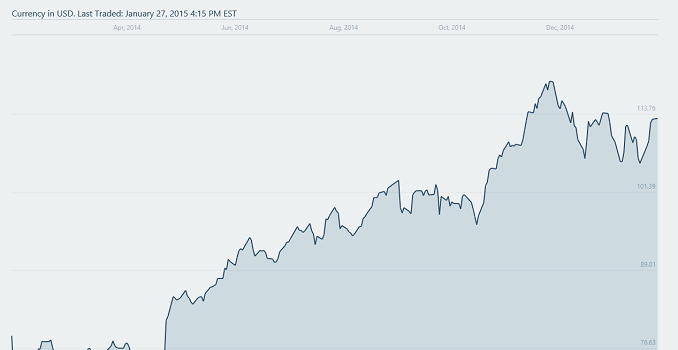
Apple announced its earnings today for their first quarter of fiscal year 2015, with the quarter ending on December 27th 2014. This was a huge quarter for them, with new iPads, iMac coming to market, and of course the iPhone which launched right at the tail end of their last quarter. New products plus the busy holiday season gave Apple its highest quarterly results ever, with a staggering $74.6 billion in revenue, and a net profit of $18 billion. That is a 29.5% growth in revenue year-over-year, and a 37.4% increase in net profit. Gross margin was up 2% to 39.9% as compared to Q1 2014, and earnings per share came in at $3.08, which was much higher than analysts’ expectations.

Apple Q1 2015 Financial Results (GAAP)
  Q1’2015 Q4’2014 Q1’2014
Revenue (in Billions USD) $74.599 $42.123 $57.594
Operating Income (in Billions USD) $24.246 $11.165 $17.463
Gross Margin (in Billions USD) $29.741 $16.009 $21.846
Net Income (in Billions USD) $18.024 $8.467 $13.072
Margins 39.9% 38.0% 37.9%
Earnings per Share (in USD) $3.08 $1.43 $2.08

The story of Apple is the iPhone, which was updated in September with two new models with larger displays. Clearly the market wanted this, even if our own Ryan Smith still swears by his smaller iPhone 5 display. Sales of the iPhone for Q1 totaled 74.5 million units, with over $51 billion in revenue. Compared to Q4 2014, when the iPhone 6 and 6+ had just launched, that is a 90% increase in sales sequentially. The holiday quarter is always strong, but even year-over-year the increase in units was up 46%, with revenue up 57%. Average Selling Price (ASP) for this quarter’s iPhones was $687.30, which is up significantly over last quarter’s ASP of $602.92 and last year’s $636.90. Clearly there was quite a bit of pent up demand for a larger iPhone.

Apple Q1 2015 Device Sales (thousands)
  Q1’2015 Q4’2014 Q1’2014 Seq Change Year/Year Change
iPhone 74,468 39,272 51,025 +90% +46%
iPad 21,419 12,316 26,035 +74% -18%
Mac 5,519 5,520 4,837 0% +14%

Next up from Apple is iPad sales, which struggled over the last year. Last quarter, the Mac overtook iPad for revenue. The new iPads did reverse that trend, with a 74% increase in units sold since the last quarter. 21.4 million iPads were sold in Q1, with revenue coming in at $8.985 billion, which works out to a ASP of $419.49. While this was a big jump from last quarter, it was still down 18% year-over-year, and revenue was down 22% from Q1 2014. Sales are still good, but iPad sales have not followed iPhone sales with large growth with each new model.

The Mac had another good quarter, with a 14% increase in units sold year-over-year. Apple sold 5.5 million Macs in Q1, which was about the same as they sold in Q4 2014, but the ASP was up slightly which resulted in a 5% gain in revenue since last quarter. Year-over-year revenue was up 9%. These are great numbers, especially when the PC market as a whole has been pretty much flat for the year, and Apple has not really updated the Mac in the last couple of quarters other than the new 5K iMac.

Apple’s iTunes, App Store, Mac App Store, iBooks, AppleCare, Apple Pay, and licensing fall into their Services segment, and this business line had modest growth of 4% quarter-over-quarter and 9% year-over-year, with it now pulling in almost $4.8 billion per quarter.

Other Products is the final category, and it includes iPod, Apple TV, Beats, and accessories. The lowly iPod, which vaulted Apple up through the 2000’s, is no longer broken down by units sold. The Other Products category had a 42% sequential increase in revenue, and a 5% loss in revenue as compared to Q1 2014, with $2.689 billion this quarter.

Apple Q1 2015 Revenue by Product (billions)
  Q1’2015 Q4’2014 Q1’2014 Revenue for current quarter
iPhone $51.182 $23.678 $32.498 68.6%
iPad $8.985 $5.316 $11.468 12.1%
Mac $6.944 $6.625 $6.395 9.3%
iTunes/Software/Services $4.799 $4.608 $4.397 6.4%
Other Products $2.689 $1.896 $2.836 3.6%

Right now, the iPhone is Apple. It accounts for 68.6% of the company’s revenue for this quarter, and iPhone revenue alone is about the same as Microsoft ($26.47B), Google ($16.52B), and Intel ($14.72B) combined. This has allowed Apple to return $57 billion to shareholders over the last twelve months, and they have declared a dividend of $0.47 per share, payable on February 12th. Looking forward, Apple is expecting revenue between $52 and 55 billion, and gross margin between 38.5% and 39.5% for the next quarter.

Source: Apple Investor Relations

Apple Announces April Ship Date for Apple Watch

Apple Announces April Ship Date for Apple Watch

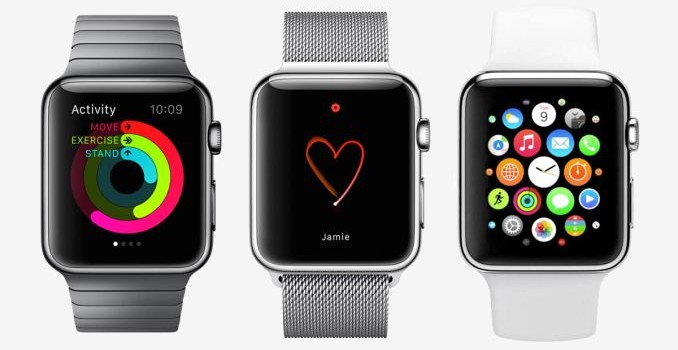
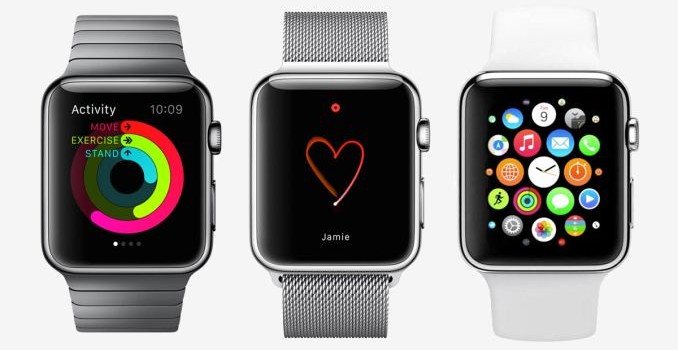
Today Apple announced their earnings and sales for the holiday quarter of 2014. The company sold 74.5 million iPhones, and had strong earnings which were fueled by the newly released iPhone 6 and 6 Plus. While the information about Apple’s financial situation is interesting for investors and analysts, it’s really of no consequence to general consumers. However, Apple CEO Tim Cook made a statement during today’s earnings call that is of great significance to anyone interested in Apple’s upcoming smartwatch, the Apple Watch. 

Like the iPhone, the Apple watch was announced several months prior to its shipping date. Until today, the only information about when Apple Watch would be available was that it was coming in early 2015. While there’s still no specific launch date, Cook stated that the development for the Apple Watch was proceeding according to schedule, and that the company expected to begin shipping it in April. Unfortunately, concrete information about the price of all the different models and the battery life of Apple Watch is still unknown. It will be interesting to see if more details get confirmed in the upcoming weeks and months as we get closer to April.

Source: Apple via Macrumors

Apple Announces April Ship Date for Apple Watch

Apple Announces April Ship Date for Apple Watch

Today Apple announced their earnings and sales for the holiday quarter of 2014. The company sold 74.5 million iPhones, and had strong earnings which were fueled by the newly released iPhone 6 and 6 Plus. While the information about Apple’s financial situation is interesting for investors and analysts, it’s really of no consequence to general consumers. However, Apple CEO Tim Cook made a statement during today’s earnings call that is of great significance to anyone interested in Apple’s upcoming smartwatch, the Apple Watch. 

Like the iPhone, the Apple watch was announced several months prior to its shipping date. Until today, the only information about when Apple Watch would be available was that it was coming in early 2015. While there’s still no specific launch date, Cook stated that the development for the Apple Watch was proceeding according to schedule, and that the company expected to begin shipping it in April. Unfortunately, concrete information about the price of all the different models and the battery life of Apple Watch is still unknown. It will be interesting to see if more details get confirmed in the upcoming weeks and months as we get closer to April.

Source: Apple via Macrumors

Interview with OCZ's CEO Ralph Schmitt: The New Tides of OCZ

Interview with OCZ’s CEO Ralph Schmitt: The New Tides of OCZ

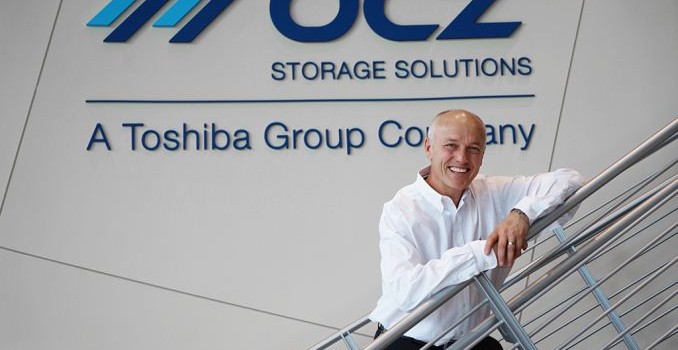
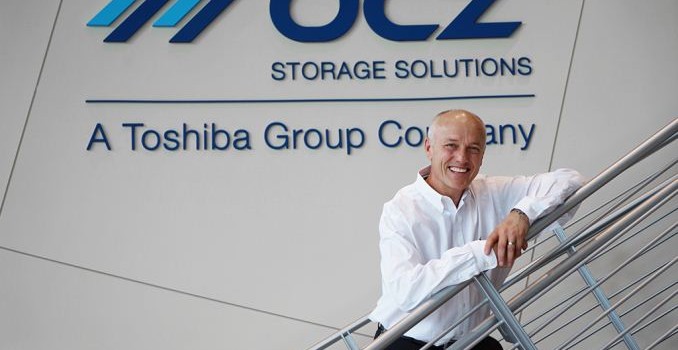
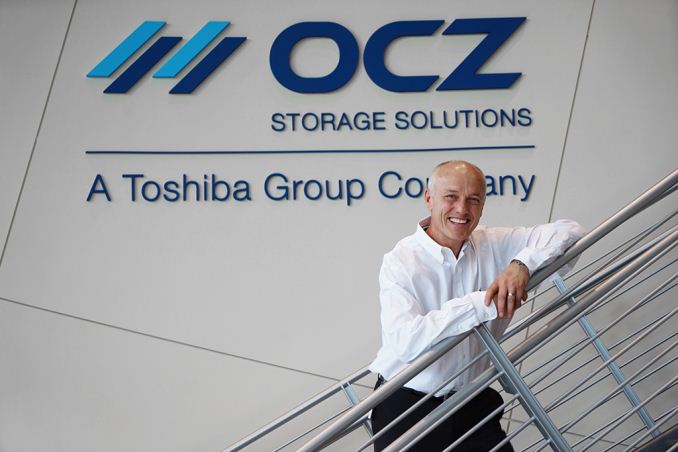
At CES I had the opportunity to sit down with Ralph Schmitt, OCZ’s CEO, for a good hour to discuss the state of the company. Before we get to the actual interview, let me introduce Mr. Schmitt. Mr. Schmitt has been OCZ’s CEO since October 2012, and prior to that he was actually an OCZ board member while he was the President and CEO of PLX Technology. Mr. Schmitt has had an honorable career in addition to OCZ and PLX Technology, as he has served in several CEO and high-level executive roles in various semiconductor companies such as Cypress and Sipex. Academically, Mr. Schmitt holds a B.S. of Electrical Engineering from Rutgers University.

Discussing OCZ’s History & Background in Brief

OCZ has gone through a lot in the past couple of years. In November 2013 OCZ filed for bankruptcy, and shortly after Toshiba announced that it will be acquiring OCZ’s assets for $35 million. Since then OCZ has been operating as an independent subsidiary under Toshiba. Unlike what usually happens after acquisitions, OCZ has not been integrated to Toshiba’s existing units and all of OCZ’s different units (such as marketing, product development etc.) have remained in tact (for what it’s worth, I’m still working with the same people as I was before the acquisition). The OCZ-Toshiba relationship resembles more like a strategic partnership to be honest as that indicates how separate the two are, but only in a good way.

The reason why Toshiba wanted to keep OCZ independent was to ensure that the company’s talent doesn’t get buried into Toshiba’s massive organization. The common issue in acquisitions is that the acquiring company may not be able to use all the talent and resources of the acquired company because the culture of each organization can differ. In the end, individual talent isn’t just something concrete and absolute like money that can easily be transferred from one place to another — there are various environmental and cultural factors that go into it. For example, a change from liberal and relaxed culture to more tightly managed one can suppress some individuals because the way they work has to change, and the new way may not suit them. It is always a major challenge to integrate two companies with different organization cultures, so keeping the two separate is not always a bad idea.

Mr. Schmitt checking testing facilities

One element of the equation for OCZ is due to some management changes in September 2012 when Ryan Petersen, the founder and CEO at that time, resigned. However, companies are very much like cargo ships: once you get them moving to a specific direction, it won’t be easy to change that, or at least it will take time and effort to do so. Even if you know that you are on your way to run aground, it may be too late to change the course and some negative results happen.

That’s essentially what happened with OCZ. Even though Mr. Schmitt stepped in as the CEO only a month after Mr. Petersen had left and started to change the course of the company for the better (less products, more emphasis on development and validation), it was too late. There was financial trouble and they had to rely on borrowed capital to keep the company running, which came in at a high cost given that their credit rating was not a top grade. So while OCZ had been heading towards the right direction for a year, the company ran out of capital in late November 2013.

Fortunately, Toshiba saw eye-to-eye with OCZ’s new path and Mr. Schmitt just wasn’t given enough time and resources to fulfill the potential. As a result, Toshiba decided to let OCZ continue its business and R&D as a separate unit by providing financial support for the company. The new OCZ had, and still has, a sustainable business plan, so there was no reason to break up the company into pieces.

The Symbiotic Partnership

Mr Schmitt explained how the partnership between OCZ and Toshiba extends far beyond financial support. As part of the Toshiba Group, OCZ is now able to leverage a number of Toshiba’s labs and run much more extensive testing throughout the design cycle, as well as do more specialized testing and validation to meet specific customer requirements. During the baby steps of the acquisition, the companies had a few different philosophies when it came to validation, which makes sense given the different backgrounds. For instance, Toshiba might focus more on the NAND during testing/validation (Toshiba is the inventor and major supplier of NAND, after all), whereas OCZ would focus on other aspects they could impact like the controller and firmware first.

The companies have then aligned their philosophies to use the same thinking during product development and testing. Toshiba holds OCZ drives to the same quality standards as its own and OCZ has adopted many of Toshiba’s processes for its quality control. The testing/validation aspect is just one example of how the two companies are supplementing each other. The key here is that both companies have and are still learning from each other to ensure that both companies are putting out the best possible products.

The simple, yet so complicated NAND

The one major advantage OCZ has gained is access to Toshiba’s NAND knowhow. At the high level NAND is a fairly simple semiconductor (you apply a high voltage that creates an electric field that forces electrons to tunnel from the channel through the silicon oxide to the floating gate), but once you get down to the atomic level it becomes a highly complex piece of technology. Some of OCZ’s engineers have been living in Japan since the acquisition and just learning things about NAND and its characteristics to help build better products. In this case, especially endurance tweaks that require a very deep understanding of NAND, so having access to that knowledge and applying it to product design will provide OCZ with a very important advantage in the market. 

Another crucial element that Toshiba provides is the access to its NAND supply. In the past OCZ had to source NAND from the open market, which resulted in varying quality NAND being used. Like many components (and goods/stocks in general), NAND is sold on spot market where anyone can sell or buy NAND. In case a NAND manufacturer (or any company) has excess stock, they can dump a portion of that into the spot market and sell it at the day’s price. It is possible to buy NAND straight from the manufacturer, but the required volume tends to be fairly high and in turn you don’t get the benefits of the dynamic spot market (predicting supply/demand and the associated price changes can be very profitable, if successful). 

Since OCZ sourced most of its NAND from the spot market, the quality wasn’t always top notch. Especially during times of low supply, OCZ basically had to use any and all NAND it got its hands into. As NAND is such a vital element of an SSD, the lower quality NAND also had an impact on overall quality and in worst cases on customer satisfaction as well.

Now that OCZ has access to Toshiba’s NAND, that is no longer a concern. Not only is OCZ getting a steady supply of NAND from Toshiba, it also has access to the latest and highest quality chips. It is not a secret that all NAND manufacturers cherry-pick NAND and use the best dies for their own drives, which is why the best quality chips don’t even end up on the open market. 

Toshiba SAS SSD

The companies have also gone through the process of unifying product roadmaps. Initially, there was quite a bit of overlap because both had their own lineups and tried to cover as much of the market as possible, but by mid-2015 there should no longer be any major product overlaps. For instance, OCZ has stopped all SAS development as Toshiba has more expertise in that field and the same goes for certain OEM drives where Toshiba has always had a strong presence. At the same time, Toshiba will let OCZ handle the OCZ branded retail sales and on the enterprise side OCZ’s focus will be in SATA and PCIe drives. The idea and goal is to supplement each other’s lineup, not to compete.

Aside from high-level roadmap comparison, there is cooperation in individual products too. For a TLC NAND based SSD, the companies decided that it’s better to let Toshiba handle the development of that drive because the company has been developing one for quite some time now and building a competitive TLC SSD requires a hefty amount of NAND knowledge, which is Toshiba’s area of strength. It simply makes sense to focus all resources on one platform instead of having OCZ and Toshiba both spend money on a design that ultimately has the same end goal. However, for the first time, the Toshiba-built TLC drive will also retail under OCZ brand, which makes sense as OCZ already has a widespread distribution network and the required support for retail sales. On the other hand, Toshiba is very interested in OCZ’s upcoming JetExpress controller, so I wouldn’t be surprised to see Toshiba branded SSDs with the JetExpress controller for OEMs.

Answering My Concerns

In addition to talking about the Toshiba relationship and direction of the company, we also discussed some of the criticism I have had over the past year on the product side. While OCZ has done a good job of cleaning its product portfolio from redundant elements, I’m still of the opinion that there is some redundancy and unnecessary overlap. The case in point is the overlap between Barefoot 3 based drives because right now OCZ is selling four different drives: ARC 100, Vertex 460, Vertex 460A and Vector 150 (although the Vertex 460A will be replacing the 460 as it’s just a change to A19nm NAND). That increases to five if you count the AMD branded R7. In any case, there is three OCZ branded Barefoot 3 drives and out of these three the ARC 100 and Vertex 460(A) are very much alike. In terms of performance the difference between the two is marginal and feature wise the Vertex 460 adds Acronis’ cloning software and a 3.5″ desktop bracket.

I have been bugging OCZ about the similarity of the two for a while now and saying that it just adds unwanted clutter to the lineup. During the meeting, Mr. Schmitt shared that OCZ decided to keep the Vertex 460 lineup around because it’s very popular in certain regions (e.g. countries within EMEA and Eastern Europe) because of the Vertex brand that has been around for so long (remember, not all buyers are as well educated as our readers). On the other hand, OCZ didn’t want to “downgrade” the Vertex brand to become a value brand and decided to create a new ARC series for that purpose.

After hearing the explanation, it all makes more sense now. I can’t say I am vouching for the existence of the Vertex 460(A) as from a reviewer’s point of view it adds little to no value to the end user over the ARC 100, but from the business perspective I can understand why OCZ was so keen on keeping the lineup around even at the cost of fragmentation and clutter. 

The Software Side of OCZ

Last but not least, for the past months OCZ has been working on an updated SSD toolbox. OCZ has offered a toolbox for its SSDs for years now, but the user interface has been rather awkward and the features lacking compared to what the competitors have. The new toolbox software is set to be released in the next couple of months and it will carry a refreshed, more user friendly UI along with the fairly common set of features (manual TRIM, over-provisioning, etc.).

It’s a no-brainer move in my opinion because the importance of software has been on an increase lately. SATA 6Gbps has put a limit on performance differentiation (although PCIe will reopen those doors), so consumers have started to look for additional features and value, which software is an essential part of.

Final Words

The OCZ of today is very different from yesterday’s OCZ. The management has changed the course to a sustainable path where focus is on long-term development and proper validation. The Toshiba partnership just further emphasizes the quality aspect and also gives OCZ the much needed NAND supply and knowledge access. 

All in all, OCZ from the outside perspective feels to be on the right path. The product roadmap, and especially the new JetExpress PCIe controller, looks very promising and I hope the potential ends up being well executed. Earning back the consumers’ trust, including those that received an unreliable drive in the past, will take time. But from our side of the fence the new OCZ has been injected with a new attitude and more resources when it comes to testing and validation. We will actually touch that subject more closely over the next couple of months with an in-depth look at OCZ’s manufacturing and validation processes, so stay tuned!

Interview with OCZ's CEO Ralph Schmitt: The New Tides of OCZ

Interview with OCZ’s CEO Ralph Schmitt: The New Tides of OCZ

At CES I had the opportunity to sit down with Ralph Schmitt, OCZ’s CEO, for a good hour to discuss the state of the company. Before we get to the actual interview, let me introduce Mr. Schmitt. Mr. Schmitt has been OCZ’s CEO since October 2012, and prior to that he was actually an OCZ board member while he was the President and CEO of PLX Technology. Mr. Schmitt has had an honorable career in addition to OCZ and PLX Technology, as he has served in several CEO and high-level executive roles in various semiconductor companies such as Cypress and Sipex. Academically, Mr. Schmitt holds a B.S. of Electrical Engineering from Rutgers University.

Discussing OCZ’s History & Background in Brief

OCZ has gone through a lot in the past couple of years. In November 2013 OCZ filed for bankruptcy, and shortly after Toshiba announced that it will be acquiring OCZ’s assets for $35 million. Since then OCZ has been operating as an independent subsidiary under Toshiba. Unlike what usually happens after acquisitions, OCZ has not been integrated to Toshiba’s existing units and all of OCZ’s different units (such as marketing, product development etc.) have remained in tact (for what it’s worth, I’m still working with the same people as I was before the acquisition). The OCZ-Toshiba relationship resembles more like a strategic partnership to be honest as that indicates how separate the two are, but only in a good way.

The reason why Toshiba wanted to keep OCZ independent was to ensure that the company’s talent doesn’t get buried into Toshiba’s massive organization. The common issue in acquisitions is that the acquiring company may not be able to use all the talent and resources of the acquired company because the culture of each organization can differ. In the end, individual talent isn’t just something concrete and absolute like money that can easily be transferred from one place to another — there are various environmental and cultural factors that go into it. For example, a change from liberal and relaxed culture to more tightly managed one can suppress some individuals because the way they work has to change, and the new way may not suit them. It is always a major challenge to integrate two companies with different organization cultures, so keeping the two separate is not always a bad idea.

Mr. Schmitt checking testing facilities

One element of the equation for OCZ is due to some management changes in September 2012 when Ryan Petersen, the founder and CEO at that time, resigned. However, companies are very much like cargo ships: once you get them moving to a specific direction, it won’t be easy to change that, or at least it will take time and effort to do so. Even if you know that you are on your way to run aground, it may be too late to change the course and some negative results happen.

That’s essentially what happened with OCZ. Even though Mr. Schmitt stepped in as the CEO only a month after Mr. Petersen had left and started to change the course of the company for the better (less products, more emphasis on development and validation), it was too late. There was financial trouble and they had to rely on borrowed capital to keep the company running, which came in at a high cost given that their credit rating was not a top grade. So while OCZ had been heading towards the right direction for a year, the company ran out of capital in late November 2013.

Fortunately, Toshiba saw eye-to-eye with OCZ’s new path and Mr. Schmitt just wasn’t given enough time and resources to fulfill the potential. As a result, Toshiba decided to let OCZ continue its business and R&D as a separate unit by providing financial support for the company. The new OCZ had, and still has, a sustainable business plan, so there was no reason to break up the company into pieces.

The Symbiotic Partnership

Mr Schmitt explained how the partnership between OCZ and Toshiba extends far beyond financial support. As part of the Toshiba Group, OCZ is now able to leverage a number of Toshiba’s labs and run much more extensive testing throughout the design cycle, as well as do more specialized testing and validation to meet specific customer requirements. During the baby steps of the acquisition, the companies had a few different philosophies when it came to validation, which makes sense given the different backgrounds. For instance, Toshiba might focus more on the NAND during testing/validation (Toshiba is the inventor and major supplier of NAND, after all), whereas OCZ would focus on other aspects they could impact like the controller and firmware first.

The companies have then aligned their philosophies to use the same thinking during product development and testing. Toshiba holds OCZ drives to the same quality standards as its own and OCZ has adopted many of Toshiba’s processes for its quality control. The testing/validation aspect is just one example of how the two companies are supplementing each other. The key here is that both companies have and are still learning from each other to ensure that both companies are putting out the best possible products.

The simple, yet so complicated NAND

The one major advantage OCZ has gained is access to Toshiba’s NAND knowhow. At the high level NAND is a fairly simple semiconductor (you apply a high voltage that creates an electric field that forces electrons to tunnel from the channel through the silicon oxide to the floating gate), but once you get down to the atomic level it becomes a highly complex piece of technology. Some of OCZ’s engineers have been living in Japan since the acquisition and just learning things about NAND and its characteristics to help build better products. In this case, especially endurance tweaks that require a very deep understanding of NAND, so having access to that knowledge and applying it to product design will provide OCZ with a very important advantage in the market. 

Another crucial element that Toshiba provides is the access to its NAND supply. In the past OCZ had to source NAND from the open market, which resulted in varying quality NAND being used. Like many components (and goods/stocks in general), NAND is sold on spot market where anyone can sell or buy NAND. In case a NAND manufacturer (or any company) has excess stock, they can dump a portion of that into the spot market and sell it at the day’s price. It is possible to buy NAND straight from the manufacturer, but the required volume tends to be fairly high and in turn you don’t get the benefits of the dynamic spot market (predicting supply/demand and the associated price changes can be very profitable, if successful). 

Since OCZ sourced most of its NAND from the spot market, the quality wasn’t always top notch. Especially during times of low supply, OCZ basically had to use any and all NAND it got its hands into. As NAND is such a vital element of an SSD, the lower quality NAND also had an impact on overall quality and in worst cases on customer satisfaction as well.

Now that OCZ has access to Toshiba’s NAND, that is no longer a concern. Not only is OCZ getting a steady supply of NAND from Toshiba, it also has access to the latest and highest quality chips. It is not a secret that all NAND manufacturers cherry-pick NAND and use the best dies for their own drives, which is why the best quality chips don’t even end up on the open market. 

Toshiba SAS SSD

The companies have also gone through the process of unifying product roadmaps. Initially, there was quite a bit of overlap because both had their own lineups and tried to cover as much of the market as possible, but by mid-2015 there should no longer be any major product overlaps. For instance, OCZ has stopped all SAS development as Toshiba has more expertise in that field and the same goes for certain OEM drives where Toshiba has always had a strong presence. At the same time, Toshiba will let OCZ handle the OCZ branded retail sales and on the enterprise side OCZ’s focus will be in SATA and PCIe drives. The idea and goal is to supplement each other’s lineup, not to compete.

Aside from high-level roadmap comparison, there is cooperation in individual products too. For a TLC NAND based SSD, the companies decided that it’s better to let Toshiba handle the development of that drive because the company has been developing one for quite some time now and building a competitive TLC SSD requires a hefty amount of NAND knowledge, which is Toshiba’s area of strength. It simply makes sense to focus all resources on one platform instead of having OCZ and Toshiba both spend money on a design that ultimately has the same end goal. However, for the first time, the Toshiba-built TLC drive will also retail under OCZ brand, which makes sense as OCZ already has a widespread distribution network and the required support for retail sales. On the other hand, Toshiba is very interested in OCZ’s upcoming JetExpress controller, so I wouldn’t be surprised to see Toshiba branded SSDs with the JetExpress controller for OEMs.

Answering My Concerns

In addition to talking about the Toshiba relationship and direction of the company, we also discussed some of the criticism I have had over the past year on the product side. While OCZ has done a good job of cleaning its product portfolio from redundant elements, I’m still of the opinion that there is some redundancy and unnecessary overlap. The case in point is the overlap between Barefoot 3 based drives because right now OCZ is selling four different drives: ARC 100, Vertex 460, Vertex 460A and Vector 150 (although the Vertex 460A will be replacing the 460 as it’s just a change to A19nm NAND). That increases to five if you count the AMD branded R7. In any case, there is three OCZ branded Barefoot 3 drives and out of these three the ARC 100 and Vertex 460(A) are very much alike. In terms of performance the difference between the two is marginal and feature wise the Vertex 460 adds Acronis’ cloning software and a 3.5″ desktop bracket.

I have been bugging OCZ about the similarity of the two for a while now and saying that it just adds unwanted clutter to the lineup. During the meeting, Mr. Schmitt shared that OCZ decided to keep the Vertex 460 lineup around because it’s very popular in certain regions (e.g. countries within EMEA and Eastern Europe) because of the Vertex brand that has been around for so long (remember, not all buyers are as well educated as our readers). On the other hand, OCZ didn’t want to “downgrade” the Vertex brand to become a value brand and decided to create a new ARC series for that purpose.

After hearing the explanation, it all makes more sense now. I can’t say I am vouching for the existence of the Vertex 460(A) as from a reviewer’s point of view it adds little to no value to the end user over the ARC 100, but from the business perspective I can understand why OCZ was so keen on keeping the lineup around even at the cost of fragmentation and clutter. 

The Software Side of OCZ

Last but not least, for the past months OCZ has been working on an updated SSD toolbox. OCZ has offered a toolbox for its SSDs for years now, but the user interface has been rather awkward and the features lacking compared to what the competitors have. The new toolbox software is set to be released in the next couple of months and it will carry a refreshed, more user friendly UI along with the fairly common set of features (manual TRIM, over-provisioning, etc.).

It’s a no-brainer move in my opinion because the importance of software has been on an increase lately. SATA 6Gbps has put a limit on performance differentiation (although PCIe will reopen those doors), so consumers have started to look for additional features and value, which software is an essential part of.

Final Words

The OCZ of today is very different from yesterday’s OCZ. The management has changed the course to a sustainable path where focus is on long-term development and proper validation. The Toshiba partnership just further emphasizes the quality aspect and also gives OCZ the much needed NAND supply and knowledge access. 

All in all, OCZ from the outside perspective feels to be on the right path. The product roadmap, and especially the new JetExpress PCIe controller, looks very promising and I hope the potential ends up being well executed. Earning back the consumers’ trust, including those that received an unreliable drive in the past, will take time. But from our side of the fence the new OCZ has been injected with a new attitude and more resources when it comes to testing and validation. We will actually touch that subject more closely over the next couple of months with an in-depth look at OCZ’s manufacturing and validation processes, so stay tuned!