
Vik


IOGEAR Updates A/V & Digital Home Solutions for 4K

IOGEAR Updates A/V & Digital Home Solutions for 4K

We visited IOGEAR’s booth at CES 2015 to take a look at the new products on display. The most striking was the DisplayLink-based products. Similar to Diamond Multimedia, we had the usual USB 3.0 dock with Ethernet, multiple display outputs, audio jack and multiple downstream USB ports (GUD342 – $200). However, while Diamond’s dock required another adapter for 4K support, the GUD342 is 4K-enabled by itself.

IOGEAR GUD342 – DisplayLink USB 3.0 Dock

There were two USB 3.0 external video card for sending out 4K signals, one over Display Port (GUC34DP – $100) and the other over HDMI (GUC34HD – $120)

IOGEAR was particularly proud of their long range wireless 5×2 HDMI Matrix PRO. It even allows for multi-casting from one source to five different locations. It comes with an IR remote and supports 1080p60 / 3D / 5.1 channel audio. For the $600 price point (which includes a couple of receivers in addition to the matrix switch), we would actually like control over IP. In any case, this is targeted mainly towards custom installers who don’t want the trouble of punching through drywall to lay out HDMI cables.

There were also a few wired HDMI switches with support for 4K and RS232 – again, targeting the custom installers. Yet another interesting product was the HDMI Cat 5e / Cat 6 extender with full HDCP support.

On the gaming front, IOGEAR is launching Keymander, a controller emulator for use with gaming consoles. It allws for the traditional gaming keyboards and mice to be used with the PlayStations and the Xboxes. The GKM602R wireless keyboard / mouse combo (the latter being the 7-button variety with adjustable DPI settings of 1000, 1500 and 2000) was also on display.
G-Technology's Evolution Series Goes Rugged

G-Technology’s Evolution Series Goes Rugged

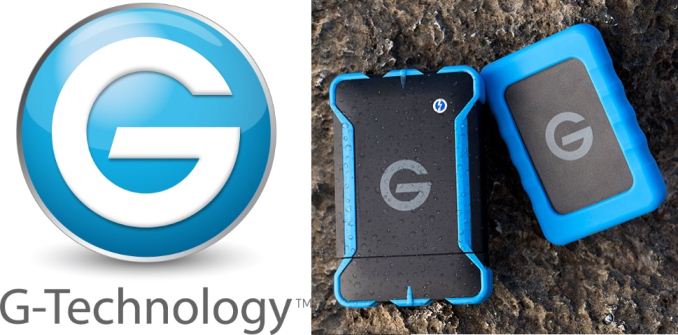
Photographers and content creators have the need for fast storage at both the editing workstation and in the field. LaCie (Seagate) and G-Technology (HGST) are the two main vendors in this field. We have already taken a look at few of LaCie’s products targeting this market segment – the 2big Thunderbolt 2 for using with a desktop and the Rugged Thunderbolt for usage on-the-go. G-Technology’s STUDIO SERIES was one of the recent introductions.

In order to create a well-rounded product lineup, G-Technology introduced a set of rugged solutions at CES 2015. Before going into the details of the new products, it is important to see how G-Technology tries to differentiate itself from LaCie. The two-bay docking solution in the form of the Evolution Series comes into the picture. The G-DOCK ev is a 2-bay Thunderbolt enclosure capable of accepting 2.5″ USB 3.0 drives (either the G-DRIVE ev or the G-DRIVE ev SSD). For the rugged line, G-Technology has chosen to add three new products to the ev lineup.

G-DRIVE ev RaW

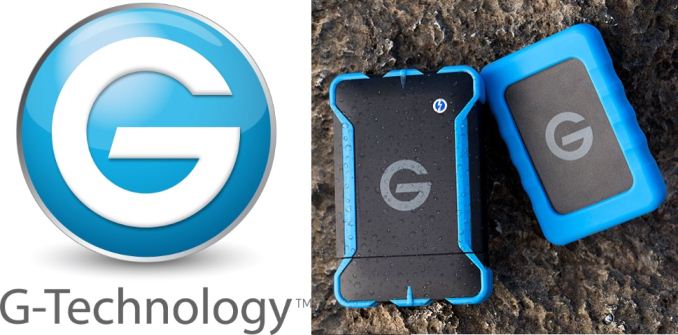
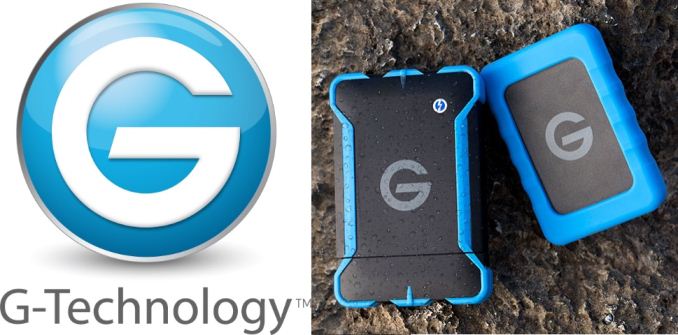
This is a 2.5″ G-DRIVE ev along with a USB 3.0 cable. It comes in either 500 GB ($100) or 1 TB ($130) versions. It has a blue bumper for protection against accidental drops of up to 1.5m.

G-DRIVE ev ATC (USB 3.0)

It is an all-terrain solution which uses the G-DRIVE ev RaW inside a watertight compartment (that also floats in water). There is also protection against pressure, shock, dust and drops up to 2m. A 1 TB version will retail for $180. Users who already possess a G-DRIVE ev (SSD or HDD) can get the USB 3.0 ATC case for $80 when it becomes available next month.

G-DRIVE ev ATC (Thunderbolt)

This is similar to the USB 3.0 ATC, with the computer interface being the only difference. This Thunderbolt peripheral (1 TB) will retail for $230. The Thunderbolt case can be purchased standalone for $130.

On one hand, LaCie has an interesting solution in the form of a single rugged enclosure for both USB 3.0 and Thunderbolt (without sacrificing the higher speeds possible through Thunderbolt). They also recently launched a portable rugged RAID solution. On the other, G-Technology is creating a package deal with the G-DOCK ev as a desktop storage solution that uses easily swappable components. From the design, it appears that the Thunderbolt version would be unlikely to perform better than the USB 3.0 version. Since most of the G-DRIVE products (including those launched at CES) are hard-drive based, it is unlikely to be a big issue. From an end-user perspective, it is great to have both choices and one can let the usage model dictate the suitable solution.

G-Technology's Evolution Series Goes Rugged

G-Technology’s Evolution Series Goes Rugged

Photographers and content creators have the need for fast storage at both the editing workstation and in the field. LaCie (Seagate) and G-Technology (HGST) are the two main vendors in this field. We have already taken a look at few of LaCie’s products targeting this market segment – the 2big Thunderbolt 2 for using with a desktop and the Rugged Thunderbolt for usage on-the-go. G-Technology’s STUDIO SERIES was one of the recent introductions.

In order to create a well-rounded product lineup, G-Technology introduced a set of rugged solutions at CES 2015. Before going into the details of the new products, it is important to see how G-Technology tries to differentiate itself from LaCie. The two-bay docking solution in the form of the Evolution Series comes into the picture. The G-DOCK ev is a 2-bay Thunderbolt enclosure capable of accepting 2.5″ USB 3.0 drives (either the G-DRIVE ev or the G-DRIVE ev SSD). For the rugged line, G-Technology has chosen to add three new products to the ev lineup.

G-DRIVE ev RaW

This is a 2.5″ G-DRIVE ev along with a USB 3.0 cable. It comes in either 500 GB ($100) or 1 TB ($130) versions. It has a blue bumper for protection against accidental drops of up to 1.5m.

G-DRIVE ev ATC (USB 3.0)

It is an all-terrain solution which uses the G-DRIVE ev RaW inside a watertight compartment (that also floats in water). There is also protection against pressure, shock, dust and drops up to 2m. A 1 TB version will retail for $180. Users who already possess a G-DRIVE ev (SSD or HDD) can get the USB 3.0 ATC case for $80 when it becomes available next month.

G-DRIVE ev ATC (Thunderbolt)

This is similar to the USB 3.0 ATC, with the computer interface being the only difference. This Thunderbolt peripheral (1 TB) will retail for $230. The Thunderbolt case can be purchased standalone for $130.

On one hand, LaCie has an interesting solution in the form of a single rugged enclosure for both USB 3.0 and Thunderbolt (without sacrificing the higher speeds possible through Thunderbolt). They also recently launched a portable rugged RAID solution. On the other, G-Technology is creating a package deal with the G-DOCK ev as a desktop storage solution that uses easily swappable components. From the design, it appears that the Thunderbolt version would be unlikely to perform better than the USB 3.0 version. Since most of the G-DRIVE products (including those launched at CES) are hard-drive based, it is unlikely to be a big issue. From an end-user perspective, it is great to have both choices and one can let the usage model dictate the suitable solution.

Zotac Updates ZBOX mini-PC Lineup at CES 2015

Zotac Updates ZBOX mini-PC Lineup at CES 2015

Zotac’s ZBOX series of mini-PCs has been receiving lots of updates over the last year or so. In addition to the traditional ZBOX (which, in itself, was small enough to carry with one hand), the lineup has expanded to include the ZBOX nano, ZBOX nano xs and ZBOX pico families (in order of decreasing size). At CES 2015, we got updates in almost all categories.

ZBOX CI321 nano

An evolutionary update to the ZBOX CI320 nano, it features a Haswell-Y Celeron in the place of a Bay Trail-M processor. The Intel Celeron 2961Y clocks in at 1.1 GHz. It is also the first nano C-series SKU to come with two GbE ports. Other than that, the specifications are just like any other C-series Intel-based mini-PC.

ZBOX EN860

This is a traditional ZBOX with a discrete mobile GPU. Like all traditional ZBOX units, it comes with two GbE ports. The gaming credentials of the system is boosted by the presence of a GTX 860M. A Haswell-U processor, the i5-4210U does the CPU duties. The unit can drive 4Kp60 displays over the DVI-I and Display Port outputs. It is also compatible with NVIDIA G-SYNC displays.

ZBOX PA330

The PA330 is the follow-up to the pocketable PI330 introduced late last year. A tablet platform in a different form factor, the PA330 uses a AMD A4-6400T quad-core Mullins APU with 2 GB of DDR3L and 32 GB eMMC storage. The PI330 from last year uses an Atom Z3775 Bay Trail-T SoC with 4 GB of LPDDR3 and 64 GB of eMMC. That said, the PI330 comes with 802.11n Wi-Fi, while the PA330 sports a 802.11ac connection. GbE LAN, a couple of USB ports and a headphone jack are also present.

Zotac also supplied us with a brochure listing features of their ZBOX units that are currently in the market. One of the tables in it tabulates the features that are available in each series. We are reproducing it below, as we believe readers will find it useful in choosing the right model that fits their needs.

Full pricing details and firm launch dates for the ZBOX models launched at CES 2015 are not yet available.

I had a few suggestions for Zotac when visiting their suite at CES. First of all, for models which have only one SO-DIMM slot, Zotac should put more marketing emphasis on the PLUS models. The drawback of the PLUS units for models with two memory slots is that consumers often do not bother to fill up the free slot. Operating in the single memory channel mode prevents users from realizing the full potential of the computing platform. The quality of the SSDs being used in those PLUS models must also be good (not the FORESEE models in the C-series that we have seen so far). For the premium ZBOX units with two GbE ports, Zotac should opt for Intel GbE transceivers instead of going with Realtek.

Zotac Updates ZBOX mini-PC Lineup at CES 2015

Zotac Updates ZBOX mini-PC Lineup at CES 2015

Zotac’s ZBOX series of mini-PCs has been receiving lots of updates over the last year or so. In addition to the traditional ZBOX (which, in itself, was small enough to carry with one hand), the lineup has expanded to include the ZBOX nano, ZBOX nano xs and ZBOX pico families (in order of decreasing size). At CES 2015, we got updates in almost all categories.

ZBOX CI321 nano

An evolutionary update to the ZBOX CI320 nano, it features a Haswell-Y Celeron in the place of a Bay Trail-M processor. The Intel Celeron 2961Y clocks in at 1.1 GHz. It is also the first nano C-series SKU to come with two GbE ports. Other than that, the specifications are just like any other C-series Intel-based mini-PC.

ZBOX EN860

This is a traditional ZBOX with a discrete mobile GPU. Like all traditional ZBOX units, it comes with two GbE ports. The gaming credentials of the system is boosted by the presence of a GTX 860M. A Haswell-U processor, the i5-4210U does the CPU duties. The unit can drive 4Kp60 displays over the DVI-I and Display Port outputs. It is also compatible with NVIDIA G-SYNC displays.

ZBOX PA330

The PA330 is the follow-up to the pocketable PI330 introduced late last year. A tablet platform in a different form factor, the PA330 uses a AMD A4-6400T quad-core Mullins APU with 2 GB of DDR3L and 32 GB eMMC storage. The PI330 from last year uses an Atom Z3775 Bay Trail-T SoC with 4 GB of LPDDR3 and 64 GB of eMMC. That said, the PI330 comes with 802.11n Wi-Fi, while the PA330 sports a 802.11ac connection. GbE LAN, a couple of USB ports and a headphone jack are also present.

Zotac also supplied us with a brochure listing features of their ZBOX units that are currently in the market. One of the tables in it tabulates the features that are available in each series. We are reproducing it below, as we believe readers will find it useful in choosing the right model that fits their needs.

Full pricing details and firm launch dates for the ZBOX models launched at CES 2015 are not yet available.

I had a few suggestions for Zotac when visiting their suite at CES. First of all, for models which have only one SO-DIMM slot, Zotac should put more marketing emphasis on the PLUS models. The drawback of the PLUS units for models with two memory slots is that consumers often do not bother to fill up the free slot. Operating in the single memory channel mode prevents users from realizing the full potential of the computing platform. The quality of the SSDs being used in those PLUS models must also be good (not the FORESEE models in the C-series that we have seen so far). For the premium ZBOX units with two GbE ports, Zotac should opt for Intel GbE transceivers instead of going with Realtek.