Vik


AMD Enters NAS Market with QNAP's 10G-Ready TVS-x63

AMD Enters NAS Market with QNAP’s 10G-Ready TVS-x63
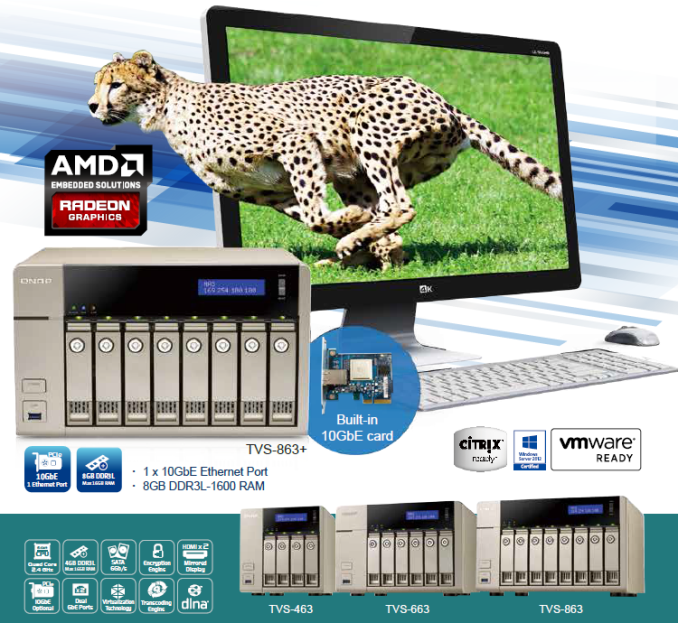
QNAP’s CES suite was quite busy when we visited them last week. Considering the number of product and feature announcements that were made, it wasn’t a surprise at all. There were three new major product announcements, and we will cover them in the course of two articles.

The NAS market has been dominated by Intel’s x86 platform at the mid- to high-end, and ARM-based SoCs at the lower end of the market. Things are shaking up this year, with the launch of a 2x 10GbE equipped ARM-based model from Synology, the DS2015xs. On the x86 front, I had often wondered why AMD never had a product in the market. Considering the fact that the HP ProLiant microservers based on the AMD Turion platform were quite popular in the DIY market, it was surprising to find the COTS NAS vendors ignoring it completely. With the launch of the TVS-x63 lineup, QNAP has become the first vendor to bring an AMD-based x86 NAS to the market.

The TVS-x63 lineup has 4-, 6- and 8-bay models. Each of them come with either 4 or 8 GB of RAM. Higher amounts of RAM are necessary for applications where the Virtualization Station package will find use. In addition, the 8-bay model also comes with a ‘+’ SKU. This version has a 10GBASE-T NIC pre-installed in the spare PCIe slot. The ‘+’ version comes with either 8 or 16 GB of RAM. We will summarize the specifications of the various models in the TVS-x63 towards the end of the article. Prior to that, we will take a look at the AMD embedded G-series SoC that powers these NAS units.

QNAP specifies the CPU in the TVS-x63 models as ‘AMD quad-core 2.4 GHz with Radeon Graphics’ in their marketing material. At the suite, we pulled up the System Information tab, which revealed the AMD SoC to be GX-424CC.
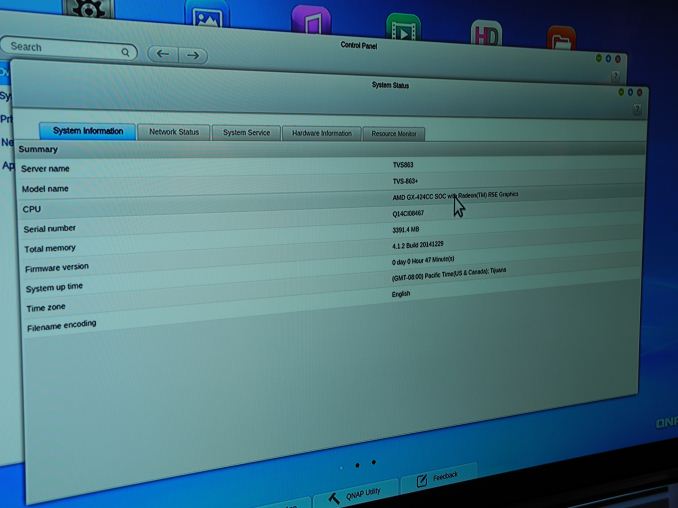
The GX-424CC is a 4C/4T Steppe Eagle configuration (based on the Puma / Jaguar+ microarchitecture). It has a TDP of 25 W. The L2 cache is 2 MB in size and the cores run at 2.4 GHz. The integrated Radeon GPU runs at 497 MHz. The unit can support DDR3 memory at 1866 MHz. Puma is the successor to Jaguar. It supports out-of-order execution. Performance-wise, it is expected to be similar to that of the Silvermont cores in the Bay Trail SoCs.

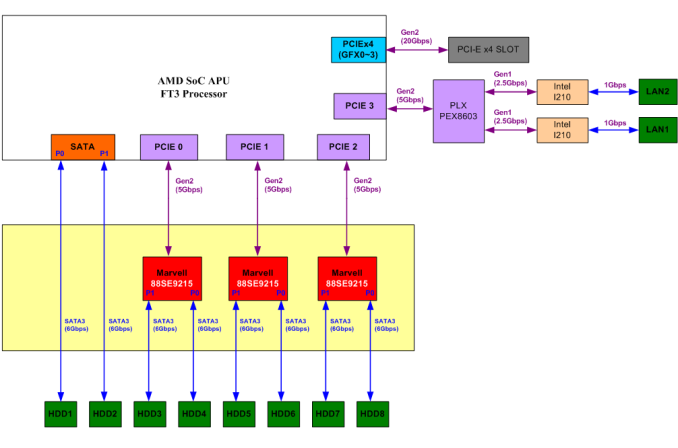
The block diagram of a typical AMD G-Series embedded SoC based on the Puma cores is produced below. It is a first-generation APU SoC design. The I/O ports mentioned at the bottom of the block diagram are important in determining how the QNAP TVS-x63 NAS units balance the I/O amongst the various necessary ports.
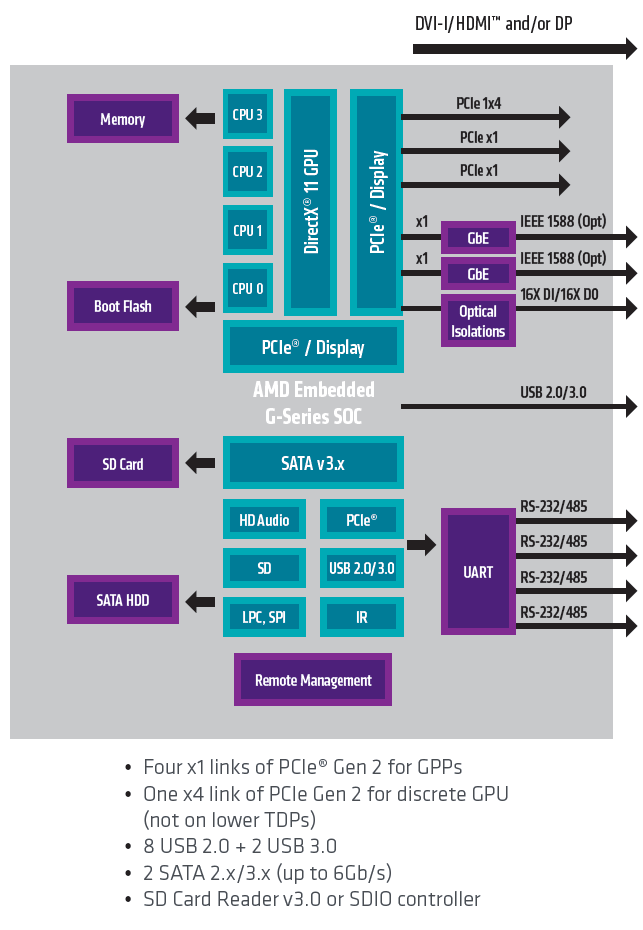
Considering the 8-bay TVS-863 for further analysis, we find the various I/Os distributed as shown below. It must be noted that the first two bays are directly connected to the SATA ports of the SoC. QNAP strongly suggests that those two ports be used for SSD caching. Typically, SoCs targeting the NAS market have native Ethernet ports, but the AMD SoC needs a PCIe bridge chip. We will have to see what effect this has in the performance department.
On the multimedia side of things, the TVS-x63 has two HDMI outputs. It supports true 4K output for the UI as well as QvPC side of things. However, video playback will be restricted to 1080p. The VCE engine is supported by the firmware, enabling hardware-accelerated transcoding similar to what we saw with the TS-x51 and TS-x53 Pro units that used Quick Sync.

The extract below summarizes the specifications of the various models in the TVS-x63 lineup.
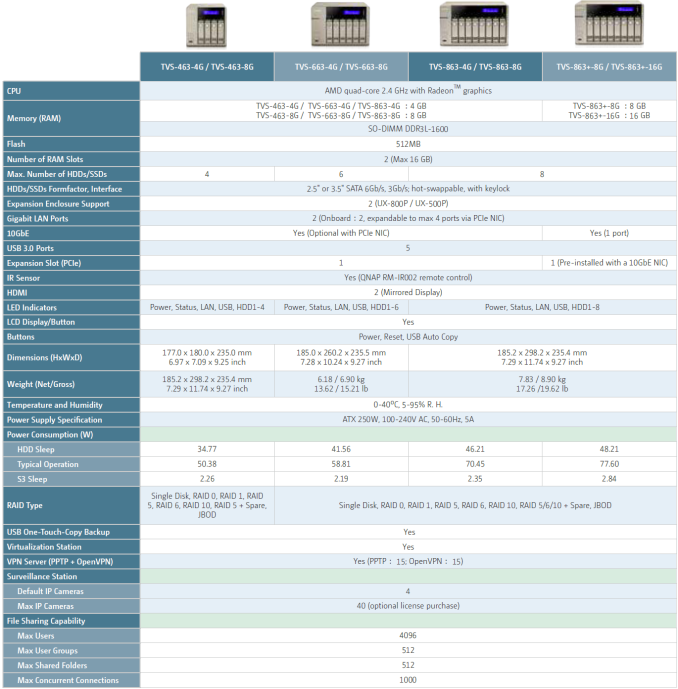
QNAP has sprung a surprise by going the AMD-route for a high performance NAS. We can probably expect the Intel-based NAS units to go down in price over the next few months. I am assuming it also provides some leverage for NAS vendors to negotiate with Intel on the pricing. On the whole, this development is a good one for consumers. In terms of pricing, the TVS-863+-8G is expected to retail for $1400. This is cheap considering the 10G port is pre-installed. The vanilla models come in at $1200 for the TVS-863-4G, $1000 for the TVS-663-4G and $800 for the TVS-463-4G.
OCZ Suite Tour: Vector 180, JetExpress PCIe NVMe Controller & Z-Drive 6000

OCZ Suite Tour: Vector 180, JetExpress PCIe NVMe Controller & Z-Drive 6000

While the Barefoot 3 platform is already a couple of years old, it is still going strong. OCZ has been in the process of adopting Toshiba’s latest A19nm to its whole product lineup and with all other drives having made the change, the Vector is the last (but definitely not the least) to make the switch to the latest NAND process.

Aside from the new NAND, OCZ is also adding a new 960GB capacity. We have seen many OEMs upping their capacities to 960GB/1TB in the past six months or so and the Vector 180 marks as OCZ’s first client-level SATA SSD with 1TB-class capacity. The Vector 180 also features partial power-loss protection (or Power Failure Management Plus as OCZ calls it), which is not a full implementation like in enterprise drives, but there are capacitors to ensure that data at rest is safe. In other words, all user data in the DRAM buffer will still be lost in the case of sudden power loss, but the capacitors ensure that all metadata is safe and that the drive will continue to operate normally after a power loss (i.e. the NAND mapping table won’t be lost, which can brick the drive or at least slow down the next boot up as the drive has to go through recovery process). 

The rest of the specs remain pretty much unchanged from the Vector 150. The drive is rated at 50GB of writes per day and carries a 5-year ShieldPlus warranty (no purchase receipt required and all defective drives will be replaced with brand new units). Given that the controller and the underlying firmware remain unchaged I would expect the performance to be very similar to the Vector 150. 

Unfortunately, the Barefoot 3 platform still doesn’t support low-power states, so the main market for the Vector 180 will be in desktop systems. This is a problem in the silicon itself (it is two years old, after all) and to fix that the silicon would require a redesign, so instead of spending resources on that OCZ has decided to focus on the next generation JetExpress controller.

Originally OCZ’s plan was to release the Vector 180 here at CES, but the company decided to spend a bit more time validating the drive to ensure that everything is okay (which, as some of you may remember, is quite different from what OCZ used to do a few years ago). Availability should be in the coming weeks, though, and I would expect pricing to be close to the Vector 150 or perhaps a bit lower given the new, more cost efficient NAND. 

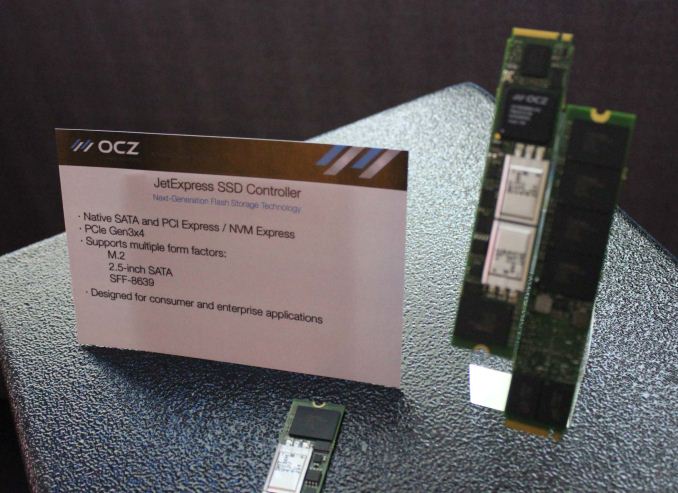
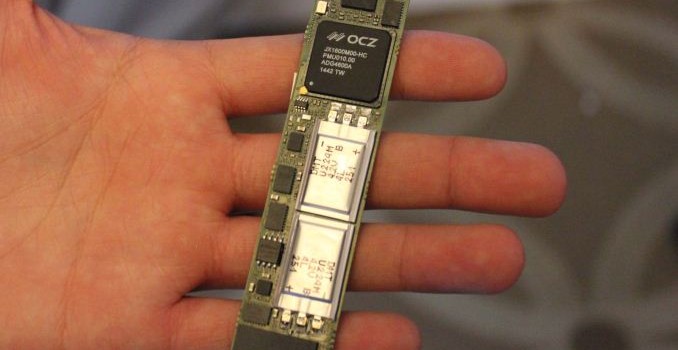
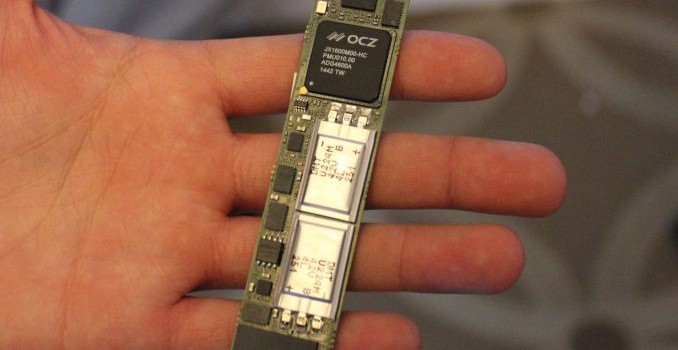
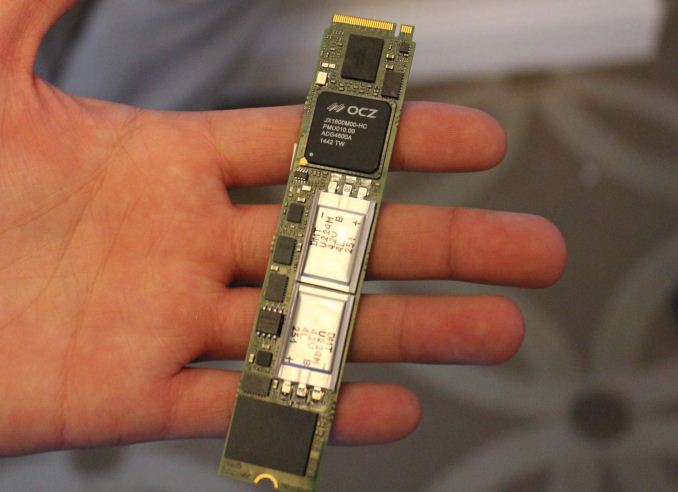
The big and obviously interesting news is OCZ’s JetExpress controller. It’s a native PCIe 3.0 x4 controller with NVMe support and SATA/AHCI are also included for legacy support (SATA isn’t going anywhere anytime soon anyway). In terms of features the JetExpress has pretty much all the bells and whistles. DevSleep, TCG Opal 2.0, eDrive, LDPC error correction and TLC NAND are all supported. The controller itself is small enough to fit in M.2 as seen above, unlike the FPGA designs that we have seen in drives like the Samsung XS1715. 

Architecturally the JetExpress sports the same Aragon cores as the Barefoot 3, but the core count is much higher (I’m hearing seven cores) with each core having its own specific purpose. The chip consists of several power islands, which can be shut down individually for increased power efficiency. The DRAM controller is massive and supports up to 32GB of DDR3, which enables very high capacities (I was told that even 10TB is achievable, although in most cases the problem is the form factor and its physical limitations, not the controller itself).

OCZ will start by shipping the JetExpress to enterprise customers in the first half of 2015 and a client release will follow in H2’15 — most likely right around the time Intel releases its Skylake platform with proper PCIe and NVMe support.

OCZ’s ECC engine is also quite interesting. The controller supports both BCH and LDPC error correction and there are three different modes (high performance, high endurance and hybrid) available. Basically, high performance mode means that only BCH ECC is used, which has less overhead than LDPC but isn’t as powerful and thus results in lower endurance. The high endurance mode, on the other hand, has LDPC enabled, which increases the endurance by about 3x from what I’ve heard. The hybrid mode basically has BCH enabled at first, but as the NAND is cycled and starts to require more ECC, LDPC will kick in to boost the endurance. The reason why OCZ is offering all three modes is that LDPC adds some latency, so once it kicks in there is some performance loss and typically enterprise customers want a device that has predictable performance throughout its life (or at least an option to choose a mode like that). Similarly, some customers value performance more than endurance (online transaction processing is a good example since the more transactions you can do the more money you will make), so OCZ is offering the customer the opportunity to select what mode is the best for their usage.

In addition to the upcoming JetExpress drive OCZ was showing off their upcoming Z-Drive 6000 for enterprises with NVMe support. The drive comes in 2.5″ 15mm form factor with the SFF-8639 connector (basically the enterprise version of SATA Express) and utilizes PCIe 3.0 x4 interface. The Z-Drive features the same PMC controller as Samsung’s XS1715 but obviously the firmware is à la OCZ. Performance comes in at up to 3GB/s for sequential reads and 2GB/s for writes and random performance is up to 700K IOPS for reads and 175K for writes. Capacities go all the way up to 3.2TB, although OCZ was very confident that the company can build a 6.4TB version as well. OCZ is currently sampling a handful of key OEMs and volume availability should be in the coming months.

I spent a good hour talking with OCZ’s CEO, Ralph Schmitt, about how OCZ is doing under Toshiba and what is the direction of the company, so watch out for a deeper dive after CES.

OCZ Suite Tour: Vector 180, JetExpress PCIe NVMe Controller & Z-Drive 6000

OCZ Suite Tour: Vector 180, JetExpress PCIe NVMe Controller & Z-Drive 6000

While the Barefoot 3 platform is already a couple of years old, it is still going strong. OCZ has been in the process of adopting Toshiba’s latest A19nm to its whole product lineup and with all other drives having made the change, the Vector is the last (but definitely not the least) to make the switch to the latest NAND process.

Aside from the new NAND, OCZ is also adding a new 960GB capacity. We have seen many OEMs upping their capacities to 960GB/1TB in the past six months or so and the Vector 180 marks as OCZ’s first client-level SATA SSD with 1TB-class capacity. The Vector 180 also features partial power-loss protection (or Power Failure Management Plus as OCZ calls it), which is not a full implementation like in enterprise drives, but there are capacitors to ensure that data at rest is safe. In other words, all user data in the DRAM buffer will still be lost in the case of sudden power loss, but the capacitors ensure that all metadata is safe and that the drive will continue to operate normally after a power loss (i.e. the NAND mapping table won’t be lost, which can brick the drive or at least slow down the next boot up as the drive has to go through recovery process). 

The rest of the specs remain pretty much unchanged from the Vector 150. The drive is rated at 50GB of writes per day and carries a 5-year ShieldPlus warranty (no purchase receipt required and all defective drives will be replaced with brand new units). Given that the controller and the underlying firmware remain unchaged I would expect the performance to be very similar to the Vector 150. 

Unfortunately, the Barefoot 3 platform still doesn’t support low-power states, so the main market for the Vector 180 will be in desktop systems. This is a problem in the silicon itself (it is two years old, after all) and to fix that the silicon would require a redesign, so instead of spending resources on that OCZ has decided to focus on the next generation JetExpress controller.

Originally OCZ’s plan was to release the Vector 180 here at CES, but the company decided to spend a bit more time validating the drive to ensure that everything is okay (which, as some of you may remember, is quite different from what OCZ used to do a few years ago). Availability should be in the coming weeks, though, and I would expect pricing to be close to the Vector 150 or perhaps a bit lower given the new, more cost efficient NAND. 

The big and obviously interesting news is OCZ’s JetExpress controller. It’s a native PCIe 3.0 x4 controller with NVMe support and SATA/AHCI are also included for legacy support (SATA isn’t going anywhere anytime soon anyway). In terms of features the JetExpress has pretty much all the bells and whistles. DevSleep, TCG Opal 2.0, eDrive, LDPC error correction and TLC NAND are all supported. The controller itself is small enough to fit in M.2 as seen above, unlike the FPGA designs that we have seen in drives like the Samsung XS1715. 

Architecturally the JetExpress sports the same Aragon cores as the Barefoot 3, but the core count is much higher (I’m hearing seven cores) with each core having its own specific purpose. The chip consists of several power islands, which can be shut down individually for increased power efficiency. The DRAM controller is massive and supports up to 32GB of DDR3, which enables very high capacities (I was told that even 10TB is achievable, although in most cases the problem is the form factor and its physical limitations, not the controller itself).

OCZ will start by shipping the JetExpress to enterprise customers in the first half of 2015 and a client release will follow in H2’15 — most likely right around the time Intel releases its Skylake platform with proper PCIe and NVMe support.

OCZ’s ECC engine is also quite interesting. The controller supports both BCH and LDPC error correction and there are three different modes (high performance, high endurance and hybrid) available. Basically, high performance mode means that only BCH ECC is used, which has less overhead than LDPC but isn’t as powerful and thus results in lower endurance. The high endurance mode, on the other hand, has LDPC enabled, which increases the endurance by about 3x from what I’ve heard. The hybrid mode basically has BCH enabled at first, but as the NAND is cycled and starts to require more ECC, LDPC will kick in to boost the endurance. The reason why OCZ is offering all three modes is that LDPC adds some latency, so once it kicks in there is some performance loss and typically enterprise customers want a device that has predictable performance throughout its life (or at least an option to choose a mode like that). Similarly, some customers value performance more than endurance (online transaction processing is a good example since the more transactions you can do the more money you will make), so OCZ is offering the customer the opportunity to select what mode is the best for their usage.

In addition to the upcoming JetExpress drive OCZ was showing off their upcoming Z-Drive 6000 for enterprises with NVMe support. The drive comes in 2.5″ 15mm form factor with the SFF-8639 connector (basically the enterprise version of SATA Express) and utilizes PCIe 3.0 x4 interface. The Z-Drive features the same PMC controller as Samsung’s XS1715 but obviously the firmware is à la OCZ. Performance comes in at up to 3GB/s for sequential reads and 2GB/s for writes and random performance is up to 700K IOPS for reads and 175K for writes. Capacities go all the way up to 3.2TB, although OCZ was very confident that the company can build a 6.4TB version as well. OCZ is currently sampling a handful of key OEMs and volume availability should be in the coming months.

I spent a good hour talking with OCZ’s CEO, Ralph Schmitt, about how OCZ is doing under Toshiba and what is the direction of the company, so watch out for a deeper dive after CES.

A Quick Look at Keyssa: Contactless USB 3.0

A Quick Look at Keyssa: Contactless USB 3.0

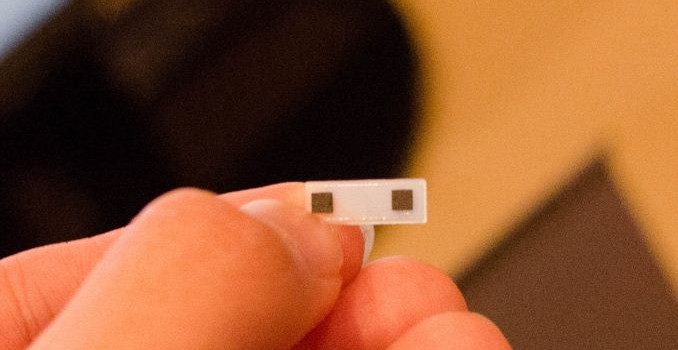
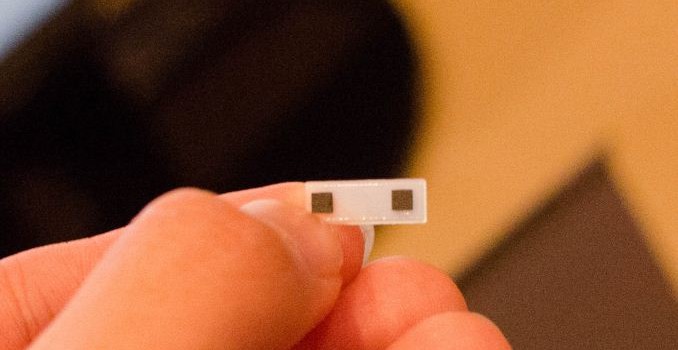
While we often don’t discuss startups, at CES we found a company called Keyssa that claims to have the technology to do away with wired connectors entirely. Normally, these claims are rather misleading, but in the case of Keyssa it seems that th…

A Quick Look at Keyssa: Contactless USB 3.0

A Quick Look at Keyssa: Contactless USB 3.0

While we often don’t discuss startups, at CES we found a company called Keyssa that claims to have the technology to do away with wired connectors entirely. Normally, these claims are rather misleading, but in the case of Keyssa it seems that th…