Vik


Intel Unveils the Xeon Scalable Processor Family: Skylake-SP in Bronze, Silver, Gold and Platinum
Intel Unveils the Xeon Scalable Processor Family: Skylake-SP in Bronze, Silver, Gold and Platinum

One of the more interesting elements of last week’s news was that some of the names of the future Intel Xeon processors, based on the Skylake microarchitecture, were accidentally ‘leaked’ via an official Intel Product Change Notification. In that list, we learned that the processors will have a new naming scheme, and we saw Gold and Platinum processors based on the LGA3647 socket having a wide range of numbers, but no core counts or clock speeds.

Today’s unveiling is minor, but an official approach to the new platform. Due to the way that Intel is expanding its reach from processors to networking to FPGAs and beyond, it has been decided that a new naming scheme needs to be in place. Thus the Xeon E/EP/EX naming regime is being reintegrated into what is now called the ‘Xeon Scalable Processor Family’, of which the first set of products will be based on the Skylake microarchitecture. This is where the ‘SP’ in ‘Skylake-SP’ comes from, as the other abbreviations are now retired.
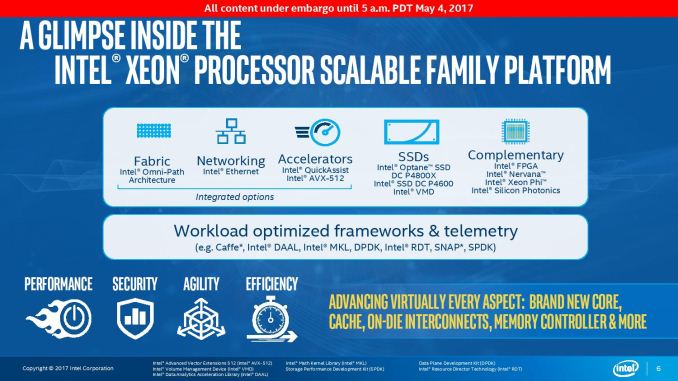
The core of Intel’s unveiling today revolves around the different processor levels they will be offering, and where the new integrated options will fit in the new stack. In the slide above, Intel lists three integrated options: Omni-Path, Networking, and Accelerators.

Integrated Omni-Path options have already been seen in Xeon Phi based products from the Knights Landing family, which occupy the same LGA3647 socket, so it is perhaps not surprising that it looks like Intel will offer some Skylake-SP Xeons with Omni-Path also integrated.

Integrated Networking (asides from OmniPath) would suggest that Intel is looking towards deeper 1000Base-T (gigabit) options and even perhaps a nod to 10G, although this would most likely be provided by additional options on the chipset rather than on the processor (and stems from system integrator leaks we have already seen.

As for integrated accelerators, here Intel mentions Intel QuickAssist (QAT) and AVX-512. AVX-512 is the next advancement in AVX instructions and we already see them in use with Xeon Phi, and we expect there to be the capabilities in silicon to run AVX-512 natively in Skylake-SP. Intel’s QAT is something we’ve seen in standalone PCIe cards before, so it would seem that Intel is also integrating this into the platform. After speaking with users familiar with QAT, due to what is needed to get QAT running at full speed, it would suggest that QAT will be chipset derived and platform dependent rather than purely on the processor.

On the right hand of this slide, Intel mentions FPGA, Nervana, Xeon Phi and Silicon Photonics. The acquisition of Altera for $16.7 billion in 2015 put FPGA integration firmly on the roadmap for Intel’s Xeon product line, however Intel has not officially stated how these will be provided with the new Xeon-SP platforms. The fact that it isn’t listed under the integrated options suggests that Intel will only offer FPGAs as add-in cards (or add-in processors, like Xeon Phi, for dual socket systems) at this time. Intel is also working on new optimized frameworks for the hardware, particularly math and AI libraries.
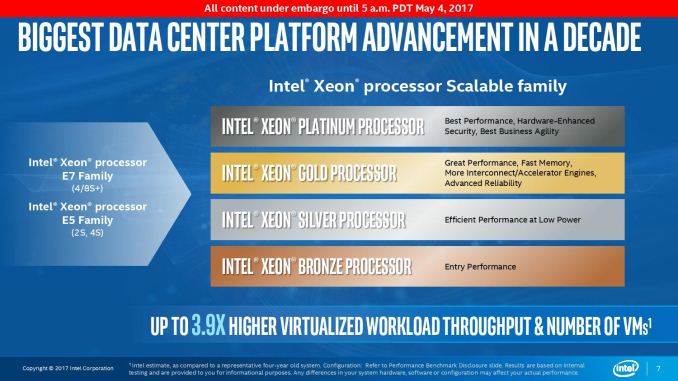
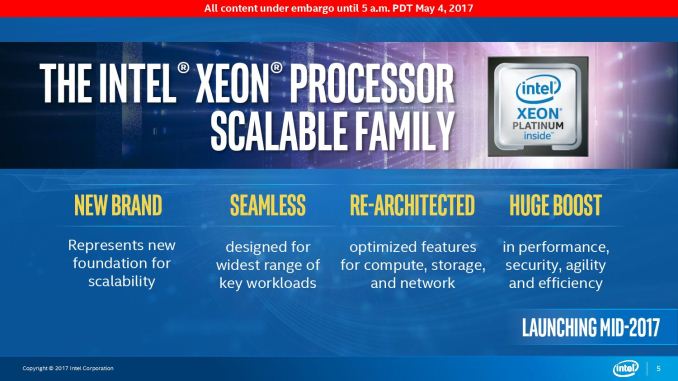
So along with the Gold and Platinum processors we saw last week, Intel will also be introducing Bronze and Silver grades as well. The Bronze group is aimed at entry performance, which sounds like the older low core count E5 parts, while the Silver parts seem aimed at lower power and will probably be low base frequency parts. The Xeon Gold family is aimed at accelerators and interconnects, which suggests they will be for multi-GPU or multi-socket platforms, while the Xeon Platinum will be the cream.

Despite this potential correlation, we were told in our briefing, given by Lisa Spelman, VP and GM of the Data Center Group, that the previous E5/E7 naming split due to potential socket configurations goes away and now we should expect to see various CPUs in all segments correlating to a variety of socket configurations. One of the reasons for this is that sometimes a customer could take advantage of an 8-socket variant processor (due to high cache per core, for example), but would never consider it because the customer only needed a two-socket configuration. One of the reasons given for the naming is to alleviate this issue.

It also means that we might see a lot more product SKUs coming to market, each with different configurations, naming, and capabilities depending on the accelerators. Typically Intel produces three dies for each Xeon generation – a low core count (LCC), a medium/high core count (MCC/HCC), and an extreme core count (XCC) version, and we see a variance up and down the stack depending on what dies fit in where: e.g. LCC were for single socket. With the new Scalable Processor Family naming scheme, we were told that Intel is trying to move away from this differentiation and just provide what the customer needs in the right segment. Not so much integration through obfuscation, but I kindly requested that when the official announcements are made, that the differentiations were made clear. Given the Gold/Platinum processor lists last week, it was unclear exactly what the numbering schemes represented, so in order to make the transition, it needs to be crystal clear.

We were told that as this is the first generation of the Xeon-SP naming scheme, the generation is omitted from the name, but future product lines (Kaby Lake-SP) will have a generational marker to denote the difference. This may be in the form of v2/v3, but this isn’t clarified at this time.

Intel isn’t announcing any products today. This is more of an opportunity to take hold of the news that already exists, and perhaps get a step up ahead of the upcoming conference season. We were told to expect a launch in the middle of the year, and were told that Intel is still on track for that.

Seagate Ships 35th Millionth SMR HDD, Confirms HAMR-Based Drives in Late 2018

Seagate Ships 35th Millionth SMR HDD, Confirms HAMR-Based Drives in Late 2018

Seagate last week made two rather important announcements regarding its current and upcoming hard drives. First, the company said that it had shipped 35 million HDDs based on shingled magnetic recording (SMR) technology. Second, the manufacturer confirmed plans to launch commercial hard drives based on its heat-assisted magnetic recording (HAMR) technology by the end of 2018, the first time the company set a precise launch timeframe for such HDDs.

35 Million and Counting

Seagate launched the Archive 8 TB, its first HDD based on SMR, in 2013. Due to the technology, it targeted archive applications – the majority of the archival workload is sequential writes, and the data is hardly ever updated, concealing peculiarities of shingled magnetic recording. As reported multiple times, to increase areal density, HDDs featuring SMR write new magnetic tracks that overlap part of the previously written tracks. This may slow down the rewriting process since the architecture requires hard drives to rewrite adjacent tracks after any writing action. To mitigate such peculiarities, Seagate incorporated various features into its device-managed SMR-based drives, which were described by Mark Re (CTO of Seagate) in an interview last year. Over the course of the recent years, Seagate has introduced several generations of SMR-based drives for archive, NAS, surveillance and mobile PC applications. Each generation refined the use of shingled magnetic recording technology in a bid to improve performance (for example, Seagate added SLC NAND-based cache to its 2.5” SMR drives) as well as improving areal density.

During a recent call with investors and financial analysts, Stephen Luczo, CEO of Seagate, said that the company had shipped 35 million SMR-based hard drives and was about to launch its fourth generation of SMR-based HDDs. The head of the company did not elaborate on the benefits of the fourth-gen SMR, but Seagate has indicated that its platform is expandable for performance and areal density benefits. In fact, we already know from Western Digital’s announcement of a 14 TB HDD that the upcoming new-gen 3.5” SMR platters have a capacity of 1.75 TB per platter, so we expect Seagate to deal with disks of around the same areal density/capacity.

“We are successfully refreshing a number of products in our portfolio, utilizing our fourth generation SMR technology,” said Mr. Luczo. “To-date, we have sold over 35 million HDDs into the nearline client and consumer markets with this technology.”

What is noteworthy is that shipments of SMR-based drives are accelerating as Seagate expands use of the technology. Seagate shipped around four million of SMR HDDs in the first two years (from September 2013 to September 2015) and then shipments of SMR HDDs have comparatively skyrocketed over the past six quarters.

The main reason why Seagate has managed to accelerate sales of its SMR drives significantly in a short period of time is because such HDDs are contained and managed in isolation, but also because they are drop-in compatible with existing data center and client infrastructure where these drives make sense the most. That being said, we suspect that certain large customers of Seagate still adjust their software before deploying such drives, eliminating unnecessary writes and thus optimizing performance and power consumption by another step from regular testing. To put Seagate’s position into context, SMR-based HDDs from HGST are managed by hosts, which requires tangible investments from their customers. Even though the Ultrastar Ha-series is strictly aimed at clients who primarily appreciate raw capacities and relatively low power consumption (a feature of helium-filled HDDs), the integration issue is not such a big problem for Western Digital as the company still ships many high-margin products. Still, device-managed SMR expertise helps Seagate to address certain market segments with products that have no direct rivals. For example, the Seagate BarraCuda 2 TB HDD and the Seagate FireCuda 2 TB hybrid HDD have no direct competitors in the 2.5”/7mm segment.

One of Seagate’s targets going forward is to make products that do not compete against SSDs directly:

“By this time next year, we anticipate less than 10% of our HDD technology portfolio will be exposed to competing flash devices,” said Mr. Luczo.

HAMR-Based HDDs Due in Late 2018

While it is inevitable that client HDDs will continue to compete with client SSDs, high-end special-purpose drives are going to complement what is available with NAND flash. High-capacity HDDs based on HAMR technology are not going to have direct flash-based rivals of the same price and capacity, therefore, it is important for Seagate to launch such drives sooner rather than later. During the conference call, Seagate indicated that HAMR-based HDDs are set to be released commercially in late calendar 2018.

“From an R&D technology perspective, we continue to invest in our next-generation areal density HAMR technology,” said Mr. Luczo. “With products on the roadmap for the late 2018 calendar year, we believe we are leading the market in developing and bringing to market this important cost-benefit solution for mass storage capacity needs.”

This is not the first time that Seagate has made a HAMR-related announcement, but this is the first time when the company has set a particular launch timeframe for such drives. Previously, Seagate has implied that the first HAMR-based HDDs would feature a capacity of 16 TB, which is a significant increase from 12 TB hard drives due to be released in the coming weeks. Given the fact that data centers cry out for high-capacity drives, it is inevitable that HAMR-based HDDs with increased performance and higher capacities will be in high demand. Keeping in mind that late 2018 (by “late” companies usually mean the fourth quarter) is over a year away, Seagate is not sharing details about experimental deployments of HAMR-based HDDs that may be planned for 2017/early 2018.

Related Reading:

Seagate Ships 35th Millionth SMR HDD, Confirms HAMR-Based Drives in Late 2018

Seagate Ships 35th Millionth SMR HDD, Confirms HAMR-Based Drives in Late 2018

Seagate last week made two rather important announcements regarding its current and upcoming hard drives. First, the company said that it had shipped 35 million HDDs based on shingled magnetic recording (SMR) technology. Second, the manufacturer confirmed plans to launch commercial hard drives based on its heat-assisted magnetic recording (HAMR) technology by the end of 2018, the first time the company set a precise launch timeframe for such HDDs.

35 Million and Counting

Seagate launched the Archive 8 TB, its first HDD based on SMR, in 2013. Due to the technology, it targeted archive applications – the majority of the archival workload is sequential writes, and the data is hardly ever updated, concealing peculiarities of shingled magnetic recording. As reported multiple times, to increase areal density, HDDs featuring SMR write new magnetic tracks that overlap part of the previously written tracks. This may slow down the rewriting process since the architecture requires hard drives to rewrite adjacent tracks after any writing action. To mitigate such peculiarities, Seagate incorporated various features into its device-managed SMR-based drives, which were described by Mark Re (CTO of Seagate) in an interview last year. Over the course of the recent years, Seagate has introduced several generations of SMR-based drives for archive, NAS, surveillance and mobile PC applications. Each generation refined the use of shingled magnetic recording technology in a bid to improve performance (for example, Seagate added SLC NAND-based cache to its 2.5” SMR drives) as well as improving areal density.

During a recent call with investors and financial analysts, Stephen Luczo, CEO of Seagate, said that the company had shipped 35 million SMR-based hard drives and was about to launch its fourth generation of SMR-based HDDs. The head of the company did not elaborate on the benefits of the fourth-gen SMR, but Seagate has indicated that its platform is expandable for performance and areal density benefits. In fact, we already know from Western Digital’s announcement of a 14 TB HDD that the upcoming new-gen 3.5” SMR platters have a capacity of 1.75 TB per platter, so we expect Seagate to deal with disks of around the same areal density/capacity.

“We are successfully refreshing a number of products in our portfolio, utilizing our fourth generation SMR technology,” said Mr. Luczo. “To-date, we have sold over 35 million HDDs into the nearline client and consumer markets with this technology.”

What is noteworthy is that shipments of SMR-based drives are accelerating as Seagate expands use of the technology. Seagate shipped around four million of SMR HDDs in the first two years (from September 2013 to September 2015) and then shipments of SMR HDDs have comparatively skyrocketed over the past six quarters.

The main reason why Seagate has managed to accelerate sales of its SMR drives significantly in a short period of time is because such HDDs are contained and managed in isolation, but also because they are drop-in compatible with existing data center and client infrastructure where these drives make sense the most. That being said, we suspect that certain large customers of Seagate still adjust their software before deploying such drives, eliminating unnecessary writes and thus optimizing performance and power consumption by another step from regular testing. To put Seagate’s position into context, SMR-based HDDs from HGST are managed by hosts, which requires tangible investments from their customers. Even though the Ultrastar Ha-series is strictly aimed at clients who primarily appreciate raw capacities and relatively low power consumption (a feature of helium-filled HDDs), the integration issue is not such a big problem for Western Digital as the company still ships many high-margin products. Still, device-managed SMR expertise helps Seagate to address certain market segments with products that have no direct rivals. For example, the Seagate BarraCuda 2 TB HDD and the Seagate FireCuda 2 TB hybrid HDD have no direct competitors in the 2.5”/7mm segment.

One of Seagate’s targets going forward is to make products that do not compete against SSDs directly:

“By this time next year, we anticipate less than 10% of our HDD technology portfolio will be exposed to competing flash devices,” said Mr. Luczo.

HAMR-Based HDDs Due in Late 2018

While it is inevitable that client HDDs will continue to compete with client SSDs, high-end special-purpose drives are going to complement what is available with NAND flash. High-capacity HDDs based on HAMR technology are not going to have direct flash-based rivals of the same price and capacity, therefore, it is important for Seagate to launch such drives sooner rather than later. During the conference call, Seagate indicated that HAMR-based HDDs are set to be released commercially in late calendar 2018.

“From an R&D technology perspective, we continue to invest in our next-generation areal density HAMR technology,” said Mr. Luczo. “With products on the roadmap for the late 2018 calendar year, we believe we are leading the market in developing and bringing to market this important cost-benefit solution for mass storage capacity needs.”

This is not the first time that Seagate has made a HAMR-related announcement, but this is the first time when the company has set a particular launch timeframe for such drives. Previously, Seagate has implied that the first HAMR-based HDDs would feature a capacity of 16 TB, which is a significant increase from 12 TB hard drives due to be released in the coming weeks. Given the fact that data centers cry out for high-capacity drives, it is inevitable that HAMR-based HDDs with increased performance and higher capacities will be in high demand. Keeping in mind that late 2018 (by “late” companies usually mean the fourth quarter) is over a year away, Seagate is not sharing details about experimental deployments of HAMR-based HDDs that may be planned for 2017/early 2018.

Related Reading: