Vik


AT20 Giveaway Day 5: Zotac GTX 1080 Ti AMP Video Card & ZBOX Mini-PC
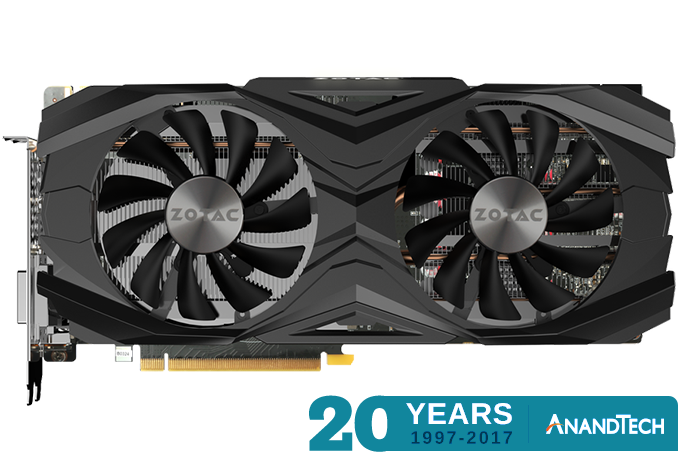
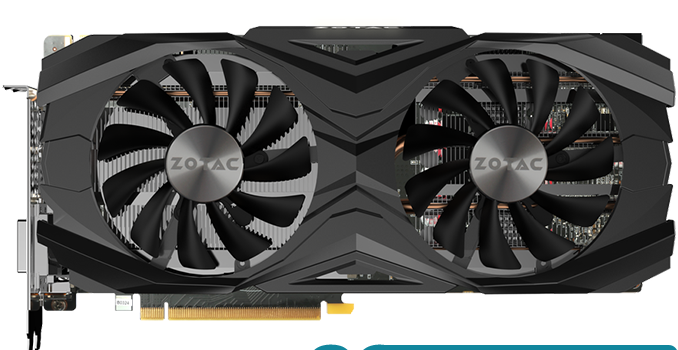
AT20 Giveaway Day 5: Zotac GTX 1080 Ti AMP Video Card & ZBOX Mini-PC

Today marks day 5 of our 20 day giveaway celebration of AnandTech’s 20th anniversary, and things are just heating up. With only 20 days to give away prizes and so many to offer, for most of the next 3 weeks we’ll be doubling up on giveaways, running one in the morning and one in the afternoon. This means that you’ll want to check in morning and night if you want to see and potentially win everything we have to offer.

So far we’ve given away some high-end CPUs and motherboards, but we haven’t done anything like that for video cards. This morning Zotac will be changing that with their GeForce GTX 1080 Ti Amp Edition, a factory overclocked GTX 1080 Ti card. Or maybe you don’t need something quite so big? Then we’ll also be starting small with our first barebones PC prize, Zotac’s ZBOX CI325 nano.

  • ZOTAC GeForce GTX 1080 Ti AMP Edition
  • Zotac ZBOX CI325 nano

The AnandTech 20th Anniversary Celebration – Zotac Giveaway

ZOTAC GeForce GTX 1080 Ti AMP Edition
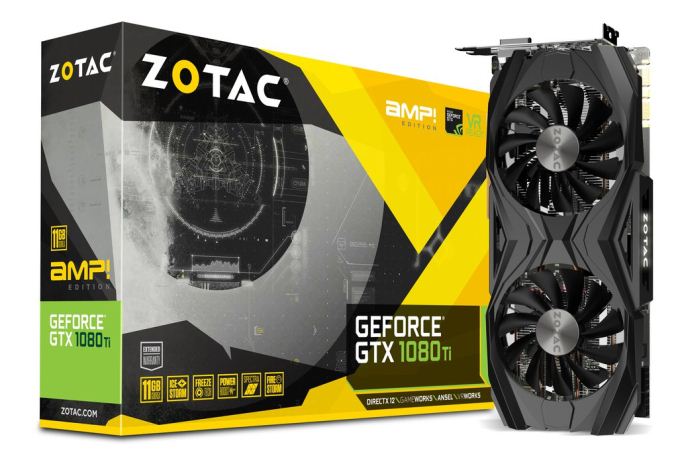
ZOTAC has long made a name for themselves with their wide range of NVIDIA-based video cards, ranging from barebones low-end cards for workstations up to their most powerful AMP family of cards for high-end gaming systems. Their GeForce GTX 1080 Ti AMP Edition in turn lives up to this name, taking NVIDIA’s already uber-powerful GeForce GTX 1080 Ti and giving it a further factory overclock.

GeForce GTX 1080 Ti Specifications
  Zotac GeForce GTX 1080 Ti AMP Edition NVIDIA GTX 1080 Ti
(Reference)
Boost Clock 1683 MHz 1582MHz
Memory Clock 11Gbps 11Gbps
VRAM 11GB 11GB
TDP 270W 250W
Length 11.81″ 10.5″
Width Double Slot Double Slot
Cooler Type Open Air Blower

Besides featuring a more powerful 1683MHz out-of-the-box boost clock, the GTX 1080 Ti AMP is also using a custom Zotac PCB, which implements no fewer than 16 power phases for the GPU. Cooling the beast is one of the company’s open-air dual-fan Icestorm coolers, which uses some rather sizable 100mm diameter fans (so make sure you have the space!).

Zotac ZBOX CI325 nano
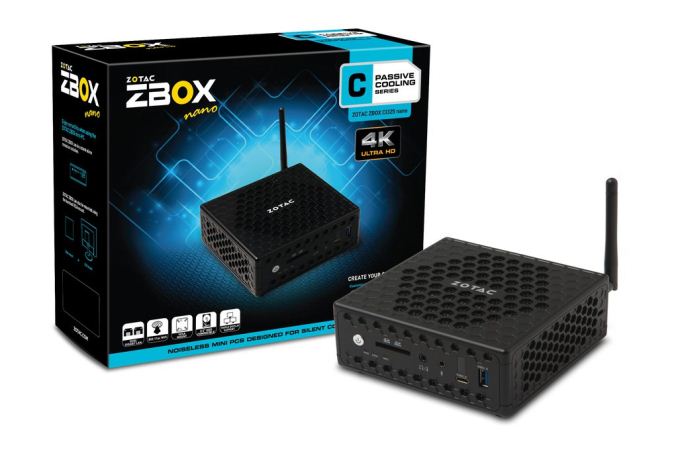
But if perhaps small is your thing, Zotac has you covered as well. The company’s other pastime is their lineup of ZBOX barebones mini-PCs, so they’re letting us give away one of those as well in the form of the ZBOX CI325 nano.

Zotac ZBOX CI325 nano Specifications
Processor Intel Celeron N3160
Airmont, 4C/4T, 2.24 GHz, 14nm
Memory DDR3L-1600, 2x SO-DIMM Slots
Graphics Intel HD Graphics 400
Disk Drive(s) 1x 2.5″ HDD/SDD Bay
Networking 1×1 802.11ac + BT 4.0
2x Gigabit Ethernet
Audio 3.5mm Headphone and Microphone Jacks
Capable of 5.1/7.1 digital output with HD audio bitstreaming (HDMI)
Display 1x DP 1.1a (3840×2160 @ 30 Hz)
1x HDMI 1.4b (3840×2160 @ 30Hz)
1x VGA
Miscellaneous I/O Ports 1x USB 3.1 Gen 1 Type-C
2x USB 3.0 Type-A
2x USB 2.0 Type-A
1x SDXC Slot
Full Specifications Zotac ZBOX CI325 nano Specifications

The ZBOX CI325 nano is an entry-level design with an emphasis on size, coming in at just 128mm wide and 57mm tall. Part of keeping the size down is thanks to the passive cooling design, which means no space is needed for fans. In turn, powering the ZBOX CI325 nano is Intel’s Celeron N3160 SoC, one of the company’s 14nm Airmont based SoCs. The N3160 can boost up to 2.24GHz and supports up to 2 SO-DIMMs. Rounding out the package is the usual selection of USB ports – including a USB-C port – and integrated 802.11ac WiFi with an external antenna.

Finally, as with our other giveaways, today’s giveaway is only open for 48 hours, so be sure to enter soon. However please note that for legal reasons, we’re only able to open these giveaways to residents of the United States.

Good luck to everyone! And be sure to check in this afternoon for our next giveaway.
AMD Releases Q1 2017 Earnings, Confirms Vega and Naples Still On-Track for This Quarter

AMD Releases Q1 2017 Earnings, Confirms Vega and Naples Still On-Track for This Quarter

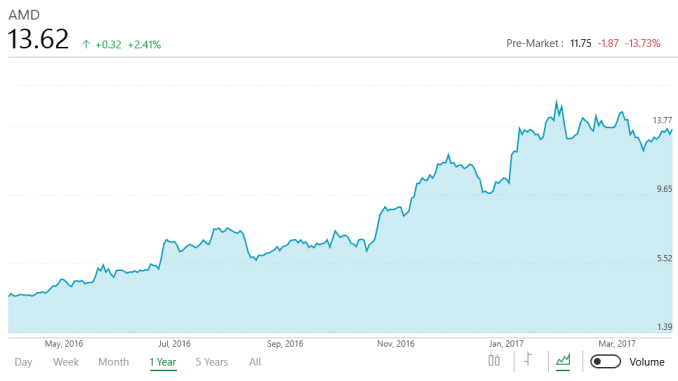
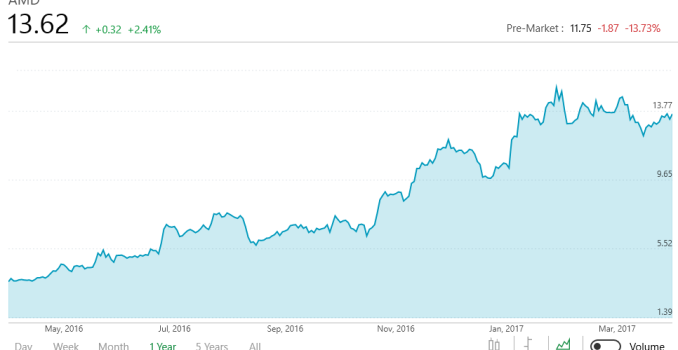
AMD’s Q1 earnings are in, capping off a very important quarter for the company. For the first quarter of the year, AMD booked $984 million in revenue, a sizable 18% jump over Q1 last year. This revenue increase was enough to narrow the company’s losses, but not to wipe them out entirely. On a GAAP basis the company lost $73M for the quarter, leading to an overall loss of $0.08 per share. Q1 is also a relatively weak quarter for technology companies in general, and AMD is no exception, with revenue down and losses up slightly compared to their revenue-strong fourth quarter of 2016.

March of course saw the launch of their first CPUs based on the Zen architecture, kicking off AMD’s big comeback into the CPU space that has long been their core competency and biggest breadwinner. The Ryzen 7 launch in turn isn’t meant to turn AMD’s fortunes around overnight – especially when it was only on retail shelves for one month of the quarter – but it’s the start of something bigger for AMD. The impending launch of Naples – which AMD has reiterated is on track for this quarter – will be the second part of this turnaround.

AMD Q1 2017 Financial Results (GAAP)
  Q1’2017 Q4’2016 Q1’2016
Revenue $948M $1110M $832M
Gross Margin 34% 32% 32%
Operating Income -$29M -$3M -$68M
Net Income -$73M -$51M -$109M
Earnings Per Share -$0.08 -$0.06 -$0.14

One bit of good news here is that AMD’s gross margin is up, and is now at 34%. AMD has structured their business to be able to operate with margins in the 30% range, but 35% has long been considered the soft floor for profitability, which means AMD is getting close to that. AMD’s cash flow is a bit less rosy though; the company has $943M in cash and short-term investments as of the end of Q1’17, versus $1.26B in the prior quarter. On an overall basis, AMD’s asset value is largely unchanged, with the difference in cash being offset by an increase in the company’s inventory and accounts receivable.

AMD’s non-GAAP results, which the company reports as a means to better show the state of the core business, show similar results. Non-GAAP results show a smaller loss overall, but the company is still in the red on operating income and net income. There is no single large factor this time around hurting GAAP results – AMD isn’t taking any large write-offs or the like – but rather it’s a number of smaller items, including the cost of employee stock-based compensation and charges related to AMD’s $1.41B in long-term debt.

AMD Q1 2017 Financial Results (Non-GAAP)
  Q1’2017 Q4’2016 Q1’2016
Revenue $984 $1110M $832M
Gross Margin 34% 32% 32%
Operating Income -$6M $26M -$55M
Net Income -$38M -$8M -$96M
Earnings Per Share -$0.04 -$0.01 -$0.12

Breaking results down by segments, AMD’s situation in Q1’17 was fairly similar to past quarters. The Computing and Graphics segment is still the largest part of AMD’s two divisions, and outside of overall stock-based compensation, is still the division losing AMD money. Overall the Computing division booked $593M in revenue for the quarter, which is up 29% from Q1’16 and in fact is barely down from the always-strong Q4. The operating loss for the quarter was $15M, down significantly from Q1’16’s $70M loss, and even still better than Q4’16’s $21M loss.

The biggest factor here, of course, is Ryzen. With its high prices compared to AMD’s past desktop processors, it has been a big part in increasing AMD’s overall average selling price both on a quarterly and yearly basis. Similarly, GPU ASPs were up as well.

AMD Q1 2017 Computing and Graphics
  Q1’2017 Q4’2016 Q1’2016
Revenue $593M $600M $460M
Operating Income -$15M -$21M -$70M

Meanwhile AMD’s Enterprise, Embedded, and Semi-Custom segment continued to stay in the black for the quarter, but revenue did drop from the previous quarter as holiday console sales tapered off. Revenue for the quarter was $391M, up slightly from the $372M of Q1’16, while the operating income was $9M, versus last year’s $16M. Otherwise the All Other segment booked a $23M loss due to the aforementioned stock-based compensation.

AMD Q1 2017 Enterprise, Embedded, and Semi-Custom
  Q1’2017 Q4’2016 Q1’2016
Revenue $391M $506M $372M
Operating Income $9M $47M $16M

Looking towards the future, AMD a 17% revenue increase for Q2, while gross margins are expected to dip slightly to 33%. Besides enjoying a full quarter of Ryzen sales, AMD has once again confirmed that they will be launching both the Naples server CPU and the Vega GPU architecture in this quarter. Both are high-end, high-profit products that should significantly help AMD’s bottom line if they perform as expected. Though even with the Q2 launch, AMD won’t enjoy the full benefits of those launches until Q3 when they have further ramped up and collect revenue for those products over the whole quarter.

AMD Releases Q1 2017 Earnings, Confirms Vega and Naples Still On-Track for This Quarter

AMD Releases Q1 2017 Earnings, Confirms Vega and Naples Still On-Track for This Quarter

AMD’s Q1 earnings are in, capping off a very important quarter for the company. For the first quarter of the year, AMD booked $984 million in revenue, a sizable 18% jump over Q1 last year. This revenue increase was enough to narrow the company’s losses, but not to wipe them out entirely. On a GAAP basis the company lost $73M for the quarter, leading to an overall loss of $0.08 per share. Q1 is also a relatively weak quarter for technology companies in general, and AMD is no exception, with revenue down and losses up slightly compared to their revenue-strong fourth quarter of 2016.

March of course saw the launch of their first CPUs based on the Zen architecture, kicking off AMD’s big comeback into the CPU space that has long been their core competency and biggest breadwinner. The Ryzen 7 launch in turn isn’t meant to turn AMD’s fortunes around overnight – especially when it was only on retail shelves for one month of the quarter – but it’s the start of something bigger for AMD. The impending launch of Naples – which AMD has reiterated is on track for this quarter – will be the second part of this turnaround.

AMD Q1 2017 Financial Results (GAAP)
  Q1’2017 Q4’2016 Q1’2016
Revenue $948M $1110M $832M
Gross Margin 34% 32% 32%
Operating Income -$29M -$3M -$68M
Net Income -$73M -$51M -$109M
Earnings Per Share -$0.08 -$0.06 -$0.14

One bit of good news here is that AMD’s gross margin is up, and is now at 34%. AMD has structured their business to be able to operate with margins in the 30% range, but 35% has long been considered the soft floor for profitability, which means AMD is getting close to that. AMD’s cash flow is a bit less rosy though; the company has $943M in cash and short-term investments as of the end of Q1’17, versus $1.26B in the prior quarter. On an overall basis, AMD’s asset value is largely unchanged, with the difference in cash being offset by an increase in the company’s inventory and accounts receivable.

AMD’s non-GAAP results, which the company reports as a means to better show the state of the core business, show similar results. Non-GAAP results show a smaller loss overall, but the company is still in the red on operating income and net income. There is no single large factor this time around hurting GAAP results – AMD isn’t taking any large write-offs or the like – but rather it’s a number of smaller items, including the cost of employee stock-based compensation and charges related to AMD’s $1.41B in long-term debt.

AMD Q1 2017 Financial Results (Non-GAAP)
  Q1’2017 Q4’2016 Q1’2016
Revenue $984 $1110M $832M
Gross Margin 34% 32% 32%
Operating Income -$6M $26M -$55M
Net Income -$38M -$8M -$96M
Earnings Per Share -$0.04 -$0.01 -$0.12

Breaking results down by segments, AMD’s situation in Q1’17 was fairly similar to past quarters. The Computing and Graphics segment is still the largest part of AMD’s two divisions, and outside of overall stock-based compensation, is still the division losing AMD money. Overall the Computing division booked $593M in revenue for the quarter, which is up 29% from Q1’16 and in fact is barely down from the always-strong Q4. The operating loss for the quarter was $15M, down significantly from Q1’16’s $70M loss, and even still better than Q4’16’s $21M loss.

The biggest factor here, of course, is Ryzen. With its high prices compared to AMD’s past desktop processors, it has been a big part in increasing AMD’s overall average selling price both on a quarterly and yearly basis. Similarly, GPU ASPs were up as well.

AMD Q1 2017 Computing and Graphics
  Q1’2017 Q4’2016 Q1’2016
Revenue $593M $600M $460M
Operating Income -$15M -$21M -$70M

Meanwhile AMD’s Enterprise, Embedded, and Semi-Custom segment continued to stay in the black for the quarter, but revenue did drop from the previous quarter as holiday console sales tapered off. Revenue for the quarter was $391M, up slightly from the $372M of Q1’16, while the operating income was $9M, versus last year’s $16M. Otherwise the All Other segment booked a $23M loss due to the aforementioned stock-based compensation.

AMD Q1 2017 Enterprise, Embedded, and Semi-Custom
  Q1’2017 Q4’2016 Q1’2016
Revenue $391M $506M $372M
Operating Income $9M $47M $16M

Looking towards the future, AMD a 17% revenue increase for Q2, while gross margins are expected to dip slightly to 33%. Besides enjoying a full quarter of Ryzen sales, AMD has once again confirmed that they will be launching both the Naples server CPU and the Vega GPU architecture in this quarter. Both are high-end, high-profit products that should significantly help AMD’s bottom line if they perform as expected. Though even with the Q2 launch, AMD won’t enjoy the full benefits of those launches until Q3 when they have further ramped up and collect revenue for those products over the whole quarter.

LG 43UD79-B Launched: 42.5-inch 4K IPS with FreeSync

LG 43UD79-B Launched: 42.5-inch 4K IPS with FreeSync

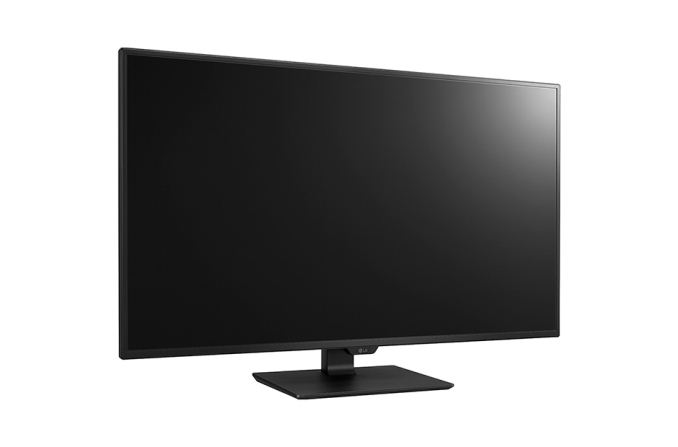
LG is about to launch a new monitor that is one of the most feature-filled monitors on the market once it arrives. Referred to as the 43UD79-B, this 42.5-inch display has a native UHD resolution of 3840 x 2160 with a conventional refresh rate of 60Hz. It features an IPS panel with a non-glare coating, a peak brightness of 350 cd/m2, a contrast ratio of up to 1000:1, and an 8ms gray-to-gray (GTG) response time. The viewing angles are wide at 178°/178°, which is typical for an IPS display. Although support for 1.07 billion colors is claimed, the lack of an explicit mention of a 10-bit panel leads us to believe that this is an 8-bit panel using A-FRC to achieve a 10-bit color depth. On the plus side, this model will ship color calibrated from the factory.

Specifications
  LG 43UD79-B
Panel 42.5″ IPS
Resolution 3840 × 2160
Refresh Rate 60 Hz
Variable Refresh Rate FreeSync
Response Time 8 ms (GTG)
Brightness 350 cd/m²
Contrast Up to 5000000:1
1000:1 Typical
Viewing Angles 178°/178° horizontal/vertical
PPI 104 pixels per inch
0.245 mm2 pixel pitch
Colors 1.07 billion
Inputs 1 × DisplayPort 1.2a
2 × HDMI 2.0
× HDMI 1.4
1 × USB Type-C with DP Alt Mode

× RS-232C
USB Hub 2-port USB 3.0 hub with KVM switch
Audio × 10W harmon/kardon speakers
Headphone Output
Launch Date May 19th, 2017 (Japan)
Launch Price ¥‎83000 (Japanese Yen)
~$745 USD

Assuming that the press release is indeed accurate, this model not only supports FreeSync variable refresh technology, but also a host of other gaming-oriented features like Game Mode, Black Stabilizer, and Dynamic Action Sync (DAS) Mode. The native 60Hz refresh rate will likely preclude this model from ever becoming a gamer favorite, but we are still glad to see that LG made an effort in catering to the gaming crowd. The peak refresh rate is likely 60 Hz for the Freesync, however LG does not specify the lower bound. Technically the specification sheet says 56-61Hz, although that is rather small for a FreeSync range.

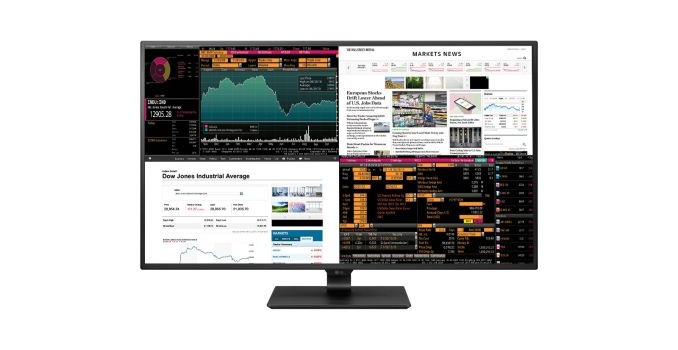
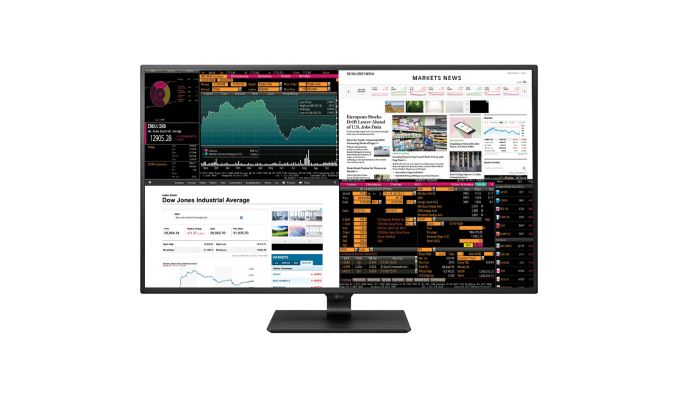
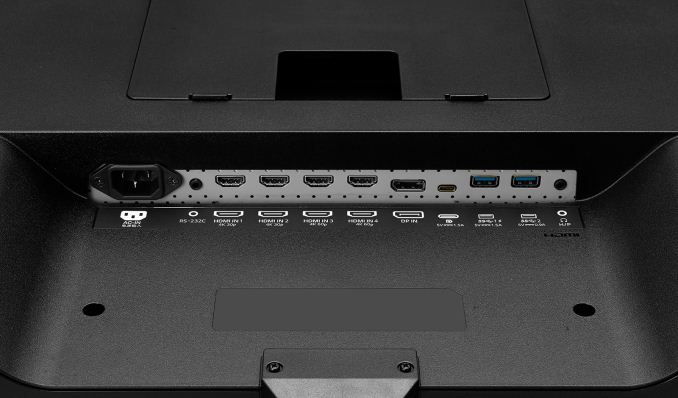
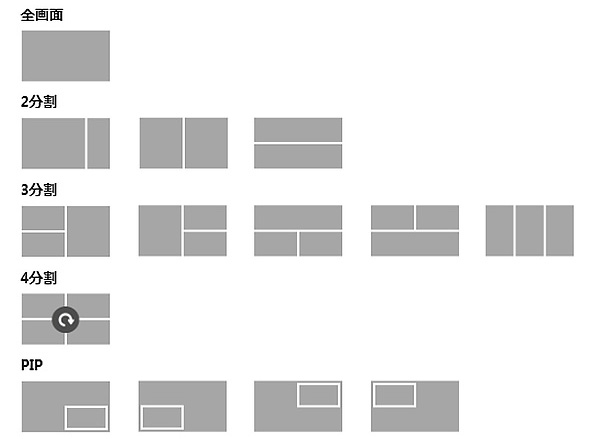
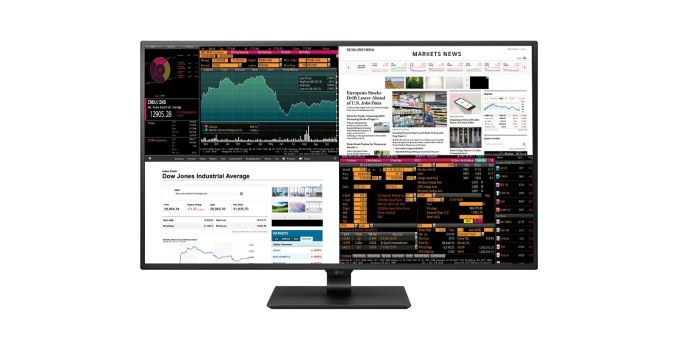
The connectivity front is where this monitor really shines. There are two HDMI 2.0 inputs (4K @ 60Hz), two HDMI 1.4 inputs (4K @ 30Hz), one USB 3.1 Type-C port that can operate in DP Alt Mode and thus carry a DisplayPort signal, and one DisplayPort 1.2a input (4K @ 60Hz) that supports the aforementioned FreeSync feature. The reason for all these inputs is that this monitor can display images from up to 4 devices at once. You can either split the screen into four 21.5-inch 1080P sections, two horizontal or vertical sections, or even three sections of varying sizes. There is also support for basic Picture-in-Picture (PIP) if you don’t wish to subdivide the screen real estate.


Different monitor arrangements with multiple inputs

Also present is LG’s Dual Controller feature, which essentially turns the monitor into a KVM switch. Users can plug a mouse and keyboard into the two downstream USB 3.0 ports, connect the monitor to two computers, and control both systems from that single mouse/keyboard combo. Rounding out the basic specifications are built-in 2x10W Harman Kardon stereo speakers, a headphone jack, an RS-232C connector, and a small remote control. The included stand is fairly basic in that it only allows tilt adjustments.

While the press release indicates a countrywide Japanese launch on May 19th at a price of around 83,000 yen, US-based retailers are already offering preorders for $697 with an expected availability of May 9th. If that holds true, that is a very attractive price for a roughly 43-inch 4K monitor with that many built-in features and a three-year warranty.

Gallery: LG 43UD79-B

LG 43UD79-B Launched: 42.5-inch 4K IPS with FreeSync

LG 43UD79-B Launched: 42.5-inch 4K IPS with FreeSync

LG is about to launch a new monitor that is one of the most feature-filled monitors on the market once it arrives. Referred to as the 43UD79-B, this 42.5-inch display has a native UHD resolution of 3840 x 2160 with a conventional refresh rate of 60Hz. It features an IPS panel with a non-glare coating, a peak brightness of 350 cd/m2, a contrast ratio of up to 1000:1, and an 8ms gray-to-gray (GTG) response time. The viewing angles are wide at 178°/178°, which is typical for an IPS display. Although support for 1.07 billion colors is claimed, the lack of an explicit mention of a 10-bit panel leads us to believe that this is an 8-bit panel using A-FRC to achieve a 10-bit color depth. On the plus side, this model will ship color calibrated from the factory.

Specifications
  LG 43UD79-B
Panel 42.5″ IPS
Resolution 3840 × 2160
Refresh Rate 60 Hz
Variable Refresh Rate FreeSync
Response Time 8 ms (GTG)
Brightness 350 cd/m²
Contrast Up to 5000000:1
1000:1 Typical
Viewing Angles 178°/178° horizontal/vertical
PPI 104 pixels per inch
0.245 mm2 pixel pitch
Colors 1.07 billion
Inputs 1 × DisplayPort 1.2a
2 × HDMI 2.0
× HDMI 1.4
1 × USB Type-C with DP Alt Mode

× RS-232C
USB Hub 2-port USB 3.0 hub with KVM switch
Audio × 10W harmon/kardon speakers
Headphone Output
Launch Date May 19th, 2017 (Japan)
Launch Price ¥‎83000 (Japanese Yen)
~$745 USD

Assuming that the press release is indeed accurate, this model not only supports FreeSync variable refresh technology, but also a host of other gaming-oriented features like Game Mode, Black Stabilizer, and Dynamic Action Sync (DAS) Mode. The native 60Hz refresh rate will likely preclude this model from ever becoming a gamer favorite, but we are still glad to see that LG made an effort in catering to the gaming crowd. The peak refresh rate is likely 60 Hz for the Freesync, however LG does not specify the lower bound. Technically the specification sheet says 56-61Hz, although that is rather small for a FreeSync range.

The connectivity front is where this monitor really shines. There are two HDMI 2.0 inputs (4K @ 60Hz), two HDMI 1.4 inputs (4K @ 30Hz), one USB 3.1 Type-C port that can operate in DP Alt Mode and thus carry a DisplayPort signal, and one DisplayPort 1.2a input (4K @ 60Hz) that supports the aforementioned FreeSync feature. The reason for all these inputs is that this monitor can display images from up to 4 devices at once. You can either split the screen into four 21.5-inch 1080P sections, two horizontal or vertical sections, or even three sections of varying sizes. There is also support for basic Picture-in-Picture (PIP) if you don’t wish to subdivide the screen real estate.


Different monitor arrangements with multiple inputs

Also present is LG’s Dual Controller feature, which essentially turns the monitor into a KVM switch. Users can plug a mouse and keyboard into the two downstream USB 3.0 ports, connect the monitor to two computers, and control both systems from that single mouse/keyboard combo. Rounding out the basic specifications are built-in 2x10W Harman Kardon stereo speakers, a headphone jack, an RS-232C connector, and a small remote control. The included stand is fairly basic in that it only allows tilt adjustments.

While the press release indicates a countrywide Japanese launch on May 19th at a price of around 83,000 yen, US-based retailers are already offering preorders for $697 with an expected availability of May 9th. If that holds true, that is a very attractive price for a roughly 43-inch 4K monitor with that many built-in features and a three-year warranty.

Gallery: LG 43UD79-B