Vik


LG 43UD79-B Launched: 42.5-inch 4K IPS with FreeSync
LG 43UD79-B Launched: 42.5-inch 4K IPS with FreeSync

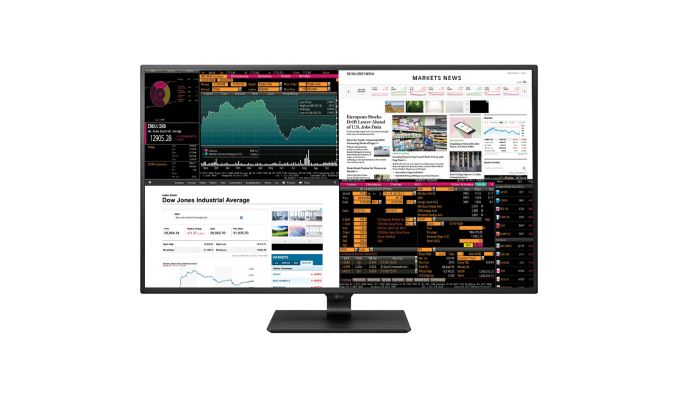
LG is about to launch a new monitor that is one of the most feature-filled monitors on the market once it arrives. Referred to as the 43UD79-B, this 42.5-inch display has a native UHD resolution of 3840 x 2160 with a conventional refresh rate of 60Hz. It features an IPS panel with a non-glare coating, a peak brightness of 350 cd/m2, a contrast ratio of up to 1000:1, and an 8ms gray-to-gray (GTG) response time. The viewing angles are wide at 178°/178°, which is typical for an IPS display. Although support for 1.07 billion colors is claimed, the lack of an explicit mention of a 10-bit panel leads us to believe that this is an 8-bit panel using A-FRC to achieve a 10-bit color depth. On the plus side, this model will ship color calibrated from the factory.

Specifications
  LG 43UD79-B
Panel 42.5″ IPS
Resolution 3840 × 2160
Refresh Rate 60 Hz
Variable Refresh Rate FreeSync
Response Time 8 ms (GTG)
Brightness 350 cd/m²
Contrast Up to 5000000:1
1000:1 Typical
Viewing Angles 178°/178° horizontal/vertical
PPI 104 pixels per inch
0.245 mm2 pixel pitch
Colors 1.07 billion
Inputs 1 × DisplayPort 1.2a
2 × HDMI 2.0
× HDMI 1.4
1 × USB Type-C with DP Alt Mode

× RS-232C
USB Hub 2-port USB 3.0 hub with KVM switch
Audio × 10W harmon/kardon speakers
Headphone Output
Launch Date May 19th, 2017 (Japan)
Launch Price ¥‎83000 (Japanese Yen)
~$745 USD

Assuming that the press release is indeed accurate, this model not only supports FreeSync variable refresh technology, but also a host of other gaming-oriented features like Game Mode, Black Stabilizer, and Dynamic Action Sync (DAS) Mode. The native 60Hz refresh rate will likely preclude this model from ever becoming a gamer favorite, but we are still glad to see that LG made an effort in catering to the gaming crowd. The peak refresh rate is likely 60 Hz for the Freesync, however LG does not specify the lower bound. Technically the specification sheet says 56-61Hz, although that is rather small for a FreeSync range.
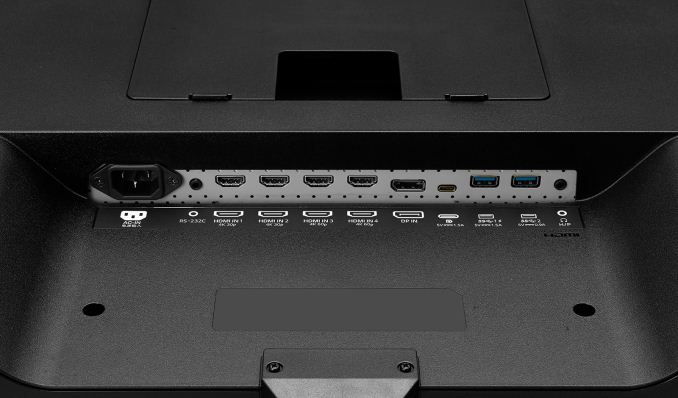
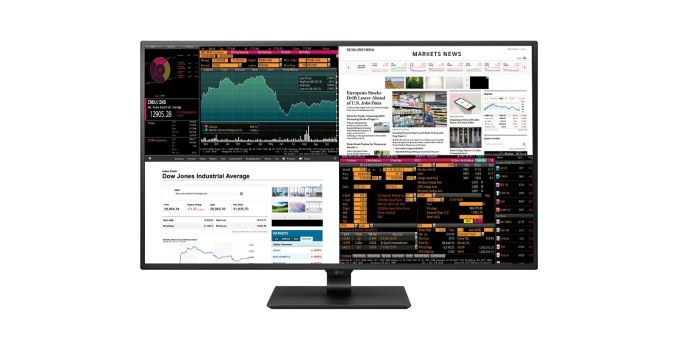
The connectivity front is where this monitor really shines. There are two HDMI 2.0 inputs (4K @ 60Hz), two HDMI 1.4 inputs (4K @ 30Hz), one USB 3.1 Type-C port that can operate in DP Alt Mode and thus carry a DisplayPort signal, and one DisplayPort 1.2a input (4K @ 60Hz) that supports the aforementioned FreeSync feature. The reason for all these inputs is that this monitor can display images from up to 4 devices at once. You can either split the screen into four 21.5-inch 1080P sections, two horizontal or vertical sections, or even three sections of varying sizes. There is also support for basic Picture-in-Picture (PIP) if you don’t wish to subdivide the screen real estate.
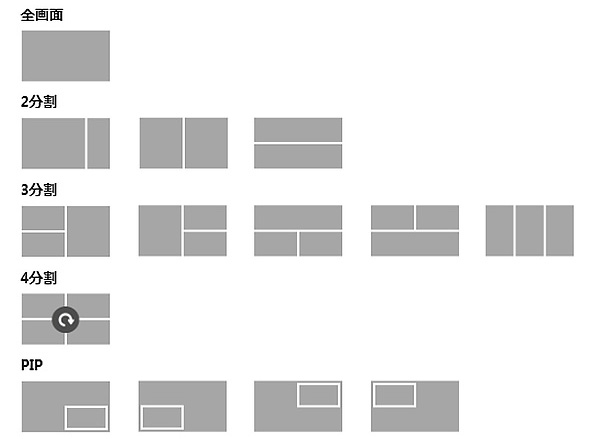

Different monitor arrangements with multiple inputs

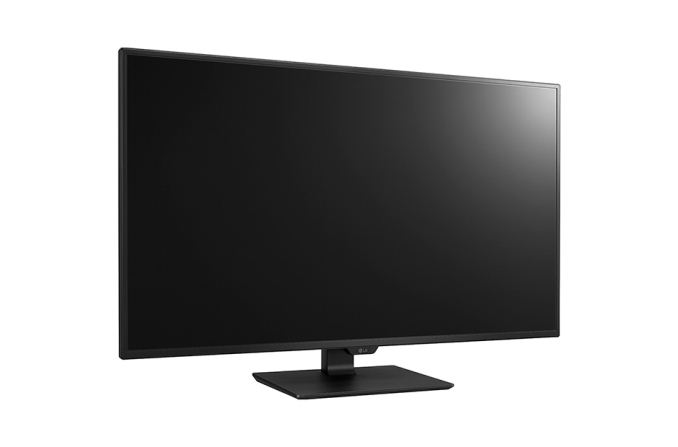
Also present is LG’s Dual Controller feature, which essentially turns the monitor into a KVM switch. Users can plug a mouse and keyboard into the two downstream USB 3.0 ports, connect the monitor to two computers, and control both systems from that single mouse/keyboard combo. Rounding out the basic specifications are built-in 2x10W Harman Kardon stereo speakers, a headphone jack, an RS-232C connector, and a small remote control. The included stand is fairly basic in that it only allows tilt adjustments.
While the press release indicates a countrywide Japanese launch on May 19th at a price of around 83,000 yen, US-based retailers are already offering preorders for $697 with an expected availability of May 9th. If that holds true, that is a very attractive price for a roughly 43-inch 4K monitor with that many built-in features and a three-year warranty.

Gallery: LG 43UD79-B

LG 43UD79-B Launched: 42.5-inch 4K IPS with FreeSync

LG 43UD79-B Launched: 42.5-inch 4K IPS with FreeSync

LG is about to launch a new monitor that is one of the most feature-filled monitors on the market once it arrives. Referred to as the 43UD79-B, this 42.5-inch display has a native UHD resolution of 3840 x 2160 with a conventional refresh rate of 60Hz. It features an IPS panel with a non-glare coating, a peak brightness of 350 cd/m2, a contrast ratio of up to 1000:1, and an 8ms gray-to-gray (GTG) response time. The viewing angles are wide at 178°/178°, which is typical for an IPS display. Although support for 1.07 billion colors is claimed, the lack of an explicit mention of a 10-bit panel leads us to believe that this is an 8-bit panel using A-FRC to achieve a 10-bit color depth. On the plus side, this model will ship color calibrated from the factory.

Specifications
  LG 43UD79-B
Panel 42.5″ IPS
Resolution 3840 × 2160
Refresh Rate 60 Hz
Variable Refresh Rate FreeSync
Response Time 8 ms (GTG)
Brightness 350 cd/m²
Contrast Up to 5000000:1
1000:1 Typical
Viewing Angles 178°/178° horizontal/vertical
PPI 104 pixels per inch
0.245 mm2 pixel pitch
Colors 1.07 billion
Inputs 1 × DisplayPort 1.2a
2 × HDMI 2.0
× HDMI 1.4
1 × USB Type-C with DP Alt Mode

× RS-232C
USB Hub 2-port USB 3.0 hub with KVM switch
Audio × 10W harmon/kardon speakers
Headphone Output
Launch Date May 19th, 2017 (Japan)
Launch Price ¥‎83000 (Japanese Yen)
~$745 USD

Assuming that the press release is indeed accurate, this model not only supports FreeSync variable refresh technology, but also a host of other gaming-oriented features like Game Mode, Black Stabilizer, and Dynamic Action Sync (DAS) Mode. The native 60Hz refresh rate will likely preclude this model from ever becoming a gamer favorite, but we are still glad to see that LG made an effort in catering to the gaming crowd. The peak refresh rate is likely 60 Hz for the Freesync, however LG does not specify the lower bound. Technically the specification sheet says 56-61Hz, although that is rather small for a FreeSync range.

The connectivity front is where this monitor really shines. There are two HDMI 2.0 inputs (4K @ 60Hz), two HDMI 1.4 inputs (4K @ 30Hz), one USB 3.1 Type-C port that can operate in DP Alt Mode and thus carry a DisplayPort signal, and one DisplayPort 1.2a input (4K @ 60Hz) that supports the aforementioned FreeSync feature. The reason for all these inputs is that this monitor can display images from up to 4 devices at once. You can either split the screen into four 21.5-inch 1080P sections, two horizontal or vertical sections, or even three sections of varying sizes. There is also support for basic Picture-in-Picture (PIP) if you don’t wish to subdivide the screen real estate.


Different monitor arrangements with multiple inputs

Also present is LG’s Dual Controller feature, which essentially turns the monitor into a KVM switch. Users can plug a mouse and keyboard into the two downstream USB 3.0 ports, connect the monitor to two computers, and control both systems from that single mouse/keyboard combo. Rounding out the basic specifications are built-in 2x10W Harman Kardon stereo speakers, a headphone jack, an RS-232C connector, and a small remote control. The included stand is fairly basic in that it only allows tilt adjustments.

While the press release indicates a countrywide Japanese launch on May 19th at a price of around 83,000 yen, US-based retailers are already offering preorders for $697 with an expected availability of May 9th. If that holds true, that is a very attractive price for a roughly 43-inch 4K monitor with that many built-in features and a three-year warranty.

Gallery: LG 43UD79-B

Acer Announces Holo 360° Camera with Integrated 4G LTE

Acer Announces Holo 360° Camera with Integrated 4G LTE

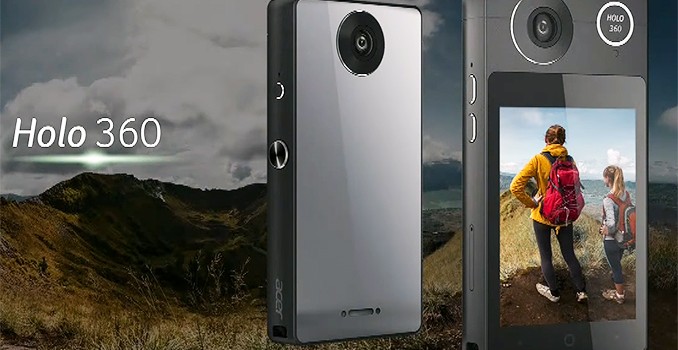
Acer has demonstrated a new camera designed to capture 360° videos and can upload content to the Internet without a PC or a smartphone. The Holo 360 camera is designed to be an easy-to-use camera for consumers,, built on top of Google’s ever-dominant Android operating system. One of the key features of the camera is integrated 4G/LTE modem that can be used to upload content to the Internet. Moreover, the camera can even make phone calls.

Right now Acer is limiting what they’re disclosing about the Holo 360, and I suspect this means that the camera is still under active development. In particular, Acer is not sharing details about the resolutions supported by the camera’s  sensors, nor sharing information about processors that power the Holo 360, or even modem it uses (though keep in mind that different regions use different LTE bands). All of which points to the idea that the current version of the camera is an early prototype and its specifications have yet to be locked down.

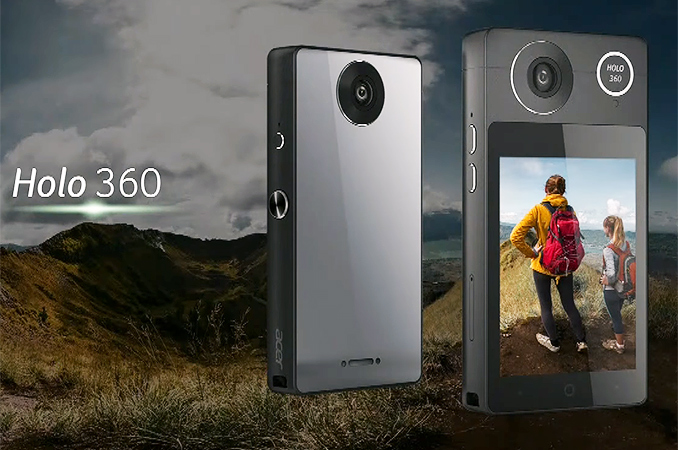
What the company is saying is that the camera can process, edit and share videos in a completely stand-alone manner: it does not need a smartphone or a computer to edit and upload content because it has integrated editing software, Wi-Fi support, as well as an LTE modem (it can even make phone calls, according to Acer). The device looks like a thick Apple iPhone 4 with two spherical cameras, a ~3” display, a slot for cards, multiple buttons and a light sensor. Given such feature set, it is not surprising that that the Holo 360 uses Google’s Android, but it is unclear whether it will have access to Google’s Play Store.

Acer did not reveal MSRP of its 360° camera or its launch date. Moreover, the company provided no specifications and even did not display it alongside other products it announced at the Next@Acer event. It is a little odd for a company to announce a device and then keep it under wraps, but we have two pontential explanations for this: either development of the Holo 360 is far from completion, or the whole device is just a test vehicle for Acer’s 360° video hardware and software, which will end up in one of the company’s upcoming smartphones.

While we do not know almost anything about the Acer Holo 360, it is important that the company demonstrated it at all. On the one hand, it shows that Acer believes in VR and 360° content, which is not exactly surprising as the manufacturer is working on its VR and mixed reality headsets with various partners. On the other hand, it means that Acer sees a potential market for this kind of product, either in an integrated or discrete form. The latter would be an especially interesting twist of fate, as the company used to make portable cameras many years ago.

Related Reading:

Acer Announces Holo 360° Camera with Integrated 4G LTE

Acer Announces Holo 360° Camera with Integrated 4G LTE

Acer has demonstrated a new camera designed to capture 360° videos and can upload content to the Internet without a PC or a smartphone. The Holo 360 camera is designed to be an easy-to-use camera for consumers,, built on top of Google’s ever-dominant Android operating system. One of the key features of the camera is integrated 4G/LTE modem that can be used to upload content to the Internet. Moreover, the camera can even make phone calls.

Right now Acer is limiting what they’re disclosing about the Holo 360, and I suspect this means that the camera is still under active development. In particular, Acer is not sharing details about the resolutions supported by the camera’s  sensors, nor sharing information about processors that power the Holo 360, or even modem it uses (though keep in mind that different regions use different LTE bands). All of which points to the idea that the current version of the camera is an early prototype and its specifications have yet to be locked down.

What the company is saying is that the camera can process, edit and share videos in a completely stand-alone manner: it does not need a smartphone or a computer to edit and upload content because it has integrated editing software, Wi-Fi support, as well as an LTE modem (it can even make phone calls, according to Acer). The device looks like a thick Apple iPhone 4 with two spherical cameras, a ~3” display, a slot for cards, multiple buttons and a light sensor. Given such feature set, it is not surprising that that the Holo 360 uses Google’s Android, but it is unclear whether it will have access to Google’s Play Store.

Acer did not reveal MSRP of its 360° camera or its launch date. Moreover, the company provided no specifications and even did not display it alongside other products it announced at the Next@Acer event. It is a little odd for a company to announce a device and then keep it under wraps, but we have two pontential explanations for this: either development of the Holo 360 is far from completion, or the whole device is just a test vehicle for Acer’s 360° video hardware and software, which will end up in one of the company’s upcoming smartphones.

While we do not know almost anything about the Acer Holo 360, it is important that the company demonstrated it at all. On the one hand, it shows that Acer believes in VR and 360° content, which is not exactly surprising as the manufacturer is working on its VR and mixed reality headsets with various partners. On the other hand, it means that Acer sees a potential market for this kind of product, either in an integrated or discrete form. The latter would be an especially interesting twist of fate, as the company used to make portable cameras many years ago.

Related Reading:

Acer Announces Holo 360° Camera with Integrated 4G LTE

Acer Announces Holo 360° Camera with Integrated 4G LTE

Acer has demonstrated a new camera designed to capture 360° videos and can upload content to the Internet without a PC or a smartphone. The Holo 360 camera is designed to be an easy-to-use camera for consumers,, built on top of Google’s ever-dominant Android operating system. One of the key features of the camera is integrated 4G/LTE modem that can be used to upload content to the Internet. Moreover, the camera can even make phone calls.

Right now Acer is limiting what they’re disclosing about the Holo 360, and I suspect this means that the camera is still under active development. In particular, Acer is not sharing details about the resolutions supported by the camera’s  sensors, nor sharing information about processors that power the Holo 360, or even modem it uses (though keep in mind that different regions use different LTE bands). All of which points to the idea that the current version of the camera is an early prototype and its specifications have yet to be locked down.

What the company is saying is that the camera can process, edit and share videos in a completely stand-alone manner: it does not need a smartphone or a computer to edit and upload content because it has integrated editing software, Wi-Fi support, as well as an LTE modem (it can even make phone calls, according to Acer). The device looks like a thick Apple iPhone 4 with two spherical cameras, a ~3” display, a slot for cards, multiple buttons and a light sensor. Given such feature set, it is not surprising that that the Holo 360 uses Google’s Android, but it is unclear whether it will have access to Google’s Play Store.

Acer did not reveal MSRP of its 360° camera or its launch date. Moreover, the company provided no specifications and even did not display it alongside other products it announced at the Next@Acer event. It is a little odd for a company to announce a device and then keep it under wraps, but we have two pontential explanations for this: either development of the Holo 360 is far from completion, or the whole device is just a test vehicle for Acer’s 360° video hardware and software, which will end up in one of the company’s upcoming smartphones.

While we do not know almost anything about the Acer Holo 360, it is important that the company demonstrated it at all. On the one hand, it shows that Acer believes in VR and 360° content, which is not exactly surprising as the manufacturer is working on its VR and mixed reality headsets with various partners. On the other hand, it means that Acer sees a potential market for this kind of product, either in an integrated or discrete form. The latter would be an especially interesting twist of fate, as the company used to make portable cameras many years ago.

Related Reading: