Vik


Acer Adds 12-Inch Switch 3 & Switch 5 2-in-1s to Kaby Lake Laptop Lineup
Acer Adds 12-Inch Switch 3 & Switch 5 2-in-1s to Kaby Lake Laptop Lineup

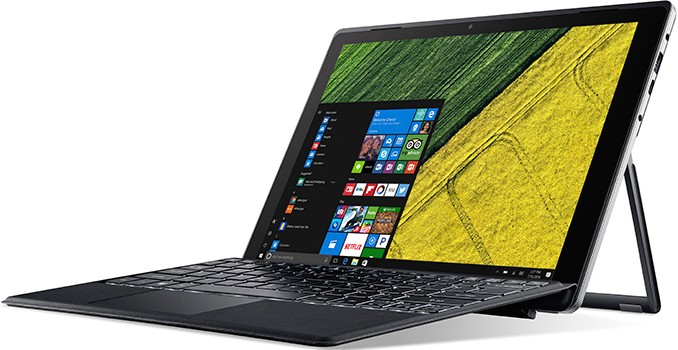
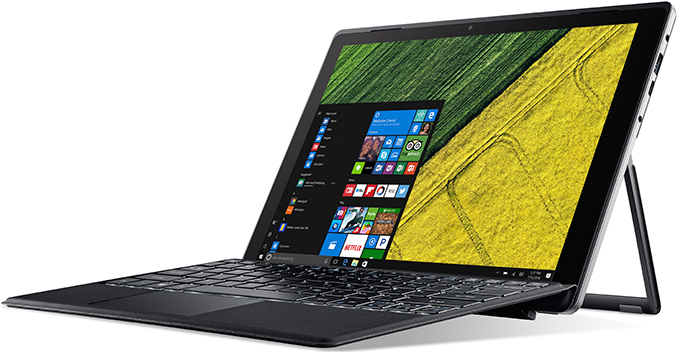
Acer this week introduced its new high-end 2-in-1 hybrid PCs that will be available later this year. The Acer Switch 5 will be aimed at users who require both portability and performance, and is based on Intel’s Core i5/i7 CPU while being paired with up to 8 GB of DRAM as well as up to 512 GB of solid-state storage. To integrate a relatively powerful CPU while retaining moderate price, power consumption and long battery life, Acer had to give up a 4K display panel and a Thunderbolt 3 controller, which were key features of the Switch 5’s predecessor. In addition, Acer announced its new inexpensive Switch 3 convertible notebook that in many ways resembles its more advanced brother.

Sales of PCs continued to decline in Q1 2017 and totaled 62.2 million units, according to Gartner. Market researchers believe that many consumers delay purchases of new PCs because their old machines are good enough and because they tend to spend more on smartphones. Meanwhile, there are multiple indications that computers in hybrid form-factors continue to gain popularity because many people want to have convenience of a tablet (e.g., compact sizes, touchscreen, etc.) and versatility of a laptop (physical keyboard, performance, features). After large PC makers introduced loads of various convertible PCs last year, competition in the segment intensified. Since 2-in-1s still represent a new category, PC vendors continue to learn what the end-user wants from such systems and continue to evolve their designs in response. To a large degree, this is exactly what Acer did with its entry-level Switch 3 and higher-end Switch 5: it upped the bar for its inexpensive machine and eliminated “overkill” features on the advanced model.

Comparison of Acer Switch 3 and 5
  Switch 5 Switch 3
Screen Resolution 12″ 2160×1440 12.2″ 1920×1200
CPU Core i5-7200U (2C/4T, 3 MB, 2.5/3.1 GHz)
Core i5-7300U (2C/4T, 3 MB, 2.6/3.5 GHz)
Core i7-7500U (2C/4T, 4 MB, 2.7/3.5 GHz)
Core i7-7600U (2C/4T, 4 MB,  2.8/3.9 GHz)
Celeron 3865U (2C/2T, 2 MB, 1.8 GHz)
Celeron 3965U (2C/2T, 2 MB, 2.2 GHz)
Pentium 4415U (2C/4T, 2 MB, 2.3 GHz)
Graphics HD Graphics 620 (24 EUs) HD Graphics 610 (12 EU)
RAM 8 GB LPDDR3 4 GB LPDDR3
Storage 256 or 512 GB PCIe 3.0 x2 32, 64 or 128 GB eMMC
Wi-Fi 2×2 802.11ac Wi-Fi
Bluetooth Bluetooth 4.0
USB 3.0 × Type-A
× Type-C (also used for charging, external display, etc.)
Card Reader MicroSD
Fingerprint Sensor Yes No
Other I/O Microphone, stereo speakers, audio jack
Battery Life 10.5 hours 8 hours
Thickness Pad: 9.6 mm
Pad + keyboard: ~15.4 mm
Pad: 9.95 mm
Pad + keyboard: 16.3 mm
Weight Pad: 920 grams
Pad + keyboard: 1270 grams
Pad: 900 grams
Pad + keyboard: unknown
Price $799 and €1099 $399 and €499

Acer Switch 5: Fanless PC with Intel Core i5/i7

The Acer Switch 5 hybrid laptop is powered by on Intel’s 7th generation dual-core Core i5/i7 CPUs with a 15W TDP. Previously the company used various Core M (Skylake-Y) CPUs for such computers, but since Core i5/i7 offer considerably higher performance due to higher frequencies, Acer decided to switch to them. The manufacturer uses its fanless “Liquid Loop” cooling solution (based on either heatpipe or vapor chamber tech) to cool down the CPU. Consequently the new PC is utterly quiet, just like its predecessors, the Acer Switch 12 S as well as the Switch Alpha.

The new 2-in-1 can be equipped with up to 8GB of LPDDR3 memory, a 256 GB or a 512 GB PCIe 3.0 x2 SSD, a 802.11 ac Wi-Fi controller with 2×2 MU-MIMO technology, front- and back-facing cameras, a fingerprint reader, one USB 3.0 Type-A, and one USB 3.0 Type-C (5 Gbps) port, as well as a MicroSD card reader.

However unlike its predecessor the Switch 12 S, the Acer Switch 5 comes with only one display option: a 12” IPS panel with a 2160×1440 resolution, covered with an unspecified protective glass. The multi-touch display supports the Acer Active Pen for note-taking and sketching, solidifying its tablet credentials. Previous-gen high-end convertibles from Acer offered an optional 4K display panel, but this time the manufacturer decided not to give such an option. Thunderbolt 3 has also been excised, presumably due to power consumption and/or cost concerns.

The Acer Switch 5 is made of anodized aluminum, and because it also now uses a higher-performance CPU and a more powerful cooling system, the unit got a little thicker and heavier than the Aspire Switch 12 S. The tablet itself is about 9.6 mm (0.38 inches) thick and weighs around 920 grams (2.03 pounds). Meanwhile, the new keyboard seems to be more compact than the predecessor, which is why the whole system became thinner and lighter: with the keyboard connected, the 2-in-1 laptop is 15.24 mm thick (0.6 inches) and weighs around 1270 grams (2.8 pounds).

The Acer Switch 5 will hit the market in North America and EMEA in June starting at $799 and €1099, respectively (exact specs vary by the region). The system will be available in China starting from July at a price from ¥7,499.

Gallery: Acer Switch 5

Acer Switch 3: Entry-Level 2-in-1 with FHD Display

The Acer Switch 3 is an entry-level 2-in-1, which is positioned above the inexpensive Switch V10 and the Switch One 10 launched a year ago. With the Switch 3, Acer is no longer pursuing the low end of the market, which is why the system inherits a lot from its more expensive brother, the Switch 5 (e.g., design, configuration of ports, etc.).

The Switch 3 is based on Intel’s Kaby Lake Celeron and Pentium processors, with cooling provided by Acer’s fanless cooling solution. The device comes with up to 4 GB of LPDDR3, up to 128 GB of eMMC solid-state storage, front- and back-facing cameras, as well as dual-band MIMO 802.11ac Wi-Fi. The 2-in-1 also features a USB Type-C port, which is used for data transfer, video output and charging. The Switch 3 has a 12.2” IPS touchscreen with 1920×1200 resolution. As for dimensions and weight, the system is a bit thicker (9.95 mm), but a bit lighter (900 grams) than the Switch 5.

Since the Switch 3 does not have to address the low end of the market, it is not going to come at a bargain price. The convertible will be available in Europe and the U.S. in June for €499 and $399, respectively. It will hit the Chinese market in July starting at ¥4,999. And keep in mind that exact specs will vary depending on the region.

Gallery: Acer Switch 3

Related Reading:

Microsoft Announces Q3 FY 2017 Results

Microsoft Announces Q3 FY 2017 Results

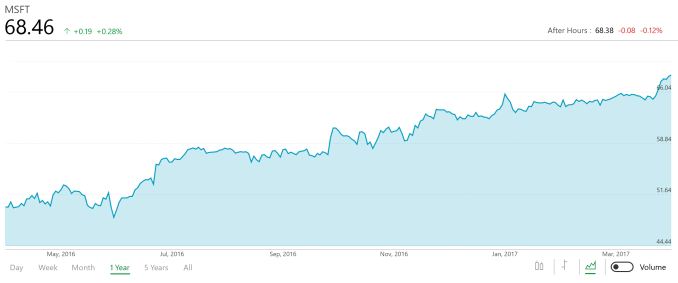
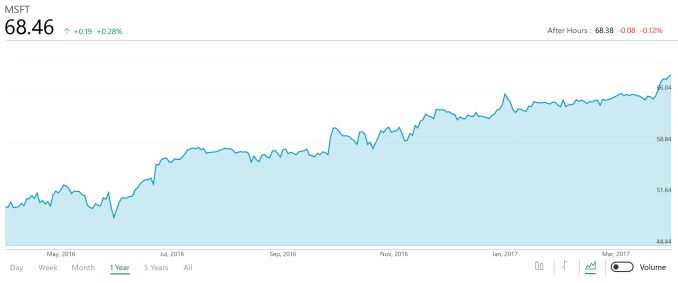
This week, Microsoft announced their earnings for the third quarter of their 2017 fiscal year. Despite missing some expectations in a few segments, Microsoft’s revenue was up 8% to $22.1 billion, and gross margin was up 10% to $14 billion, resulting in a gross margin of 64% for the quarter. Operating income was up 6% to $5.6 billion, and net income was up 28% to $4.8 billion, which resulted in earnings-per-share of $0.61, which is up 30% from the same time last year.

Microsoft Q3 2017 Financial Results (GAAP)
  Q3’2017 Q2’2017 Q3’2016
Revenue (in Billions USD) $22.090 $24.090 $20.531
Operating Income (in Billions USD) $5.594 $6.177 $5.283
Gross Margin (in Billions USD) $14.030 $14.189 $12.809
Margins 63.5% 58.9% 62.4%
Net Income (in Billions USD) $4.801 $5.200 $3.756
Basic Earnings per Share (in USD) $0.61 $0.66 $0.47

Microsoft also reports Non-GAAP results, which report earnings with constant currency reconciliations to equalize the strength or weakness of the USD versus global currencies, as well as Windows 10 revenue deferrals due to it including upgrade rights for the lifetime of the product, so rather than just counting the sale of a Windows license as a lump sum, it is now deferred. Microsoft will be switching to a new revenue standard to count Windows 10 sales up front in the future, but for now their revenue recognition practices require them to defer it. On a Non-GAAP basis, Microsoft earned $23.6 billion in revenue, up 6%, or 7% in constant currency (CC), had a gross margin of $15.5 billion, up 7% or 9% CC, which as a percentage of revenue is 66%, up 1% from a year ago. Operating income for the quarter was $7.1 billion, up 2%, or 5% CC, and net income was $5.7 billion, up 13%, or 16% CC. This resulted in diluted earnings per share of $0.73, up 16%, or 19% CC.

Microsoft returned $4.6 billion to shareholders this quarter, with $1.6 billion in share repurchases, and $3.0 billion in dividends. Microsoft had been buying back shares at an accelerated rate, but in the earnings call, announced they would be moving back to their more historic levels for share buybacks.

This is their first full quarter since the acquisition of LinkedIn, and LinedIn had revenues of $975 million. The cost of the revenue, thanks to amortization of assets from the acquisition, and other costs, was $396 million, and operating expenses from the amortization of assets from the acquisition and other operating expenses for LinkedIn was $965 million, meaning LinkedIn is currently a drag on the operating income of Microsoft at a cost of $386 million this quarter. LinkedIn results will be calculated in the Productivity and Business Process segment, but for now Microsoft is also breaking out the numbers on their own, which isn’t something they always do.

Speaking of Productivity and Business Processes, this segment includes not only LinkedIn, but also Office Commercial, Office Consumer, and Dynamics. Revenue for this segment for this quarter was up 22% to $7.96 billion, with LinkedIn revenues adding 15% to the result since they’ve not been included before. Operating income though dropped for the same reasons, down 7% to $2.78 billion, almost exclusively due to the operating drag of LinkedIn. But despite that, this was still an important quarter for Microsoft, since Office 365 commercial seats grew another 35% year-over-year, and now has over 100 million monthly active users. Microsoft Teams is now a part of this as well, and Microsoft stated they have over 50,000 customers using Teams already, and since it is included with Office 365, that number will likely grow quickly. Office 365 consumer (Personal and Home versions) now has 26.2 million subscribers, which is up 18% year-over-year. Dynamics also had a strong quarter, with revenue up 10% (11% CC), and Dynamics 365 revenue up 81% (82% CC).

Intelligent Cloud, which includes hosted and cloud server products, as well as enterprise services, had $6.76 billion in revenue, up 11% (12% CC) thanks to growth in server products and cloud services, but there was a decline in revenue from Enterprise Services thanks to a drop in Windows Server 2003 support contracts, as more companies finally move off of that version of Windows Server and no longer need to pay for additional support. Operating income for this segment was flat at $2.18 billion (up 3% CC). Azure continues to be a very strong performer for Microsoft, with Azure revenue up 93% year-over-year (94% CC) and Azure compute usage more than doubled in the last year. Server products and cloud services grew 15%, and Enterprise Mobility had its install base grow by over two times for the twelfth consecutive quarter.

More Personal Computing had a revenue decline of 7% to $8.84 billion, due to lowered revenue in phones (which are now at about zero) and a decline in Surface sales. Operating income grew 20% though, to $2.1 billion, and operating expenses declined 11% for this segment driven by lower phone expenses, and Surface launch marketing a year ago.

Surface, as already stated, was down for the quarter, and it was a substantial drop of 26% (25% CC), and Microsoft is attributing this to end-of-lifecycle dynamics, as well as increased price competition from the competition. To put that in plain speak, Surface hasn’t seen a substantial refresh since Surface Pro 4 and Surface Book were unveiled in October 2015, and although the Surface Studio was announced in October, that is a very niche device and it would be unfair to think it would play a big part in sales. Also, their competitors have brought competing devices to market to directly compete against Microsoft, especially with the successful Surface Pro 4, and we’ve seen quite a few direct competitors launched since the SP4 came out. We would expect to see something from Microsoft soon, but the original goal for Surface was to drive the ecosystem to better products, and clearly they’ve almost succeeded too well.

With phone revenue declining $730 million, the revenue of this entire segment took a big hit, but since Microsoft lost money on every phone sold, they are actually coming out ahead here. Phone revenue was down 99% from a year ago, meaning they should finally be able to stop reporting this result. 

Windows did well, with OEM Pro revenue up 10%, and OEM non-Pro declined 1%, which is well ahead of the PC market as a whole. Search revenue was up 8%, and gaming revenue was up 4%, driven by growth in Xbox Live, which now has 52 million active users.

Microsoft Q3 2017 Financial Results (GAAP)
  Productivity and Business Processes Intelligent Cloud More Personal Computing
Revenue (in Billions USD) $7.96 $6.76 $8.84
Operating Income (in Billions USD) $2.78 $2.18 $2.10
Revenue Change YoY +22%, +23% CC +11%, +12% CC -7%, -7% CC
Operating Income Change YoY -7%, -4% CC 0%, +3% CC +20%, +23% CC

It was another strong quarter from Microsoft, and although their hopes of being a player in the mobile market have faded, they are still very well positioned for the future in their cloud business, while at the same time their consumer devices and software continue to outperform the declining PC market.

Source: Microsoft


AT20 Giveaway Day 3: Intel Core CPUs, SSDs, & Optane Memory Too

AT20 Giveaway Day 3: Intel Core CPUs, SSDs, & Optane Memory Too

Good morning everyone! We’re now on day 3 of our 20 day celebration of AnandTech’s 20th anniversary.

After yesterday’s HTC U Ultra giveaway, today we’re back to PC parts, courtesy of Intel. For today’s giveaway the 800lb gorilla has contributed a true silicon sampler, sending us CPUs, SSDs, and even some Optane Memory cache drives to give away to you.

  • 2x Intel Core i7-7700K
  • 2x Intel SSD 600p 512GB
  • 2x Intel Optane Memory 32GB

The AnandTech 20th Anniversary – Intel Giveaway

Intel Core i7-7700K

First up, Intel’s Core i7-7700K needs no introduction. Intel’s flagship consumer CPU is still the chip to beat for all but the most heavily threaded workloads, thanks to the high IPC of Intel’s architecture combined with the equally high clockspeeds afforded by Kaby Lake. The i7-7700K will turbo boost to 4.5GHz, and as this is an unlocked processor, you can should must always overclock it even further.

Core i7-7700K Specifications
  Cores/
Threads
Base/
Turbo
IGP L3 TDP
i7-7700K 4/8 4.2/4.5 HD 630 8 MB 91 W

As a reminder, retail box i7-7700Ks do not include a cooler, so along with a compatible motherboard you’ll need a 3rd party cooler as well to complete the ensemble.

Intel SSD 600p 512GB

Second on our list of prizes is a pair of Intel 512GB 600p SSDs. The 600p is from Intel’s mainstream SSD family, combining an Intel-customized Silicon Motion SM2260 controller with Intel/Micron’s own 3D TLC NAND. These are single-sided M.2 2280 drives, so they’ll fit in virtually all M.2-equipped motherboards and laptops. And as one of what’s still a relatively small number of NVMe-capable PCIe 3.0 x4 drives on the market, the 512GB 600p can easily sustain reads over several-hundred megabytes-per-second.

Intel SSD 600p 512GB Specifications
Form Factor single-sided M.2 2280
Controller Intel-customized Silicon Motion SM2260
Interface PCIe 3.0 x4
NAND Intel 384Gb 32-layer 3D TLC
SLC Cache Size 17.5 GB
Sequential Read 1775 MB/s
Sequential Write (SLC Cache) 560 MB/s
4KB Random Read (QD32) 128.5k IOPS
4KB Random Write (QD32) 128k IOPS
Endurance 288 TBW
Warranty 5 years

As Billy Tallis noted in our review of the drive, the 600p “offer[s] peak performance that is as high as promised” but do bear in mind that these are drives meant for consumer systems. So best not to try running your database server off of one.

Intel Optane Memory 32GB

Finally, we have a pair of Intel’s recently-released Optane Memory cache drives. Built using Intel’s newly-developed next-generation 3D XPoint memory technology, Intel has opted to start the consumer rollout of the technology by building cache drives, which maps well to the higher endurance and higher serial performance of 3D XPoint.

Intel Optane Memory Specifications
Capacity 32 GB
Form Factor M.2 2280 B+M key
Interface PCIe 3.0 x2
Protocol NVMe 1.1
Controller Intel
Memory 128Gb 20nm Intel 3D XPoint
Sequential Read 1350 MB/s
Sequential Write 290 MB/s
Random Read 240k IOPS
Random Write 65k IOPS
Read Latency 9 µs
Write Latency 30 µs
Active Power 3.5 W
Idle Power 1 W
Endurance 182.5 TB
Warranty 5 years

It’s important to note that to take full advantage of these drives, you will need a Kaby Lake Core-series processor and a supported chipset, as that’s the only platform to support Intel’s full Optane cache mode. Otherwise the drives can be used in some other systems, but they’d only show up as a small 32GB NVMe drive. According to our resident SSD-sommelier, Billy Tallis, these drives tend to be best paired with something like a Core i3 processor in a lower-end system, to transparently speed up performance on a HDD boot volume.

Finally, as with our other giveaways, today’s giveaway is only open for 48 hours, so be sure to enter soon. However please note that for legal reasons, we’re only able to open these giveaways to residents of the United States.

Good luck to everyone! And be sure to check in Monday for our next giveaway.