Vik


Lenovo Launches 2-in-1 Flex 11 Chromebook: Quad-Core SoC, 4 GB RAM, from $279
Lenovo Launches 2-in-1 Flex 11 Chromebook: Quad-Core SoC, 4 GB RAM, from $279

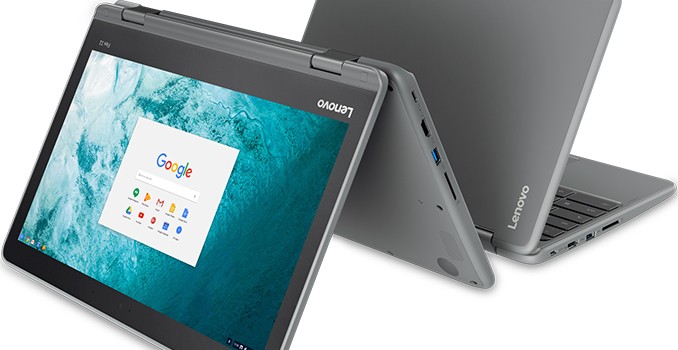
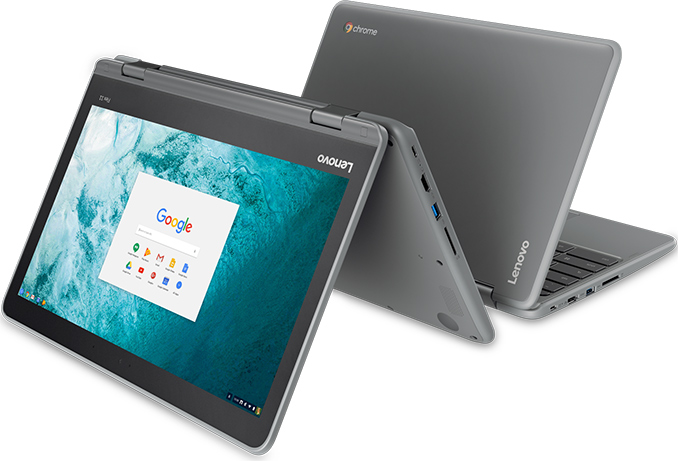
Lenovo has announced its first 2-in-1 Chromebook designed specifically for consumers. The Flex 11 laptop is powered by an SoC with four ARM cores, features a 360° hinge, a battery that can last for 10 hours and an anti-spill keyboard, a rare feature on inexpensive PCs. The computer will initially ship without the Google Play Store, but the manufacturer promises that Android apps will be coming to the Flex 11 “soon.” Lenovo plans to start selling the new notebook already this month for a price below $300.

Lenovo was not among the first wave Chromebook manufacturers back in 2011, but released its first laptop running Google’s Chrome OS nearly two years later. Since then the company has been gradually expanding its lineup of Chromebooks targeting different audiences. At first, Lenovo only aimed its ThinkPad X131e Chromebook at students in 2013, then it moved on to business users with the ThinkPad Chromebook 13 in mid-2016. Such approach is perfectly logical because students and road warriors use a relatively limited set of applications. With the Flex 11, the company finally releases a Chrome OS-based computer for general consumers, whose needs are very diverse. One of the reasons why Lenovo can target wide audiences with its Chromebooks is because the Chrome OS now supports Android apps and end users can use a wide range of programs they might need. Keep in mind though that there are not a lot of Android applications developed specifically for tablets or 2-in-1s.
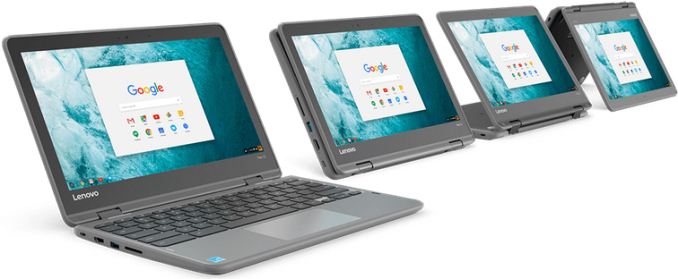
Since the Lenovo Flex 11 Chromebook was designed with Android software in mind, it is not surprising that the manufacturer decided to go with the 2-in-1 form-factor and an 11.6” touchscreen display with a 1366×768 resolution. The 360° hinge of the Flex 11 supports four dynamic modes (watch, tent, laptop, and tablet) to better handle different activities. Lenovo claims that the Flex 11 comes in a drop-resistant enclosure made of plastic with an anti-spill keyboard (can handle up to 330 ml of liquid) and “reinforced” ports (whatever that means). The rugged casing made of thick plastic affected dimensions and weight of the Flex 11: it is 21.2 mm thick and weighs 1.35 kilograms, which means that Lenovo traded portability for lower weight, which is logical as the 2-in-1 has a tablet mode (the lower the better).

When it comes to the CPU, the Lenovo Flex 11 is based on an SoC featuring four ARM cores running at 2.1 GHz. The manufacturer does not elaborate which SoC it uses, but since the notebook looks strikingly similar to the N23 Yoga Chromebook quietly launched earlier this year, it is logical to assume that the two computers use the same processor, the MediaTek MT8173C (also found inside the Acer R13). The MT8173 has two ARM Cortex-A72, two ARM Cortex-A53 general-purpose cores, an LPDDR3 memory controller as well as the PowerVR GX6250 (2 clusters) GPU. The chip was originally released in Q1 2015 and today it can be considered as an entry-level solution, something you expect from a sub-$300 computer.
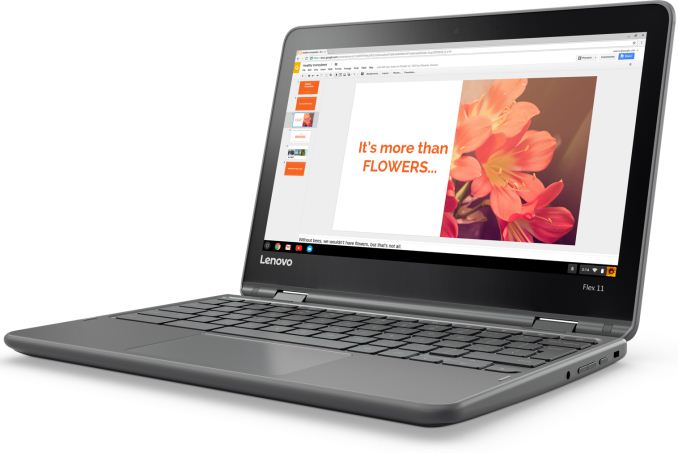
As for other hardware, the Lenovo Flex 11 is equipped with 4 GB of LPDDR3 memory, 32 GB of eMMC storage (it is possible that higher-end model(s) will include more NAND flash), an 802.11ac Wi-Fi module (no word on Bluetooth, but technically the MT8173 supports it) and a 720p webcam. The laptop also features a USB Type-C port for data and charging, a USB 3.0 header, an HDMI output, an SD card reader as well as a TRRS audio connector for headphones and mic.

Lenovo Flex 11 Chromebook
  Entry Level Model
Screen Resolution 1366×768
CPU MediaTek 8173C (?)

2 × ARM Cortex-A72
2 × ARM Cortex-A53

Note: the SoC is not confirmed by Lenovo

Graphics ImgTec PowerVR GX6250
RAM 4 GB LPDDR3
Storage 32 GB of eMMC storage
Wi-Fi 802.11ac Wi-Fi module
Bluetooth unknown
USB USB 3.0 Type-A
USB 3.0 Type-C
HDMI One HDMI output
Other I/O 720p webcam, TRRS connector for audio
Dimensions (H × W × D) 296 mm × 206 mm × 21.2 mm
11.65″ × 8.11″ × 0.83″
Weight 1.35 kilograms / 3.0 pounds
Price $279

Lenovo’s Flex 11 Chromebook will hit the shelves later this month and its entry-level configuration will retail for $279. Lenovo did not say when exactly Android apps are coming to the Flex 11, so if you need them, wait till the Chromebook actually gets an appropriate update.

Related Reading:

EIZO Announces ColorEdge Prominence CG3145: 4096x2160, 98% P3 and HDR10

EIZO Announces ColorEdge Prominence CG3145: 4096×2160, 98% P3 and HDR10

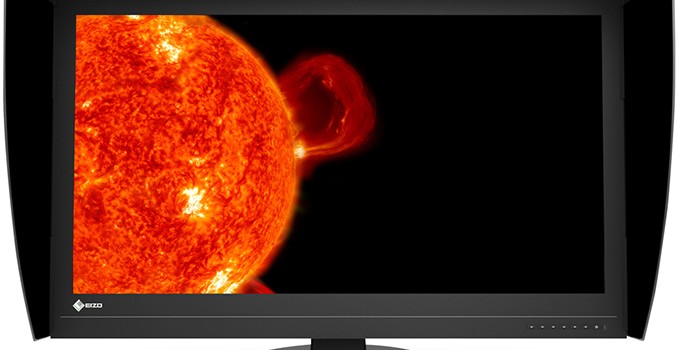
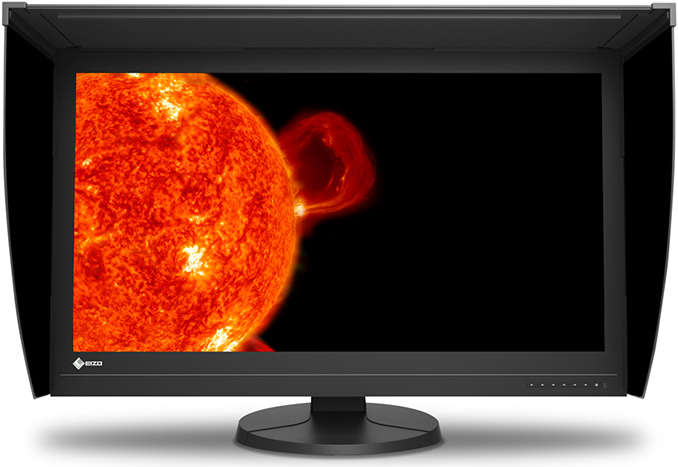
EIZO this week announced its new ColorEdge Prominence CG3145 reference monitor with a DCI-4K resolution and a display covering 98% of the DCI-P3 color space. The monitor is claimed to be designed for professionals working with HDR post-production, particularly for TV and home video industries. The display offers a very high brightness level and contrast ratio, but the key feature of the screen that EIZO mentions is the ability of its IPS panel to display both deep blacks and very bright colors at the same time without artefacts caused by the peculiarities of competing displays.

The EIZO ColorEdge Prominence CG3145 monitor is based on a 10-bit IPS panel that can reproduce 1.07 billion colors and features a 4096×2160 resolution at 60 Hz. The manufacturer says that the display has a 1000 nits typical brightness (as well as a 1,000,000 static contrast ratio). The ColorEdge Prominence CG3145 covers 98% of the DCI-P3, 99% of the Adobe RGB, as well as 80% of the Rec. 2020 color spaces (but these numbers may change as the product is being tuned up now). This comes with a 24-bit 3D LUT (look-up table) for HDR color gradations. As for connectivity, the display will have one DisplayPort capable of DCI-4K with 4:4:4 chroma subsampling at 50/60 Hz, as well as two HDMI 2.0 inputs capable of DCI-4K with 4:2:2 at 50/60 Hz. Since the monitor is aimed primarily at post production video professionals, EIZO has not currently disclosed support of sRGB and also does not disclose specs like response time or power consumption.

The key feature of the ColorEdge Prominence CG3145 display is its ability to properly reproduce both very bright and very dark areas on the scene without artefacts caused by local dimming (used on many IPS-based televisions and on some monitors) or an auto brightness limiter. EIZO does not reveal many details about the IPS panel it uses for the CG3145, but it claims that it has control of backlight intensity in every pixel. The latter means that the company either uses Panasonic’s IPS panels with a special layer of light-modulating cells that enable pixel-by-pixel control of backlight intensity, or a similar technology it has developed in-house.

In both cases, the pixel-by-pixel control of the backlight sets the ColorEdge Prominence CG3145 display apart from the rivals which use IPS panels with local dimming. Another feature that the monitor has is its 24-bit 3D LUT, which has a potential to produce more accurate colors than the 14-bit 3D LUTs supported by other HDR monitors. Speaking of HDR, it is noteworthy that the CG3145 supports both HLG (hybrid log-gamma) and PQ (perceptual quantization) gamma curves. The HLG is suitable for live TV broadcasting as it has a peak luminance of 1000 nits, whereas the PQ supports considerably higher luminance (up to 10,000 nits) and is suitable for recorded content. The combination of these features means that EIZO has positioned the ColorEdge Prominence CG3145 as a reference monitor for HDR content.

Specifications of the EIZO ColorEdge Prominence Reference HDR Display
  CG3145
Panel 31.1″ IPS
Native Resolution 4096 × 2160
Maximum Refresh Rate 60 Hz
Response Time unknown
Brightness 1000 cd/m² (typical)
Contrast ‘1,000,000:1’
Viewing Angles 178°/178° horizontal/vertical
HDR HDR10 with 24-bit LUT
Dynamic Refresh Rate none
Pixel Pitch 0.170 mm²
Pixel Density 149 ppi
Display Colors 1.07 billion
Color Gamut Support DCI-P3: 98%
Adobe RGB: 99%
Rec. 2020: 80%
sRGB: unknown
Aspect Ratio 1.9:1
Stand to be announced
Inputs 1 × DisplayPort
2 × HDMI 2.0a/2.0b (HDCP 2.2)
1 × USB for monitor control and the USB hub
USB Hub 3-port USB 3.0 hub
Launch Date Late 2017

EIZO plans to demonstrate the ColorEdge Prominence CG3145 monitor at the NAB Show later this month. Actual sales of the product are going to start sometimes in late 2017 after the manufacturer finalizes all the details and specifications. Given that the display is not going to show up for another six months, EIZO does not talk about its price. EIZO positions the CG3145 as a reference monitor, which are typically priced above professional-grade models.

Related Reading:

EIZO Announces ColorEdge Prominence CG3145: 4096x2160, 98% P3 and HDR10

EIZO Announces ColorEdge Prominence CG3145: 4096×2160, 98% P3 and HDR10

EIZO this week announced its new ColorEdge Prominence CG3145 reference monitor with a DCI-4K resolution and a display covering 98% of the DCI-P3 color space. The monitor is claimed to be designed for professionals working with HDR post-production, particularly for TV and home video industries. The display offers a very high brightness level and contrast ratio, but the key feature of the screen that EIZO mentions is the ability of its IPS panel to display both deep blacks and very bright colors at the same time without artefacts caused by the peculiarities of competing displays.

The EIZO ColorEdge Prominence CG3145 monitor is based on a 10-bit IPS panel that can reproduce 1.07 billion colors and features a 4096×2160 resolution at 60 Hz. The manufacturer says that the display has a 1000 nits typical brightness (as well as a 1,000,000 static contrast ratio). The ColorEdge Prominence CG3145 covers 98% of the DCI-P3, 99% of the Adobe RGB, as well as 80% of the Rec. 2020 color spaces (but these numbers may change as the product is being tuned up now). This comes with a 24-bit 3D LUT (look-up table) for HDR color gradations. As for connectivity, the display will have one DisplayPort capable of DCI-4K with 4:4:4 chroma subsampling at 50/60 Hz, as well as two HDMI 2.0 inputs capable of DCI-4K with 4:2:2 at 50/60 Hz. Since the monitor is aimed primarily at post production video professionals, EIZO has not currently disclosed support of sRGB and also does not disclose specs like response time or power consumption.

The key feature of the ColorEdge Prominence CG3145 display is its ability to properly reproduce both very bright and very dark areas on the scene without artefacts caused by local dimming (used on many IPS-based televisions and on some monitors) or an auto brightness limiter. EIZO does not reveal many details about the IPS panel it uses for the CG3145, but it claims that it has control of backlight intensity in every pixel. The latter means that the company either uses Panasonic’s IPS panels with a special layer of light-modulating cells that enable pixel-by-pixel control of backlight intensity, or a similar technology it has developed in-house.

In both cases, the pixel-by-pixel control of the backlight sets the ColorEdge Prominence CG3145 display apart from the rivals which use IPS panels with local dimming. Another feature that the monitor has is its 24-bit 3D LUT, which has a potential to produce more accurate colors than the 14-bit 3D LUTs supported by other HDR monitors. Speaking of HDR, it is noteworthy that the CG3145 supports both HLG (hybrid log-gamma) and PQ (perceptual quantization) gamma curves. The HLG is suitable for live TV broadcasting as it has a peak luminance of 1000 nits, whereas the PQ supports considerably higher luminance (up to 10,000 nits) and is suitable for recorded content. The combination of these features means that EIZO has positioned the ColorEdge Prominence CG3145 as a reference monitor for HDR content.

Specifications of the EIZO ColorEdge Prominence Reference HDR Display
  CG3145
Panel 31.1″ IPS
Native Resolution 4096 × 2160
Maximum Refresh Rate 60 Hz
Response Time unknown
Brightness 1000 cd/m² (typical)
Contrast ‘1,000,000:1’
Viewing Angles 178°/178° horizontal/vertical
HDR HDR10 with 24-bit LUT
Dynamic Refresh Rate none
Pixel Pitch 0.170 mm²
Pixel Density 149 ppi
Display Colors 1.07 billion
Color Gamut Support DCI-P3: 98%
Adobe RGB: 99%
Rec. 2020: 80%
sRGB: unknown
Aspect Ratio 1.9:1
Stand to be announced
Inputs 1 × DisplayPort
2 × HDMI 2.0a/2.0b (HDCP 2.2)
1 × USB for monitor control and the USB hub
USB Hub 3-port USB 3.0 hub
Launch Date Late 2017

EIZO plans to demonstrate the ColorEdge Prominence CG3145 monitor at the NAB Show later this month. Actual sales of the product are going to start sometimes in late 2017 after the manufacturer finalizes all the details and specifications. Given that the display is not going to show up for another six months, EIZO does not talk about its price. EIZO positions the CG3145 as a reference monitor, which are typically priced above professional-grade models.

Related Reading:

EIZO Announces ColorEdge Prominence CG3145: 4096x2160, 98% P3 and HDR10

EIZO Announces ColorEdge Prominence CG3145: 4096×2160, 98% P3 and HDR10

EIZO this week announced its new ColorEdge Prominence CG3145 reference monitor with a DCI-4K resolution and a display covering 98% of the DCI-P3 color space. The monitor is claimed to be designed for professionals working with HDR post-production, particularly for TV and home video industries. The display offers a very high brightness level and contrast ratio, but the key feature of the screen that EIZO mentions is the ability of its IPS panel to display both deep blacks and very bright colors at the same time without artefacts caused by the peculiarities of competing displays.

The EIZO ColorEdge Prominence CG3145 monitor is based on a 10-bit IPS panel that can reproduce 1.07 billion colors and features a 4096×2160 resolution at 60 Hz. The manufacturer says that the display has a 1000 nits typical brightness (as well as a 1,000,000 static contrast ratio). The ColorEdge Prominence CG3145 covers 98% of the DCI-P3, 99% of the Adobe RGB, as well as 80% of the Rec. 2020 color spaces (but these numbers may change as the product is being tuned up now). This comes with a 24-bit 3D LUT (look-up table) for HDR color gradations. As for connectivity, the display will have one DisplayPort capable of DCI-4K with 4:4:4 chroma subsampling at 50/60 Hz, as well as two HDMI 2.0 inputs capable of DCI-4K with 4:2:2 at 50/60 Hz. Since the monitor is aimed primarily at post production video professionals, EIZO has not currently disclosed support of sRGB and also does not disclose specs like response time or power consumption.

The key feature of the ColorEdge Prominence CG3145 display is its ability to properly reproduce both very bright and very dark areas on the scene without artefacts caused by local dimming (used on many IPS-based televisions and on some monitors) or an auto brightness limiter. EIZO does not reveal many details about the IPS panel it uses for the CG3145, but it claims that it has control of backlight intensity in every pixel. The latter means that the company either uses Panasonic’s IPS panels with a special layer of light-modulating cells that enable pixel-by-pixel control of backlight intensity, or a similar technology it has developed in-house.

In both cases, the pixel-by-pixel control of the backlight sets the ColorEdge Prominence CG3145 display apart from the rivals which use IPS panels with local dimming. Another feature that the monitor has is its 24-bit 3D LUT, which has a potential to produce more accurate colors than the 14-bit 3D LUTs supported by other HDR monitors. Speaking of HDR, it is noteworthy that the CG3145 supports both HLG (hybrid log-gamma) and PQ (perceptual quantization) gamma curves. The HLG is suitable for live TV broadcasting as it has a peak luminance of 1000 nits, whereas the PQ supports considerably higher luminance (up to 10,000 nits) and is suitable for recorded content. The combination of these features means that EIZO has positioned the ColorEdge Prominence CG3145 as a reference monitor for HDR content.

Specifications of the EIZO ColorEdge Prominence Reference HDR Display
  CG3145
Panel 31.1″ IPS
Native Resolution 4096 × 2160
Maximum Refresh Rate 60 Hz
Response Time unknown
Brightness 1000 cd/m² (typical)
Contrast ‘1,000,000:1’
Viewing Angles 178°/178° horizontal/vertical
HDR HDR10 with 24-bit LUT
Dynamic Refresh Rate none
Pixel Pitch 0.170 mm²
Pixel Density 149 ppi
Display Colors 1.07 billion
Color Gamut Support DCI-P3: 98%
Adobe RGB: 99%
Rec. 2020: 80%
sRGB: unknown
Aspect Ratio 1.9:1
Stand to be announced
Inputs 1 × DisplayPort
2 × HDMI 2.0a/2.0b (HDCP 2.2)
1 × USB for monitor control and the USB hub
USB Hub 3-port USB 3.0 hub
Launch Date Late 2017

EIZO plans to demonstrate the ColorEdge Prominence CG3145 monitor at the NAB Show later this month. Actual sales of the product are going to start sometimes in late 2017 after the manufacturer finalizes all the details and specifications. Given that the display is not going to show up for another six months, EIZO does not talk about its price. EIZO positions the CG3145 as a reference monitor, which are typically priced above professional-grade models.

Related Reading:

First Look: Samsung Galaxy S8

First Look: Samsung Galaxy S8

We first saw Samsung’s new 5.8-inch Galaxy S8 and 6.2-inch Galaxy S8+ at its Unpacked event a few weeks ago. During the event, we saw demos of its new virtual assistant, Bixby, and its DeX docking station, which allows the Galaxy S8 to provide a…