
Vik


Intel Discontinues the Intel Developer Forum; IDF17 Cancelled

In a bit of breaking news this morning, it appears that Intel has decided to cancel their Intel Developer Forum tradeshow going forward, including this summer’s expected IDF17.

In an announcement posted on the IDF website, Intel has announced that IDF is no more, and that the entire IDF program is ending.

Intel has evolved its event portfolio and decided to retire the IDF program moving forward. Thank you for nearly 20 great years with the Intel Developer Forum! Intel has a number of resources available on intel.com, including a Resource and Design Center with documentation, software, and tools for designers, engineers, and developers. As always, our customers, partners, and developers should reach out to their Intel representative with questions.

Previously, Intel had stated that there would not be an IDF in China this year. However an IDF was still expected in the US, albeit with a “new format.” Prior to today’s update, Intel’s IDF page stated the following (as can be seen on this cached copy of the page).

We are making changes to the Intel Developer Forum. This fall the event in San Francisco will have a new format and we will not be hosting an event in China. More details to come soon.

Meanwhile the official Moscone Center Calendar had (and still has) Intel reserving Moscone West from August 15th through the 17th.

IDF has been Intel’s yearly home to major product announcements. This has spanned from CPU announcements like Skylake and Kaby Lake, to storage products like Optane, to networking fabrics like Omni-Path. So the cancellation of IDF means that Intel no longer has a (currently scheduled) venue to announce new products and update the public and investors on their plans. Though what’s more interesting is how this will affect developers (both presenting and attending), who were the heart and soul of the show.

While it seems highly unlikely that Intel is doing away with trade shows and launch events entirely, it’s clear that something is afoot at Intel, and that as a result the traditional IDF is gone. With Intel’s product roadmap becoming increasingly elongated and less aligned to a yearly cadence, a yearly tradeshow is obviously a harder event to hold and justify. But what will replace their combination trade show and venue for product announcements remains to be seen.

We’ve reached out to Intel for more information, and will update this story if we hear anything further.


Update 13:26 ET (Ian): I just got off the phone with Intel, discussing why IDF is being cancelled. The main reason I was given is that Intel has been changing rapidly over the last two-to-three years, especially as they are changing from a PC-centric company to a data-centric company. With the rise of AI, FPGAs, Optane, IoT, wireless comms, automotive, and the other new areas that Intel is moving into, Intel felt that IDF no longer fills the need when it comes to giving out information. As a result, the decision has been made to find new ways to communicate with the audience (media, developers and companies) and the ecosystem with targeted events. These will be like the recent AI Day or Manufacturing Day, or be connected to partner events, or involve separate geocentric events. So rather than have one big melee on everything, Intel is set to split its message across several different areas in the hope that it accurately digs deep enough into every area. I was told that Intel wants to find a better way to present the experiences in each of the fields, and this is the way to do that.

Personally, I feel the loss of an event like IDF is frustrating. Here was an annual event, usually held around the same time each year, that went deep into how Intel is pushing their portfolio in the PC space. In the last couple of years, the event expanded into IoT and automotive, and attendances kept rising (despite some of the hardware talks being attended by six people – trust me it was a fun talk nonetheless). With Intel deciding to move to a multitude of different events, I can understand the need to focus on specific parts at each event – if you want to deep on AI, hold an AI event; if you want to go deep on cloud computing, hold a Cloud Day. However, this gives Intel more opportunities to have a disconnected message, and not speak as one, especially if a particular event is split based on region. It also makes it harder to plan from our side, because undoubtedly we have to travel to an event at a few weeks notice that might occur the same time as a holiday that was paid for six months ago. IDF ensured regularity – there were keynotes on the important topics, and it was a chance for Intel to lay all the high-end cards on the table (and have everyone there to talk to). As noted, Intel also removed IDF Shenzhen from the event schedule. If Intel now plans to have something like an ‘x86 developer conference’ and have it held on the same day at different global locations, that only adds to the logistical complexity, and splits the key members of the team giving the talk(s) or answering the questions. Again, I can see Intel’s reasoning for wanting to focus given the spectrum of markets it is now moving into, but IDF will be missed.
Intel Discontinues the Intel Developer Forum; IDF17 Cancelled

In a bit of breaking news this morning, it appears that Intel has decided to cancel their Intel Developer Forum tradeshow going forward, including this summer’s expected IDF17.

In an announcement posted on the IDF website, Intel has announced that IDF is no more, and that the entire IDF program is ending.

Intel has evolved its event portfolio and decided to retire the IDF program moving forward. Thank you for nearly 20 great years with the Intel Developer Forum! Intel has a number of resources available on intel.com, including a Resource and Design Center with documentation, software, and tools for designers, engineers, and developers. As always, our customers, partners, and developers should reach out to their Intel representative with questions.

Previously, Intel had stated that there would not be an IDF in China this year. However an IDF was still expected in the US, albeit with a “new format.” Prior to today’s update, Intel’s IDF page stated the following (as can be seen on this cached copy of the page).

We are making changes to the Intel Developer Forum. This fall the event in San Francisco will have a new format and we will not be hosting an event in China. More details to come soon.

Meanwhile the official Moscone Center Calendar had (and still has) Intel reserving Moscone West from August 15th through the 17th.

IDF has been Intel’s yearly home to major product announcements. This has spanned from CPU announcements like Skylake and Kaby Lake, to storage products like Optane, to networking fabrics like Omni-Path. So the cancellation of IDF means that Intel no longer has a (currently scheduled) venue to announce new products and update the public and investors on their plans. Though what’s more interesting is how this will affect developers (both presenting and attending), who were the heart and soul of the show.

While it seems highly unlikely that Intel is doing away with trade shows and launch events entirely, it’s clear that something is afoot at Intel, and that as a result the traditional IDF is gone. With Intel’s product roadmap becoming increasingly elongated and less aligned to a yearly cadence, a yearly tradeshow is obviously a harder event to hold and justify. But what will replace their combination trade show and venue for product announcements remains to be seen.

We’ve reached out to Intel for more information, and will update this story if we hear anything further.


Update 13:26 ET (Ian): I just got off the phone with Intel, discussing why IDF is being cancelled. The main reason I was given is that Intel has been changing rapidly over the last two-to-three years, especially as they are changing from a PC-centric company to a data-centric company. With the rise of AI, FPGAs, Optane, IoT, wireless comms, automotive, and the other new areas that Intel is moving into, Intel felt that IDF no longer fills the need when it comes to giving out information. As a result, the decision has been made to find new ways to communicate with the audience (media, developers and companies) and the ecosystem with targeted events. These will be like the recent AI Day or Manufacturing Day, or be connected to partner events, or involve separate geocentric events. So rather than have one big melee on everything, Intel is set to split its message across several different areas in the hope that it accurately digs deep enough into every area. I was told that Intel wants to find a better way to present the experiences in each of the fields, and this is the way to do that.

Personally, I feel the loss of an event like IDF is frustrating. Here was an annual event, usually held around the same time each year, that went deep into how Intel is pushing their portfolio in the PC space. In the last couple of years, the event expanded into IoT and automotive, and attendances kept rising (despite some of the hardware talks being attended by six people – trust me it was a fun talk nonetheless). With Intel deciding to move to a multitude of different events, I can understand the need to focus on specific parts at each event – if you want to deep on AI, hold an AI event; if you want to go deep on cloud computing, hold a Cloud Day. However, this gives Intel more opportunities to have a disconnected message, and not speak as one, especially if a particular event is split based on region. It also makes it harder to plan from our side, because undoubtedly we have to travel to an event at a few weeks notice that might occur the same time as a holiday that was paid for six months ago. IDF ensured regularity – there were keynotes on the important topics, and it was a chance for Intel to lay all the high-end cards on the table (and have everyone there to talk to). As noted, Intel also removed IDF Shenzhen from the event schedule. If Intel now plans to have something like an ‘x86 developer conference’ and have it held on the same day at different global locations, that only adds to the logistical complexity, and splits the key members of the team giving the talk(s) or answering the questions. Again, I can see Intel’s reasoning for wanting to focus given the spectrum of markets it is now moving into, but IDF will be missed.
Intel Discontinues the Intel Developer Forum; IDF17 Cancelled

In a bit of breaking news this morning, it appears that Intel has decided to cancel their Intel Developer Forum tradeshow going forward, including this summer’s expected IDF17.

In an announcement posted on the IDF website, Intel has announced that IDF is no more, and that the entire IDF program is ending.

Intel has evolved its event portfolio and decided to retire the IDF program moving forward. Thank you for nearly 20 great years with the Intel Developer Forum! Intel has a number of resources available on intel.com, including a Resource and Design Center with documentation, software, and tools for designers, engineers, and developers. As always, our customers, partners, and developers should reach out to their Intel representative with questions.

Previously, Intel had stated that there would not be an IDF in China this year. However an IDF was still expected in the US, albeit with a “new format.” Prior to today’s update, Intel’s IDF page stated the following (as can be seen on this cached copy of the page).

We are making changes to the Intel Developer Forum. This fall the event in San Francisco will have a new format and we will not be hosting an event in China. More details to come soon.

Meanwhile the official Moscone Center Calendar had (and still has) Intel reserving Moscone West from August 15th through the 17th.

IDF has been Intel’s yearly home to major product announcements. This has spanned from CPU announcements like Skylake and Kaby Lake, to storage products like Optane, to networking fabrics like Omni-Path. So the cancellation of IDF means that Intel no longer has a (currently scheduled) venue to announce new products and update the public and investors on their plans. Though what’s more interesting is how this will affect developers (both presenting and attending), who were the heart and soul of the show.

While it seems highly unlikely that Intel is doing away with trade shows and launch events entirely, it’s clear that something is afoot at Intel, and that as a result the traditional IDF is gone. With Intel’s product roadmap becoming increasingly elongated and less aligned to a yearly cadence, a yearly tradeshow is obviously a harder event to hold and justify. But what will replace their combination trade show and venue for product announcements remains to be seen.

We’ve reached out to Intel for more information, and will update this story if we hear anything further.


Update 13:26 ET (Ian): I just got off the phone with Intel, discussing why IDF is being cancelled. The main reason I was given is that Intel has been changing rapidly over the last two-to-three years, especially as they are changing from a PC-centric company to a data-centric company. With the rise of AI, FPGAs, Optane, IoT, wireless comms, automotive, and the other new areas that Intel is moving into, Intel felt that IDF no longer fills the need when it comes to giving out information. As a result, the decision has been made to find new ways to communicate with the audience (media, developers and companies) and the ecosystem with targeted events. These will be like the recent AI Day or Manufacturing Day, or be connected to partner events, or involve separate geocentric events. So rather than have one big melee on everything, Intel is set to split its message across several different areas in the hope that it accurately digs deep enough into every area. I was told that Intel wants to find a better way to present the experiences in each of the fields, and this is the way to do that.

Personally, I feel the loss of an event like IDF is frustrating. Here was an annual event, usually held around the same time each year, that went deep into how Intel is pushing their portfolio in the PC space. In the last couple of years, the event expanded into IoT and automotive, and attendances kept rising (despite some of the hardware talks being attended by six people – trust me it was a fun talk nonetheless). With Intel deciding to move to a multitude of different events, I can understand the need to focus on specific parts at each event – if you want to deep on AI, hold an AI event; if you want to go deep on cloud computing, hold a Cloud Day. However, this gives Intel more opportunities to have a disconnected message, and not speak as one, especially if a particular event is split based on region. It also makes it harder to plan from our side, because undoubtedly we have to travel to an event at a few weeks notice that might occur the same time as a holiday that was paid for six months ago. IDF ensured regularity – there were keynotes on the important topics, and it was a chance for Intel to lay all the high-end cards on the table (and have everyone there to talk to). As noted, Intel also removed IDF Shenzhen from the event schedule. If Intel now plans to have something like an ‘x86 developer conference’ and have it held on the same day at different global locations, that only adds to the logistical complexity, and splits the key members of the team giving the talk(s) or answering the questions. Again, I can see Intel’s reasoning for wanting to focus given the spectrum of markets it is now moving into, but IDF will be missed.
Upcoming LGA3647 Skylake Xeons: A 2P Skylake-SP Motherboard Leaked

Upcoming LGA3647 Skylake Xeons: A 2P Skylake-SP Motherboard Leaked

The next generation of high-performance Intel Xeons will be the second stage of Intel rearranging its professional stack. Stage one was separating chipset requirements of low core count Xeons from the consumer counterparts, but stage two to occur later this year will be something to wrap your head around. We still haven’t confirmed most of the salient details, such as significant changes in the naming and strategy when it comes to socket and die differentiators, but what we do know is that the large E5-class Xeons (some of which may or may not get a name change from –EP to –SP) will be in the LGA3647 socket, which is exactly where the current generation of Xeon Phi, Knights Landing (KNL), also sits as they will be pin compatible. So for the most part, E5 CPUs will move from the current LGA2011-3 sockets up to a much larger design, and rather than go into the details of what that means, this news post is more about seeing motherboards that support them in the wild. We expect to hear more about the new Skylake-SP Xeon platform in the summer, probably at IDF in August, but for now we get to gaze on accidental leaks like this one.

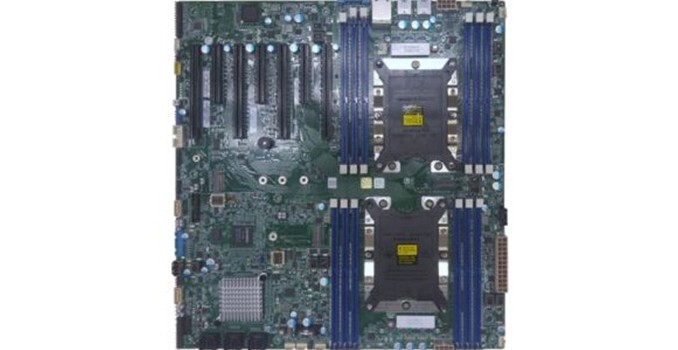
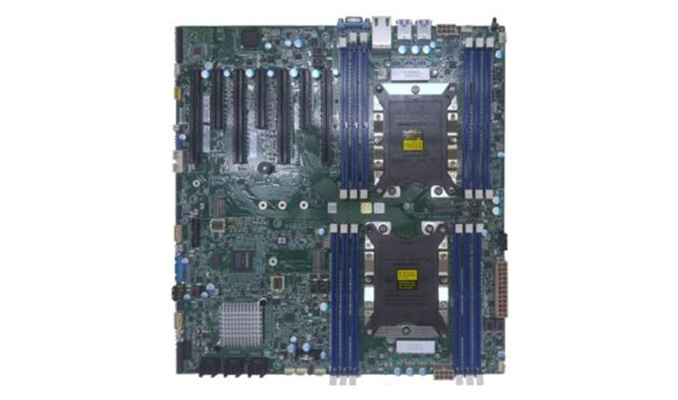
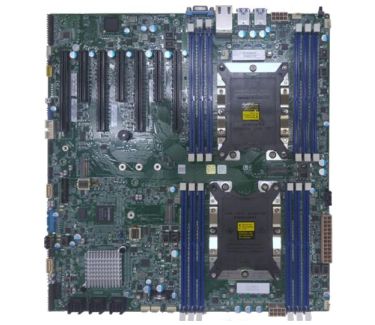
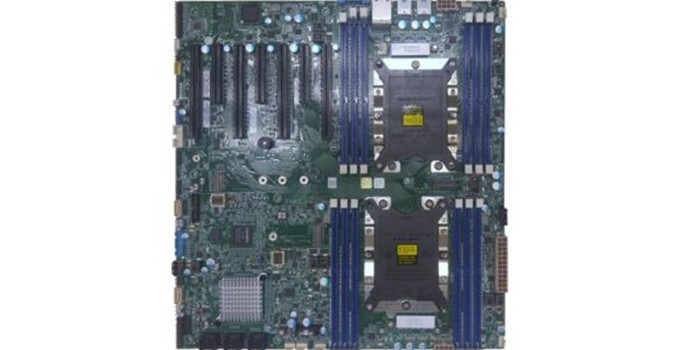
An Intel enterprise system integrator accidentally posted up details regarding a pair of upcoming motherboards from a well-known Intel enterprise motherboard manufacturer. These motherboards use a pair of LGA3647 sockets on the top of the board, with the DRAM slots above and below to assist with airflow through a server. As with some of the 2P motherboards we see today, the sockets are slightly staggered due to connectors and trace layouts, but both sockets exhibit a full six channels of DRAM with one DIMM per channel (1 DPC, we expect Skylake-SP Xeons to support 2DPC or 3DPC depending on the model).

While the image is small, and low quality, some determinations can be made. The specification list was fully listed on the SI website as well.

Motherboard Specifications
  Server SKU Workstation SKU
CPU Support Intel Xeon Scalable Processor Family
(Xeon-SP) up to 205W TDP
Chipset C621 (LBG-1G)
Memory 6+6 DDR4-2666 Slots
Up to 768GB RDIMM/LRDIMM
Network 2 x RJ45 GbE (Intel I350-AM2)
PCIe 4 x PCIe 3.0 x16
3 x PCIe 3.0 x8
PCIe Storage 1 x PCIe 3.0 x4 M.2-2280 (CPU)
1 x PCIe 3.0 x4 M.2-2242 (PCH)
Storage 14 x SATA 6 Gbps w/RAID
USB 4 x USB 3.0 (rear)
IPMI Aspeed AST2500
Audio Realtek ALC892

Each socket will support a TDP of 205W, which is up from the previous maximum of 160W on CPUs like the E5-2687W v4 that were focused on high performance. This might mean that Intel is targeting an even higher window for their CPUs, or there will be added silicon on board (how Intel plans to integrate FPGAs into the ecosystem is still unconfirmed, but rumors have been surfacing), or the fact that Xeons might be paired with Knights Landing Xeon Phi chips, which are currently offered from 215W to 260W. Technically that is above the socket TDP for this board, but that might be because of how the board expects to be positioned without Xeon Phi, and we might see motherboards with higher TDP ratings and the power delivery to back them up.

The chipset is listed as Intel’s C621, which is not listed on ark.intel (the site that holds Intel’s chip specifications), indicating it is a new chip. Typically the chipsets ending in ‘1’ are the low-end models, with Intel putting C608, C236 and others at the top of their respective stacks. The website where the motherboard is listed also states ‘LBG-1G’, which is a secondary indicator of the chipset and it’s capabilities. We have seen documents signalling potential different types of Intel chipset for the SP platform, and this corresponds with one of those, particularly the ‘1G’ part which is a nod to the fact that this chipset will directly support gigabit ethernet. We won’t comment on unconfirmed details regarding the chipset stack from Intel, however it is expected that the capabilities of the chipset stack will be expanded for Skylake-SP compared to older platforms.

With the memory, the website confirms six memory channels per CPU. The website states that the board can support 768GB of RDIMM/LRDIMM DDR4-2666 memory, and given that we have 1DPC this means that the support is the sum across both sockets, leading to 64GB modules maximum.

PCIe support shows four primary PCIe 3.0 x16 slots, interspersed with secondary PCIe 3.0 x8 slots. With experience, these secondary slots are most likely switched with the primary slots, such that when occupied the primary slots are reduced to PCIe 3.0 x8 bandwidth. Even with the low-resolution image, it is clear that there is no big PLX 8000-series or 9000-series PCIe switch chip-on-board, suggesting that these lanes are all native to the CPUs. As the board supports four PCIe 3.0 x16 slots natively, this indicates that either a single CPU can support 64 PCIe lanes, or that each CPU takes 32 PCIe lanes. We would expect the latter to be the case for this generation of Xeon processors.

Additional to the PCIe slots, there is some storage in PCIe form, with a single M.2-2280 slot being listed as from the CPU, and supporting PCIe 3.0 x4. This most likely comes at the expense of a PCIe 3.0 x8 (as in, when the M.2 is installed, a PCIe 3.0 x8 is either disabled or drops to a PCIe 3.0 x4), depending on exactly how the PCIe root complexes are configured in the Xeons. If the Xeon has a full 40 lanes, installation of M.2 storage probably has no direct effect. For other storage, the website lists an M.2-2242 slot as supporting PCIe 3.0 x4 from the chipset. These new chipsets may mirror the newer consumer chipsets by having plenty of PCIe lanes free for this sort of configuration, though the interesting thing here is limiting it to the 2242 size. There are enterprise drives available in 2242 (and a few consumer ones), although at that size you have limited dies to take advantage of the parallelism needed to saturate a full PCIe 3.0 x4 slot. Along with the PCIe storage, the motherboard will also support 14 SATA 6Gbps ports, all listed as being from the chipset due to Intel RSTe 5.0 RAID support. This would indicate that the new chipsets also have increased native SATA capability (previous generations had 10 SATA ports, of which only six were RST capable).

Other connectivity on the boards is listed in terms of Ethernet (two gigabit RJ45 ports from an Intel I350-AM2 controller), USB 3.0 ports (four on the rear) and TPM support. The two boards differ in the IPMI and Audio: the server SKU has the Aspeed AST2500 BMC with iKVM and IPMI, whereas the workstation SKU has a Realtek ALC892 audio codec instead.

With a larger image of the motherboard, more analysis may have been possible. But seeing this motherboard being listed this early, and publicly, is unexpected (and probably breaks someone’s NDA along the line). Nonetheless, system integrators like this are reaching out to potential partners for sales and taking inquiries about future product designs.

Many thanks to @momomo_us for the link.

Edit 4/18: At the request of the SI, the names of the companies involved have been removed. 

Upcoming LGA3647 Skylake Xeons: A Tyan 2P Skylake-SP Motherboard Leaked

Upcoming LGA3647 Skylake Xeons: A Tyan 2P Skylake-SP Motherboard Leaked

The next generation of high-performance Intel Xeons will be the second stage of Intel rearranging its professional stack. Stage one was separating chipset requirements of low core count Xeons from the consumer counterparts, but stage two to occur later this year will be something to wrap your head around. We still haven’t confirmed most of the salient details, such as significant changes in the naming and strategy when it comes to socket and die differentiators, but what we do know is that the large E5-class Xeons (some of which may or may not get a name change from –EP to –SP) will be in the LGA3647 socket, which is exactly where the current generation of Xeon Phi, Knights Landing (KNL), also sits as they will be pin compatible. So for the most part, E5 CPUs will move from the current LGA2011-3 sockets up to a much larger design, and rather than go into the details of what that means, this news post is more about seeing motherboards that support them in the wild. We expect to hear more about the new Skylake-SP Xeon platform in the summer, probably at IDF in August, but for now we get to gaze on accidental leaks like this one.

Exxact Corp, an Intel enterprise system integrator, posted up details regarding a pair of upcoming motherboards from Tyan, a well-known Intel enterprise motherboard manufacturer. These motherboards use a pair of LGA3647 sockets on the top of the board, with the DRAM slots above and below to assist with airflow through a server. As with some of the 2P motherboards we see today, the sockets are slightly staggered due to connectors and trace layouts, but both sockets exhibit a full six channels of DRAM with one DIMM per channel (1 DPC, we expect Skylake-SP Xeons to support 2DPC or 3DPC depending on the model).

While the image is small, and low quality, some determinations can be made. The specification list of the TYAN S7100GM2NR (and TYAN S7100AG2NR) is fully listed on the SI website as well.

Tyan S7100xx2NR Motherboard Specifications
  S7100GM2NR S7100AG2NR
CPU Support Intel Xeon Scalable Processor Family
(Xeon-SP) up to 205W TDP
Chipset C621 (LBG-1G)
Memory 6+6 DDR4-2666 Slots
Up to 768GB RDIMM/LRDIMM
Network 2 x RJ45 GbE (Intel I350-AM2)
PCIe 4 x PCIe 3.0 x16
3 x PCIe 3.0 x8
PCIe Storage 1 x PCIe 3.0 x4 M.2-2280 (CPU)
1 x PCIe 3.0 x4 M.2-2242 (PCH)
Storage 14 x SATA 6 Gbps w/RAID
USB 4 x USB 3.0 (rear)
IPMI Aspeed AST2500
Audio Realtek ALC892

Each socket will support a TDP of 205W, which is up from the previous maximum of 160W on CPUs like the E5-2687W v4 that were focused on high performance. This might mean that Intel is targeting an even higher window for their CPUs, or there will be added silicon on board (how Intel plans to integrate FPGAs into the ecosystem is still unconfirmed, but rumors have been surfacing), or the fact that Xeons might be paired with Knights Landing Xeon Phi chips, which are currently offered from 215W to 260W. Technically that is above the socket TDP for this Tyan board, but that might be because of how the Tyan board expects to be positioned without Xeon Phi, and we might see motherboards with higher TDP ratings and the power delivery to back them up.

The chipset is listed as Intel’s C621, which is not listed on ark.intel (the site that holds Intel’s chip specifications), indicating it is a new chip. Typically the chipsets ending in ‘1’ are the low-end models, with Intel putting C608, C236 and others at the top of their respective stacks. The website where the Tyan motherboard is listed also states ‘LBG-1G’, which is a secondary indicator of the chipset and it’s capabilities. We have seen documents signalling potential different types of Intel chipset for the SP platform, and this corresponds with one of those, particularly the ‘1G’ part which is a nod to the fact that this chipset will directly support gigabit ethernet. We won’t comment on unconfirmed details regarding the chipset stack from Intel, however it is expected that the capabilities of the chipset stack will be expanded for Skylake-SP compared to older platforms.

With the memory, the website confirms six memory channels per CPU. The website states that the board can support 768GB of RDIMM/LRDIMM DDR4-2666 memory, and given that we have 1DPC this means that the support is the sum across both sockets, leading to 64GB modules maximum.

PCIe support shows four primary PCIe 3.0 x16 slots, interspersed with secondary PCIe 3.0 x8 slots. With experience, these secondary slots are most likely switched with the primary slots, such that when occupied the primary slots are reduced to PCIe 3.0 x8 bandwidth. Even with the low-resolution image, it is clear that there is no big PLX 8000-series or 9000-series PCIe switch chip-on-board, suggesting that these lanes are all native to the CPUs. As the board supports four PCIe 3.0 x16 slots natively, this indicates that either a single CPU can support 64 PCIe lanes, or that each CPU takes 32 PCIe lanes. We would expect the latter to be the case for this generation of Xeon processors.

Additional to the PCIe slots, there is some storage in PCIe form, with a single M.2-2280 slot being listed as from the CPU, and supporting PCIe 3.0 x4. This most likely comes at the expense of a PCIe 3.0 x8 (as in, when the M.2 is installed, a PCIe 3.0 x8 is either disabled or drops to a PCIe 3.0 x4), depending on exactly how the PCIe root complexes are configured in the Xeons. If the Xeon has a full 40 lanes, installation of M.2 storage probably has no direct effect. For other storage, the website lists an M.2-2242 slot as supporting PCIe 3.0 x4 from the chipset. These new chipsets may mirror the newer consumer chipsets by having plenty of PCIe lanes free for this sort of configuration, though the interesting thing here is limiting it to the 2242 size. There are enterprise drives available in 2242 (and a few consumer ones), although at that size you have limited dies to take advantage of the parallelism needed to saturate a full PCIe 3.0 x4 slot. Along with the PCIe storage, the motherboard will also support 14 SATA 6Gbps ports, all listed as being from the chipset due to Intel RSTe 5.0 RAID support. This would indicate that the new chipsets also have increased native SATA capability (previous generations had 10 SATA ports, of which only six were RST capable).

Other connectivity on the boards is listed in terms of Ethernet (two gigabit RJ45 ports from an Intel I350-AM2 controller), USB 3.0 ports (four on the rear) and TPM support. The two boards from Tyan differ in the IPMI and Audio: the S7100GM2NR has the Aspeed AST2500 BMC with iKVM and IPMI, whereas the S7100AG2NR has a Realtek ALC892 audio codec instead.

With a larger image of the motherboard, more analysis may have been possible. But seeing this motherboard being listed this early, and publicly, is unexpected (and probably breaks someone’s NDA along the line). Nonetheless, system integrators like this are reaching out to potential partners for sales and taking inquiries about future product designs.

Sources: Link
Many thanks to @momomo_us for the link.