Vik


A New Challenger Appears: Palit's Own-Brand UVS and GFS SSDs Announced

A New Challenger Appears: Palit’s Own-Brand UVS and GFS SSDs Announced
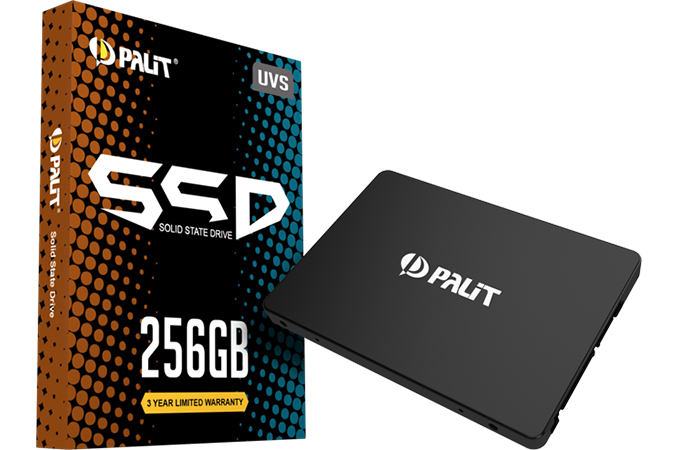
Palit has announced two families of SSDs that it plans to sell under its own brand. The new drives are aimed at entry-level and mainstream gaming PCs, and will be based on controllers from Phison using 3D MLC or 3D TLC NAND flash memory from Micron depending on which drive you pick up. The Palit SSDs will be among the first drives on the market that will use a combination of a Phison controller and 3D NAND memory ICs from Micron, but we expect this combination to spread across several SSD vendors in due course.

Palit Microsystems is one of the world’s largest producers of graphics cards, but it is not entirely new to SSDs too. Palit’s GALAX and KFA2 brands have offered Phison-based SSDs for quite a while, but their lineups have never been large and the whole effort looked more like a brand development rather than an attempt to compete against much of the market. This time, Palit has announced two families of SSDs under its own trademark and with seven drives in total, it plans to address entry-level and mainstream gaming PCs. We do not know Palit’s plans in regards of higher-end drives in M.2 or add-in-card form-factors, but such products are available from other brands that Palit owns and it should not be a problem for the company to expand its own lineup if it needs to.

Palit will initially offer two families of SSDs: First is the Palit UVS family, featuring the Phison S3111-S11 controller and 3D TLC memory for entry-level gaming systems. Then second is the Palit GFS family, based on the same Phison S3111-S11 controller but with 3D MLC NAND flash.

Phison PS3111-S11 Controller Specifications
  PS3111-S11
Interface SATA 3.2
NAND Channels 2
CE Targets 16
DRAM Cache Supported
ECC LDPC
Supported Capacities MLC Up to 1 TB
TLC 128 GB, 256 GB, 512 GB, 1 TB
Supported NAND Toshiba 15 nm MLC/TLC
SK Hynix 14 nm MLC/TLC
Micron L06/B0KB
3D NAND

NAND flash memory with 8KB and 16KB blocks.

Additional Features Data Compression
End to End Data Path Protection

Before we start discussing the drives, let’s talk a little bit about the controller itself. Formally, the PS3111-S11 is positioned below the S10 because it has only two NAND channels with 16 CE targets and physically cannot deliver breakthrough performance. As it is a SATA controller, the PS3111-S11 does not have to deliver anything sequentially higher than 550 MB/s and this is something it can do with both MLC and TLC chips (sustained performance is a different comparison). The most important advancement of the controller versus its predecessors is that the PS3111-S11 supports LDPC ECC, and thus can be enabled on SSDs with sufficient endurance. Additionally, the PS3111-S11 supports 3D and 1z MLC/TLC NAND flash and memory with large (8 KB and 16 KB) blocks.
As for the drives, the Palit UVS family will include 120 GB, 256 GB, 480 GB and 512 GB models using 3D TLC NAND (except the 120GB, which is planar TLC). Depending on the model, the drives are rated to deliver up to 560 MB/s sequential read speed and up to 470 MB/s (370 MB/s for the 120 GB version) sequential write speed. As for random performance, the numbers on the box give 72,500 read IOPS and up to 85,000 write IOPS.

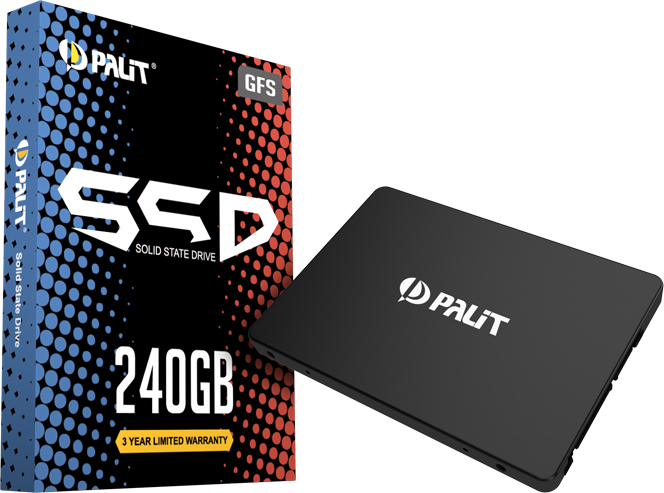
The Palit GFS lineup consists of three drives with 120 GB, 128 GB and 240 GB capacities all based on 3D MLC and offering all the endurance-related benefits of such memory. From a performance point of view, the GFS SSDs are slightly faster than the UVS drives: they are rated for up to 560 MB/s sequential read speed and up to 480 MB/s sequential write speed. Palit also states they can also perform up to 75,000 read IOPS and up to 87,500 write IOPS (240 GB version only). Palit may decide to expand the GFS lineup with higher-capacity offerings over time, but right now, its premium drives only offer entry-level capacities.

Palit UVS and GFS SSDs Specifications
  UVS GFS
UVS10AT-SSD120 UVS-SSD256 UVS-SSD480 UVS-SSD512 GFS-SSD120 GFS-SSD128 GFS-SSD240
Capacity 120 GB 256 GB 480 GB 512 GB 120 GB 128 GB 240 GB
Controller Phison S3111-S11
NAND Flash TLC 3D TLC NAND 3D MLC NAND
Sequential Read (max) 560 MB/s 525 MB/s 540 MB/s 560 MB/s
Sequential Write (max) 375 MB/s 470 MB/s 465 MB/s 450 MB/s 480 MB/s
Random Read IOPS (max) 70.0K 67.5K 72.5K 47.5K 75.0K
Random Write IOPS (max) 77.5K 85K 87.5K
DRAM Buffer 32 MB
Pseudo-SLC Caching Supported
Power Management DevSleep 5mW
Form-Factor, Interface 2.5″/7 mm, Serial ATA 3.2
Warranty 3 years

There are two intrigues about Palit’s SSDs: the memory supplier and actual manufacturer. Typically, Phison ships its controllers with memory and firmware and in many cases even provides assembly and test services (essentially, shipping already made drives). Despite this, Palit has enough SMT lines and can produce virtually everything itself. At present, we do not know whether Palit-branded SSDs are made by Palit, or are manufactured by a third party, but the latter is clearly a possibility here.

The supplier of the NAND is also not obvious and could come from different sources. Palit does not disclose who is their supplier, but it is worth noting that Phison usually ships its controllers primarily with memory from Toshiba. We do know that there are Phison PS3111-S11-based reference designs featuring Toshiba’s BICS2 memory (which is not exactly positioned for SSDs by Toshiba) as well as S11 drives with Micron’s 3D NAND memory. 

The Palit SSDs are expected to hit the market in the coming months. We do not have any information about their MSRP of the new drives, but it is logical to assume that Palit will try to make them competitive in terms of pricing.
Related Reading

A New Challenger Appears: Palit's Own-Brand UVS and GFS SSDs Announced

A New Challenger Appears: Palit’s Own-Brand UVS and GFS SSDs Announced

Palit has announced two families of SSDs that it plans to sell under its own brand. The new drives are aimed at entry-level and mainstream gaming PCs, and will be based on controllers from Phison using 3D MLC or 3D TLC NAND flash memory from Micron depending on which drive you pick up. The Palit SSDs will be among the first drives on the market that will use a combination of a Phison controller and 3D NAND memory ICs from Micron, but we expect this combination to spread across several SSD vendors in due course.

Palit Microsystems is one of the world’s largest producers of graphics cards, but it is not entirely new to SSDs too. Palit’s GALAX and KFA2 brands have offered Phison-based SSDs for quite a while, but their lineups have never been large and the whole effort looked more like a brand development rather than an attempt to compete against much of the market. This time, Palit has announced two families of SSDs under its own trademark and with seven drives in total, it plans to address entry-level and mainstream gaming PCs. We do not know Palit’s plans in regards of higher-end drives in M.2 or add-in-card form-factors, but such products are available from other brands that Palit owns and it should not be a problem for the company to expand its own lineup if it needs to.

Palit will initially offer two families of SSDs: First is the Palit UVS family, featuring the Phison S3111-S11 controller and 3D TLC memory for entry-level gaming systems. Then second is the Palit GFS family, based on the same Phison S3111-S11 controller but with 3D MLC NAND flash.

Phison PS3111-S11 Controller Specifications
  PS3111-S11
Interface SATA 3.2
NAND Channels 2
CE Targets 16
DRAM Cache Supported
ECC LDPC
Supported Capacities MLC Up to 1 TB
TLC 128 GB, 256 GB, 512 GB, 1 TB
Supported NAND Toshiba 15 nm MLC/TLC
SK Hynix 14 nm MLC/TLC
Micron L06/B0KB
3D NAND

NAND flash memory with 8KB and 16KB blocks.

Additional Features Data Compression
End to End Data Path Protection

Before we start discussing the drives, let’s talk a little bit about the controller itself. Formally, the PS3111-S11 is positioned below the S10 because it has only two NAND channels with 16 CE targets and physically cannot deliver breakthrough performance. As it is a SATA controller, the PS3111-S11 does not have to deliver anything sequentially higher than 550 MB/s and this is something it can do with both MLC and TLC chips (sustained performance is a different comparison). The most important advancement of the controller versus its predecessors is that the PS3111-S11 supports LDPC ECC, and thus can be enabled on SSDs with sufficient endurance. Additionally, the PS3111-S11 supports 3D and 1z MLC/TLC NAND flash and memory with large (8 KB and 16 KB) blocks.

As for the drives, the Palit UVS family will include 120 GB, 256 GB, 480 GB and 512 GB models using 3D TLC NAND (except the 120GB, which is planar TLC). Depending on the model, the drives are rated to deliver up to 560 MB/s sequential read speed and up to 470 MB/s (370 MB/s for the 120 GB version) sequential write speed. As for random performance, the numbers on the box give 72,500 read IOPS and up to 85,000 write IOPS.

The Palit GFS lineup consists of three drives with 120 GB, 128 GB and 240 GB capacities all based on 3D MLC and offering all the endurance-related benefits of such memory. From a performance point of view, the GFS SSDs are slightly faster than the UVS drives: they are rated for up to 560 MB/s sequential read speed and up to 480 MB/s sequential write speed. Palit also states they can also perform up to 75,000 read IOPS and up to 87,500 write IOPS (240 GB version only). Palit may decide to expand the GFS lineup with higher-capacity offerings over time, but right now, its premium drives only offer entry-level capacities.

Palit UVS and GFS SSDs Specifications
  UVS GFS
UVS10AT-SSD120 UVS-SSD256 UVS-SSD480 UVS-SSD512 GFS-SSD120 GFS-SSD128 GFS-SSD240
Capacity 120 GB 256 GB 480 GB 512 GB 120 GB 128 GB 240 GB
Controller Phison S3111-S11
NAND Flash TLC 3D TLC NAND 3D MLC NAND
Sequential Read (max) 560 MB/s 525 MB/s 540 MB/s 560 MB/s
Sequential Write (max) 375 MB/s 470 MB/s 465 MB/s 450 MB/s 480 MB/s
Random Read IOPS (max) 70.0K 67.5K 72.5K 47.5K 75.0K
Random Write IOPS (max) 77.5K 85K 87.5K
DRAM Buffer 32 MB
Pseudo-SLC Caching Supported
Power Management DevSleep 5mW
Form-Factor, Interface 2.5″/7 mm, Serial ATA 3.2
Warranty 3 years

There are two intrigues about Palit’s SSDs: the memory supplier and actual manufacturer. Typically, Phison ships its controllers with memory and firmware and in many cases even provides assembly and test services (essentially, shipping already made drives). Despite this, Palit has enough SMT lines and can produce virtually everything itself. At present, we do not know whether Palit-branded SSDs are made by Palit, or are manufactured by a third party, but the latter is clearly a possibility here.

The supplier of the NAND is also not obvious and could come from different sources. Palit does not disclose who is their supplier, but it is worth noting that Phison usually ships its controllers primarily with memory from Toshiba. We do know that there are Phison PS3111-S11-based reference designs featuring Toshiba’s BICS2 memory (which is not exactly positioned for SSDs by Toshiba) as well as S11 drives with Micron’s 3D NAND memory. 

The Palit SSDs are expected to hit the market in the coming months. We do not have any information about their MSRP of the new drives, but it is logical to assume that Palit will try to make them competitive in terms of pricing.
Related Reading

JEDEC: DDR5 to Double Bandwidth Over DDR4, NVDIMM-P Specification Due Next Year

JEDEC: DDR5 to Double Bandwidth Over DDR4, NVDIMM-P Specification Due Next Year

JEDEC made two important announcements about the future of DRAM and non-volatile DIMMs for servers last week. Development of both is proceeding as planned and JEDEC intends to preview them in the middle of this year and publish the final specifications sometimes in 2018.

Traditionally each new successive DRAM memory standard aims for consistent jumps: doubling the bandwidth per pin, reducing power consumption by dropping Vdd/Vddq voltage, and increasing the maximum capacity of memory ICs (integrated circuits). DDR5 will follow this trend and JEDEC last week confirmed that it would double the bandwidth and density over DDR4, improve performance, and power efficiency.

Given that official DDR4 standard covers chips with up to 16 Gb capacity and with up to 2133-3200 MT/s data rate per pin, doubling that means 32 Gb ICs with up to 4266-6400 MT/s data rate per pin. If DDR5 sustains 64-bit interface for memory modules, we will see single-sided 32 GB DDR5-6400 DIMMs with 51.2 GB/s bandwidth in the DDR5 era. Speaking of modules, it is interesting to note that among other things DDR5 promises “a more user-friendly interface”, which probably means a new retention mechanism or increased design configurability.


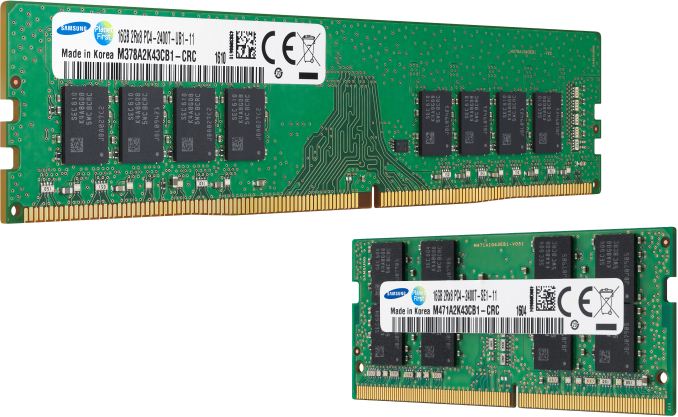
Samsung’s DDR4 memory modules. Image for illustrative purposes only.

Part of the DDR5 specification will be improved channel use and efficiency. Virtually all modern random access memory sub-systems are single-channel, dual-channel or multi-channel, but actual memory bandwidth of such systems does not increase linearly with the increase of the number of channels (i.e., channel utilization decreases). Part of the problem is the fact that host cores fight for DRAM bandwidth, and memory scheduling is a challenge for CPU and SoC developers. Right now we do not know how DRAM developers at JEDEC plan to address the memory channel efficiency problem on the specification level, but if they manage to even partly solve the problem, that will be a good news. Host cores will continue to fight for bandwidth and memory scheduling will remain important, but if channel utilization increases it could mean both performance and power advantages. Keep in mind that additional memory channels mean additional DRAM ICs and a significant increase in power consumption, which is important for mobile DRAM subsystems, but it is also very important for servers.

JEDEC plans to disclose more information about the DDR5 specification at its Server Forum event in Santa Clara on June 19, 2017, and then publish the spec in 2018. It is noteworthy that JEDEC published the DDR4 specification in September 2012, whereas large DRAM makers released samples of their DDR4 chips/modules a little before that. Eventually, Intel launched the world’s first DDR4-supporting platforms in 2014, two years after the standard was finalized. If DDR5 follows the same path, we will see systems using the new type of DRAM in 2020 or 2021.

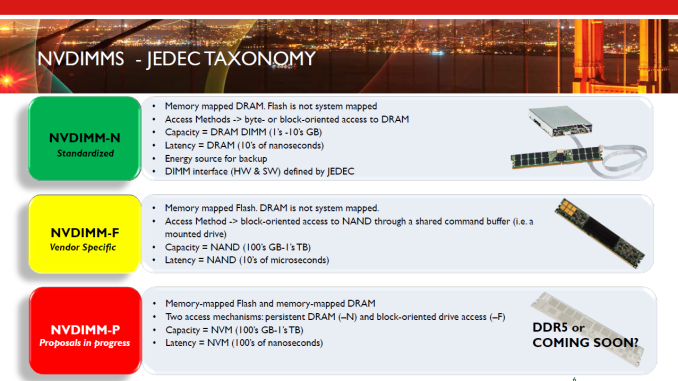
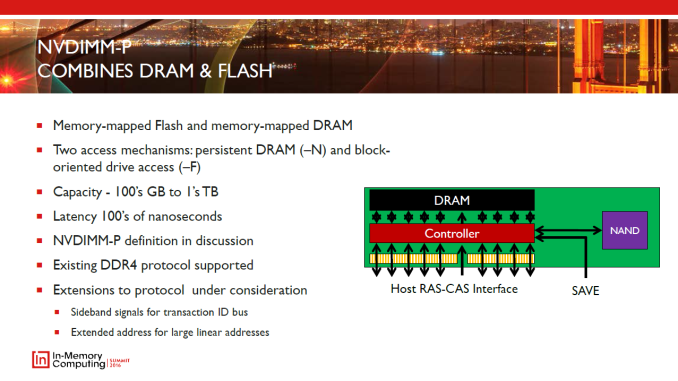
Another specification that JEDEC plans to finalize in 2018 is the NVDIMM-P that will enable high-capacity memory modules featuring persistent memory (flash, 3D XPoint, new types of storage-class memory, etc.) and DRAM. The capacity of today’s NVDIMM-Ns is limited to the capacity of regular server DRAM modules, but the NVDIMM-P promises to change that and increase capacities of modules to hundreds of GBs or even to TBs. The NVDIMM-P is currently a work in progress and we are going to learn more about the tech in June.

Related Reading

Sources of images: SNIA, Samsung

JEDEC: DDR5 to Double Bandwidth Over DDR4, NVDIMM-P Specification Due Next Year

JEDEC: DDR5 to Double Bandwidth Over DDR4, NVDIMM-P Specification Due Next Year

JEDEC made two important announcements about the future of DRAM and non-volatile DIMMs for servers last week. Development of both is proceeding as planned and JEDEC intends to preview them in the middle of this year and publish the final specifications sometimes in 2018.

Traditionally each new successive DRAM memory standard aims for consistent jumps: doubling the bandwidth per pin, reducing power consumption by dropping Vdd/Vddq voltage, and increasing the maximum capacity of memory ICs (integrated circuits). DDR5 will follow this trend and JEDEC last week confirmed that it would double the bandwidth and density over DDR4, improve performance, and power efficiency.

Given that official DDR4 standard covers chips with up to 16 Gb capacity and with up to 2133-3200 MT/s data rate per pin, doubling that means 32 Gb ICs with up to 4266-6400 MT/s data rate per pin. If DDR5 sustains 64-bit interface for memory modules, we will see single-sided 32 GB DDR5-6400 DIMMs with 51.2 GB/s bandwidth in the DDR5 era. Speaking of modules, it is interesting to note that among other things DDR5 promises “a more user-friendly interface”, which probably means a new retention mechanism or increased design configurability.


Samsung’s DDR4 memory modules. Image for illustrative purposes only.

Part of the DDR5 specification will be improved channel use and efficiency. Virtually all modern random access memory sub-systems are single-channel, dual-channel or multi-channel, but actual memory bandwidth of such systems does not increase linearly with the increase of the number of channels (i.e., channel utilization decreases). Part of the problem is the fact that host cores fight for DRAM bandwidth, and memory scheduling is a challenge for CPU and SoC developers. Right now we do not know how DRAM developers at JEDEC plan to address the memory channel efficiency problem on the specification level, but if they manage to even partly solve the problem, that will be a good news. Host cores will continue to fight for bandwidth and memory scheduling will remain important, but if channel utilization increases it could mean both performance and power advantages. Keep in mind that additional memory channels mean additional DRAM ICs and a significant increase in power consumption, which is important for mobile DRAM subsystems, but it is also very important for servers.

JEDEC plans to disclose more information about the DDR5 specification at its Server Forum event in Santa Clara on June 19, 2017, and then publish the spec in 2018. It is noteworthy that JEDEC published the DDR4 specification in September 2012, whereas large DRAM makers released samples of their DDR4 chips/modules a little before that. Eventually, Intel launched the world’s first DDR4-supporting platforms in 2014, two years after the standard was finalized. If DDR5 follows the same path, we will see systems using the new type of DRAM in 2020 or 2021.

Another specification that JEDEC plans to finalize in 2018 is the NVDIMM-P that will enable high-capacity memory modules featuring persistent memory (flash, 3D XPoint, new types of storage-class memory, etc.) and DRAM. The capacity of today’s NVDIMM-Ns is limited to the capacity of regular server DRAM modules, but the NVDIMM-P promises to change that and increase capacities of modules to hundreds of GBs or even to TBs. The NVDIMM-P is currently a work in progress and we are going to learn more about the tech in June.

Related Reading

Sources of images: SNIA, Samsung

Apple To Develop Own GPU, Drop Imagination’s GPUs From SoCs

In a bombshell of a press release issued this morning, Imagination has announced that Apple has informed their long-time GPU partner that they will be winding down their use of Imagination’s IP. Specifically, Apple expects that they will no long…