Vik


AMD Releases Radeon Software ReLive Crimson Edition 17.3.2

AMD Releases Radeon Software ReLive Crimson Edition 17.3.2

Continuing their momentum in update frequency, we have another driver release form AMD. This latest update is a minor “point update” for the month, and it includes only two fixes and game support. However, that game is the highly anticipated Mass Effect: Andromeda.

In our short list of fixes today, we have a fix for texture corruption from The Division seen while running DX12, and an oddly specific fix for texture flickering and black screens found in For Honor when performing task switching in 4-way CrossFire system configurations. AMD’s last driver update was only Monday of last week, so I expect more of that lengthy “Known Issues” list to move its way up in due time.

Likely more important for many, support for Mass Effect: Andromeda comes bundled in with this update as well. AMD is claiming performance gains of up to 12% on a Radeon RX 480 with an i7-6700K and 8GB of DDR4-2666 when compared with Radeon Software Crimson ReLive edition 17.3.1 (the footnote claims that rise is from 53.7 to 60.1 FPS). Meanwhile in addition to officially supporting Mass Effect, and likely contributing to any performance gains, AMD has added an Optimized Tessellation Profile for the game.

As always, those interested in reading more or installing the updated hotfix drivers for AMD’s desktop, mobile, and integrated GPUs can find them either under the driver update section in Radeon Settings or on AMDs Radeon Software Crimson ReLive Edition download page.

AMD Releases Radeon Software ReLive Crimson Edition 17.3.2

AMD Releases Radeon Software ReLive Crimson Edition 17.3.2

Continuing their momentum in update frequency, we have another driver release form AMD. This latest update is a minor “point update” for the month, and it includes only two fixes and game support. However, that game is the highly anticipated Mass Effect: Andromeda.

In our short list of fixes today, we have a fix for texture corruption from The Division seen while running DX12, and an oddly specific fix for texture flickering and black screens found in For Honor when performing task switching in 4-way CrossFire system configurations. AMD’s last driver update was only Monday of last week, so I expect more of that lengthy “Known Issues” list to move its way up in due time.

Likely more important for many, support for Mass Effect: Andromeda comes bundled in with this update as well. AMD is claiming performance gains of up to 12% on a Radeon RX 480 with an i7-6700K and 8GB of DDR4-2666 when compared with Radeon Software Crimson ReLive edition 17.3.1 (the footnote claims that rise is from 53.7 to 60.1 FPS). Meanwhile in addition to officially supporting Mass Effect, and likely contributing to any performance gains, AMD has added an Optimized Tessellation Profile for the game.

As always, those interested in reading more or installing the updated hotfix drivers for AMD’s desktop, mobile, and integrated GPUs can find them either under the driver update section in Radeon Settings or on AMDs Radeon Software Crimson ReLive Edition download page.

AMD Announces Ryzen 5 Lineup: Hex-Core from $219, Available April 11th

AMD Announces Ryzen 5 Lineup: Hex-Core from $219, Available April 11th

As part of our initial Ryzen 7 review, AMD also teased the presence of two more elements to the Ryzen lineup, specifically Ryzen 5 and Ryzen 3, both aiming at a lower cost market and allowing AMD to sell some of the silicon that didn’t quite make it to the Ryzen 7 lineup. Today is the official announcement for Ryzen 5, featuring four processors in hex-core and quad-core formats, all with Simultaneous Multi-Threading (SMT) and all using the same AM4 platform as Ryzen 5.

Ryzen 5

Whereas Ryzen 7 was AMD’s main attack on high-performance x86 and a shot across the bow against Intel’s high-end desktop platform, Ryzen 5 is targeted more at mainstream users. The goal here is that where Intel has four cores with no hyperthreading, AMD can provide six cores with SMT, effectively offering three times as many threads for the same price and potentially smashing any multithreaded workload.

Without further ado, here is where the Ryzen families stand:

AMD Ryzen 7 SKUs
  Cores/
Threads
Base/
Turbo
XFR L3 TDP Cost Cooler
Ryzen 7 1800X 8/16 3.6/4.0 +100 16 MB 95 W $499
Ryzen 7 1700X 8/16 3.4/3.8 +100 16 MB 95 W $399
Ryzen 7 1700 8/16 3.0/3.7 +50 16 MB 65 W $329 Spire
RGB
AMD Ryzen 5 SKUs
  Cores/
Threads
Base/
Turbo
XFR L3 TDP Cost Cooler
Ryzen 5 1600X 6/12 3.6/4.0 +100 16 MB 95 W $249
Ryzen 5 1600 6/12 3.2/3.6 +100 16 MB 65 W $219 Spire
Ryzen 5 1500X 4/8 3.5/3.7 +200 16 MB 65 W $189 Spire
Ryzen 5 1400 4/8 3.2/3.4 +50 8 MB 65 W $169 Stealth

Traditionally we are used to a part with fewer cores having a higher clock frequency, however perhaps due to the voltage scaling of the design, we see a matched Ryzen 5 1600X in frequency to the Ryzen 7 1800X, but the rest of the Ryzen 5 family are offered at a lower TDP instead.

All the Ryzen 5 parts are unlocked, similar to the Ryzen 7 parts, and all four exhibit some movement in XFR mode, with the 1500X offering +200 MHz depending on the cooler used. AMD is going to offer some of these SKUs with their redesigned Wraith coolers:
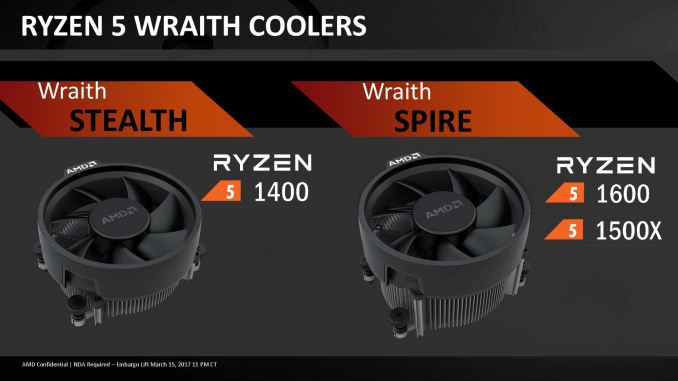
It is worth noting that the Wraith Spire for Ryzen 5 will not have RGB lighting, whereas the Wraith Spire for Ryzen 7 does use an RGB ring. OEMs will be able to use the higher-end Wraith Max stock cooler for their pre-built systems. AMD stated that at present, there are no plans to bring the Wraith coolers to retail as individual units, however they will keep track of how many users want them as individual items and regularly approach the issue internally.

To clarify some initial confusion, AMD has given me official TDP support numbers for the coolers. The entry level Wraith Stealth is 65W, the Wraith Spire is 65W for high-ambient conditions (AMD states this might be considered an ’80W’ design in low-ambient), and the Wraith Max is 95W for OEM builds using Ryzen 7 95W parts.

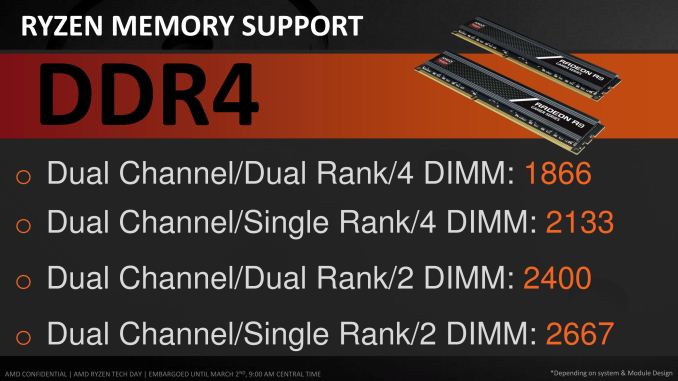
All the Ryzen 5 parts will support DDR4 ECC and non-ECC memory, and the memory support is the same as Ryzen 7, and will depend on how many modules and the types of modules being used. Recently companies like ADATA announced official support for AM4, as some users have found that there were memory growing pains when Ryzen 7 was launched.
Platform support for Ryzen 5, relating to PCIe lanes and chipset configurations, is identical to Ryzen 7. Each CPU offers sixteen PCIe 3.0 lanes for graphics, along with four lanes for a chipset and four lanes for storage. Chipsets can then offer up to eight PCIe 2.0 lanes which can be bifurcated up to x4 (AMD GPUs can use chipset lanes for graphics as well, however at reduced bandwidth and additional latency).

Competition

The high-end Ryzen 5 1600X, at $249, is a shoe-in to compete against Intel’s i5-7600K at $242. Intel’s CPU is based on the Kaby Lake microarchitecture, and we’ve already shown in the Ryzen 7 review that by comparison Ryzen is more circa Broadwell, which is two generations behind. AMD won’t win much when it comes to single-threaded tests here, but the multi-threaded situation is where AMD shines.

Comparison: Ryzen 5 1600X vs Core i5-7600K
AMD
Ryzen 5 1600X
Features Intel
Core i5-7600K
6 / 12 Cores/Threads 4 / 4
3.6 / 4.0 GHz Base/Turbo 3.8 / 4.2 GHz
16 PCIe 3.0 Lanes 16
16 MB L3 Cache 6 MB
95 W TDP 91 W
$249 Price (MSRP) $242

Here we have twelve threads against four, at a 95W TDP compared to a 91W TDP (the 1600 is 65W, which looks better on paper). It is expected that for situations where a compute workload can scale across cores and threads that the AMD chip will wipe the floor with the competition. For more generic office workloads, it will interesting to see where the marks fall.

On the quad-core parts, there are several competitive points to choose from. The AMD Ryzen 5 1500X, at $189, sits near Intel’s Core i5-7500 at $192. This would be a shootout of a base quad-core versus a quad-core with hyperthreading.

Comparison: Ryzen 5 1500X vs Core i5-7500
AMD
Ryzen 5 1500X
Features Intel
Core i5-7500
4 / 8 Cores/Threads 4 / 4
3.5 / 3.7 GHz Base/Turbo 3.4 / 3.8 GHz
16 PCIe 3.0 Lanes 16
16 MB L3 Cache 6 MB
65 W TDP 65 W
$189 Price (MSRP) $182

The reason why I didn’t pull out the Core i3-7350K there, at $168, is because the performance of the 7350K sits near the Pentium G4560, which is only $64 (and the subject of an upcoming review). That all being said, the $168 price of the i3-7350K matches up to the $169 price of the Ryzen 5 1400, although the 1400 has double the cores and double the threads of the 7350K.

Cutting up the Cores

Ryzen 5, both the hex-core and the quad-core variants, will use the same eight-core base Zeppelin silicon that Ryzen 7 does.
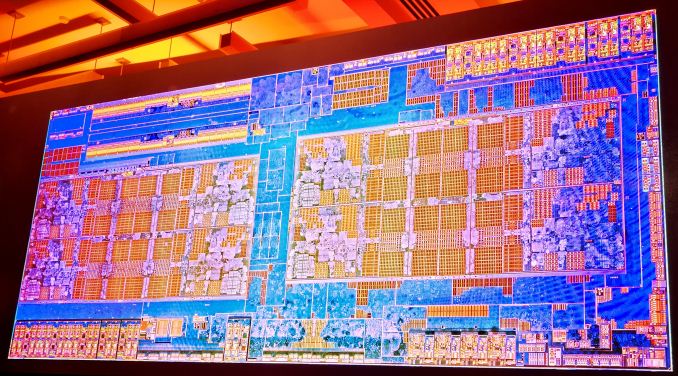
The silicon design consists of two core complexes (CCX) of four cores apiece, and each with 8MB of L3 cache that is an exclusive victim cache. One of the suggestions regarding Ryzen 7’s performance was about thread migration and scheduling on the core design, especially as core-to-core latency varies depending on where the cores are located (and there’s a jump between CCXes). Despite the use of AMD’s new Infinity Fabric, which is ultimately a superset of HyperTransport, there is still a slightly longer delay jumping over that CCX boundary, although the default Windows scheduler knows how to manage that boundary as demonstrated by Allyn at PCPerspective earlier this week.
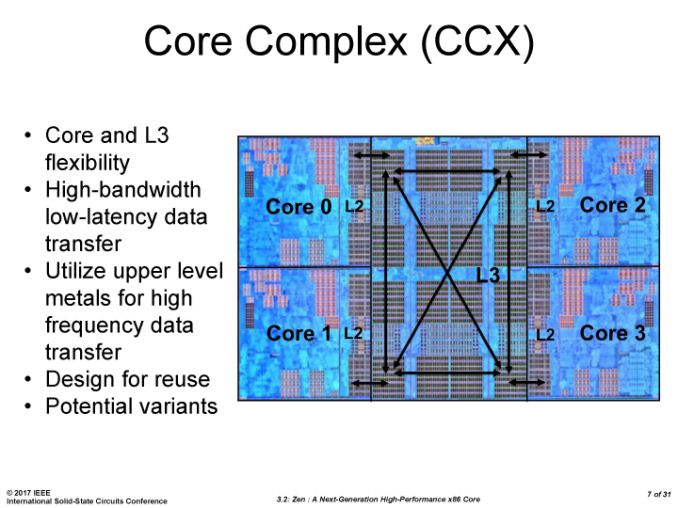
So when dealing with a four-core or six-core CPU, and the base core design has eight-cores, how does AMD cut them up? It is possible for AMD to offer a 4+0, 3+1 or 2+2 design for its quad-core parts, or 4+2 and 3+3 variants for its hexacore parts, similar to the way that Intel cuts up its integrated graphics for GT1 variants. The downside with this way is that performance might differ between the variants, making it difficult to manage. The upside is that more CPUs with defects can be used.

We have confirmation from AMD that there are no silly games going to be played with Ryzen 5. The six-core parts will be a strict 3+3 combination, while the four-core parts will use 2+2. This will be true across all CPUs, ensuring a consistent performance throughout.

Performance Estimates

We won’t have these CPUs in for a while, but given our new benchmark suite and the results we’ve seen so far with Ryzen, we’ve tried to lay out some estimates in performance in both single thread and multi-threaded workloads.
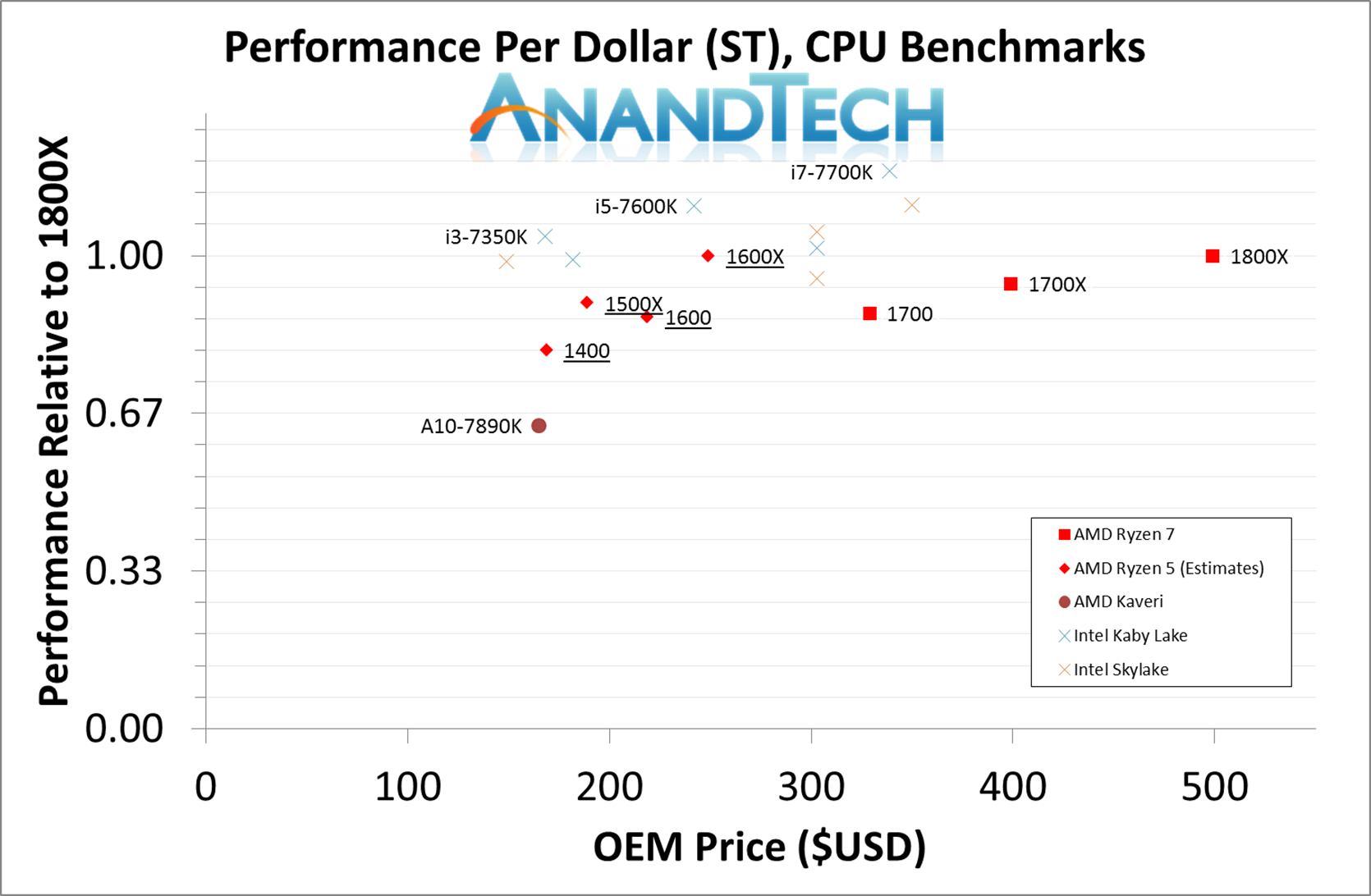
Single thread performance is easy enough to estimate – we work from the turbo and XFR frequencies of each processor. For users looking for peak single thread performance, something like Intel’s Pentium G3258 or i3-7350K that can be overclocked to 5GHz+ (or starts as a base 4.2 GHz) is going to be a performance per dollar crown here. On the AMD side, we expect the Ryzen 5 1600X to match the Ryzen 7 1700X as it has the same frequency.
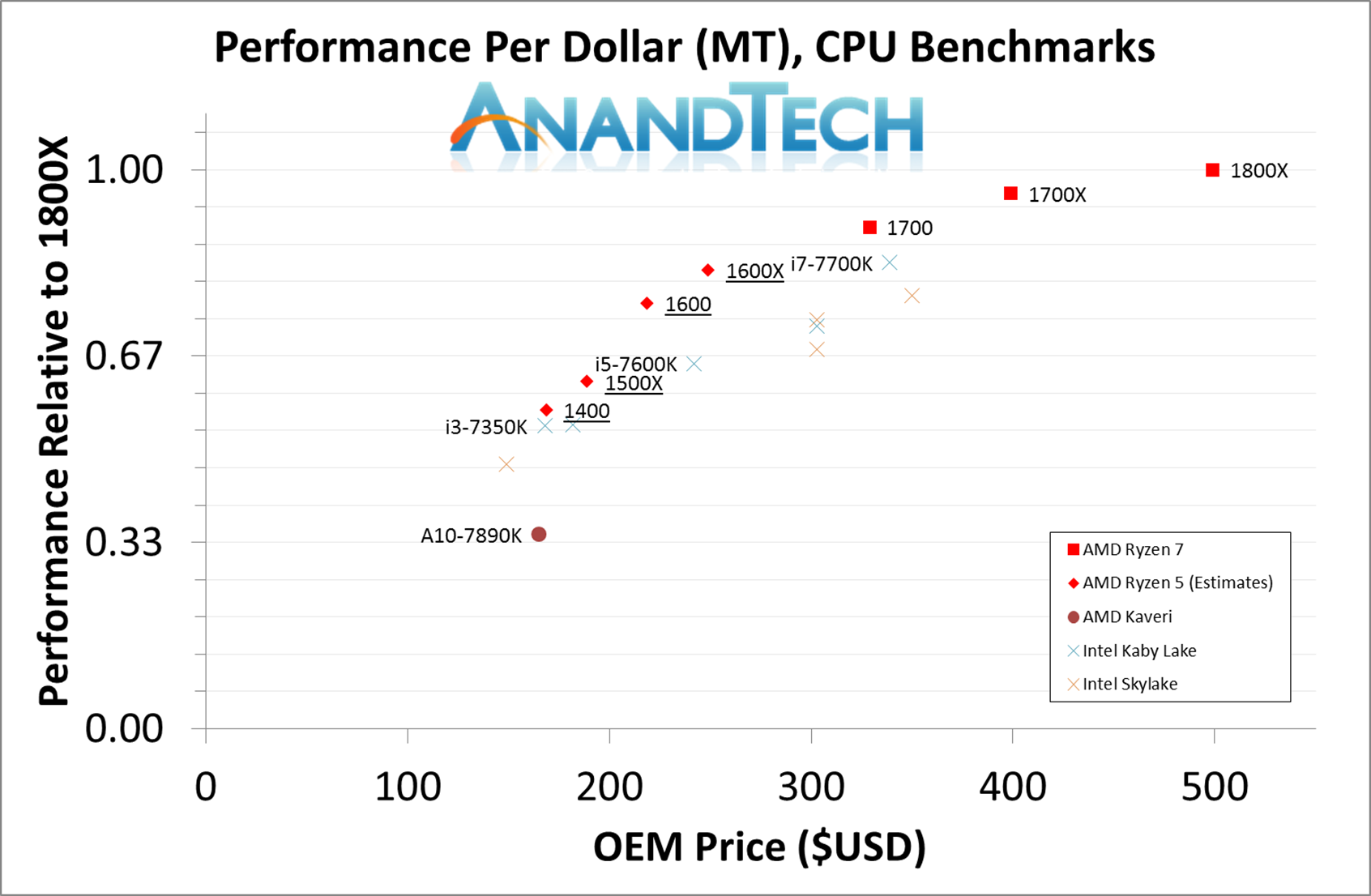
Multithreaded is more difficult to predict. Some of our benchmarks offer perfect scaling across cores and threads, meaning that if you half the cores, you get half the score. Some of the benchmarks are not as clear cut though, hence why we see something like Intel’s Core i3-7350K, which should get about half the score of an i7-7700K, scoring 65% instead of 50%. We’ve tried to take this into account with the Ryzen 5 parts, and we get the graph above.

The key results here show that the 1600 and 1600X should sit way above the i5-7600K, and the 1600X should offer so much better performance per dollar than the Core i7-7700K.
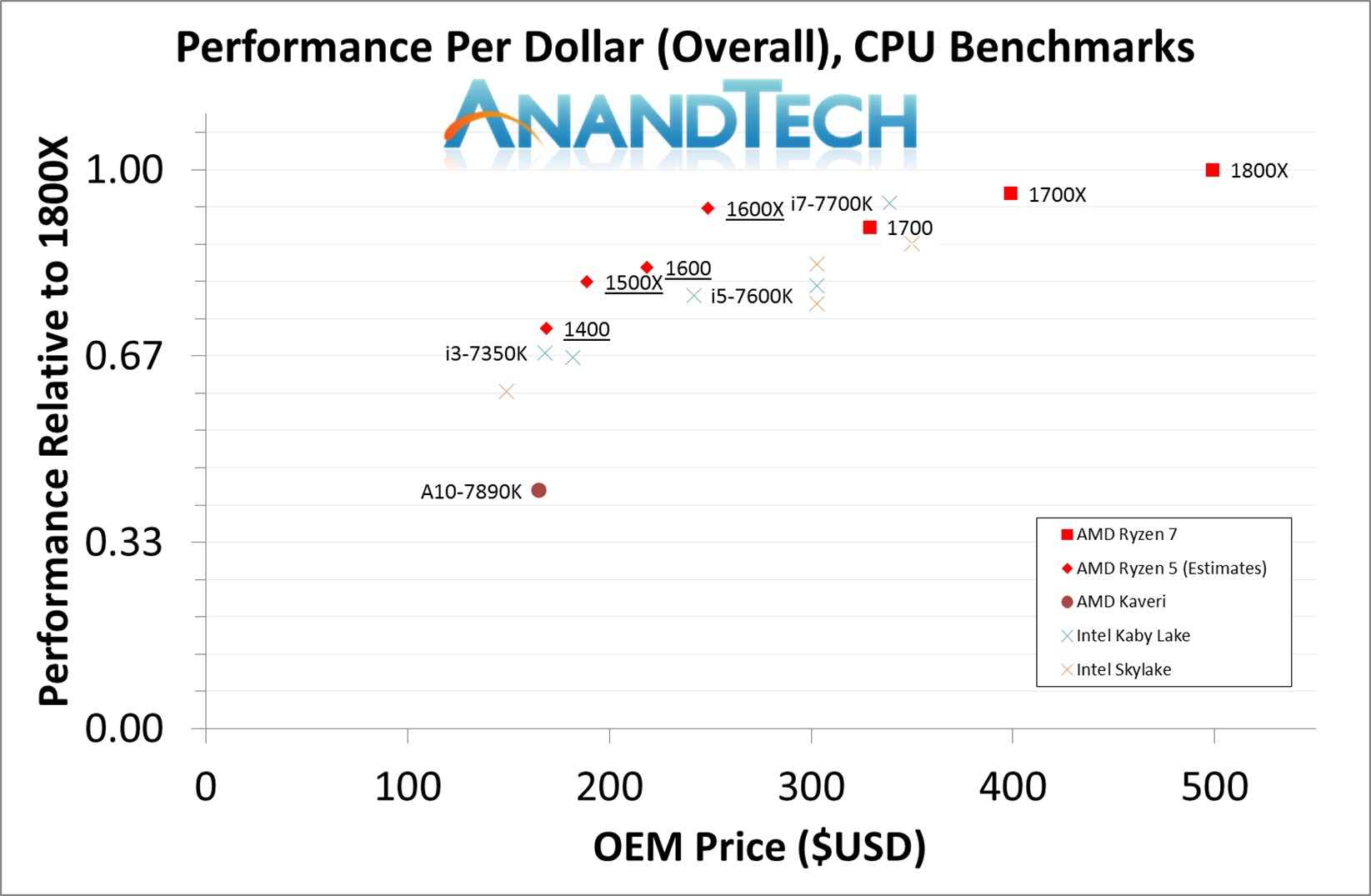
On overall performance, taking the combination of results (our suite is slightly unbalanced in favor of MT, but this is taken into consideration) we funnily see a straight line between the 1800X, 1700X, 1700, 1600 and 1500X, putting the 1600X at a really good position as a performance per dollar CPU.

The caveat here is that the Ryzen 7 processors came across as good workstation processors. Ryzen 7 was marketed towards that group of users, and it made sense. Ryzen 5 is more targeted towards mainstream gamers and users, which might offer some interesting results. Our results don’t feature any gaming numbers yet (still working on a Ryzen 7 part 2 for this), but it will be interesting to see how the core counts and frequency will affect gaming performance.

The Bottom Line

Ryzen 5.
Two CPUs with six-core, from $219-$249.
Two CPUs with four-core. From $169-$189.
Retail availability on April 11th.
Stay tuned for the AnandTech review.

(Ryzen 3 is still slated for 2H17.)

Related Reading

AMD Announces Ryzen 5 Lineup: Hex-Core from $219, Available April 11th

AMD Announces Ryzen 5 Lineup: Hex-Core from $219, Available April 11th

As part of our initial Ryzen 7 review, AMD also teased the presence of two more elements to the Ryzen lineup, specifically Ryzen 5 and Ryzen 3, both aiming at a lower cost market and allowing AMD to sell some of the silicon that didn’t quite make it to the Ryzen 7 lineup. Today is the official announcement for Ryzen 5, featuring four processors in hex-core and quad-core formats, all with Simultaneous Multi-Threading (SMT) and all using the same AM4 platform as Ryzen 5.

Ryzen 5

Whereas Ryzen 7 was AMD’s main attack on high-performance x86 and a shot across the bow against Intel’s high-end desktop platform, Ryzen 5 is targeted more at mainstream users. The goal here is that where Intel has four cores with no hyperthreading, AMD can provide six cores with SMT, effectively offering three times as many threads for the same price and potentially smashing any multithreaded workload.

Without further ado, here is where the Ryzen families stand:

AMD Ryzen 7 SKUs
  Cores/
Threads
Base/
Turbo
XFR L3 TDP Cost Cooler
Ryzen 7 1800X 8/16 3.6/4.0 +100 16 MB 95 W $499
Ryzen 7 1700X 8/16 3.4/3.8 +100 16 MB 95 W $399
Ryzen 7 1700 8/16 3.0/3.7 +50 16 MB 65 W $329 Spire
RGB
AMD Ryzen 5 SKUs
  Cores/
Threads
Base/
Turbo
XFR L3 TDP Cost Cooler
Ryzen 5 1600X 6/12 3.6/4.0 +100 16 MB 95 W $249
Ryzen 5 1600 6/12 3.2/3.6 +100 16 MB 65 W $219 Spire
Ryzen 5 1500X 4/8 3.5/3.7 +200 16 MB 65 W $189 Spire
Ryzen 5 1400 4/8 3.2/3.4 +50 8 MB 65 W $169 Stealth

Traditionally we are used to a part with fewer cores having a higher clock frequency, however perhaps due to the voltage scaling of the design, we see a matched Ryzen 5 1600X in frequency to the Ryzen 7 1800X, but the rest of the Ryzen 5 family are offered at a lower TDP instead.

All the Ryzen 5 parts are unlocked, similar to the Ryzen 7 parts, and all four exhibit some movement in XFR mode, with the 1500X offering +200 MHz depending on the cooler used. AMD is going to offer some of these SKUs with their redesigned Wraith coolers:

It is worth noting that the Wraith Spire for Ryzen 5 will not have RGB lighting, whereas the Wraith Spire for Ryzen 7 does use an RGB ring. OEMs will be able to use the higher-end Wraith Max stock cooler for their pre-built systems. AMD stated that at present, there are no plans to bring the Wraith coolers to retail as individual units, however they will keep track of how many users want them as individual items and regularly approach the issue internally.

To clarify some initial confusion, AMD has given me official TDP support numbers for the coolers. The entry level Wraith Stealth is 65W, the Wraith Spire is 65W for high-ambient conditions (AMD states this might be considered an ’80W’ design in low-ambient), and the Wraith Max is 95W for OEM builds using Ryzen 7 95W parts.

All the Ryzen 5 parts will support DDR4 ECC and non-ECC memory, and the memory support is the same as Ryzen 7, and will depend on how many modules and the types of modules being used. Recently companies like ADATA announced official support for AM4, as some users have found that there were memory growing pains when Ryzen 7 was launched.

Platform support for Ryzen 5, relating to PCIe lanes and chipset configurations, is identical to Ryzen 7. Each CPU offers sixteen PCIe 3.0 lanes for graphics, along with four lanes for a chipset and four lanes for storage. Chipsets can then offer up to eight PCIe 2.0 lanes which can be bifurcated up to x4 (AMD GPUs can use chipset lanes for graphics as well, however at reduced bandwidth and additional latency).

Competition

The high-end Ryzen 5 1600X, at $249, is a shoe-in to compete against Intel’s i5-7600K at $242. Intel’s CPU is based on the Kaby Lake microarchitecture, and we’ve already shown in the Ryzen 7 review that by comparison Ryzen is more circa Broadwell, which is two generations behind. AMD won’t win much when it comes to single-threaded tests here, but the multi-threaded situation is where AMD shines.

Comparison: Ryzen 5 1600X vs Core i5-7600K
AMD
Ryzen 5 1600X
Features Intel
Core i5-7600K
6 / 12 Cores/Threads 4 / 4
3.6 / 4.0 GHz Base/Turbo 3.8 / 4.2 GHz
16 PCIe 3.0 Lanes 16
16 MB L3 Cache 6 MB
95 W TDP 91 W
$249 Price (MSRP) $242

Here we have twelve threads against four, at a 95W TDP compared to a 91W TDP (the 1600 is 65W, which looks better on paper). It is expected that for situations where a compute workload can scale across cores and threads that the AMD chip will wipe the floor with the competition. For more generic office workloads, it will interesting to see where the marks fall.

On the quad-core parts, there are several competitive points to choose from. The AMD Ryzen 5 1500X, at $189, sits near Intel’s Core i5-7500 at $192. This would be a shootout of a base quad-core versus a quad-core with hyperthreading.

Comparison: Ryzen 5 1500X vs Core i5-7500
AMD
Ryzen 5 1500X
Features Intel
Core i5-7500
4 / 8 Cores/Threads 4 / 4
3.5 / 3.7 GHz Base/Turbo 3.4 / 3.8 GHz
16 PCIe 3.0 Lanes 16
16 MB L3 Cache 6 MB
65 W TDP 65 W
$189 Price (MSRP) $182

The reason why I didn’t pull out the Core i3-7350K there, at $168, is because the performance of the 7350K sits near the Pentium G4560, which is only $64 (and the subject of an upcoming review). That all being said, the $168 price of the i3-7350K matches up to the $169 price of the Ryzen 5 1400, although the 1400 has double the cores and double the threads of the 7350K.

Cutting up the Cores

Ryzen 5, both the hex-core and the quad-core variants, will use the same eight-core base Zeppelin silicon that Ryzen 7 does.

The silicon design consists of two core complexes (CCX) of four cores apiece, and each with 8MB of L3 cache that is an exclusive victim cache. One of the suggestions regarding Ryzen 7’s performance was about thread migration and scheduling on the core design, especially as core-to-core latency varies depending on where the cores are located (and there’s a jump between CCXes). Despite the use of AMD’s new Infinity Fabric, which is ultimately a superset of HyperTransport, there is still a slightly longer delay jumping over that CCX boundary, although the default Windows scheduler knows how to manage that boundary as demonstrated by Allyn at PCPerspective earlier this week.

So when dealing with a four-core or six-core CPU, and the base core design has eight-cores, how does AMD cut them up? It is possible for AMD to offer a 4+0, 3+1 or 2+2 design for its quad-core parts, or 4+2 and 3+3 variants for its hexacore parts, similar to the way that Intel cuts up its integrated graphics for GT1 variants. The downside with this way is that performance might differ between the variants, making it difficult to manage. The upside is that more CPUs with defects can be used.

We have confirmation from AMD that there are no silly games going to be played with Ryzen 5. The six-core parts will be a strict 3+3 combination, while the four-core parts will use 2+2. This will be true across all CPUs, ensuring a consistent performance throughout.

Performance Estimates

We won’t have these CPUs in for a while, but given our new benchmark suite and the results we’ve seen so far with Ryzen, we’ve tried to lay out some estimates in performance in both single thread and multi-threaded workloads.

Single thread performance is easy enough to estimate – we work from the turbo and XFR frequencies of each processor. For users looking for peak single thread performance, something like Intel’s Pentium G3258 or i3-7350K that can be overclocked to 5GHz+ (or starts as a base 4.2 GHz) is going to be a performance per dollar crown here. On the AMD side, we expect the Ryzen 5 1600X to match the Ryzen 7 1700X as it has the same frequency.

Multithreaded is more difficult to predict. Some of our benchmarks offer perfect scaling across cores and threads, meaning that if you half the cores, you get half the score. Some of the benchmarks are not as clear cut though, hence why we see something like Intel’s Core i3-7350K, which should get about half the score of an i7-7700K, scoring 65% instead of 50%. We’ve tried to take this into account with the Ryzen 5 parts, and we get the graph above.

The key results here show that the 1600 and 1600X should sit way above the i5-7600K, and the 1600X should offer so much better performance per dollar than the Core i7-7700K.

On overall performance, taking the combination of results (our suite is slightly unbalanced in favor of MT, but this is taken into consideration) we funnily see a straight line between the 1800X, 1700X, 1700, 1600 and 1500X, putting the 1600X at a really good position as a performance per dollar CPU.

The caveat here is that the Ryzen 7 processors came across as good workstation processors. Ryzen 7 was marketed towards that group of users, and it made sense. Ryzen 5 is more targeted towards mainstream gamers and users, which might offer some interesting results. Our results don’t feature any gaming numbers yet (still working on a Ryzen 7 part 2 for this), but it will be interesting to see how the core counts and frequency will affect gaming performance.

The Bottom Line

Ryzen 5.
Two CPUs with six-core, from $219-$249.
Two CPUs with four-core. From $169-$189.
Retail availability on April 11th.
Stay tuned for the AnandTech review.

(Ryzen 3 is still slated for 2H17.)

Related Reading

Spreadtrum SC9861G-IA: An Intel Atom Octocore Smartphone SoC on 14nm with LTE

Spreadtrum SC9861G-IA: An Intel Atom Octocore Smartphone SoC on 14nm with LTE

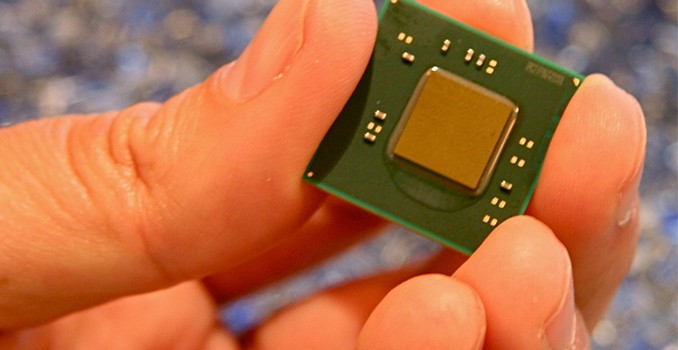
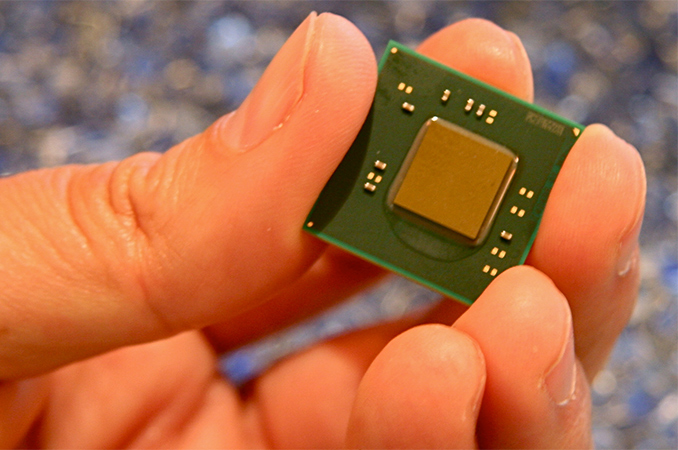
Last year Intel decided to cease development of its smartphone SoCs and focus instead on microprocessors for other devices, as well as LTE, 5G modems, as well as various IoT solutions. While we weren’t expecting a new x86 SoC in the space, Intel did not specify that would be the case: the agreements with third-party SoC developers such as Spreadtrum and Rockchip were still in place. Despite this, we were surprised to hear that At MWC 2017, Intel’s partner Spreadtrum introduced a brand new application processor for high-end handsets, featuring Intel’s 2015 Airmont cores (as seen in Cherry Trail) and made using Intel’s 14 nm process technology.

The Spreadtrum SC9861G-IA SoC features eight Intel’s Airmont cores with running at up to 2 GHz, with Imagination Technology’s PowerVR GT7200 GPU. Also integrated is Spreadtrum’s own 5-mode LTE Cat 7 modem (up to 300 Mbps download, up to 100 Mbps upload). The SoC also integrates an ISP that supports up to two 13 MP camera sensors, a dedicated sensor hub, and hardware-based decoders/encoders for HEVC and other popular video codecs that support up to 3840×2160 resolution. The display controller can handle resolutions up to 2560×1600.

Spreadtrum’s 8-Core Airmont SoC
  SC9861G-IA
CPU Cores 8 × Intel Airmont at up to 2 GHz
GPU PowerVR GT7200
Imaging Capabilities Up to 26 MP,
up to two 13 MP sensors
Video 4Kp30, HEVC
Display Controller 2560 × 1440
Modem TD-LTE/FDD LTE/TD-SCDMA/WCDMA/EGG
LTE Category 7
(DL: 300Mbps, UL: 100Mbps)
Process Technology 14 nm

To date, the Spreadtrum SC9861G-IA is the most powerful (and presumably energy-efficient) x86-based SoCfor smartphones. It has more cores, better graphics, and a faster modem than Intel’s own code-named Moorefield SoCs introduced in 2014, made using its 22 nm fabrication process, or the SoFIA chips (designed by Rockchip) launched in 2015 made using TSMC’s 28 nm technologies. Using Intel’s 14 nm manufacturing technology for this new SoC helps to reduce minimum power requirements and die size (which still remain unknown).

The SC9861G-IA is the first x86-based SoC by Spreadtrum, and the development was enabled by an agreement signed in late 2014 after Intel acquired a $1.5-billion worth stake in Tsinghua Unigroup, the owner of Spreadtrum. The chip will not carry the Intel Atom brand, and thus Intel will not help makers of devices to integrate it or make any other incentives to popularize the platform. It will also not invest in its advertising. What is interesting is that the SC9861G-IA will not be Spreadtrum’s last x86-based SoC, according to the CEO of Intel.

“We look forward to working with Spreadtrum on additional mobile platforms,” said Brian Krzanich.

Neither company elaborated on the future plans, and we do not know whether Spreadtrum will continue to introduce smartphone SoCs featuring Intel’s low-power cores, or if they will launch something for higher-end tablets as well.

Intel and Spreadtrum did not disclose when they expect the first devices based on the SC9861G-IA to show up, but only noted that the platform can address both mainstream and high-end handsets.