Vik


AOC Expands AGON Family with Curved AG322QCX and AG272FCX 144 Hz Displays

AOC Expands AGON Family with Curved AG322QCX and AG272FCX 144 Hz Displays

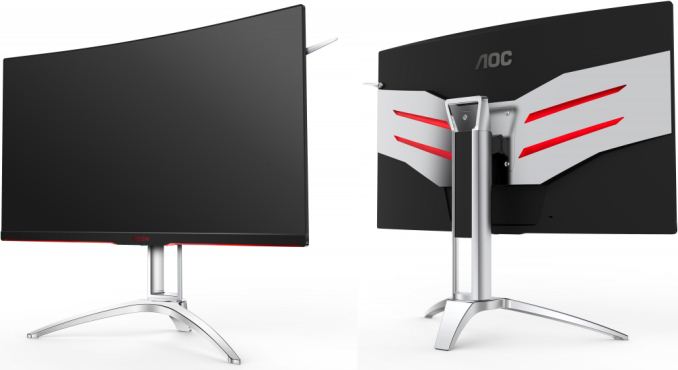
AOC has introduced two new curved gaming monitors as part of the AGON family, the AG322QCX and the AG272FCX. The new monitors feature rather high refresh rates along with VESA’s Adaptive-Sync technology (which generally means support for AMD’s FreeSync). The displays have a number of similarities, but are aimed at different segments of the market, with varying prices and feature sets..

The AOC AGON AG272FCX is the smaller of the two and uses a 27” VA panel with 1920×1080 resolution, whereas the AOC AGON AG322QCX is the larger one and features a 31.5” VA panel with 2560×1440 resolution. The monitors have 1800R curvature, a 16:9 aspect ratio, as well as refresh rates between 48 Hz and 144 Hz. The general specifications of the displays resembles those of many other gaming monitors: 250/300 nits brightness, 3000:1/2000:1 contrast ratio, 178°/178° viewing angles, 16.7 million colors (and the sRGB color gamut), a 4 ms response time (grey-to-grey) and so on. The monitors support VESA’s Adaptive-Sync technology, and I expect it’s only a matter of time until AMD certifies them for FreeSync.

As for connectivity, the AGON AG272FCX has a D-Sub(!), DisplayPort, and two HDMI inputs, whereas the AGON AG322QCX comes with two HDMI and two DisplayPort inputs. The smaller display also has a dual-port USB 3.0 hub as well as integrated 3 W stereo speakers, two logical features for an entry-level monitor. By contrast, the larger screen is a much more straightforward pure monitor, which is par for the course as higher-end monitors rarely ship with speakers since customers usually already have external speakers/headphones. A more important drawback is the lack of any HDCP support on the AG322QCX, which greatly limits the monitor’s ability to be used with protected HD video content such as Blu-rays or Netflix streaming.

AOC’s AGON Curved 16:9 Displays
  AGON AG272FCX AGON AG322QCX
Panel 27″ VA 31.5″ VA
Native Resolution 1920 × 1080 2560 × 1440
Maximum Refresh Rate 144 Hz
Response Time 4 ms
Dynamic Refresh Rate Adaptive-Sync (not yet FreeSync certified)
Brightness 250 cd/m² 300 cd/m²
Contrast 3000:1 2000:1
Viewing Angles 178°/178° horizontal/vertical
Curvature 1800R
Pixel Pitch 0.3114 mm 0.2724 mm
Pixel Density 82 ppi 93 ppi
Anti-Glare Coating Yes
Inputs 1 × DisplayPort (HDCP)
1 × D-Sub
2 × HDMI (HDCP)
2× DisplayPort
2 × HDMI
USB Hub 2-port USB 3.0 hub
Audio 3 W × 2
audio in/out ports
Power Consumption Idle: 0.5 W
Operating: 47 W
Idle: 0.5 W
Operating: 40 W
Launch Price £389 ($485) in the U.K. £519 ($647) in the U.K.

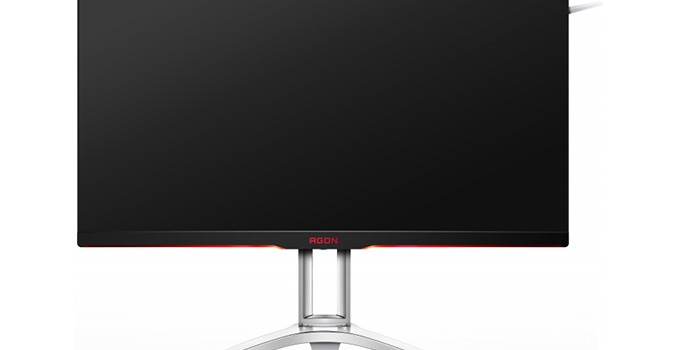
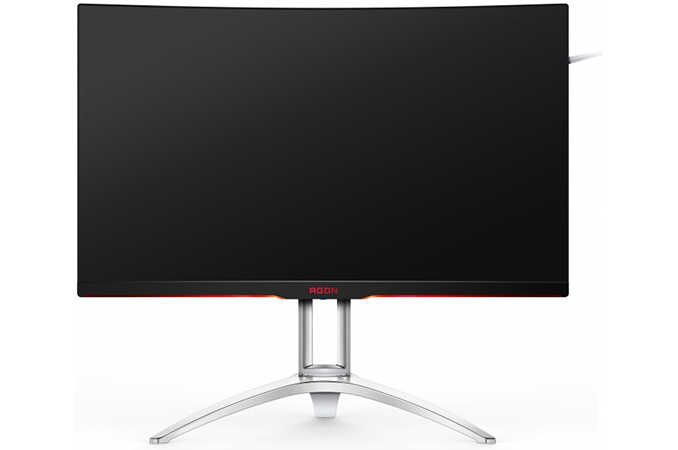
When it comes to visual aesthetics, the new AGON displays feature ultra-thin bezels as well as an aggressive design that highlights their gaming nature. Furthermore, the monitors have four large LEDs with adjustable colors (red, green, blue) located on the back and two located on the bottom edges of the displays.

The addition of these latest AGON displays brings AOC to a total of four curved monitors introduced under the brand in the last few months, joining the company’s previously launched ultrawide curved monitors and making these the company’s first curved 16:9 monitors. So it appears that AOC is pinning a lot of its hopes for the AGON brand on curved gaming screens with high refresh rates designed for gamers. 

AOC’s AGON AG322QCX and AGON AG272FCX monitors will be available in May. The exact MSRPs of the displays in the U.S. and Continental Europe are unknown, but Hexus reports that in the U.K. they will cost £519 ($647) and £389 ($485) respectively.

Related Reading:

AOC Expands AGON Family with Curved AG322QCX and AG272FCX 144 Hz Displays

AOC Expands AGON Family with Curved AG322QCX and AG272FCX 144 Hz Displays

AOC has introduced two new curved gaming monitors as part of the AGON family, the AG322QCX and the AG272FCX. The new monitors feature rather high refresh rates along with VESA’s Adaptive-Sync technology (which generally means support for AMD’s FreeSync). The displays have a number of similarities, but are aimed at different segments of the market, with varying prices and feature sets..

The AOC AGON AG272FCX is the smaller of the two and uses a 27” VA panel with 1920×1080 resolution, whereas the AOC AGON AG322QCX is the larger one and features a 31.5” VA panel with 2560×1440 resolution. The monitors have 1800R curvature, a 16:9 aspect ratio, as well as refresh rates between 48 Hz and 144 Hz. The general specifications of the displays resembles those of many other gaming monitors: 250/300 nits brightness, 3000:1/2000:1 contrast ratio, 178°/178° viewing angles, 16.7 million colors (and the sRGB color gamut), a 4 ms response time (grey-to-grey) and so on. The monitors support VESA’s Adaptive-Sync technology, and I expect it’s only a matter of time until AMD certifies them for FreeSync.

As for connectivity, the AGON AG272FCX has a D-Sub(!), DisplayPort, and two HDMI inputs, whereas the AGON AG322QCX comes with two HDMI and two DisplayPort inputs. The smaller display also has a dual-port USB 3.0 hub as well as integrated 3 W stereo speakers, two logical features for an entry-level monitor. By contrast, the larger screen is a much more straightforward pure monitor, which is par for the course as higher-end monitors rarely ship with speakers since customers usually already have external speakers/headphones. A more important drawback is the lack of any HDCP support on the AG322QCX, which greatly limits the monitor’s ability to be used with protected HD video content such as Blu-rays or Netflix streaming.

AOC’s AGON Curved 16:9 Displays
  AGON AG272FCX AGON AG322QCX
Panel 27″ VA 31.5″ VA
Native Resolution 1920 × 1080 2560 × 1440
Maximum Refresh Rate 144 Hz
Response Time 4 ms
Dynamic Refresh Rate Adaptive-Sync (not yet FreeSync certified)
Brightness 250 cd/m² 300 cd/m²
Contrast 3000:1 2000:1
Viewing Angles 178°/178° horizontal/vertical
Curvature 1800R
Pixel Pitch 0.3114 mm 0.2724 mm
Pixel Density 82 ppi 93 ppi
Anti-Glare Coating Yes
Inputs 1 × DisplayPort (HDCP)
1 × D-Sub
2 × HDMI (HDCP)
2× DisplayPort
2 × HDMI
USB Hub 2-port USB 3.0 hub
Audio 3 W × 2
audio in/out ports
Power Consumption Idle: 0.5 W
Operating: 47 W
Idle: 0.5 W
Operating: 40 W
Launch Price £389 ($485) in the U.K. £519 ($647) in the U.K.

When it comes to visual aesthetics, the new AGON displays feature ultra-thin bezels as well as an aggressive design that highlights their gaming nature. Furthermore, the monitors have four large LEDs with adjustable colors (red, green, blue) located on the back and two located on the bottom edges of the displays.

The addition of these latest AGON displays brings AOC to a total of four curved monitors introduced under the brand in the last few months, joining the company’s previously launched ultrawide curved monitors and making these the company’s first curved 16:9 monitors. So it appears that AOC is pinning a lot of its hopes for the AGON brand on curved gaming screens with high refresh rates designed for gamers. 

AOC’s AGON AG322QCX and AGON AG272FCX monitors will be available in May. The exact MSRPs of the displays in the U.S. and Continental Europe are unknown, but Hexus reports that in the U.K. they will cost £519 ($647) and £389 ($485) respectively.

Related Reading:

Samsung Announces Exynos 8895 SoC: 10nm, Mali G71MP20, & LPDDR4x

Samsung Announces Exynos 8895 SoC: 10nm, Mali G71MP20, & LPDDR4x

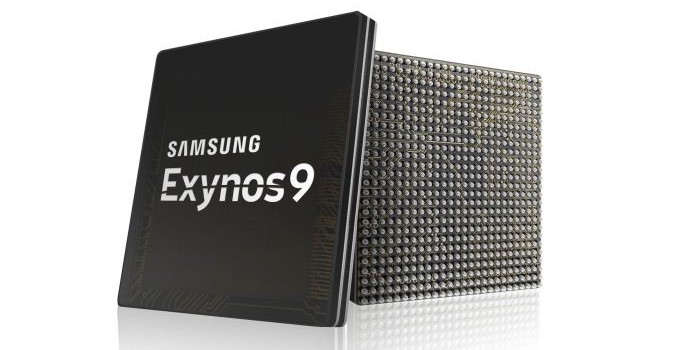
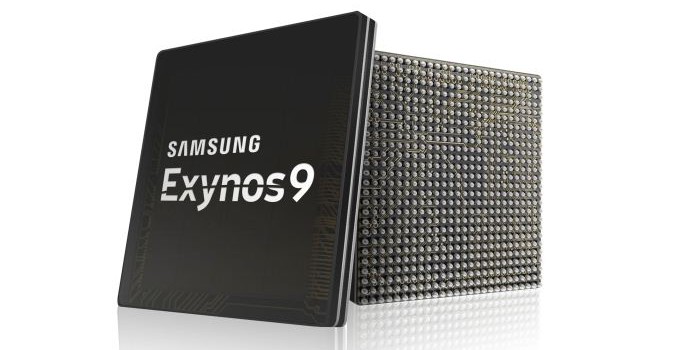
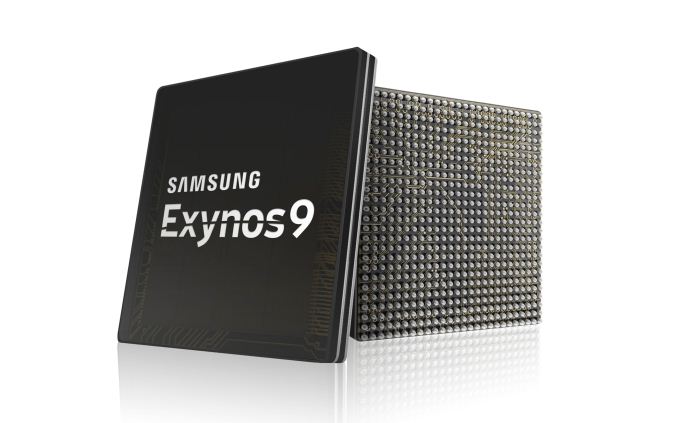
Even though Mobile World Congress doesn’t kick off for another few days, Samsung isn’t wasting any time in getting started. This morning the company is announcing their latest generation high-end ARM SoC, the Exynos 8895. Their first in-house 10nm SoC, the company isn’t talking about what it will go in, but based on the context of the announcement it’s a safe bet we’re looking at the SoC for at least some SKUs of the next Galaxy S phone.

While Samsung has been in the SoC game with the Exynos series for a number of years now, it’s been in the last few years that they’ve really cemented their positon as a market leader at the high-end. Thanks in part to the company’s 14nm process, the Exynos 7420 proved to be a very capable and powerful SoC from the company. Last year Samsung followed that up with the Exynos 8890, which among other firsts marked Samsung’s entry into designing their own CPU cores with the M1.

Now for 2017 Samsung wants to repeat their success over the past couple of years with the Exynos 9 Series 8895. As you can likely infer from the name, it’s not meant to be radically different from the preceding 8890, but there are still some pretty important changes here that should affect performance across the board.

Samsung Exynos SoCs Specifications
SoC Exynos 8895 Exynos 8890 Exynos 7420
CPU 4x A53

4x Exynos M2(?)

4x [email protected]

4x Exynos M1 @ 2.3GHz

4x [email protected]

4x [email protected]

GPU Mali G71MP20 Mali T880MP12
@ 650MHz
Mali T760MP8
@ 770MHz
Memory
Controller
2x 32-bit(?)
LPDDR4x
 
2x 32-bit
LPDDR4 @ 1794MHz

28.7GB/s b/w

2x 32-bit
LPDDR4 @ 1555MHz

24.8GB/s b/w

Storage eMMC 5.1, UFS 2.1 eMMC 5.1, UFS 2.0 eMMC 5.1, UFS 2.0
Modem Down: LTE Cat16
Up: LTE Cat13
Down: LTE Cat12
Up: LTE Cat13
N/A
ISP Rear: 28MP
Front: 28MP
Rear: 24MP
Front: 13MP
Rear: 16MP
Front: 5MP
Mfc.
Process
Samsung
10nm LPE
Samsung
14nm LPP
Samsung
14nm LPE

The big deal for Samsung of course is that the Exynos 8895 is their first 10nm SoC, designed by Samsung LSI and fabbed by Samsung. Semantics of what is or isn’t 10nm aside, Samsung’s 10nm LPE process is cutting-edge for a mobile SoC, and relative to the current 14nm process offers better density and better performance characteristics. Samsung has talked about the process a bit in the past, and for the Exynos 8895 announcement they are reiterating that the 10nm LPE process offers “up to 27% higher performance while consuming 40% less power” relative to 14nm. However this may be in error in phrasing on Samsung’s part, as last year it was “27-percent higher performance or 40-percent lower power consumption”, which is a more realistic statement. Either way, for 8895 in particular, Samsung isn’t talking about performance quite yet.

Diving into the specs, the CPU situation looks a great deal like the previous 8890. Samsung has gone with 8 cores – 4 high-power, 4 low-power – with a mix of custom and licensed silicon. The high-power cores are composed of what Samsung is calling a “2nd generation” custom CPU core. This would presumably be a newer iteration of the M1 (so the M2?), but Samsung isn’t offering up much in the way of details at this time over what’s changed from the M1. What we do know is that Samsung is touting that it offers both better performance and improved energy efficiency. Meanwhile low-power work is once again being provided by ARM’s Cortex-A53. (ed: which on 10nm, must be absolutely tiny, considering that a core was sub-1mm2 on 14nm)

Meanwhile on the GPU side, Samsung has significantly upgraded their graphics capabilities by tapping ARM’s latest-generation Mali-G71 GPU in an MP20 configuration. Based on ARM’s new Bifrost GPU architecture, the G71 radically overhauls the internal workings of the GPU to match the contemporary thread level parallelism (TLP)-centric nature of desktop GPUs and modern workloads. ARM has previously discussed that they expect G71-based devices to offer around 50% better graphics performance than T880 devices, and Samsung is going one step further by touting it as 60% faster performance.

In another first for Samsung, the 8895 is also their first Heterogeneous System Architecture (HSA) compliant SoC. This requires that the CPU, GPU, and interconnect all support HSA, and indeed all of the necessary pieces have come together for 8895. We’ve previously seen that the Mali-G71 GPU is HSA-compliant, and meanwhile for the 8895 Samsung has rolled out a new version of their interconnect (the Samsung Coherent Interconnect) to support HSA. This isn’t a development that I expect will have immediate ramifications, but HSA is ultimately at the core of making it easier for developers to program applications that use the GPU in a compute context, thanks to the common (and common-sense) architecture rules for HSA.

To feed the resulting beast, Samsung has added support for LPDDR4x memory. An extension of the original LPDDR4 standard, LPDDR4x is designed to reduce DRAM power consumption by up to 20% by reducing the output driver power (I/O VDDQ voltage) by 45%, from 1.1 V to 0.6 V. LPDDR4x memory has just started shipping, so along with the previously announced Snapdragon 835, the Exynos 8895 is the other high-performance SoC coming out this year to support the new memory.

The Exynos 8895 is also getting an upgraded ISP. The latest ISP supports 28MP for both the front and rear cameras, while a bit more nebulously, Samsung’s spec sheet also lists support for “28MP+16MP Dual Camera” mode, an unsurprising development given the recent popularity of dual camera phone designs. Diving a bit deeper, we find that the 8895’s ISP is actually two ISPs: a high-performance ISP and a low-power ISP, with the low-power ISP presumably providing the aforementioned 16MP capability. Samsung is touting this combination as allowing them to offer dual camera functionality while still keeping power consumption in check.

On the flip slide of the coin, the Exynos 8895 also gets a new version of Samsung’s video decode block, which the company calls their Multi-Format Codec (MFC). This latest MFC supports all the bells and whistles you’d expect, with both HEVC and VP9 decoding up to 4Kp120. Samsung’s press release also briefly mentions a “video processing technology that enables a higher quality experience by enhancing the image quality” that’s capable of “enhancing the image quality of a specific portion that is perceived more sensitive to the human eye.” Given the VR applications – and Samsung wants to be able to do 4K VR –  this sounds a bit like a variation on the idea of foveated rendering, but there aren’t any further details on the technology at this time.

Also appearing for the first time on the Exynos 8895 is Samsung’s Cat16 LTE modem design. With their modem Samsung is using 5x Carrier Aggregation to achieve up to 1Gbps down, while uploading is rated at LTE Cat 13, using 2 carriers to get 150Mbps up. What’s notable here is that, as best as I can tell, this is the first modem using 5x CA; Qualcomm’s equivalent modem, the X16, uses 3 or 4x CA depending on the scenario. Unfortunately with the limited details Samsung offers right now, I’m not sure whether they have to use 5x CA to get Cat 16 bandwidth, or this is just another optional mode.

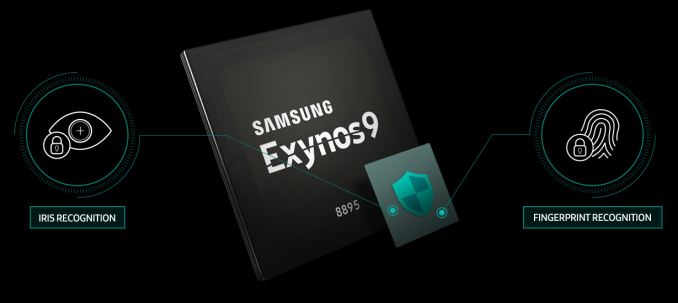
Finally, the Exynos 8895 also includes what Samsung is calling an “enhanced security sub-system with a separate security processing unit” for use with user authentication, mobile payments, and the like. Based on Samsung’s description this sounds a heck of a lot like Apple’s Secure Enclave, which would be a very welcome development, as in Apple’s case it has made their phones a lot harder to break into.
Wrapping things up, along with today’s product announcement of the Exynos 8895, Samsung is also announcing that the SoC is in mass production; and indeed I would be surprised if this isn’t the SoC they announced back in October, which would mean it’s been in production for some time now. We still don’t know when we’re going to see the next Samsung Galaxy S phone, but given how Samsung is announcing the SoC in this fashion, clearly it’s going to be sooner than later. In the meantime, hopefully we’ll get some additional SoC details next week at MWC.

Samsung Announces Exynos 8895 SoC: 10nm, Mali G71MP20, & LPDDR4x

Samsung Announces Exynos 8895 SoC: 10nm, Mali G71MP20, & LPDDR4x

Even though Mobile World Congress doesn’t kick off for another few days, Samsung isn’t wasting any time in getting started. This morning the company is announcing their latest generation high-end ARM SoC, the Exynos 8895. Their first in-house 10nm SoC, the company isn’t talking about what it will go in, but based on the context of the announcement it’s a safe bet we’re looking at the SoC for at least some SKUs of the next Galaxy S phone.

While Samsung has been in the SoC game with the Exynos series for a number of years now, it’s been in the last few years that they’ve really cemented their positon as a market leader at the high-end. Thanks in part to the company’s 14nm process, the Exynos 7420 proved to be a very capable and powerful SoC from the company. Last year Samsung followed that up with the Exynos 8890, which among other firsts marked Samsung’s entry into designing their own CPU cores with the M1.

Now for 2017 Samsung wants to repeat their success over the past couple of years with the Exynos 9 Series 8895. As you can likely infer from the name, it’s not meant to be radically different from the preceding 8890, but there are still some pretty important changes here that should affect performance across the board.

Samsung Exynos SoCs Specifications
SoC Exynos 8895 Exynos 8890 Exynos 7420
CPU 4x A53

4x Exynos M2(?)

4x [email protected]

4x Exynos M1 @ 2.3GHz

4x [email protected]

4x [email protected]

GPU Mali G71MP20 Mali T880MP12
@ 650MHz
Mali T760MP8
@ 770MHz
Memory
Controller
2x 32-bit(?)
LPDDR4x
 
2x 32-bit
LPDDR4 @ 1794MHz

28.7GB/s b/w

2x 32-bit
LPDDR4 @ 1555MHz

24.8GB/s b/w

Storage eMMC 5.1, UFS 2.1 eMMC 5.1, UFS 2.0 eMMC 5.1, UFS 2.0
Modem Down: LTE Cat16
Up: LTE Cat13
Down: LTE Cat12
Up: LTE Cat13
N/A
ISP Rear: 28MP
Front: 28MP
Rear: 24MP
Front: 13MP
Rear: 16MP
Front: 5MP
Mfc.
Process
Samsung
10nm LPE
Samsung
14nm LPP
Samsung
14nm LPE

The big deal for Samsung of course is that the Exynos 8895 is their first 10nm SoC, designed by Samsung LSI and fabbed by Samsung. Semantics of what is or isn’t 10nm aside, Samsung’s 10nm LPE process is cutting-edge for a mobile SoC, and relative to the current 14nm process offers better density and better performance characteristics. Samsung has talked about the process a bit in the past, and for the Exynos 8895 announcement they are reiterating that the 10nm LPE process offers “up to 27% higher performance while consuming 40% less power” relative to 14nm. However this may be in error in phrasing on Samsung’s part, as last year it was “27-percent higher performance or 40-percent lower power consumption”, which is a more realistic statement. Either way, for 8895 in particular, Samsung isn’t talking about performance quite yet.

Diving into the specs, the CPU situation looks a great deal like the previous 8890. Samsung has gone with 8 cores – 4 high-power, 4 low-power – with a mix of custom and licensed silicon. The high-power cores are composed of what Samsung is calling a “2nd generation” custom CPU core. This would presumably be a newer iteration of the M1 (so the M2?), but Samsung isn’t offering up much in the way of details at this time over what’s changed from the M1. What we do know is that Samsung is touting that it offers both better performance and improved energy efficiency. Meanwhile low-power work is once again being provided by ARM’s Cortex-A53. (ed: which on 10nm, must be absolutely tiny, considering that a core was sub-1mm2 on 14nm)

Meanwhile on the GPU side, Samsung has significantly upgraded their graphics capabilities by tapping ARM’s latest-generation Mali-G71 GPU in an MP20 configuration. Based on ARM’s new Bifrost GPU architecture, the G71 radically overhauls the internal workings of the GPU to match the contemporary thread level parallelism (TLP)-centric nature of desktop GPUs and modern workloads. ARM has previously discussed that they expect G71-based devices to offer around 50% better graphics performance than T880 devices, and Samsung is going one step further by touting it as 60% faster performance.

In another first for Samsung, the 8895 is also their first Heterogeneous System Architecture (HSA) compliant SoC. This requires that the CPU, GPU, and interconnect all support HSA, and indeed all of the necessary pieces have come together for 8895. We’ve previously seen that the Mali-G71 GPU is HSA-compliant, and meanwhile for the 8895 Samsung has rolled out a new version of their interconnect (the Samsung Coherent Interconnect) to support HSA. This isn’t a development that I expect will have immediate ramifications, but HSA is ultimately at the core of making it easier for developers to program applications that use the GPU in a compute context, thanks to the common (and common-sense) architecture rules for HSA.

To feed the resulting beast, Samsung has added support for LPDDR4x memory. An extension of the original LPDDR4 standard, LPDDR4x is designed to reduce DRAM power consumption by up to 20% by reducing the output driver power (I/O VDDQ voltage) by 45%, from 1.1 V to 0.6 V. LPDDR4x memory has just started shipping, so along with the previously announced Snapdragon 835, the Exynos 8895 is the other high-performance SoC coming out this year to support the new memory.

The Exynos 8895 is also getting an upgraded ISP. The latest ISP supports 28MP for both the front and rear cameras, while a bit more nebulously, Samsung’s spec sheet also lists support for “28MP+16MP Dual Camera” mode, an unsurprising development given the recent popularity of dual camera phone designs. Diving a bit deeper, we find that the 8895’s ISP is actually two ISPs: a high-performance ISP and a low-power ISP, with the low-power ISP presumably providing the aforementioned 16MP capability. Samsung is touting this combination as allowing them to offer dual camera functionality while still keeping power consumption in check.

On the flip slide of the coin, the Exynos 8895 also gets a new version of Samsung’s video decode block, which the company calls their Multi-Format Codec (MFC). This latest MFC supports all the bells and whistles you’d expect, with both HEVC and VP9 decoding up to 4Kp120. Samsung’s press release also briefly mentions a “video processing technology that enables a higher quality experience by enhancing the image quality” that’s capable of “enhancing the image quality of a specific portion that is perceived more sensitive to the human eye.” Given the VR applications – and Samsung wants to be able to do 4K VR –  this sounds a bit like a variation on the idea of foveated rendering, but there aren’t any further details on the technology at this time.

Also appearing for the first time on the Exynos 8895 is Samsung’s Cat16 LTE modem design. With their modem Samsung is using 5x Carrier Aggregation to achieve up to 1Gbps down, while uploading is rated at LTE Cat 13, using 2 carriers to get 150Mbps up. What’s notable here is that, as best as I can tell, this is the first modem using 5x CA; Qualcomm’s equivalent modem, the X16, uses 3 or 4x CA depending on the scenario. Unfortunately with the limited details Samsung offers right now, I’m not sure whether they have to use 5x CA to get Cat 16 bandwidth, or this is just another optional mode.

Finally, the Exynos 8895 also includes what Samsung is calling an “enhanced security sub-system with a separate security processing unit” for use with user authentication, mobile payments, and the like. Based on Samsung’s description this sounds a heck of a lot like Apple’s Secure Enclave, which would be a very welcome development, as in Apple’s case it has made their phones a lot harder to break into.

Wrapping things up, along with today’s product announcement of the Exynos 8895, Samsung is also announcing that the SoC is in mass production; and indeed I would be surprised if this isn’t the SoC they announced back in October, which would mean it’s been in production for some time now. We still don’t know when we’re going to see the next Samsung Galaxy S phone, but given how Samsung is announcing the SoC in this fashion, clearly it’s going to be sooner than later. In the meantime, hopefully we’ll get some additional SoC details next week at MWC.
Toshiba Samples 64-Layer 512 Gb BiCS 3D NAND, Announces 1 TB BGA SSD

Toshiba Samples 64-Layer 512 Gb BiCS 3D NAND, Announces 1 TB BGA SSD

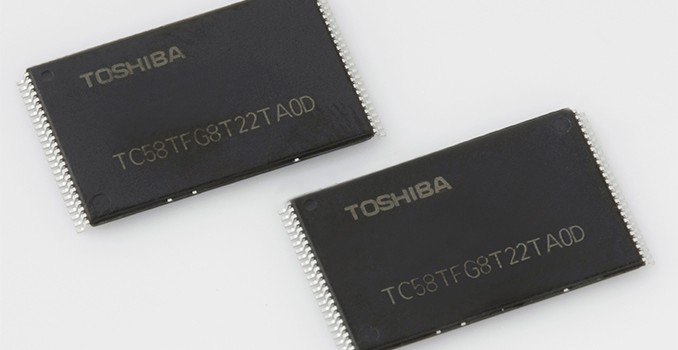
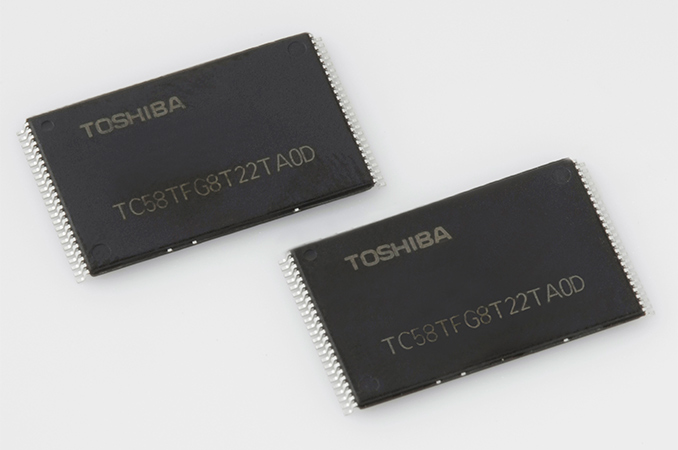
Toshiba on Wednesday said that it had begun to sample its latest BiCS 3D NAND flash memory chips with 64 word layers and 512 Gb capacity. A co-development project with Western Digital, the two companies intend to produce the new ICs (integrated circuits) in high volume sometimes in the second half of this year. Among the first products to use the new chips will be Toshiba’s BGA SSD with 1 TB capacity.

Looking at the specifications, Toshiba’s 512 Gb (64 GB) 64-layer BiCS 3D NAND will be TLC-based, with the use of TLC being unsurprising here as all makers of non-volatile memory nowadays concentrate on TLC ICs for SSDs. Toshiba as well as its fab and development partner (Western Digital) has not formally revealed the interface speed of their new 512 Gb 3D NAND ICs nor the number of planes per IC, but these are details that the companies are probably going to share when they are ready to ship such devices in high volume (or simply decide to publish their ISSCC presentation from earlier this month).

In fact, a 64-layer 3D TLC BiCS NAND chips per se are not a 2017 breakthrough. Western Digital, has been using its 64-layer 3D TLC NAND devices for actual products (e.g., removable media) since November or December. However, those 64-layer 3D TLC NAND ICs have capacity of 256 Gb, whereas the new chips can store 512 Gb of data. Toshiba itself says that its 256 Gb 64-layer BiCS ICs are in high-volume production today.

Toshiba and Western Digital said that high-volume manufacturing of their 512 Gb 64-layer devices will commence in the second half of 2017 in Yokkaichi, Japan. The two companies said that the new ICs will help them to address various retail, mobile and data center applications. The latter indicates that the devices will be used not only for removable media and mobile storage, but also for high-end enterprise-class SSDs.

Meanwhile, Toshiba’s BGA SSDs will be among the first to use the company’s new memory devices. The company plans to produce a BGA drive (as well as M.2 modules based on such BGA devices) with 1 TB capacity featuring 16 chips. Such SSDs are designed for various mobile and UCFF (ultra-compact form-factor) PCs and enable to reduce their thickness and overall footprint as well as improve battery life. Samples of the BGA drives will be available in April, whereas mass production will start sometimes in 2H 2017.

Note: Images are for illustrative purposes only.

Related Reading: