Vik


Toshiba Samples 64-Layer 512 Gb BiCS 3D NAND, Announces 1 TB BGA SSD
Toshiba Samples 64-Layer 512 Gb BiCS 3D NAND, Announces 1 TB BGA SSD

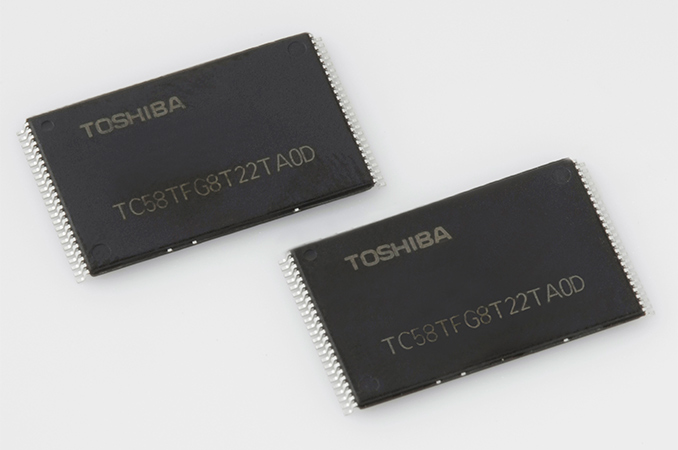
Toshiba on Wednesday said that it had begun to sample its latest BiCS 3D NAND flash memory chips with 64 word layers and 512 Gb capacity. A co-development project with Western Digital, the two companies intend to produce the new ICs (integrated circuits) in high volume sometimes in the second half of this year. Among the first products to use the new chips will be Toshiba’s BGA SSD with 1 TB capacity.

Looking at the specifications, Toshiba’s 512 Gb (64 GB) 64-layer BiCS 3D NAND will be TLC-based, with the use of TLC being unsurprising here as all makers of non-volatile memory nowadays concentrate on TLC ICs for SSDs. Toshiba as well as its fab and development partner (Western Digital) has not formally revealed the interface speed of their new 512 Gb 3D NAND ICs nor the number of planes per IC, but these are details that the companies are probably going to share when they are ready to ship such devices in high volume (or simply decide to publish their ISSCC presentation from earlier this month).

In fact, a 64-layer 3D TLC BiCS NAND chips per se are not a 2017 breakthrough. Western Digital, has been using its 64-layer 3D TLC NAND devices for actual products (e.g., removable media) since November or December. However, those 64-layer 3D TLC NAND ICs have capacity of 256 Gb, whereas the new chips can store 512 Gb of data. Toshiba itself says that its 256 Gb 64-layer BiCS ICs are in high-volume production today.

Toshiba and Western Digital said that high-volume manufacturing of their 512 Gb 64-layer devices will commence in the second half of 2017 in Yokkaichi, Japan. The two companies said that the new ICs will help them to address various retail, mobile and data center applications. The latter indicates that the devices will be used not only for removable media and mobile storage, but also for high-end enterprise-class SSDs.

Meanwhile, Toshiba’s BGA SSDs will be among the first to use the company’s new memory devices. The company plans to produce a BGA drive (as well as M.2 modules based on such BGA devices) with 1 TB capacity featuring 16 chips. Such SSDs are designed for various mobile and UCFF (ultra-compact form-factor) PCs and enable to reduce their thickness and overall footprint as well as improve battery life. Samples of the BGA drives will be available in April, whereas mass production will start sometimes in 2H 2017.

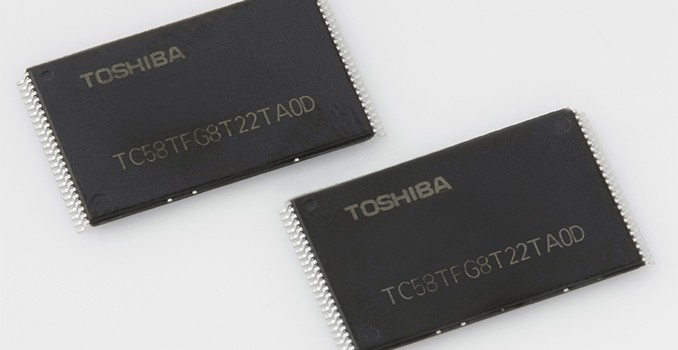
Note: Images are for illustrative purposes only.

Related Reading:
Intel Launches Atom C3000 SoCs: Up to 16 Cores for NAS, Servers, Vehicles

Intel Launches Atom C3000 SoCs: Up to 16 Cores for NAS, Servers, Vehicles

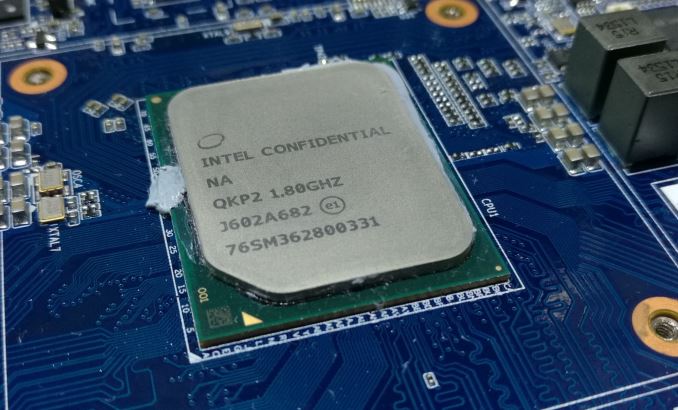
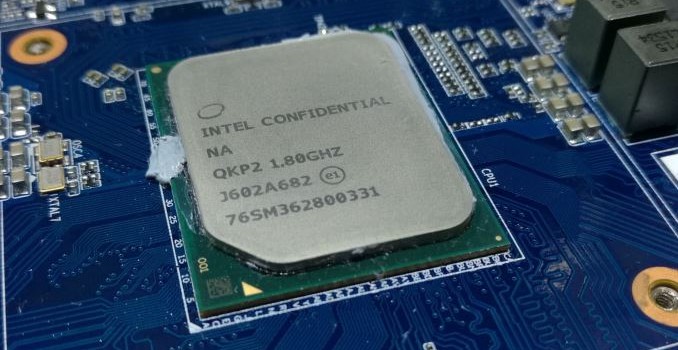
Intel this week formally launched its Atom C3000-series processors (formerly codenamed Denverton). The new chips are designed for inexpensive storage servers, NAS applications, as well as autonomous vehicles. The C3000 series features up to 16 low power x86 cores, integrated 10 GbE, rather rich I/O capabilities, as well as Intel’s Quick Assist technology.

Intel’s Atom C3000 processors are based on Intel’s current-generation Goldmont Atom microarchitecture, with SKUs offering between 2 and 16 cores and clockspeeds up to 2.2 GHz. Being designed for primarily for NAS and servers, the Atom C3000 SoCs fully support Intel’s VT-d hardware virtualization, Quick Assist compression/encryption technology (up to 20 Gbps throughput) as well as up to 64 GB of single-channel DDR4-1866 or DDR3L-1600 ECC memory. When it comes to I/O, the Atom C3000 features a PCIe 3.0 x16 controller (with x2, x4 and x8 bifurcation), 16 SATA 3.0 ports, four 10 GbE controllers, and four USB 3.0 ports.

Due to its rich I/O capabilities, the Atom C3000 is aimed at a wide range of devices, including servers/NAS (which they were originally designed for) as well as emerging applications like IoT and autonomous vehicles. For example, PCIe 3.0 bus may be used to connect various controllers, sensors and co-processors (e.g., a GPU) to the SoC. Last year we examined one of the server-oriented C3000-based designs that is going to be one of the many devices featuring the new chips.

Intel will offer various versions of its Atom C3000 SoCs with different TDPs starting at 8.5 W. The chips will support extended temperature ranges for storage, industrial and autonomous driving environments. In addition, Intel says that the processors feature “automotive-grade safety and security features,” but does not elaborate (generally, ECC, Quick Assist, virtualization, etc. can be considered as safety and security features too).

So far, Intel has only announced one Atom C3000-series SoC: the Atom C3338, which has two cores running at 1.5 – 2.2 GHz, 4 MB cache, 10 PCIe 3.0 lanes, 10 SATA 3.0 ports, four Gigabit Ethernet ports and so on. The chip has 9 W TDP and costs $27 in commercial quantities and is expected to be available to Intel’s customers already this quarter.

Intel’s partners have been testing the Atom C3000 processors since at least early 2016. The chipmaker expects its allies to start launching actual products based on the chips by mid-2017. In addition to the SoCs themselves, Intel will also supply a data plane development kit (DPDK) as well as a storage performance development kit (SPDK) to assist its partners in development of networking and storage applications.

Related Reading:

Intel Launches Atom C3000 SoCs: Up to 16 Cores for NAS, Servers, Vehicles

Intel Launches Atom C3000 SoCs: Up to 16 Cores for NAS, Servers, Vehicles

Intel this week formally launched its Atom C3000-series processors (formerly codenamed Denverton). The new chips are designed for inexpensive storage servers, NAS applications, as well as autonomous vehicles. The C3000 series features up to 16 low power x86 cores, integrated 10 GbE, rather rich I/O capabilities, as well as Intel’s Quick Assist technology.

Intel’s Atom C3000 processors are based on Intel’s current-generation Goldmont Atom microarchitecture, with SKUs offering between 2 and 16 cores and clockspeeds up to 2.2 GHz. Being designed for primarily for NAS and servers, the Atom C3000 SoCs fully support Intel’s VT-d hardware virtualization, Quick Assist compression/encryption technology (up to 20 Gbps throughput) as well as up to 64 GB of single-channel DDR4-1866 or DDR3L-1600 ECC memory. When it comes to I/O, the Atom C3000 features a PCIe 3.0 x16 controller (with x2, x4 and x8 bifurcation), 16 SATA 3.0 ports, four 10 GbE controllers, and four USB 3.0 ports.

Due to its rich I/O capabilities, the Atom C3000 is aimed at a wide range of devices, including servers/NAS (which they were originally designed for) as well as emerging applications like IoT and autonomous vehicles. For example, PCIe 3.0 bus may be used to connect various controllers, sensors and co-processors (e.g., a GPU) to the SoC. Last year we examined one of the server-oriented C3000-based designs that is going to be one of the many devices featuring the new chips.

Intel will offer various versions of its Atom C3000 SoCs with different TDPs starting at 8.5 W. The chips will support extended temperature ranges for storage, industrial and autonomous driving environments. In addition, Intel says that the processors feature “automotive-grade safety and security features,” but does not elaborate (generally, ECC, Quick Assist, virtualization, etc. can be considered as safety and security features too).

So far, Intel has only announced one Atom C3000-series SoC: the Atom C3338, which has two cores running at 1.5 – 2.2 GHz, 4 MB cache, 10 PCIe 3.0 lanes, 10 SATA 3.0 ports, four Gigabit Ethernet ports and so on. The chip has 9 W TDP and costs $27 in commercial quantities and is expected to be available to Intel’s customers already this quarter.

Intel’s partners have been testing the Atom C3000 processors since at least early 2016. The chipmaker expects its allies to start launching actual products based on the chips by mid-2017. In addition to the SoCs themselves, Intel will also supply a data plane development kit (DPDK) as well as a storage performance development kit (SPDK) to assist its partners in development of networking and storage applications.

Related Reading: