Vik


NEC Goes for a Curved Display, Launches 3440×1440 MultiSync EX341R Monitors
NEC Goes for a Curved Display, Launches 3440×1440 MultiSync EX341R Monitors

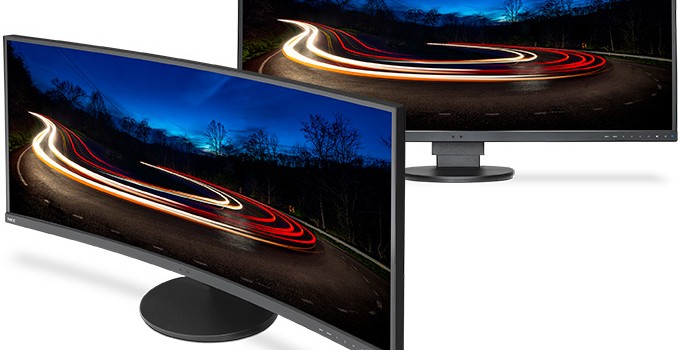
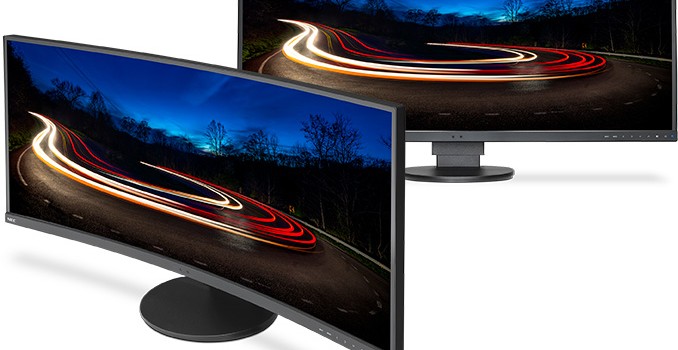
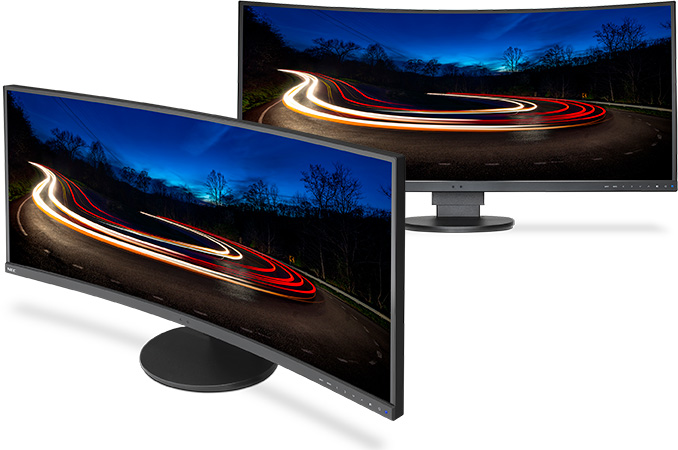
This week NEC has announced its first curved ultrawide display, the EX341R. NEC is promoting the panel for offices, control rooms, trading rooms, and other applications that typically use multi-monitor configurations but also appreciate color accuracy. The screen has a number of differences when compared to displays for gamers, and the price of the new MultiSync EX341R will be reflected in this.

In the recent years, NEC concentrated on displays for commercial and professional use, whereas its consumer monitor lineup slowly stepped into the background. The majority of curved ultrawide displays nowadays are designed with gamers in mind, which is why manufacturers tend to incorporate very high refresh rates along with dynamic refresh rate technologies and gaming specific features or aesthetics. Nonetheless, ultrawide displays may make sense to replace those used to multi-monitor environments, and this is a reason why Dell introduced its business-oriented curved ultrawide screens last year. NEC now also sees demand for monitors with a 21:9 aspect ratio from its customers, which is why the company announced its new MultiSync EX341R-BK and EX341R-SV-BK products this week.
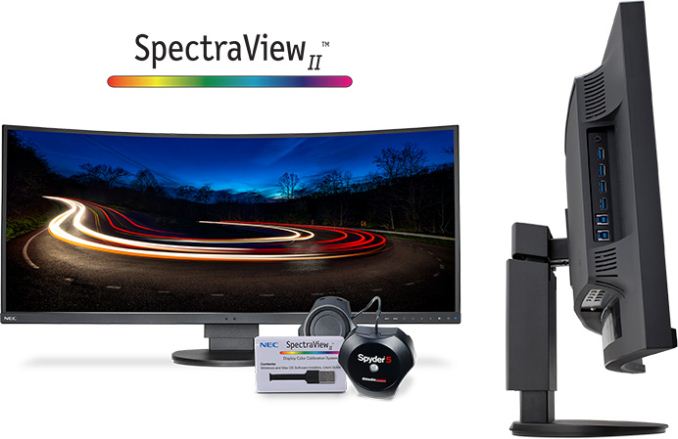
The NEC MultiSync EX341R-series displays are based on SVA panels (presumably made by Samsung) with a 3440×1440 resolution, a 1000:1 contrast ratio, 290 nits brightness, 178°/178° viewing angles, 5 ms response time and a 60 Hz refresh rate. It also targets customers that need various degrees of color accuracy (NEC markets the panels as supporting 99.5% sRGB) and therefore bundles the Spyder5 color calibration sensor and the SpectraView II software with the EX341R-SV-BK monitor.

As for connectivity, the NEC MultiSync EX341R has one DisplayPort 1.2 with MST support as well as two HDMI headers (one 1.4 and one 2.0). The monitor fully supports NEC’s control Sync technology that allows controlling the settings of up to 25 displays in a multi-monitor setup using controls of only one of them. Additionally, the display supports PBP and PiP features when connected to two computers. Finally, it has a quad-port USB 3.0 hub with two USB Type-B upstream ports (to connect to two different PCs).

NEC’s MultiSync EX341R-Series Displays
  EX341R-BK EX341R-SV-BK
Panel 34″ SVA
Native Resolution 3440 × 1440
Maximum Refresh Rate 60 Hz
Response Time 5 ms
Brightness 290 cd/m²
Contrast 3000:1
Viewing Angles 178°/178° horizontal/vertical
Curvature 1800R
Pixel Pitch 0.23 mm
Pixel Density 110 ppi
Color Gamut NTSC: 77.5%
sRGB: 99.5%
‘16.7 million colors’
Inputs 1 × DisplayPort 1.2
1 × HDMI 2.0
1 × HDMI 1.4
Outputs DisplayPort 1.2 (SST/MST)
USB Hub 4-port USB 3.0 hub
2 × USB Type-B upstream ports
Audio 1 W × 2
audio in/out ports
Power Consumption (idle/active) Idle: 0.26 W
Active: 62 W
Product Bundle Setup sheet
User manual
Power cord
DisplayPort cable
USB cable
ControlSync cable
Setup sheet
User manual
Power cord
DisplayPort cable
USB cable
ControlSync cable
SpectraViewII Software USB
Spyder5 Color Calibration Sensor
Launch Price $999 $1150

The NEC MultiSync EX341R-BK and EX341R-SV-BK displays will be available in February at an MSRP of $999 and $1,149 respectively.

Related Reading:

NEC Goes for a Curved Display, Launches 3440×1440 MultiSync EX341R Monitors

NEC Goes for a Curved Display, Launches 3440×1440 MultiSync EX341R Monitors

This week NEC has announced its first curved ultrawide display, the EX341R. NEC is promoting the panel for offices, control rooms, trading rooms, and other applications that typically use multi-monitor configurations but also appreciate color accuracy. The screen has a number of differences when compared to displays for gamers, and the price of the new MultiSync EX341R will be reflected in this.

In the recent years, NEC concentrated on displays for commercial and professional use, whereas its consumer monitor lineup slowly stepped into the background. The majority of curved ultrawide displays nowadays are designed with gamers in mind, which is why manufacturers tend to incorporate very high refresh rates along with dynamic refresh rate technologies and gaming specific features or aesthetics. Nonetheless, ultrawide displays may make sense to replace those used to multi-monitor environments, and this is a reason why Dell introduced its business-oriented curved ultrawide screens last year. NEC now also sees demand for monitors with a 21:9 aspect ratio from its customers, which is why the company announced its new MultiSync EX341R-BK and EX341R-SV-BK products this week.

The NEC MultiSync EX341R-series displays are based on SVA panels (presumably made by Samsung) with a 3440×1440 resolution, a 1000:1 contrast ratio, 290 nits brightness, 178°/178° viewing angles, 5 ms response time and a 60 Hz refresh rate. It also targets customers that need various degrees of color accuracy (NEC markets the panels as supporting 99.5% sRGB) and therefore bundles the Spyder5 color calibration sensor and the SpectraView II software with the EX341R-SV-BK monitor.

As for connectivity, the NEC MultiSync EX341R has one DisplayPort 1.2 with MST support as well as two HDMI headers (one 1.4 and one 2.0). The monitor fully supports NEC’s control Sync technology that allows controlling the settings of up to 25 displays in a multi-monitor setup using controls of only one of them. Additionally, the display supports PBP and PiP features when connected to two computers. Finally, it has a quad-port USB 3.0 hub with two USB Type-B upstream ports (to connect to two different PCs).

NEC’s MultiSync EX341R-Series Displays
  EX341R-BK EX341R-SV-BK
Panel 34″ SVA
Native Resolution 3440 × 1440
Maximum Refresh Rate 60 Hz
Response Time 5 ms
Brightness 290 cd/m²
Contrast 3000:1
Viewing Angles 178°/178° horizontal/vertical
Curvature 1800R
Pixel Pitch 0.23 mm
Pixel Density 110 ppi
Color Gamut NTSC: 77.5%
sRGB: 99.5%
‘16.7 million colors’
Inputs 1 × DisplayPort 1.2
1 × HDMI 2.0
1 × HDMI 1.4
Outputs DisplayPort 1.2 (SST/MST)
USB Hub 4-port USB 3.0 hub
2 × USB Type-B upstream ports
Audio 1 W × 2
audio in/out ports
Power Consumption (idle/active) Idle: 0.26 W
Active: 62 W
Product Bundle Setup sheet
User manual
Power cord
DisplayPort cable
USB cable
ControlSync cable
Setup sheet
User manual
Power cord
DisplayPort cable
USB cable
ControlSync cable
SpectraViewII Software USB
Spyder5 Color Calibration Sensor
Launch Price $999 $1150

The NEC MultiSync EX341R-BK and EX341R-SV-BK displays will be available in February at an MSRP of $999 and $1,149 respectively.

Related Reading:

Intel to Equip Fab 42 for 7 nm

Intel to Equip Fab 42 for 7 nm

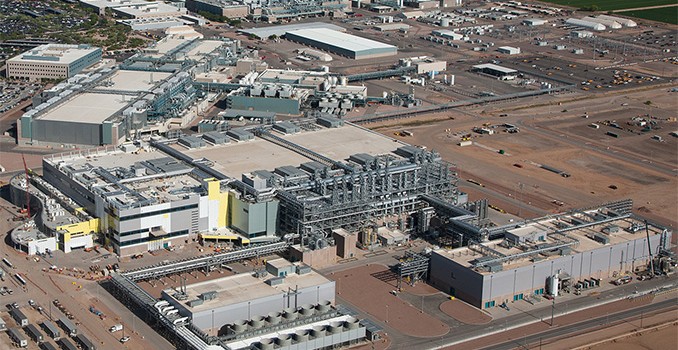
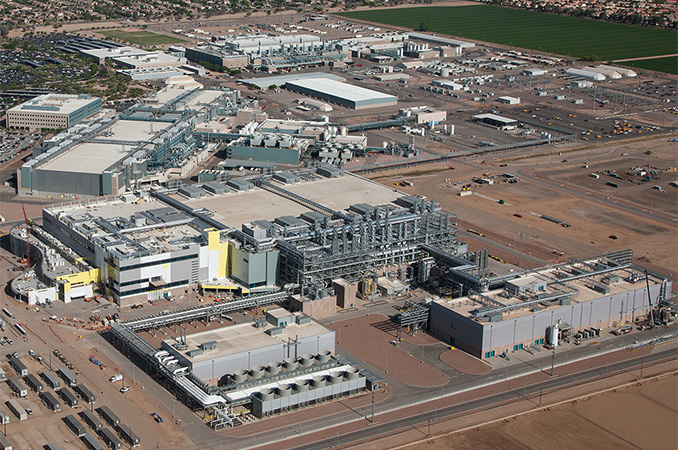
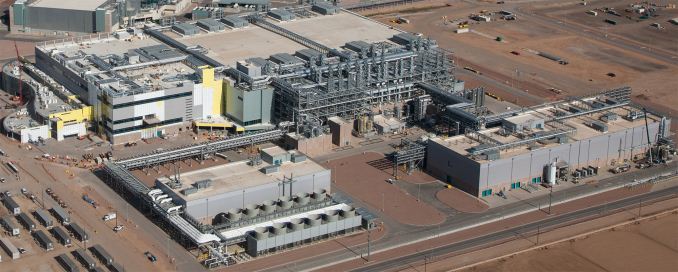
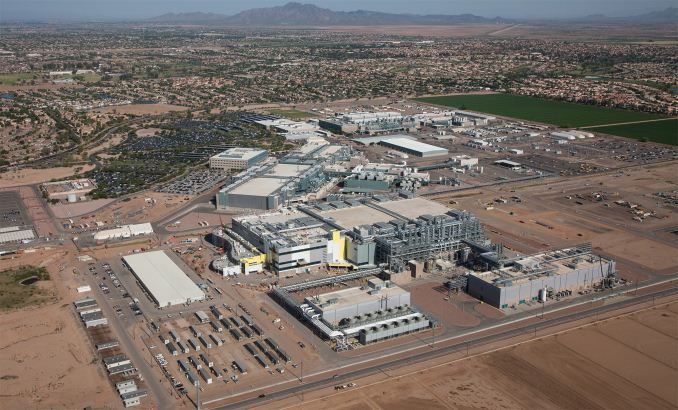
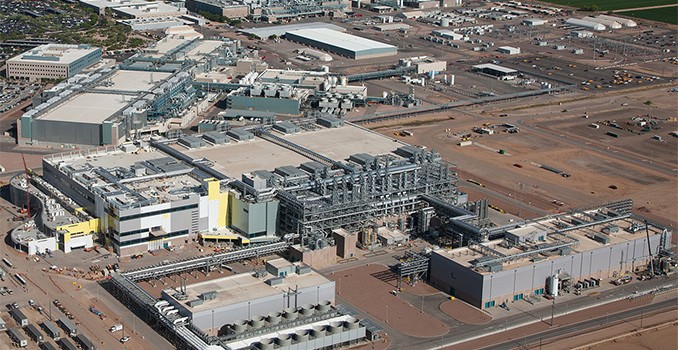
Intel this week announced plans to bring its Fab 42 online to produce semiconductors using a 7 nm fabrication process. It will take three to four years, and the move will cost Intel several billions of dollars but will create approximately 3,000 of high-tech jobs in Chandler, Arizona. Unfortunately, Intel did not share details about its 7 nm manufacturing technology at this time.

Intel began construction of its Fab 42 back in 2011 with the aim to build the most advanced, high-volume chip production facility in the world. The building was completed in 2013, but instead of moving in equipment to produce chips using 14 nm fabrication process, Intel decided to postpone its completion in early 2014. The site is equipped with heating, air conditioning, and other essential things, but no actual semiconductor manufacturing equipment has been installed. Intel still has no immediate public plans to use the Fab 42 for the production of chips using its 10 nm process technology in the short-term future but has indicated it intends to use it for its 7 nm ICs several years down the road.

Intel intends to spend as much as $7 billion to equip Fab 42, but at the moment the company does not share what kind of tools it plans to install. As a result we have no new information about Intel’s 7 nm technology. Intel has implied that it could start using extreme ultraviolet (EUV) lithography at 7 nm, but has never committed to the plan. Earlier this year the company said it would invest in a 7 nm pilot line in one of its development sites, but did not elaborate beyond that. One of the things that the CEO of Intel disclosed about the 7 nm in general in his email to employees this week is that it requires “an increasing amount of factory space per wafer.” This possibly means that Intel will insert EUV equipment into the process technology for cirical layers and will continue to use a lot of multipatterning, which increases the diversity requirements for the production tools.

Intel believes that when completed, Fab 42 will be the most advanced semiconductor wafer fab in the world that will create 3,000 direct high-tech jobs and 10,000 direct and indirect jobs in total. It should be noted that the semiconductor company will not start to move in equipment into the Fab 42 before it figures out all the peculiarities of the 7 nm manufacturing technology. Once it finalizes the pilot line and is satisfied with the equipment performance, it starts to replicate the line at different sites.

Intel said that it will use its 7 nm fabrication process to produce various processors for PCs, data centers and other devices that will be used for AI, automated driving, medical research/treatment as well as other applications. So, as usually, the manufacturing technology will be positioned to make the whole stack of Intel’s products several years from now.

Related Reading:

Intel to Equip Fab 42 for 7 nm

Intel to Equip Fab 42 for 7 nm

Intel this week announced plans to bring its Fab 42 online to produce semiconductors using a 7 nm fabrication process. It will take three to four years, and the move will cost Intel several billions of dollars but will create approximately 3,000 of high-tech jobs in Chandler, Arizona. Unfortunately, Intel did not share details about its 7 nm manufacturing technology at this time.

Intel began construction of its Fab 42 back in 2011 with the aim to build the most advanced, high-volume chip production facility in the world. The building was completed in 2013, but instead of moving in equipment to produce chips using 14 nm fabrication process, Intel decided to postpone its completion in early 2014. The site is equipped with heating, air conditioning, and other essential things, but no actual semiconductor manufacturing equipment has been installed. Intel still has no immediate public plans to use the Fab 42 for the production of chips using its 10 nm process technology in the short-term future but has indicated it intends to use it for its 7 nm ICs several years down the road.

Intel intends to spend as much as $7 billion to equip Fab 42, but at the moment the company does not share what kind of tools it plans to install. As a result we have no new information about Intel’s 7 nm technology. Intel has implied that it could start using extreme ultraviolet (EUV) lithography at 7 nm, but has never committed to the plan. Earlier this year the company said it would invest in a 7 nm pilot line in one of its development sites, but did not elaborate beyond that. One of the things that the CEO of Intel disclosed about the 7 nm in general in his email to employees this week is that it requires “an increasing amount of factory space per wafer.” This possibly means that Intel will insert EUV equipment into the process technology for cirical layers and will continue to use a lot of multipatterning, which increases the diversity requirements for the production tools.

Intel believes that when completed, Fab 42 will be the most advanced semiconductor wafer fab in the world that will create 3,000 direct high-tech jobs and 10,000 direct and indirect jobs in total. It should be noted that the semiconductor company will not start to move in equipment into the Fab 42 before it figures out all the peculiarities of the 7 nm manufacturing technology. Once it finalizes the pilot line and is satisfied with the equipment performance, it starts to replicate the line at different sites.

Intel said that it will use its 7 nm fabrication process to produce various processors for PCs, data centers and other devices that will be used for AI, automated driving, medical research/treatment as well as other applications. So, as usually, the manufacturing technology will be positioned to make the whole stack of Intel’s products several years from now.

Related Reading: