Vik


Apple Announces Record Q1 2017 Results
Apple Announces Record Q1 2017 Results

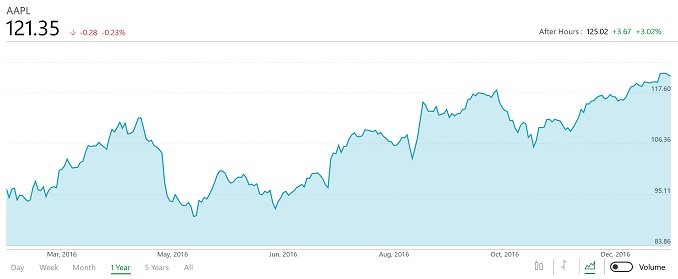
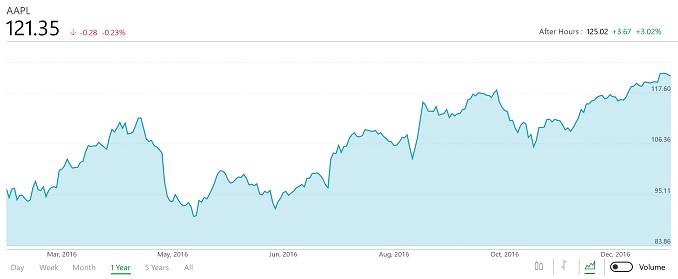
Today Apple announced their earnings for the first quarter of their 2017 fiscal year. As is normally the case now that the iPhone has moved to a fall launch, Q1 tends to be their big quarter, and this one was the biggest yet for revenue, with Apple announcing $78.351 billion in revenue for the quarter. This is up 9% from a year ago. Gross margin was not as strong though, down $247 million despite the almost $2.5 billion more in revenue, but as a percentage it is still a strong 38.5%. Operating income was also down for the quarter, at $23.359 billion, compared to $24.171 billion a year ago. Net income was down 2.56% to $17.891 billion, but thanks to the share buyback program, Apple has less outstanding shares, meaning Apple set a record for earnings per diluted share of $3.36, despite the drop in net income. Apple has announced a dividend of $0.57 per share as well.

Apple Q1 2017 Financial Results (GAAP)
  Q1’2017 Q4’2016 Q1’2016
Revenue (in Billions USD) $78.351 $46.852 $75.872
Gross Margin (in Billions USD) $30.176 $17.813 $30.423
Operating Income (in Billions USD) $23.359 $11.761 $24.171
Net Income (in Billions USD) $17.891 $9.014 $18.361
Margins 38.5% 38.0% 40.1%
Earnings per Share (in USD) $3.36 $1.67 $3.28

With the launch of the latest iPhone 7, there was certainly controversy over the loss of the headphone jack, but that did not stop people from buying it. Apple sold 78.29 million iPhones this quarter, up 5% from a year ago. This is a new record for iPhone sales in the quarter, up about 3.5 million units, which is a good sign for Apple after had several quarters in a row of slowed iPhone sales. We’ll see if they can keep it up for fiscal year 2017. As far as revenue, iPhone is still the juggernaut of Apple’s financials with $54.378 billion in revenue for the quarter. That is 69.4% of all of the revenue for Apple.

iPad continues to struggle, at least compared to the rest of Apple, with sales dropping another 19% this quarter to 13.081 million, and despite the higher priced iPads in the lineup, revenue dropped even further to $5.533 billion, which is down 22%. That puts an average selling price of just $422 on the iPad, down from $439 a year ago, despite the addition of the 9.7-inch iPad Pro last year with it’s $100 higher asking price of $599. New iPad models haven’t really saved this segment from continuing to contract, but with the addition of the larger iPhone I suppose this makes some sense.

Mac sales for the quarter were up 1% only, despite the launch of the refreshed MacBook Pro models in October, but they were not shipping in volume until later in the quarter, so there may be some impact from that. Despite the sales only being up 1%, revenue was up 7% to a new record high of $7.244 billion this quarter, and the Mac has slowly worked itself back up to being the second largest source of revenue for Apple. But I don’t think that’s going to last for much longer.

Apple Q1 2017 Device Sales (thousands)
  Q1’2017 Q4’2016 Q1’2016 Seq Change Year/Year Change
iPhone 78,290 45,513 74,779 +72% +5%
iPad 13,081 9,267 16,122 +41% -19%
Mac 5,374 4,886 5,312 +1% +7%

Apple’s Services segment, which includes digital content from iTunes, app revenue, AppleCare, Apple Pay, and other services, is now the fastest growing segment of Apple, with revenues for the quarter of $7.172 billion, which is up 13% from last quarter and up 18% from last year. At this rate, it will overtake the Mac revenue next quarter, depending on how Mac sales go. This has been a very strong market for Apple over the last while, and I would think the addition of Apple Music must be helping as well.

Other Products include Apple TV, Apple Watch, Beats, and accessories, and although the segment overall is down 8% to $4.024 billion, Apple did announce they sold a record for Apple Watch revenue, although they’ve never announced numbers for that.

Apple is projecting revenue for next quarter of $51.5 to $53.5 billion, and margins between 38 and 39 percent.

Source: Apple Investor Relations
Apple Announces Record Q1 2017 Results

Apple Announces Record Q1 2017 Results

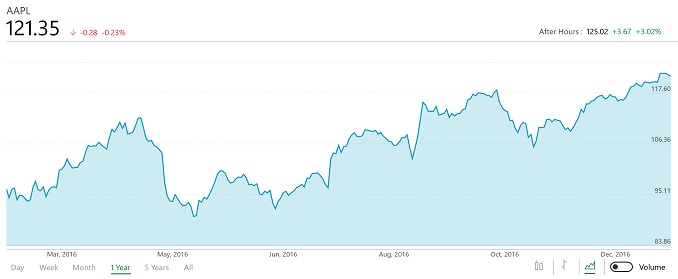
Today Apple announced their earnings for the first quarter of their 2017 fiscal year. As is normally the case now that the iPhone has moved to a fall launch, Q1 tends to be their big quarter, and this one was the biggest yet for revenue, with Apple announcing $78.351 billion in revenue for the quarter. This is up 9% from a year ago. Gross margin was not as strong though, down $247 million despite the almost $2.5 billion more in revenue, but as a percentage it is still a strong 38.5%. Operating income was also down for the quarter, at $23.359 billion, compared to $24.171 billion a year ago. Net income was down 2.56% to $17.891 billion, but thanks to the share buyback program, Apple has less outstanding shares, meaning Apple set a record for earnings per diluted share of $3.36, despite the drop in net income. Apple has announced a dividend of $0.57 per share as well.

Apple Q1 2017 Financial Results (GAAP)
  Q1’2017 Q4’2016 Q1’2016
Revenue (in Billions USD) $78.351 $46.852 $75.872
Gross Margin (in Billions USD) $30.176 $17.813 $30.423
Operating Income (in Billions USD) $23.359 $11.761 $24.171
Net Income (in Billions USD) $17.891 $9.014 $18.361
Margins 38.5% 38.0% 40.1%
Earnings per Share (in USD) $3.36 $1.67 $3.28

With the launch of the latest iPhone 7, there was certainly controversy over the loss of the headphone jack, but that did not stop people from buying it. Apple sold 78.29 million iPhones this quarter, up 5% from a year ago. This is a new record for iPhone sales in the quarter, up about 3.5 million units, which is a good sign for Apple after had several quarters in a row of slowed iPhone sales. We’ll see if they can keep it up for fiscal year 2017. As far as revenue, iPhone is still the juggernaut of Apple’s financials with $54.378 billion in revenue for the quarter. That is 69.4% of all of the revenue for Apple.

iPad continues to struggle, at least compared to the rest of Apple, with sales dropping another 19% this quarter to 13.081 million, and despite the higher priced iPads in the lineup, revenue dropped even further to $5.533 billion, which is down 22%. That puts an average selling price of just $422 on the iPad, down from $439 a year ago, despite the addition of the 9.7-inch iPad Pro last year with it’s $100 higher asking price of $599. New iPad models haven’t really saved this segment from continuing to contract, but with the addition of the larger iPhone I suppose this makes some sense.

Mac sales for the quarter were up 1% only, despite the launch of the refreshed MacBook Pro models in October, but they were not shipping in volume until later in the quarter, so there may be some impact from that. Despite the sales only being up 1%, revenue was up 7% to a new record high of $7.244 billion this quarter, and the Mac has slowly worked itself back up to being the second largest source of revenue for Apple. But I don’t think that’s going to last for much longer.

Apple Q1 2017 Device Sales (thousands)
  Q1’2017 Q4’2016 Q1’2016 Seq Change Year/Year Change
iPhone 78,290 45,513 74,779 +72% +5%
iPad 13,081 9,267 16,122 +41% -19%
Mac 5,374 4,886 5,312 +1% +7%

Apple’s Services segment, which includes digital content from iTunes, app revenue, AppleCare, Apple Pay, and other services, is now the fastest growing segment of Apple, with revenues for the quarter of $7.172 billion, which is up 13% from last quarter and up 18% from last year. At this rate, it will overtake the Mac revenue next quarter, depending on how Mac sales go. This has been a very strong market for Apple over the last while, and I would think the addition of Apple Music must be helping as well.

Other Products include Apple TV, Apple Watch, Beats, and accessories, and although the segment overall is down 8% to $4.024 billion, Apple did announce they sold a record for Apple Watch revenue, although they’ve never announced numbers for that.

Apple is projecting revenue for next quarter of $51.5 to $53.5 billion, and margins between 38 and 39 percent.

Source: Apple Investor Relations
Synology at CES 2017 - RT2600ac Wi-Fi Router, DSM Value Additions, and New Business NAS Units

Synology at CES 2017 – RT2600ac Wi-Fi Router, DSM Value Additions, and New Business NAS Units

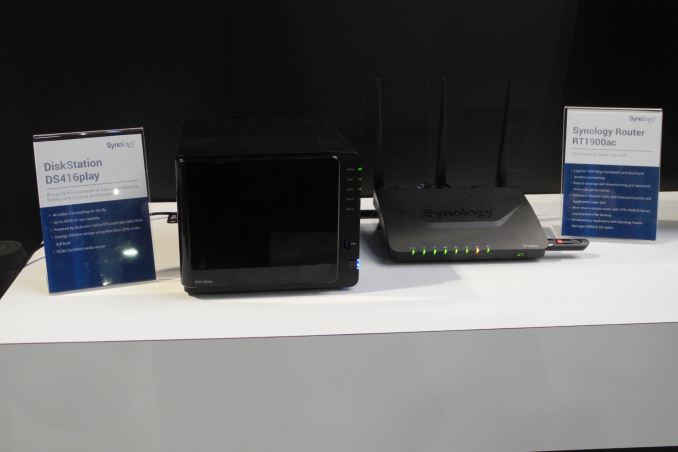
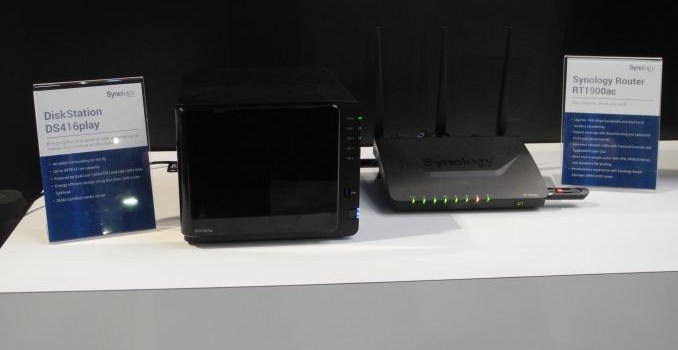
As part of my usual CES vendor visits, I caught up with Synology and took a look at the new products and DSM features that had been announced around the show’s timeframe. The most interesting product was their second generation Wi-Fi router – the RT2600ac. A few business-oriented NAS products were also on display. The new DSM 6.1 (beta at CES, now in the final release candidate stage) and some value additions were also seen at the booth.

Synology RT2600ac Wi-Fi Router

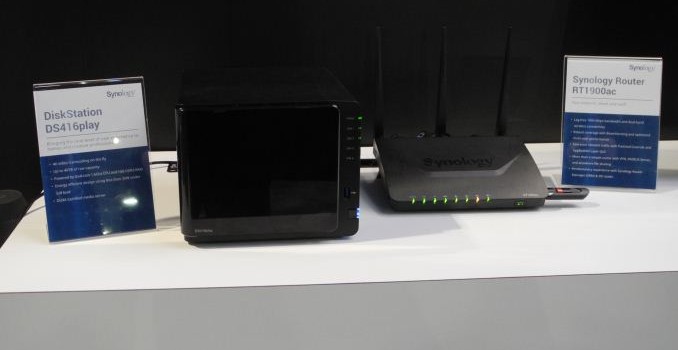
A follow-on to the Broadcom-based RT1900ac launched in 2015, the RT2600ac makes the move to a Qualcomm Atheros platform. The AC2600 platform has been around since 2015. Synology has again opted not to ship a cutting-edge hardware platform. While the first set of AC2600 routers used a Qualcomm Atheros QCA9980 radio along with a 1.4 GHz IPQ8064 SoC for network processing duties, Synology’s 2017 entry has allowed them to go for a slightly more modern platform. The radio is the QCA9984 – it sports specifications similar to the QCA9980 (4×4:4 802.11abgn+ac), with the primary difference being support for 160MHz-wide channels. Note, however, that the maximum data rate possible is still only 1.7 Gbps because the radio doesn’t support four spatial streams in the 160MHz mode. The network processor is the IPQ8065 – a higher-clocked version of the IPQ8064 used in the first set of AC2600 routers. The IPQ8065’s dual-core Krait CPU and the network accelerator blocks operate at 1.7 GHz and 800 MHz respectively (compared to the IPQ8064’s 1.4 GHz and 730 MHz).

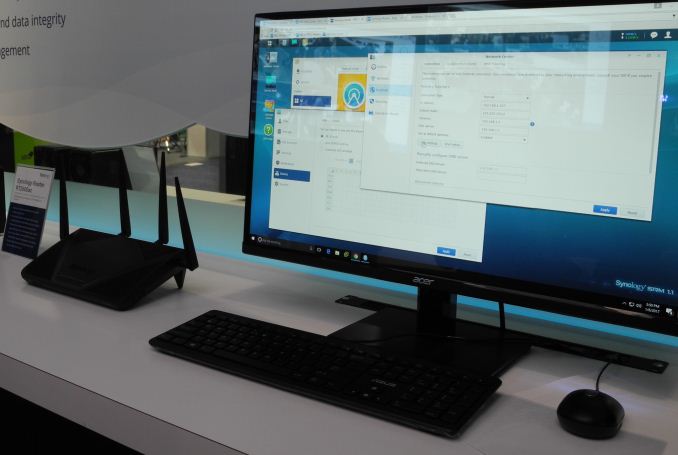
The RT1900ac was praised mainly for its operating system / user experience / add-ons, rather than the Wi-Fi performance. For the RT2600ac, Synology has further fine-tuned the SRM OS (Synology Router Manager). It is also playing up the VPN capabilities. Many Synology NAS owners have taken advantage of the VPN features of the Synology NAS. However, that requires setting up port forwarding in the router, and some challenges related to the subnet configurations that can be accessed from an external network. Placing the VPN server in the router / gateway is the logical solution to the problem, and Synology is aptly promoting their VPN Plus server package for advanced VPN configurations.

Other than the VPN features, Synology also supports dual WAN capabilities in the RT2600ac. Readers interested in the detailed specifications can peruse the datasheet (PDF).

Business NAS Products

Synology’s DSM is one of the few NAS operating systems to support both btrfs and ext4 for the internal volumes. This allows them to support different business requirements. Their business lineup has benefited quite a bit from this dual file-system support. In order to capitalize further on this aspect, Synology has launched a number of high-end systems targeting SMBs and SMEs.

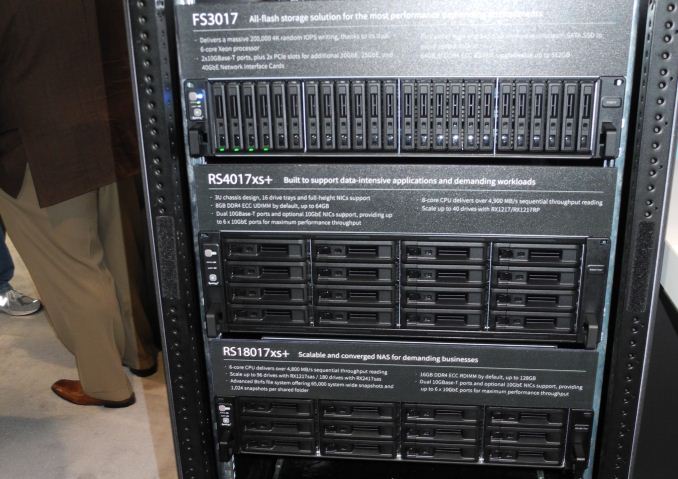
Amongst the new business-oriented NAS products on display was the FS3017 (PDF) – a 24-bay 2U rackmount NAS equipped with two Xeon E5-2620 v3 CPUs and 64GB (expandable to 512GB) of DDR4 ECC DRAM. There are two 10GBASE-T ports, with spare PCIe slots to integrate 10GbE / 25GbE / 40 GbE network cards. Both 2.5″ SATA and SAS drives are supported, with the primary focus being delivery of high IOPS for performance-sensitive applications.

The DS3617xs (PDF) is a Xeon D-based tower form-factor NAS with 12 bays. The Xeon D-1527 used in the system is a 4C/8T model. It is complemented by 16GB of DDR4 ECC DRAM (expandable to 48GB). The system also supports two DX1215 expansion chassis (with Infiniband connections). There are only four 1GbE LAN ports, though a PCIe 3.0 x8 slot is available (for installation of 10GbE cards, if needed).

The RS4017xs+ (PDF) is a Xeon D-1541 (8C/16T)-based 3U rackmount with 16 3.5″ bays. It ships with 8GB of DDR4 ECC RAM (expandable to 64GB). There are two native 10GBASE-T ports and four 1GbE ports. Two PCIe 3.0 x8 slots are available to add more high-performance LAN interfaces. The system can scale up to 40 bays with two RX1217(RP) expansion chassis.

The RS18017xs+ (PDF) is a Xeon D-1531 (6C/12T)-based 2U rackmount with 12 3.5″ bays. It ships with 16GB of DDR4 ECC RAM (expandable to 128GB). There are two native 10GBASE-T ports with four 1GbE ports, as well as two PCIe 3.0 x8 slots for additional network interface cards. The 12-bay unit can pair with up to 7 expansion units (RX1217sas for 84 bays, and RX2417sas for 168 bays) over its single SAS expansion slot.

It is interesting to see that Synology is mainly using the Xeon D SKUs for their rackmounts, compared to QNAP and Netgear’s primary push using the tower form factor. The support for multiple expansion chassis with huge bay counts differentiates Synology’s Xeon D offerings from the rest of the vendors. It is not clear if IT administrators might prefer a more powerful CPU (like the Xeon used in the FS3017) to handle large number of physical drives, though dedicating some of the bays for cold storage might make Xeon D an attractive solution.

New DSM 6.1 Features

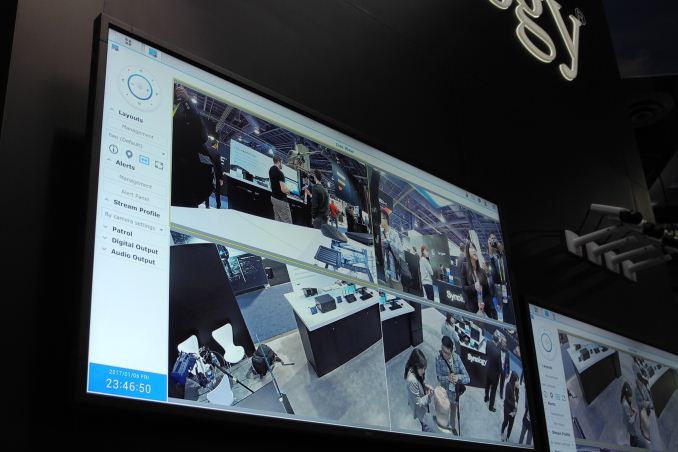
The next version of the Disk Station Manager (DSM 6.1) is slated to come out around mid-February 2017. At CES, Synology was showing off some of the new features such as Universal Search (couldn’t help drawing similarities to QNAP’s QSirch). Surveillance Station 8.0 has also been released, and the native Windows client support (also available in a portable version) definitely improves usability. The traditional web view is still supported – so, it is overall a welcome addition.

DSM 6.1 also has some features that work exclusively with the Seagate IronWolf drives for better health monitoring than what is done with just S.M.A.R.T alone. The Seagate IronWolf Health Manager (IHM) takes advantage of the hardware sensors and firmware features that are present in the new IronWolf drives.

Synology also played up their frequent security and feature updates to DSM. Having recently set up the testbed to evaluate the software features of various COTS NAS units, I can say that Synology units are the ones that prompt me to upgrade most frequently. I would prefer avoiding the associated reboots, but, there is definitely some peace of mind in knowing that Synology is being proactive in handling security threats. Given the Synolocker issue that affected some Synology users back in 2014, it is good to see the company taking efforts to prevent the recurrence of any similar attacks.

Synology had a number of interesting announcements before and after the show, with the CES booth allowing us to take a look at the products and software features in person. Frequent OS updates and focused hardware launches bode well on the NAS side. On the consumer router side, the shipping of the RT2600ac MU-MIMO Wi-Fi router with a focus on Synology’s strengths (VPN and other value additions) shows that the company is in the highly competitive market segment for the long haul.

Synology at CES 2017 - RT2600ac Wi-Fi Router, DSM Value Additions, and New Business NAS Units

Synology at CES 2017 – RT2600ac Wi-Fi Router, DSM Value Additions, and New Business NAS Units

As part of my usual CES vendor visits, I caught up with Synology and took a look at the new products and DSM features that had been announced around the show’s timeframe. The most interesting product was their second generation Wi-Fi router – the RT2600ac. A few business-oriented NAS products were also on display. The new DSM 6.1 (beta at CES, now in the final release candidate stage) and some value additions were also seen at the booth.

Synology RT2600ac Wi-Fi Router

A follow-on to the Broadcom-based RT1900ac launched in 2015, the RT2600ac makes the move to a Qualcomm Atheros platform. The AC2600 platform has been around since 2015. Synology has again opted not to ship a cutting-edge hardware platform. While the first set of AC2600 routers used a Qualcomm Atheros QCA9980 radio along with a 1.4 GHz IPQ8064 SoC for network processing duties, Synology’s 2017 entry has allowed them to go for a slightly more modern platform. The radio is the QCA9984 – it sports specifications similar to the QCA9980 (4×4:4 802.11abgn+ac), with the primary difference being support for 160MHz-wide channels. Note, however, that the maximum data rate possible is still only 1.7 Gbps because the radio doesn’t support four spatial streams in the 160MHz mode. The network processor is the IPQ8065 – a higher-clocked version of the IPQ8064 used in the first set of AC2600 routers. The IPQ8065’s dual-core Krait CPU and the network accelerator blocks operate at 1.7 GHz and 800 MHz respectively (compared to the IPQ8064’s 1.4 GHz and 730 MHz).

The RT1900ac was praised mainly for its operating system / user experience / add-ons, rather than the Wi-Fi performance. For the RT2600ac, Synology has further fine-tuned the SRM OS (Synology Router Manager). It is also playing up the VPN capabilities. Many Synology NAS owners have taken advantage of the VPN features of the Synology NAS. However, that requires setting up port forwarding in the router, and some challenges related to the subnet configurations that can be accessed from an external network. Placing the VPN server in the router / gateway is the logical solution to the problem, and Synology is aptly promoting their VPN Plus server package for advanced VPN configurations.

Other than the VPN features, Synology also supports dual WAN capabilities in the RT2600ac. Readers interested in the detailed specifications can peruse the datasheet (PDF).

Business NAS Products

Synology’s DSM is one of the few NAS operating systems to support both btrfs and ext4 for the internal volumes. This allows them to support different business requirements. Their business lineup has benefited quite a bit from this dual file-system support. In order to capitalize further on this aspect, Synology has launched a number of high-end systems targeting SMBs and SMEs.

Amongst the new business-oriented NAS products on display was the FS3017 (PDF) – a 24-bay 2U rackmount NAS equipped with two Xeon E5-2620 v3 CPUs and 64GB (expandable to 512GB) of DDR4 ECC DRAM. There are two 10GBASE-T ports, with spare PCIe slots to integrate 10GbE / 25GbE / 40 GbE network cards. Both 2.5″ SATA and SAS drives are supported, with the primary focus being delivery of high IOPS for performance-sensitive applications.

The DS3617xs (PDF) is a Xeon D-based tower form-factor NAS with 12 bays. The Xeon D-1527 used in the system is a 4C/8T model. It is complemented by 16GB of DDR4 ECC DRAM (expandable to 48GB). The system also supports two DX1215 expansion chassis (with Infiniband connections). There are only four 1GbE LAN ports, though a PCIe 3.0 x8 slot is available (for installation of 10GbE cards, if needed).

The RS4017xs+ (PDF) is a Xeon D-1541 (8C/16T)-based 3U rackmount with 16 3.5″ bays. It ships with 8GB of DDR4 ECC RAM (expandable to 64GB). There are two native 10GBASE-T ports and four 1GbE ports. Two PCIe 3.0 x8 slots are available to add more high-performance LAN interfaces. The system can scale up to 40 bays with two RX1217(RP) expansion chassis.

The RS18017xs+ (PDF) is a Xeon D-1531 (6C/12T)-based 2U rackmount with 12 3.5″ bays. It ships with 16GB of DDR4 ECC RAM (expandable to 128GB). There are two native 10GBASE-T ports with four 1GbE ports, as well as two PCIe 3.0 x8 slots for additional network interface cards. The 12-bay unit can pair with up to 7 expansion units (RX1217sas for 84 bays, and RX2417sas for 168 bays) over its single SAS expansion slot.

It is interesting to see that Synology is mainly using the Xeon D SKUs for their rackmounts, compared to QNAP and Netgear’s primary push using the tower form factor. The support for multiple expansion chassis with huge bay counts differentiates Synology’s Xeon D offerings from the rest of the vendors. It is not clear if IT administrators might prefer a more powerful CPU (like the Xeon used in the FS3017) to handle large number of physical drives, though dedicating some of the bays for cold storage might make Xeon D an attractive solution.

New DSM 6.1 Features

The next version of the Disk Station Manager (DSM 6.1) is slated to come out around mid-February 2017. At CES, Synology was showing off some of the new features such as Universal Search (couldn’t help drawing similarities to QNAP’s QSirch). Surveillance Station 8.0 has also been released, and the native Windows client support (also available in a portable version) definitely improves usability. The traditional web view is still supported – so, it is overall a welcome addition.

DSM 6.1 also has some features that work exclusively with the Seagate IronWolf drives for better health monitoring than what is done with just S.M.A.R.T alone. The Seagate IronWolf Health Manager (IHM) takes advantage of the hardware sensors and firmware features that are present in the new IronWolf drives.

Synology also played up their frequent security and feature updates to DSM. Having recently set up the testbed to evaluate the software features of various COTS NAS units, I can say that Synology units are the ones that prompt me to upgrade most frequently. I would prefer avoiding the associated reboots, but, there is definitely some peace of mind in knowing that Synology is being proactive in handling security threats. Given the Synolocker issue that affected some Synology users back in 2014, it is good to see the company taking efforts to prevent the recurrence of any similar attacks.

Synology had a number of interesting announcements before and after the show, with the CES booth allowing us to take a look at the products and software features in person. Frequent OS updates and focused hardware launches bode well on the NAS side. On the consumer router side, the shipping of the RT2600ac MU-MIMO Wi-Fi router with a focus on Synology’s strengths (VPN and other value additions) shows that the company is in the highly competitive market segment for the long haul.