Vik


GIGABYTE Server Shows Two-Phase Immersion Liquid Cooling on a 2U GPU G250-S88 using 3M Novec

GIGABYTE Server Shows Two-Phase Immersion Liquid Cooling on a 2U GPU G250-S88 using 3M Novec

In the land of immersed systems, there are many ways of doing things. A few intrepid users have gone with oil, still using a CPU cooler but relying on the liquid cycling throughout the system to remove heat energy. Going back over a decade and a half, I recall a system whereby a 35W processor was immersed, without a heatsink, into a bath of a 3M hydrocarbon with a modest boiling point, around 45C, which was then combined in a sealed system with an external thermal electric cooler to initiate the recycling. The demonstration by GIGABYTE at CES this year with a fully-embedded system is more the latter than the former.

Obviously you cannot use water (unless exceptionally pure/distilled) for conductivity reasons, so some inert hydrocarbon is the purpose here. The concept for this design is a two-phase change from liquid to vapor and back, using no pumps but relying on the fact that the gas will condense and fall back into the solution and sink, causing automatic cycling.
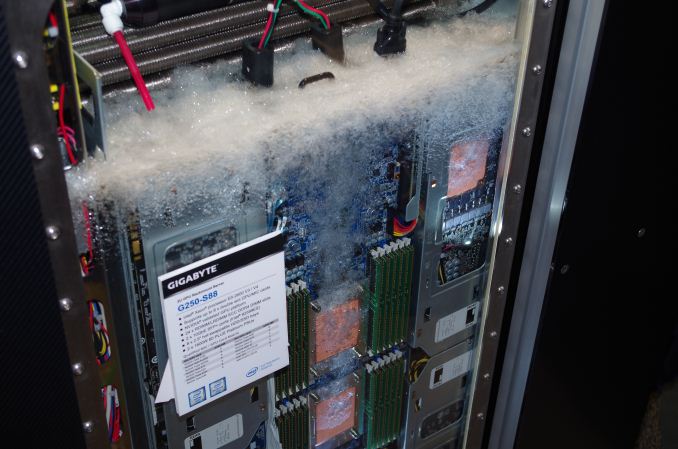
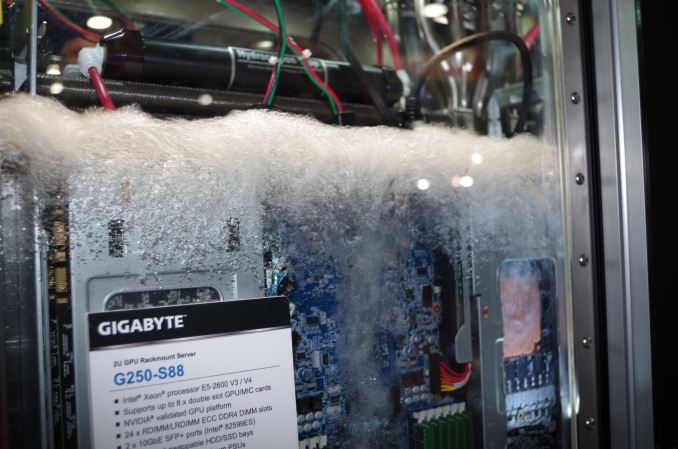
As I mentioned before, previously I had only seen this on a small low powered system, but GIGABYTE and 3M had submerged a full 8-GPU, dual CPU system with 24 memory modules and nothing more than large copper heatsinks on the CPU/GPU, and had even removed the power delivery heatsinks.

To cool the vapor as it rises through the system, a cold radiator is placed inside the sealed system. Well, I say sealed, but during the demo it was being opened and the demonstrator was clearly putting his hand inside. There seemed to also be a system in place to add/remove hydrocarbon material through a pump as well.

So the point in all this is more efficient cooling – no need for massive air conditioning units in a data center, no need to pump chilled water into water blocks. I’m surprised that this system was suitable for all that hardware, but it does leave on issue on the table: getting access to replacing hardware. Moving from air to liquid cooling in a data-center always has this issue.

So to keep things under wraps, 3M’s Novec line of liquids involve a full array of halogenated hydrocarbon compounds for different uses, and the variant of Novec that is under use here was not specified. However a quick search turns up a likely candidate in Novec 72DA.

Novec 72DA liquid is a solution of 70% 1,2-trans-dichloroethylene, 4-16% ethyl nonafluorobutyl ether, 4-6% ethyl nonafluoroisobutyl ether and trace other similar methyl variants. The liquid has a boiling point of 45ºC at very low viscosity (0.4 cP, compared to 0.89 cP for water), but also a low specific heat capacity (1.33 J/g/K, compared to 4.184 for water). Typically water cooling (with blocks) with the high heat capacity is preferred, but at 1.33 J/g/K for the main ingredient in Novec is interesting: take a CPU that uses 140W, and in 60 seconds it will change 8.4 kJ of energy from electricity to heat. That would raise one kg of liquid (0.8 liters, due to 1.257 kg per liter for density) up by 7.24ºC. Thus it would take around 3 minutes from a slightly chilled start to create one kg of the main component of Novec to boiling point. If we add in the latent heat of vaporization, or the energy it takes to transform a chemical from a liquid at boiling point to vapor, then we need another 350 kJ/kg, or 41.67 minutes.

Now obviously in such a system it doesn’t work on pure kilograms of chemical – energy is transferred at larger doses on smaller amounts of liquid at once, causing the effect we see in the photos.


GIGABYTE Server Shows Two-Phase Immersion Liquid Cooling on a 2U GPU G250-S88 using 3M Novec

GIGABYTE Server Shows Two-Phase Immersion Liquid Cooling on a 2U GPU G250-S88 using 3M Novec

In the land of immersed systems, there are many ways of doing things. A few intrepid users have gone with oil, still using a CPU cooler but relying on the liquid cycling throughout the system to remove heat energy. Going back over a decade and a half, I recall a system whereby a 35W processor was immersed, without a heatsink, into a bath of a 3M hydrocarbon with a modest boiling point, around 45C, which was then combined in a sealed system with an external thermal electric cooler to initiate the recycling. The demonstration by GIGABYTE at CES this year with a fully-embedded system is more the latter than the former.

Obviously you cannot use water (unless exceptionally pure/distilled) for conductivity reasons, so some inert hydrocarbon is the purpose here. The concept for this design is a two-phase change from liquid to vapor and back, using no pumps but relying on the fact that the gas will condense and fall back into the solution and sink, causing automatic cycling.

As I mentioned before, previously I had only seen this on a small low powered system, but GIGABYTE and 3M had submerged a full 8-GPU, dual CPU system with 24 memory modules and nothing more than large copper heatsinks on the CPU/GPU, and had even removed the power delivery heatsinks.

To cool the vapor as it rises through the system, a cold radiator is placed inside the sealed system. Well, I say sealed, but during the demo it was being opened and the demonstrator was clearly putting his hand inside. There seemed to also be a system in place to add/remove hydrocarbon material through a pump as well.

So the point in all this is more efficient cooling – no need for massive air conditioning units in a data center, no need to pump chilled water into water blocks. I’m surprised that this system was suitable for all that hardware, but it does leave on issue on the table: getting access to replacing hardware. Moving from air to liquid cooling in a data-center always has this issue.

So to keep things under wraps, 3M’s Novec line of liquids involve a full array of halogenated hydrocarbon compounds for different uses, and the variant of Novec that is under use here was not specified. However a quick search turns up a likely candidate in Novec 72DA.

Novec 72DA liquid is a solution of 70% 1,2-trans-dichloroethylene, 4-16% ethyl nonafluorobutyl ether, 4-6% ethyl nonafluoroisobutyl ether and trace other similar methyl variants. The liquid has a boiling point of 45ºC at very low viscosity (0.4 cP, compared to 0.89 cP for water), but also a low specific heat capacity (1.33 J/g/K, compared to 4.184 for water). Typically water cooling (with blocks) with the high heat capacity is preferred, but at 1.33 J/g/K for the main ingredient in Novec is interesting: take a CPU that uses 140W, and in 60 seconds it will change 8.4 kJ of energy from electricity to heat. That would raise one kg of liquid (0.8 liters, due to 1.257 kg per liter for density) up by 7.24ºC. Thus it would take around 3 minutes from a slightly chilled start to create one kg of the main component of Novec to boiling point. If we add in the latent heat of vaporization, or the energy it takes to transform a chemical from a liquid at boiling point to vapor, then we need another 350 kJ/kg, or 41.67 minutes.

Now obviously in such a system it doesn’t work on pure kilograms of chemical – energy is transferred at larger doses on smaller amounts of liquid at once, causing the effect we see in the photos.

ZTE's CSX "Hawkeye" Concept Phone Detailed, Kickstarter Launched

ZTE’s CSX “Hawkeye” Concept Phone Detailed, Kickstarter Launched

For some time now ZTE has been running a program to crowdsource the ideas for smartphones. The basis for this is to collect the ideas of consumers in order to best build the kind of device that consumers want. Some may actually disagree with this philosophy, but it’s one that ZTE has taken to its extreme with their crowd sourced X (CSX) program, where X stands for any physically possible mobile device that consumers can dream up.

ZTE’s CSX program is now beginning to show results with the announcement of ZTE’s first crowdsourced smartphone, the Hawkeye. Given that this is a very experimental way of developing a smartphone, ZTE is departing from their standard methods for development and distribution. They’ve set up a Kickstarter campaign, which for the time being will also serve as the storefront for buyers to purchase the phone. Right now the goal is set at $500,000 USD, and with each phone priced at $200 it appears that ZTE hopes to sell at least 2500 units, which seems feasible even for a very niche device.

The two primary features of the Hawkeye phone that came from consumer input are the ability to navigate the interface using eye movement, and the inclusion of an adhesive case that allows the phone to be attached to surfaces. It’s worth noting that Samsung has implemented eye-tracking to control the UI in the past, and it hasn’t worked out well due to problems with tracking, eye strain, and the general lack of sense in moving a smartphone UI around with ones eyes. The adhesive case is being billed as a convenient feature, and while I don’t really see the use of it, it’s obviously something that was proposed to ZTE and supported by enough users that it was chosen to be put into production. Until now there hasn’t been much detail about the Hawkeye stacks up internally, but we now have an idea of what the specs look like, and I’ve included those below.

  ZTE Hawkeye
SoC Qualcomm Snapdragon 625
8 x 2.0GHz Cortex A53
RAM 3GB
Display 5.5″ 1920 x 1080
Size / Mass 156.4 x 75.8 x 7.9mm
Battery 3000 mAh
Rear Camera 12MP + 13MP
“Optical Zoom”
PDAF
Front Camera 8MP
Storage 32GB
I/O USB Type-C connector, 3.5mm audio, dual SIM, NFC
Fingerprint Scanner Yes
Software Android 7.0 Nougat
Price $199 USD

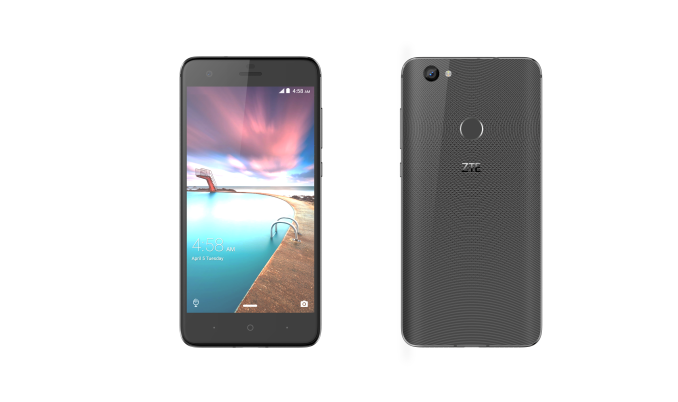
As you can see, there are still some details missing, but the available specs give a good idea as to where the ZTE Hawkeye sits in the market. As of right now there are no true photos of the Hawkeye, partially due to the fact that ZTE is still crowdsourcing ideas regarding the design, including the color choices and the materials to be used, although that latter part will obviously be limited to a degree by the cost of the phone. The cover image for this article is a concept render, and you may have already noted oddities like the fact that it only has a single rear camera when the Hawkeye is supposed to have two.

Anyone interested in buying the ZTE Hawkeye can check out ZTE’s Kickstarter campaign. It’s priced at $199 USD, and ZTE states that they plan to have it available in September of this year, but that date is subject to change. They also caution that they may not be able to deliver the eye-tracking and adhesion features in a satisfactory manner, which could lead to the device being cancelled. In the event of the phone’s cancellation, buyers will be entitled to a ZTE phone of equivalent price, with there seemingly being no option to have the contribution refunded instead.